Sales Battlecards: The Best One Is the Line That Reaches the Rep
Most sales battlecard advice is about the artifact: what fields to include, how to format the grid.
The artifact is the easy part. What battle cards in sales are, the four types, a filled-in example, and what decides whether a card ever changes a call.
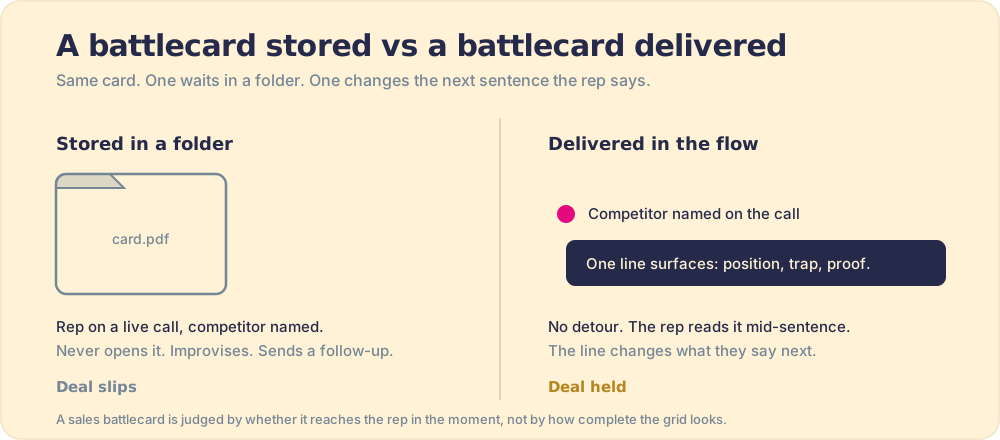
Sales battlecards are short reference cards that give a rep the positioning, traps, and proof points to win against a named competitor; the ones that work are built to reach the rep the instant the competitor comes up, not to be stored in a folder.
Watch a rep on a competitive call. The buyer says, almost in passing, “we’re also looking at [the incumbent].” The rep’s competitive battlecard for that exact competitor exists. It is well made. Product marketing spent two weeks on it, with a clean grid, real proof points, and the objection rebuttals worked out. It lives in the content library. And in the three seconds the rep has before they have to say something, they do not open it, because opening it means leaving the call, finding the folder, scanning the page, and coming back, and no one does that with a buyer mid-sentence. So the rep improvises, fumbles the comparison, and promises to “send something over.” The card had the answer. The rep, in the only moment that mattered, was alone.
The usual battlecard advice is about the artifact: which fields to include, how to lay out the grid, whether to use a SWOT or a head-to-head. All of that is the easy part. A battlecard the rep does not open during the call is dead paper, however good the design. The value was never the document. It is the one line that reaches the rep the instant a competitor is named, while the conversation is still live. Build battlecards to be delivered in the moment, not stored in a folder, and most of the usual advice inverts.
So here is the more useful definition. Sales battlecards are short reference cards that give a rep the positioning, traps, and proof points to win against a named competitor. The version that predicts whether the work pays off is this: a battlecard is the thing meant to put the right competitive line in front of a rep the moment the competitor comes up, in the flow of the call. Judge it by whether it changes the next sentence the rep says, not by how complete the grid looks.
What are battle cards in sales?
Battle cards in sales are one-screen reference cards that tell a rep how to win a deal against a named competitor: how to position against them, what they do well, which questions expose their gaps, and which proof to use. Strip away the templates and a sales battlecard is a cheat sheet for one fight: this rep, this deal, against this named competitor. It tells the rep how to hold their ground when the buyer is weighing two vendors, which usually happens more than teams admit. Crayon’s 2025 State of Competitive Intelligence report found sellers go head-to-head with a competitor in 68% of deals (Crayon). Two thirds of the pipeline runs through a moment a battlecard is built for. That alone should make the card the most-used asset a rep owns. It is usually among the least used.
The reason the delivery definition matters is that the two readings lead to different work. Read a battlecard as a document and the job is to make the document complete: more competitors covered, more objections answered, more proof points stacked, a richer grid. Read it as a delivery problem and the job is to make the right line arrive at the right second, which means shorter, fresher, and closer to where the rep already works. A battlecard the rep cannot reach mid-call is not a battlecard. It is a briefing they read once in onboarding and forgot.
Teams call these competitive battlecards, and in the wider battle cards sales literature the name barely varies. Product marketing usually writes them, which is why you also see them called marketing battlecards, and the label changes nothing about the test: does the card reach the rep while the competitor is still on the buyer’s lips?
What are the types of sales battlecards?
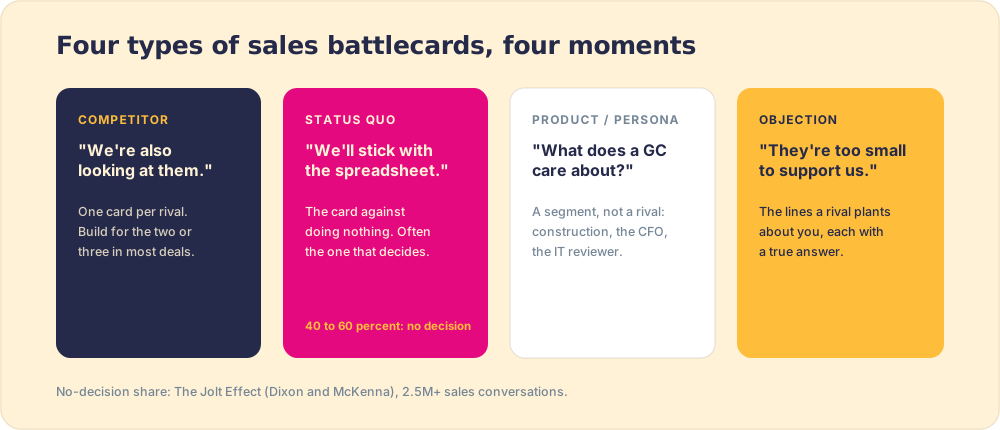
Four kinds of card cover nearly every competitive moment a mid-market team meets, and naming the type keeps each card short, because each one answers a different question.
- Competitor battlecard. One card per named rival, for the moment the buyer says “we’re also looking at them.” The classic card, and the one this post spends most of its time on. Build it for the two or three competitors that show up in most of your deals, not all twenty you could name.
- Status-quo battlecard. The card against doing nothing: the spreadsheet, the in-house tool, the decision to wait. It often matters more than any competitor card, because The Jolt Effect research found 40 to 60 percent of qualified deals end in no decision rather than a loss to a rival (The Jolt Effect).
- Product or persona battlecard. The card for a segment rather than a rival: what a construction general contractor, a CFO, or an IT reviewer cares about, and the proof that lands with them. Teams searching for industry battlecards (construction is a common one) usually need this type.
- Objection battlecard. The short card for the three objections a competitor’s reps plant about you (“they are too small,” “they will not integrate”), each with a true answer. It pairs with the fuller list of common sales objections.
What goes on a sales battlecard?
A usable sales battlecard template has a small number of parts, and the discipline is keeping each one short enough to absorb in the seconds between a buyer’s question and the rep’s answer. The standard grid is fine as a skeleton. The failure is almost always length, not structure.
- The positioning line. One sentence on how you frame yourself against this specific competitor. Not your generic value prop, the contrast that matters when this name is in the room. If the rep can only read one thing, it is this.
- Their genuine strengths. Name what the competitor is good at, so the rep is never blindsided and never caught lying. A card that pretends the competitor has no strengths trains the rep to lose trust the moment the buyer knows better.
- Their weaknesses, framed as questions. Not a list of put-downs, but the two or three questions the rep can ask that let the buyer discover the gap themselves. A discovered weakness persuades; an asserted one sounds like fear.
- The traps to set. The specific landmines that expose the difference, the requirement the competitor cannot meet, the hidden cost, the integration they fake. Plant these early, before the competitor frames the deal on their terms.
- Objection rebuttals. The lines the competitor’s reps use against you, each with a crisp, true answer. These are the sentences a rep needs verbatim, under pressure, with no time to compose them.
- Two proof points. A metric and a named reference, not ten. One number the buyer will remember and one customer who switched. Proof is heavier when it is light enough to recall.
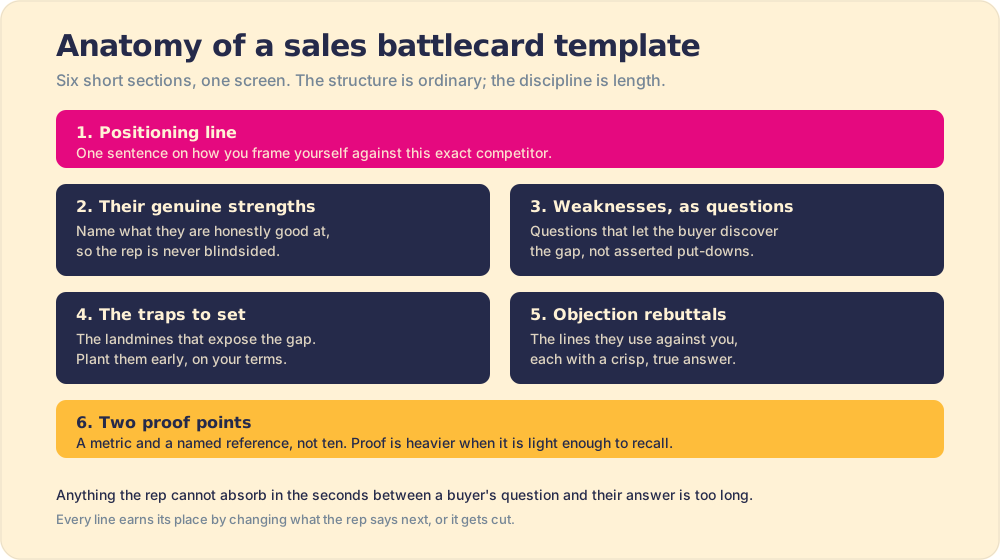
Six parts, and the list is short on purpose. The temptation is always to add: another competitor variant, a deeper teardown, a fuller objection library. Every addition makes the card more complete and less usable, because the cost of a battlecard is paid in the currency a rep has least of mid-call, which is attention. Curate the card down to the lines that change the next thing the rep says. Adding surface area is the opposite of helping.
What does a sales battlecard example look like?
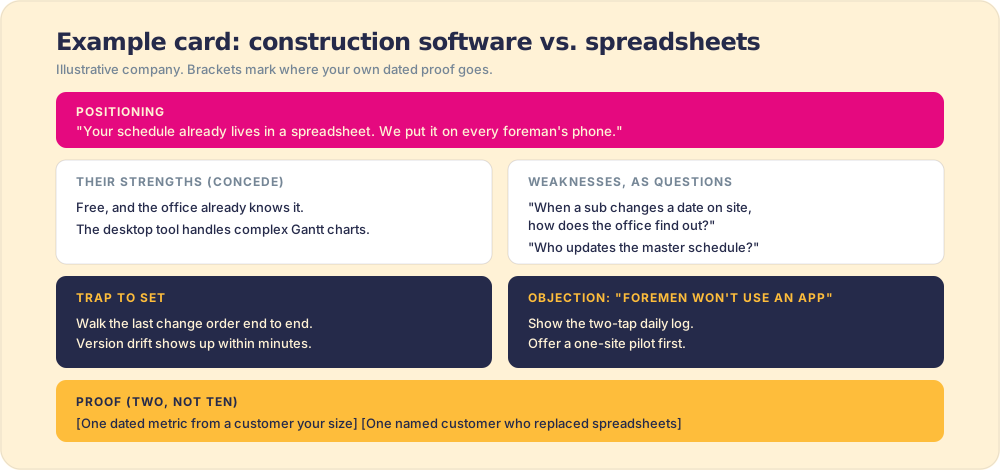
Here is a filled-in sales battlecard example for an illustrative case: a construction project-management software vendor selling to a mid-size general contractor, where the real competitor is the contractor’s current setup of spreadsheets plus an older desktop scheduling tool. The company is invented; the shape is what to copy. Brackets mark the places your own numbers and customers go, because a card with made-up proof is worse than one with none.
| Section | What the card says |
|---|---|
| Positioning line | ”Your schedule already lives in a spreadsheet. We put it on the phone of every foreman, so the field and the office read the same version.” |
| Their strengths | The spreadsheet is free, the office already knows it, and the desktop tool handles complex Gantt charts well. Concede both. |
| Weaknesses as questions | ”When a sub changes a date on site, how does the office find out?” “Who updates the master schedule, and how often?” |
| Trap to set | Ask to see the last change order end to end. Version drift between the field and the office shows up within minutes. |
| Objection rebuttal | ”Our foremen won’t use an app.” Answer: show the two-tap daily log, and offer a one-site pilot before any rollout. |
| Proof points | [One metric from a customer of similar size, with a date.] [One named customer who replaced spreadsheets.] |
Two features of the example matter more than its content. The strengths row is real, which keeps the rep from being caught out when the superintendent says the spreadsheet works fine. And every weakness is a question the buyer answers, which is the move from how to handle a sales objection applied before the objection arrives. For a second worked layout and the six-page failure mode it replaces, our companion piece on the sales battlecard walks the same anatomy from the other direction.
Why do most sales battlecards go unused?
Not because the content is wrong. Because the card lives in the wrong place at the wrong time. A battlecard parked in a content library asks the rep to do four things while a buyer is mid-sentence: remember the card exists, leave the call to find it, scan the page, and return with the line. That round trip almost never happens. The asset is excellent. The reach is the problem.
The pattern is not new, and it is not a battlecard quirk. It is the same structural failure that haunts every piece of enablement content. The Sales Enablement Collective’s 2025 Impact of Enablement report found 79.7% of enablement leaders say their reps leave at least 40% of a stand-alone tool’s features untouched (SEC). Read that against battlecards: the card is a feature, in a tool, away from the work, and the same gravity pulls it into the untouched 40%. Capability gets bought. Behavior never arrives. A battlecard is a small, sharp instance of the largest problem in enablement, which is that content separated from the moment of work does not get used.
There is a second failure, slower but as fatal: the card goes stale. Competitive intelligence has a short shelf life. The competitor ships a feature, drops a price, changes a positioning line, and a card written three months ago now coaches the rep to plant a trap the competitor has defused. Crayon’s data is blunt here too: the average compete team rates itself a 3.8 out of 10 on competitive selling, and 44% of companies have no competitor visibility inside their CRM at all (Crayon). The card cannot reach the rep where the deal lives, and even when it does, it may be describing a competitor that no longer exists in that form. Dead paper, twice over.
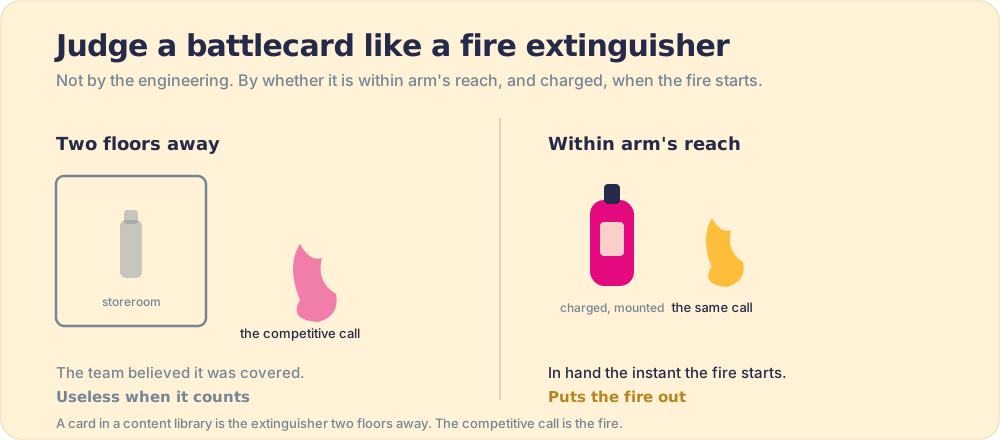
Think of a battlecard like a fire extinguisher. You do not judge it by how well it is engineered or how thorough the instructions printed on the side are. You judge it by one thing: when the fire starts, is it within arm’s reach, and is it charged? A beautiful extinguisher locked in a storeroom on another floor is worse than useless, because someone believed they were covered. A battlecard in a content library is that extinguisher. The competitive call is the fire. The rep is standing in the kitchen, and the card is two floors away, behind a door they have to remember to open.
How do you make competitive battlecards reps use?
Two moves, and they map onto the two failures. Deliver the card in the flow of the work, and keep it charged. Everything else is detail.
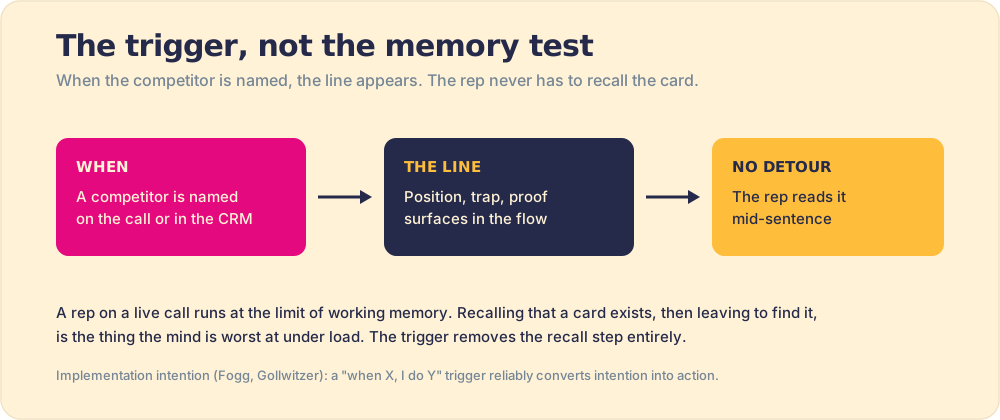
Deliver it in the flow first. The card should surface the instant the competitor is named, in the tools the rep already lives in, the CRM, the call, the email, so reading it costs no detour. The reason this works is not convenience, it is cognitive. A rep on a live call is running at the limit of working memory: tracking the buyer, the objection, the next question, the clock. Asking them to also recall that a card exists, suppress the conversation, and go fetch it is asking them to do a thing the human mind is bad at under load. Behavioral scientists call the fix an implementation intention, the “when X happens, I do Y” trigger that BJ Fogg and Peter Gollwitzer have shown reliably converts intention into action. The card delivered on the trigger (“competitor named, line appears”) is that mechanism made literal. The rep does not have to remember. The system remembers for them.
Then keep it charged. A battlecard is a depreciating asset, and the depreciation is fast. Curate ruthlessly and refresh on a fixed cycle:
- Cut to one screen. If the rep cannot absorb it in the gap between the buyer’s question and their answer, it is too long. Length is not thoroughness; it is friction.
- Refresh on a cycle, not on a whim. Competitive intel decays. Pick a cadence (monthly for active competitors, faster after a competitor’s launch) and treat an out-of-date card as a defect, not a nuisance. Tools built for this, Crayon and Klue, both independent competitive-intelligence platforms as of 2026 (Klue named a Leader in the first Gartner Magic Quadrant for Competitive and Market Intelligence Platforms in April 2026), exist precisely because the refresh problem is real and constant.
- Write for the call, not the author. The card is not a knowledge base for product marketing to feel complete. It is a script for the rep to feel ready. A line earns its place by changing what the rep says next, or it gets cut.
Teams whose guidance is embedded in the flow of work hit quota at 49 percent. Teams whose guidance lives in docs, wikis, and a separate tool hit quota at 15 percent. Same content. The moment of delivery is the lever.
That contrast, from the State of Sales Enablement 2026, is the entire battlecard argument in two numbers. The same competitive guidance, delivered in the flow of the work versus parked in a separate tool, more than triples the share of reps hitting quota, 49% against 15%. The variable is not the quality of the card. It is whether the card arrived where the work was already happening. A battlecard program built around a content library will keep failing that test, because the library is, by design, somewhere the rep has to go.
Can you build or automate sales battlecards with AI?
Yes for the draft and for the delivery, and no for the judgment. A language model can turn win-loss notes, call transcripts, and a competitor’s public pages into a first-draft card in minutes, and a CRM rule can put that card in front of the rep when the competitor field is filled or the name comes up on a call. What AI cannot do is decide which claims are true this month, and a battlecard with one wrong claim about a competitor’s pricing costs the rep the buyer’s trust on the spot.
A prompt that produces a usable first draft:
Using only the sources below, draft a one-screen sales battlecard against [competitor]
for [our product], sold to [segment]. Sections: positioning line (one sentence),
their genuine strengths, three weaknesses written as questions the rep can ask,
one trap to set, the three objections their reps raise about us with a true answer
to each, and two proof points. Cite the source and date for every claim about the
competitor. If a section has no source, write "NEEDS SOURCE" instead of guessing.

Sources: [win-loss notes] [call transcript excerpts] [competitor pricing page, date]
The “NEEDS SOURCE” line does most of the work. It turns the model’s tendency to fill gaps into a visible list of research to do. Then the human steps stay human: product marketing verifies each competitor claim and dates it, and enablement decides the trigger that delivers it.
The order matters too. In our survey, 40% of teams with strong process adherence rated AI’s impact as high, against 21% of teams with weak adherence (State of Sales Enablement 2026). AI drafting a card is the easy half. A team that has not decided when the card should appear, and does not check whether reps use it, gets faster drafts of cards that still sit in a folder.
What the best battlecard programs do differently
The strongest competitive battlecards are not the most complete ones. They are the ones that reach the rep as a single, timely line instead of a page the rep has to find. Build the delivery as carefully as the document. Product marketing still does the intel work, the positioning, the traps, the proof, and the handoff from product marketing to enablement decides whether any of it reaches the call. The change is where that work ends up: not in a library the rep visits, but in the flow of the call, the instant the competitor is named.
So measurement belongs in a battlecard program from the start. You cannot ask “which battlecard is working?” until you can see whether reps are using them on competitive deals at all, and 44% of companies have no competitor visibility in the CRM to check (the Crayon figure above). In our survey, teams that inspect deals against a defined process at the highest frequency hit quota at 6.3 times the rate of teams that rarely do, the largest gap of any variable we tested (State of Sales Enablement 2026). For battlecards, inspection answers the only question that matters: when the competitor came up, did the right line reach the rep, and did the rep use it? Without that signal, you are refining a document and hoping.
The payoff is not internal alone. A rep who gets the right competitive line in the moment gives the buyer a clearer, steadier comparison, instead of a fumble and a follow-up email. Crayon estimates that weak competitive selling costs the average team between two and ten million dollars a year in deals they could have won (Crayon). That money is not lost in the battlecard’s design. It is lost in the three seconds the rep spent alone, with the answer two floors away.
So when you next build a sales battlecard, do not start with the grid. Start with the moment: a rep, a live call, a competitor named a moment ago, three seconds to respond. Build for that, and the grid sorts itself out. If you want the wider view of why content fails until reps use it, sales enablement content makes the full case; if you are weighing where competitive guidance should live in your stack, the sales tech stack post maps the layers; if conversation data is how you spot the competitor on the call in the first place, start with conversation intelligence; and if you want the system that delivers all of it in the flow of the work, the sales enablement software guide is the place to begin.
Frequently asked questions
What is a sales battlecard?+
What goes on a sales battlecard?+
Why do most sales battlecards go unused?+
How do you make competitive battlecards reps use?+
What is the best format for a sales battlecard?+
What are battle cards in sales?+
Can AI create sales battlecards?+
Your process, running itself.