RevOps Tech Stack: Chantel Hirschel's Five Tools, With Salesforce at the Center
Chantel Hirschel runs RevOps at Sana Benefits, where broker emails once got typed in by hand. Her five tools, from Excel to Salesforce, and why every AI tool she buys either writes into the CRM or sits on top of it.
A RevOps tech stack is the set of systems a revenue operations team uses to move a customer from lead to cash; in Chantel Hirschel's version, one governed CRM record sits in the middle and every other tool writes into it, checks it, or works on top of it.
When Chantel Hirschel started at Sana Benefits, two people sat in a shared Gmail distribution list typing broker emails into the system by hand. The work was not even in Salesforce. Sana sells small business health insurance through brokers, and brokers do not fill out forms. They send mass emails with attachments to every carrier they work with, and somebody has to turn those into quotes.
Chantel is Director of RevOps at Sana, where her team of about 10 supports around 15 sellers and owns onboarding and implementation. Sana measures itself in member lives, about 15,000 covered when we spoke. She counted down the five tools in her revenue operations tech stack with me on Show Me Your Stack. The Gmail list comes up again at number two, and how she fixed it explains most of her choices. She got the work into Salesforce first, and only then brought in tools and AI to help with it.
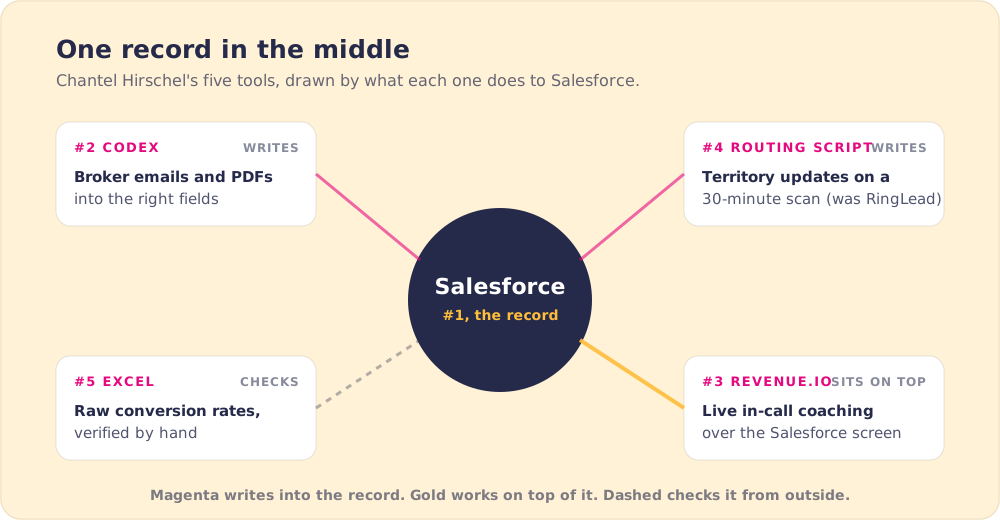
Wherever she is working, Chantel thinks lead to cash. “If you don’t keep them in that first year, it’s all over,” she said of new customers, so the stack has to serve the renewal as much as the first sale.
Why does a RevOps director still rank Excel?
Her number five is Excel, every day. “I know it’s basic,” she said. Her reason was about trust. “Sometimes I just want to check what all the other systems are saying and I want to like get into that data and find patterns myself.” She learned business in Excel, back when she was, in her words, “vibe coding in VBA,” and it still gives her confidence.
When she rebuilt forecasting at Sana, she went back to the raw data “and been like let’s actually see what those conversion rates look like because I need to know.” She tried letting AI build spreadsheets for her and “just didn’t feel confident enough in it.”
She has reason to check. Validity surveyed more than 600 CRM admins and found 24% say less than half their data is accurate and complete, and 67% are worried about whether their data is ready for AI (Validity, 2024). Chantel would rather find a bad conversion rate herself, in a spreadsheet, than have someone else find it in her forecast.
What made RingLead her all-time favorite?
Number four is a tool she no longer uses. RingLead, now part of the ZoomInfo stack, handles routing, deduplication and mass updates. It lacks HIPAA certification, so a health insurer cannot run it, “but it is my favorite tool that I do love and would bring on in a heartbeat if I could.”
She compared it with LeanData and Traction Complete and called RingLead “not the prettiest version.” Its mass update tool won her over. When an account rep changed or territories moved, she could update everything at once without exporting and reimporting through Data Loader. At her last company she had “dozens of integrations running on that on an hourly cycle that just were helping keep the database clean.” It cleaned up thousands of accounts, matched leads to contacts, and linked leads to accounts in Salesforce.
At Sana, a simpler territory model runs on Zapier, and she is moving it into a Python script she builds with Codex. She still ranks RingLead fourth, even though she can’t use it, because the work it did still has to get done.
Why did she pick Revenue.io over Gong?
Number three is new to her stack. She chose Revenue.io over Gong and moved off Salesloft, which she wanted to leave after “the debacle last year.” In August 2025, attackers used stolen OAuth tokens from the Salesloft Drift integration to export data from Salesforce instances, and Salesloft and Salesforce revoked all Drift tokens on August 20 (Google Threat Intelligence, 2025). Sana sells health insurance, so a breach that ran through a connected app gave her one more reason to leave.
Her first reason was live coaching. The tool listens during the call and pops up on screen. “It’s like Chantel you’re talking too fast because that’s my cardinal sin in any situation,” she said. Her team wanted it to improve the pitch. It also “sits directly over my Salesforce interface, so I’m not having to like be in and out of like multiple tools.”
Her second reason is one I rarely hear from buyers. “I just felt like I was going to get better support from the team,” she said. “I have made several purchasing decisions over the last year that were based on how much I thought that their team would support me.” Call recording tools overlap a lot on features, so the support team was what tipped her.
How does Codex turn broker emails into Salesforce data?
Number two is Codex, OpenAI’s coding agent, used with the OpenAI API. It strips information out of PDFs and emails and puts it “properly into the right Salesforce fields,” her biggest win so far.
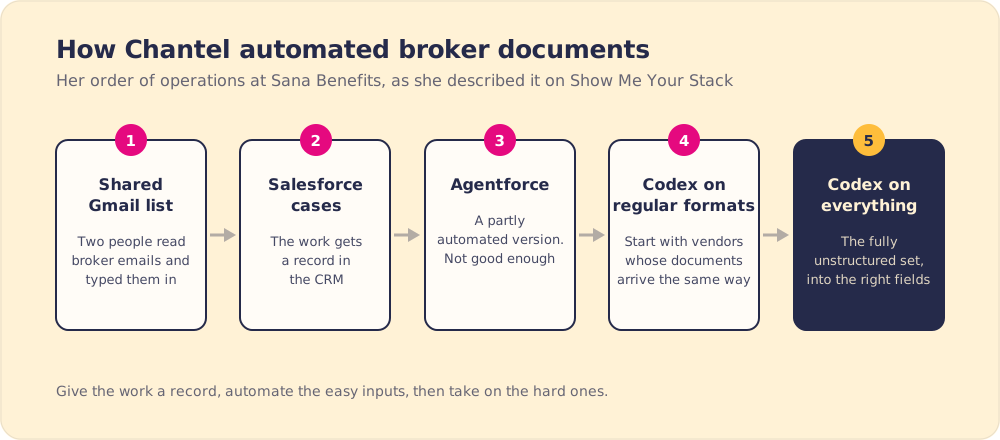
She got there in steps. She moved the two-person Gmail operation into Salesforce cases, so the work had a record. She tried Agentforce for a partly automated version, “and then I was like, that’s still not good enough.” So she started building with the vendors whose documents came in the most consistent format, and only then moved to the fully unstructured set.
Her territory work follows the same pattern. A Codex-built script scans every 30 minutes, finds what is new and updates it. “I named it after my dog so that that way, you know, she’s digging for leads. So now she’s digging in my systems, too.”
I use Claude, so I pushed her on why she chose Codex. Her reasons were practical. Sana has a HIPAA agreement with OpenAI and a corporate ChatGPT account, and she will not put company data anywhere else: “I don’t like to use anything that’s not fitting in a corporate.” She also came up in AI with ChatGPT. “I just felt it knew how to talk to me.”
Her order of operations runs against a common failure. MIT’s NANDA initiative found about 95% of enterprise generative AI pilots stall with little measurable effect on profit and loss, and its lead author blamed generic tools that “don’t learn from or adapt to workflows” (Fortune, 2025). Chantel built the workflow first and brought the AI to it.
Why does the CRM matter more as AI spreads?
Number one: “It’s got to be my bread and butter, my boo. Salesforce.”
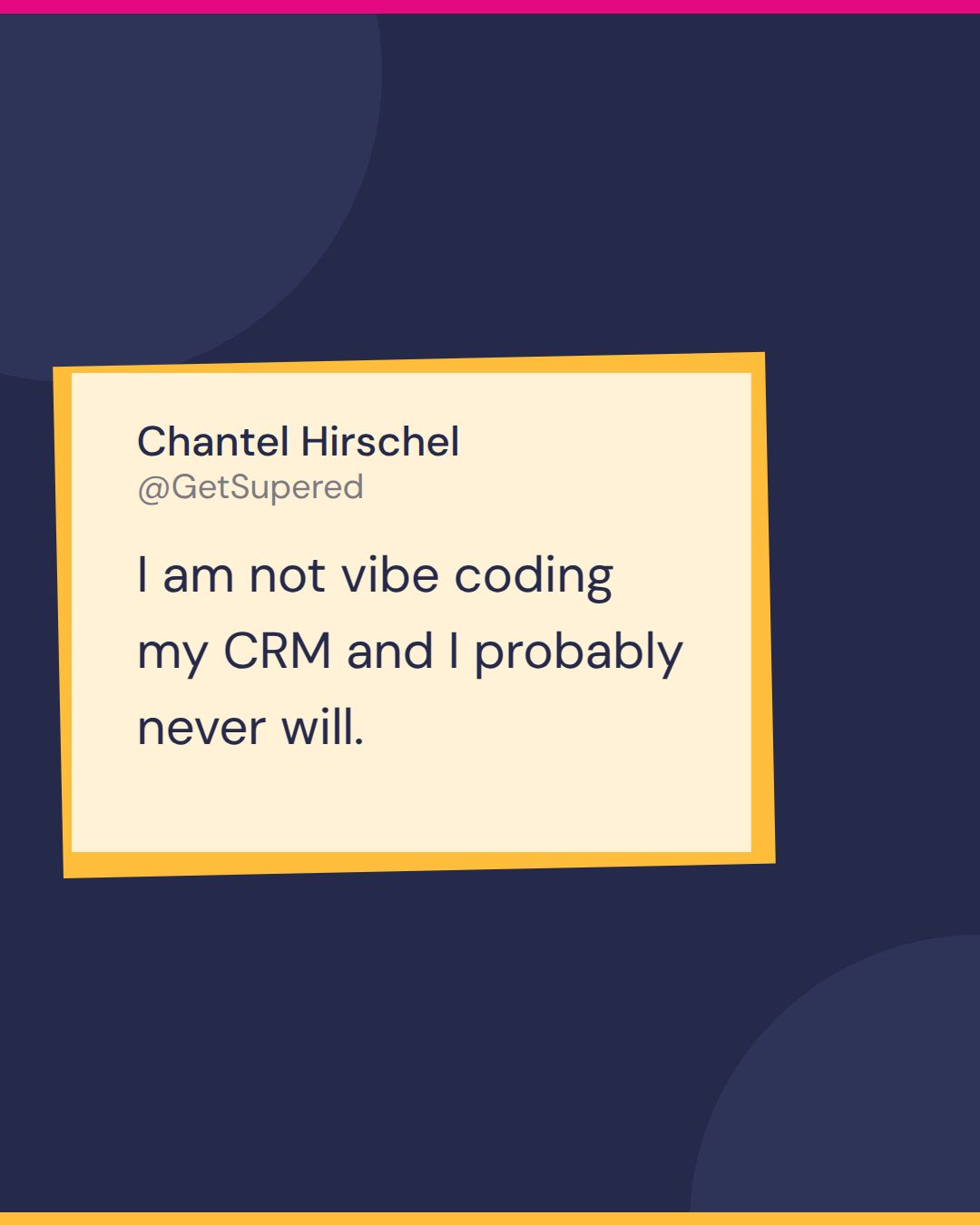
I asked whether she was vibe coding her CRM. “I am not vibe coding my CRM and I probably never will.”
She had the most to say about the CRM itself. “AI is cool,” she said, “but … some people are using AI to do what automation always could do. The difference now is that some people who weren’t in my seat where they had like the backend skills to get it done, they can try to do that with AI, which made everybody think they’re a RevOps expert to some extent.” Then she described the result: a confident dashboard built on the wrong pipeline, because “you forgot to filter your record type.”
She does use AI inside the record. When she needs to match accounts, she feeds them to Agentforce inside a Salesforce flow “without having to, you know, buy another tool.” And she wants reps where the record is. “I want people in Salesforce almost all the time. I do not want them leaving and going to another tool.” She counts Slack as part of Salesforce now, since Salesforce owns it.
I agreed with her on the episode, and I said why. A RevOps leader has to decide where reps will live, how they get questions answered fast, and how they know what to do next. I suspect pulling reps out of the CRM into chat windows that organize their day adds risk.
Sales teams are already pointing AI at that foundation. In The State of Sales Enablement 2026, 46% of teams said they use AI for CRM admin and cleanup, and fewer than 30% use it for deal strategy or forecasting (The State of Sales Enablement 2026).
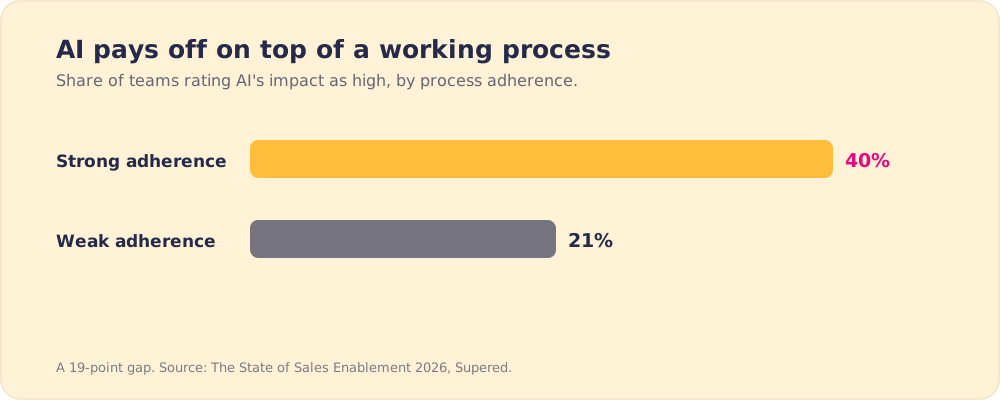
Even HubSpot, which sells AI agents, now shows customers a context completeness score and claims teams using AI with high-quality context win 3.2x more deals (HubSpot, 2026). HubSpot sells AI, so read that as vendor data, but it lines up with what Chantel told me. Our post on Salesforce data quality covers the rules that keep automated writes clean.
Key points from Chantel’s RevOps tech stack
- Record before model. She moved broker emails into Salesforce cases before any AI touched them.
- Easy inputs first. Codex started on the vendors with consistent formats and widened from there.
- A hand check. Excel stays in the stack so she can verify what every other system reports.
- Compliance decides. RingLead lost to HIPAA, and the job it did moved to Zapier and a Codex script.
- Support is a feature. Revenue.io won partly on her confidence in the team behind it.
- Reps stay in the CRM. Coaching sits over Salesforce, AI runs inside its flows, and Slack counts as part of it.
The stack we would build from Chantel’s list
Start where she started: find the work that happens outside the CRM, like her Gmail list, and give it a record. Automate the most consistent slice first and widen from there. Keep one number you rebuild by hand. And decide, on purpose, where your reps will spend their day, then judge each new tool by whether it keeps them there.
That last decision is the one we built Supered around: the next step in the sales process, shown to reps inside HubSpot and Salesforce while they work, and measured so you can see whether it happened.
If your reps drift out of the CRM, our guide to CRM adoption covers why it happens and what brings them back, and our Salesforce adoption guide goes deeper for teams on Salesforce.
Frequently asked questions
What is in a RevOps director's tech stack?+
Does AI make the CRM less important?+
How do you use AI to process unstructured documents into a CRM?+
Why do RevOps leaders still use Excel?+
What should you look for when buying a call recording tool?+
Your process, running itself.

