Context Graph: Why Justin Hudon Ranks It Above His CRM
Justin Hudon runs sales and customer success at Vasco, a startup with a go-to-market team of ten.
On Show Me Your Stack he counted down his five tools, defended the CRM, and explained why a context graph sits at number one.
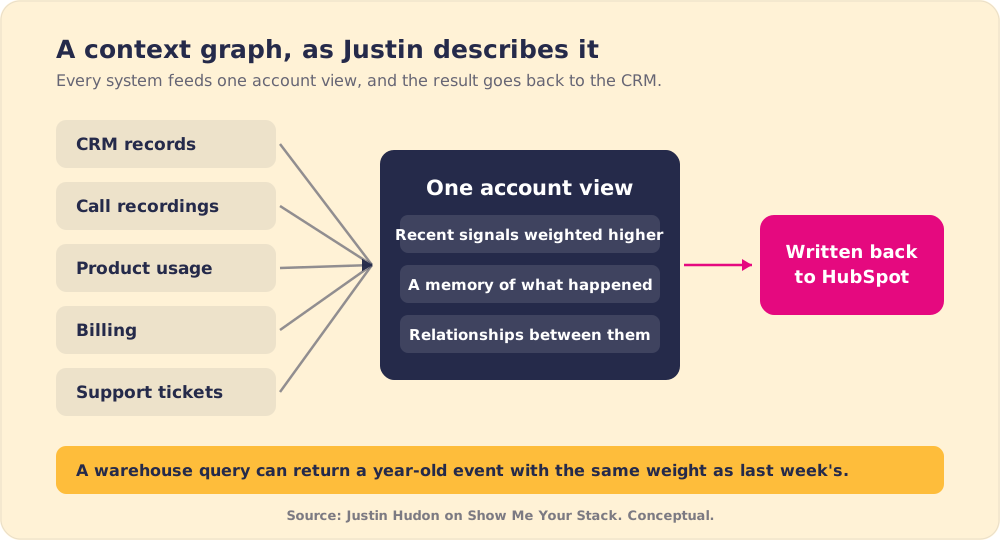
A context graph is a connected, constantly updated view of an account and everything related to it, from calls and product usage to billing and support tickets, with recent signals weighted above old ones so people and AI agents can act on what is true now.
Justin Hudon runs sales and customer success at Vasco, a company of 30 to 35 people that was approaching its Series A when we recorded. His go-to-market team is ten people: three in customer success, two in sales, and each person, as he put it, “wearing multiple hats.” When I asked him on Show Me Your Stack which five tools carry that team, he put a context graph at number one and the CRM at number two, and he spent a good part of the episode explaining why the second one is not going anywhere.
He judges a tool by one test. Leaders are “trying to do more with less,” he said, and on a small team “it’s always about being as efficient as possible” and “trying to remove the noise as much as possible.”
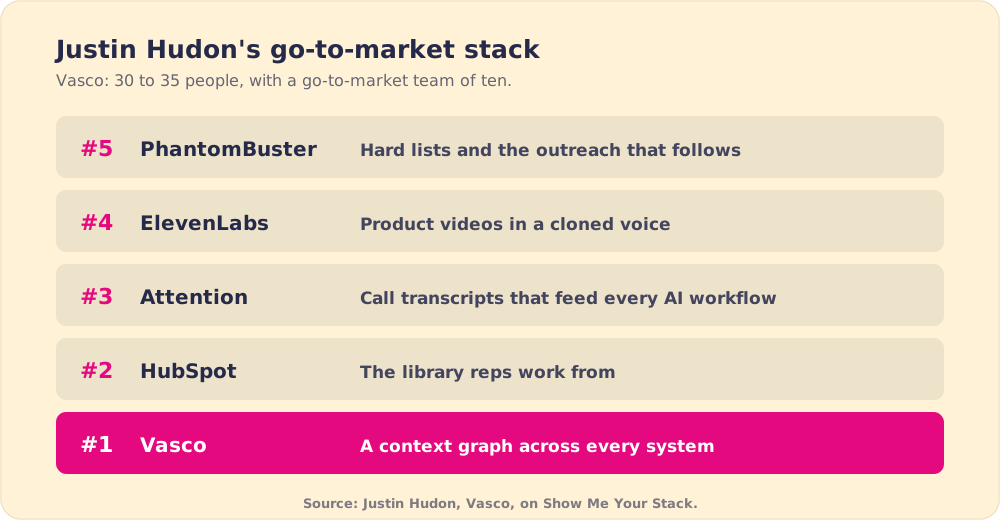
#5 PhantomBuster: how does a small team build hard-to-find lists?
Justin heard about PhantomBuster from a go-to-market engineer who pointed his team toward signal-based outreach. He uses it for lists that are “not the easiest to create,” such as people who engaged with a social post cross-referenced against another list on LinkedIn.
His most useful list right now comes from events. Vasco runs workshops and dinners, and PhantomBuster builds the attendee list and then runs the outreach that follows. When I asked whether he used it for the list or the outreach, he answered, “Both list creation and outreach. Exactly.” Before, that meant a lot of data export and manipulation by hand before anything went out.
He also liked how it charges. The price is based on how long the automation runs, and he finds that interesting while buyers and vendors alike are rethinking how tools price and what teams spend on them.
#4 ElevenLabs: who records the product videos when the product ships every week?
This one he barely touches himself, and it still made his list. “Product velocity is just increased so much,” Justin said, and keeping customers current on new features had become “challenging” and slow work for customer success. He and the CEO used to run the production of every product update video.
Now the marketing team uses ElevenLabs for the voice. “It’s able to copy your voice,” he said. You give it content you have already recorded, or read a script into it, and marketing writes the text and produces the product tour in that voice. The result, in his words, “makes me actually not even a part of that process anymore.”
It does not do his face, only his voice. I told him I preferred that to a fake Justin showing up. I had never heard of the tool, and his problem was mine almost word for word. I was the one doing our product update videos, so I looked it up while we were still talking.
#3 Attention: why pick a call recorder when every tool records calls?
Justin agreed with my premise. Transcripts are “very much a commodity right now,” he said, and a new recorder seems to launch every week. So I asked why Attention, out of Fathom, Gong, Ask Elephant, Fireflies and the rest.
His first reason was the people. “It was mainly due to the relationship that we had with them,” he said. He got to know their partnerships team, and using the product followed. Since then Attention has added agents and search across calls.
His second reason is the one I would use to choose. In a stack where transcripts feed AI work, “the quality of the transcripts is probably the most important thing.” Vasco passes them into its own analysis, such as which messages land with each ICP tier,; most of its flows run outside the recorder, so each one starts from the transcript. Attention’s own case study with Vasco, where Justin is quoted, reports one to two hours saved per rep per day on notes and CRM work (Attention). That figure is the vendor’s.
#2 HubSpot: are CRMs dead?
“CRM are not dead,” Justin said, and he has used HubSpot for more than a decade. He described the CRM as “like a library of information specifically for your reps,” a place where everything about an account is consolidated, and HubSpot as a canvas where data from other sources can land.
He would give the administrative tasks to AI flows. The reps, he said, “need to go somewhere to get all their information that pertains to an account and that remains the CRM for now anyways and for the foreseeable future.”
He asked what I thought, and I agree with him. I believe CRMs are going to be more important. I think reps are going to live in them more, as AI gets consolidated into one stack, and keeping the data correct so you can report on it gets harder. Our posts on CRM adoption and the RevOps tech stack go further into why.
#1 Vasco: what is a context graph, and why does it lead the list?
Justin works at Vasco, and he knew I saw this one coming. I asked him to explain what it does for his team.
He started with the problem. HubSpot holds most of what a rep needs, “however there are still a number of different tools,” he said: the call recorder, product analytics, billing. “There’s a lot of context that lives across all these different tools,” and Vasco’s job is “creating that context layer and removing the complexity.”
He gave a health score as the example. Is a customer happy? Their payment history lives in the billing tool. Their open tickets may live in Zendesk or Intercom, outside HubSpot. A forecast has the same gap, because signals outside HubSpot can change how likely a deal is to close. Vasco pulls those together and sends the result back to the CRM.
Then I pushed. Say I am Supered, with Intercom for customer success, Fathom for calls, HubSpot as the CRM and a separate ERP, and none of it works together. Why not put everything in Snowflake?
Justin called the Vasco model “what we call like a context graph,” which he defined as “the view of the account and all its relationships.” Those relationships are the calls, the actions taken in the product, and how they tie together. He cares about weighting. “Being able to properly weigh those signals is extremely important,” he said, because what happened last week says more about an account than what happened last year. He cares just as much about time. “The memory of what’s happened is extremely important as well,” he said. A table in Snowflake can return the old event with the same weight as the new one. “It might reference something that’s happened a year ago,” he said, “and that’s not relevant whatsoever to what’s happening in that account currently.” What he wants instead is “an ever evolving brain of the company.”
The term has a short history. Foundation Capital partners Jaya Gupta and Ashu Garg popularized it in December 2025, defining a context graph as “a living record of decision traces stitched across entities and time so precedent becomes searchable” (Foundation Capital, 2025). By April 2026 Forbes was reporting that venture investors saw context graphs as a possible next big thing in AI (Forbes, 2026). Vasco’s own product page describes “one unified GTM context graph” built from CRM, billing, call recording, support and product analytics data (Vasco).
What does a context graph do for a weekly business review?
I asked Justin for the uses his team depends on every week, and he gave me two.
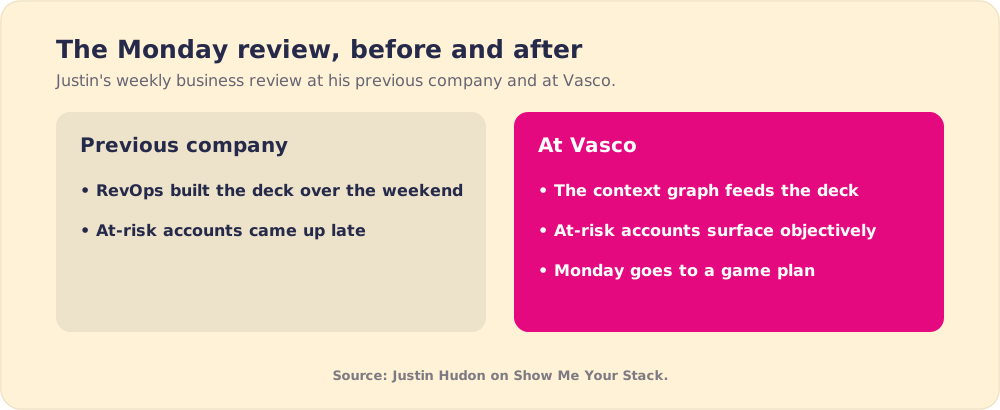
The first is the Monday weekly business review. The whole team meets to look at performance and what needs to happen that week, and Vasco now feeds the deck they review. At his previous company, that same deck “was put together on the weekend” by a RevOps team so go-to-market had its direction by Monday. He said the new way saves time, “but it’s also making us talk about the right things in meetings.”
The second is at-risk accounts. He said those discussions “can easily be avoided at times” for the wrong reasons. When the accounts are surfaced “in a way where it’s very objective,” he said, the meeting produces “discussion and a game plan” for those accounts. Otherwise that talk happens “way after the fact.”
Salesforce’s 2024 State of Sales survey of 5,500 sales professionals found reps spend 70% of their time on non-selling tasks, and that 53% of sales teams that had fully implemented AI consolidated their tech stack first (Salesforce, 2024). A deck built by hand over the weekend is one of those tasks, and Justin’s team no longer has it.
Key points from Justin Hudon’s stack
- One test for each tool. Do more with less and remove the noise, because each person on a ten-person team wears several hats.
- Hard lists built by machine. PhantomBuster builds event and engagement lists and runs the outreach that follows.
- A cloned voice for product videos. ElevenLabs took Justin and his CEO out of product update production.
- Transcript quality over recorder features. Vasco’s own analysis, such as messaging by ICP tier, starts from the transcript.
- The CRM as the reps’ library. AI takes the admin work, and reps still go to one place for the account.
- A context graph on top. Billing, support, calls and product data weighted by recency and written back to HubSpot.
What I would take from Justin’s list
Look at your team’s weekly review and ask where its deck comes from. If someone builds it by hand over the weekend, or if at-risk accounts only come up after they churn, those are the two jobs Justin moved to a context graph, and they are a fair test of whether you need one. Before buying anything, write down which systems hold the signals your health score or forecast is missing today.
Then keep the CRM at the center, as Justin does. The context graph’s output only helps if it lands where reps already work, which is the part of the stack we build at Supered, inside HubSpot and Salesforce. For more operator stacks, read Michael’s GTM tools countdown and our go-to-market tech stack post.
Frequently asked questions
What is a context graph?+
How is a context graph different from a data warehouse?+
Does a context graph replace the CRM?+
What can a sales team do with a context graph?+
Who coined the term context graph?+
Your process, running itself.
Turn the playbook into rep behavior.
More from Show Me Your Stack

RevOps Tools: Alexander Müller's Top Five, From Granola to Claude Code
Alexander Müller
RevOps Tech Stack: Chantel Hirschel's Five Tools, With Salesforce at the Center
Chantel Hirschel