Productized Services: How Andrew Logan Grew Floww Digital 240% in a Year
Andrew Logan used to sell anything with the word web in it. Then he cut Floww Digital's offer to three or four packages per HubSpot hub, told clients to forget about HubSpot, and stopped doing it all himself. His lessons on productized services, adoption and hiring.
Productized services are packaged service offerings with a set scope, a name and a known way of delivering them, sold the same way each time; Andrew Logan built Floww Digital's growth on three or four of them per HubSpot hub.
Andrew Logan started Floww Digital in 2016 as an inbound marketing agency. It ran lead-generation campaigns, and the clients struggled to handle the leads it sent. They tracked them on sticky notes and whiteboards, or in CRMs so complicated that no one opened them. So Andrew, who calls himself “a product guy” and “a tech geek,” signed up for about 15 CRM trials himself. He figured that if he couldn’t use one, his clients never would. HubSpot was the one he could use. Ten years later, 75% of Floww’s revenue comes from HubSpot work, the team is eight people, and the agency is “240% up this year.” A lot of that came after he stopped selling custom work and started selling productized services, a few fixed packages with names.
Andrew, the founder and CEO of Floww Digital in Glasgow, walked me through all of it on Fast & Tierious. He credits the growth to “systems, processes, and people,” and for each one he had to change how he himself worked.
Why did Andrew cut his services to three or four options per hub?
For years Floww sold whatever a client asked for. In the early days, Andrew said, “if it had the word internet or web in it, I would do it.” “If you needed your email set up, I would do that.” Then he stepped back and asked himself: “Hold on. What is it we’re actually doing here?”
The old way was slow to sell and hard to deliver. “Each project was very bespoke and regardless of the size of it,” he said. A small business could get a tailored onboarding plan it didn’t need. “Every presentation had to be custom made. Every pitch deck, every proposal, that’s all unique.” And training a new consultant meant teaching a different delivery for every client.
Now Floww sells packages. “You’ve got three or four options that you can choose per hub,” Andrew said, and they cover a client of any size. Bespoke work still happens, on top of a known core. Andrew sees the biggest change inside his own team. When he says “this one’s a sales hub full onboarding,” his consultants all know what that means. “The team knows the language.” In his words, simplifying let Floww “go to market faster and also deliver better.”
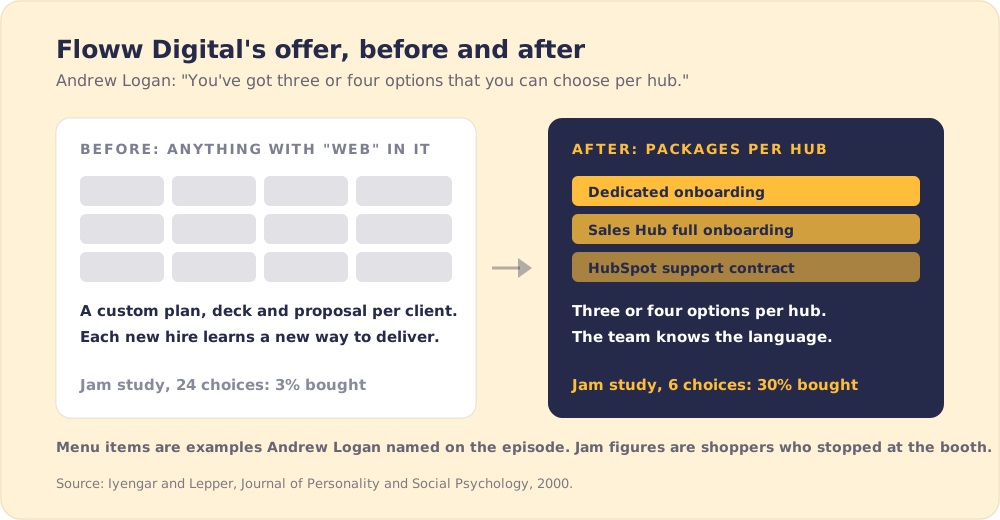
The buyer side of this is well studied. In Sheena Iyengar and Mark Lepper’s grocery-store experiment, 30% of shoppers who stopped at a table of 6 jams bought one, against 3% at a table of 24 (Iyengar and Lepper, Journal of Personality and Social Psychology, 2000).
Andrew cared more about what the packages did for his consultants. Floww delivers through people, and a new hire can learn a named package once and run it again for the next client. When I said on the call that “simplifying services is the way to get to also get quality itself,” he agreed. I also said the hard part out loud: you have to know what clients want before you can simplify, and Andrew only learned that from years of selling whatever came through the door.
Why does Andrew tell every new client to forget about HubSpot?
Floww’s first move in an implementation is to take the software off the table. “We tell everyone to forget about HubSpot,” Andrew said, “don’t think about the system, don’t think about the software, let’s think about what does your customer look like?”
His reasoning comes from watching migrations go wrong: companies moving from other platforms try to fit their processes into whatever the software does by default. So Floww runs two workshops to map the customer journey and the client’s internal processes first. The client brings one kind of knowledge and Floww brings another: “they know their business better than we do. Hopefully, we know HubSpot better than they do.”
The workshops sometimes turn up problems that have nothing to do with software. Clients look at a service line in the workshop and say, “Actually, we’ve never thought about this, but that’s really unprofitable and we hate doing that. Why are we doing that?”
The second rule is about who sits in the room. “There’s nothing worse than the senior leadership team designing a system and then handing it over to the team that are going to have to actually use it without them having any input in it at all,” Andrew said. After the workshops, Floww sets HubSpot up for each user, using the words that user already uses at work.
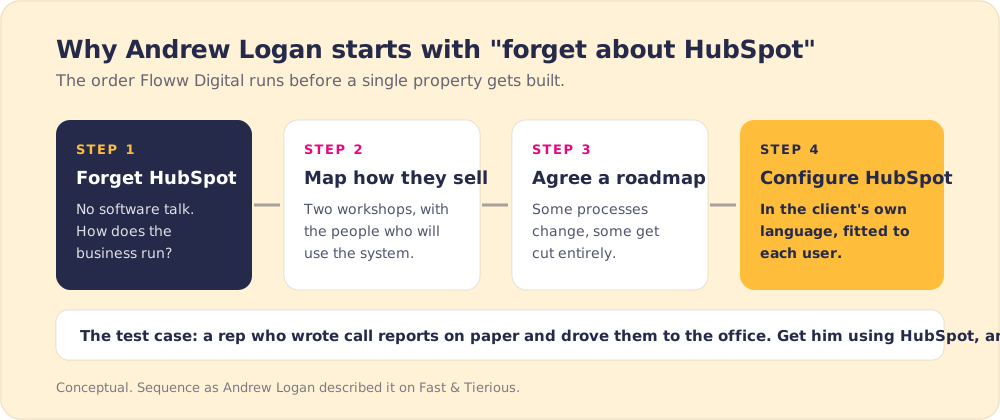
His favorite test case is a salesman on a recent project. The team of seven or eight included some CRM-fatigued veterans and a couple of quick adopters, and one man who “writes his call reports on a piece of paper” and drives them into the office at the end of the week. Someone used to type them into the old system for him.
Andrew loved it. If Floww could get him in, they could get “anybody using HubSpot.”
The evidence backs his order of work. Prosci’s research found projects with excellent change management met or exceeded objectives 88% of the time, against 13% with poor change management, about seven times as likely (Prosci). When we asked revenue teams why their tools end up unused, the most common answer was that reps do not see the value, cited by 55% (The State of Sales Enablement 2026). Andrew’s workshops go after that answer directly: the salesman with the paper reports helps decide what goes into the system, so he can see what it does for him. Our guide to CRM adoption goes deeper on why rollouts stall.
Floww also checks its own work. At the end of an onboarding, the team runs a postmortem: “What could we have done better? What was really good? What was bad?” They survey the end users as well as the project leads.
When does a founder stop owning a job?
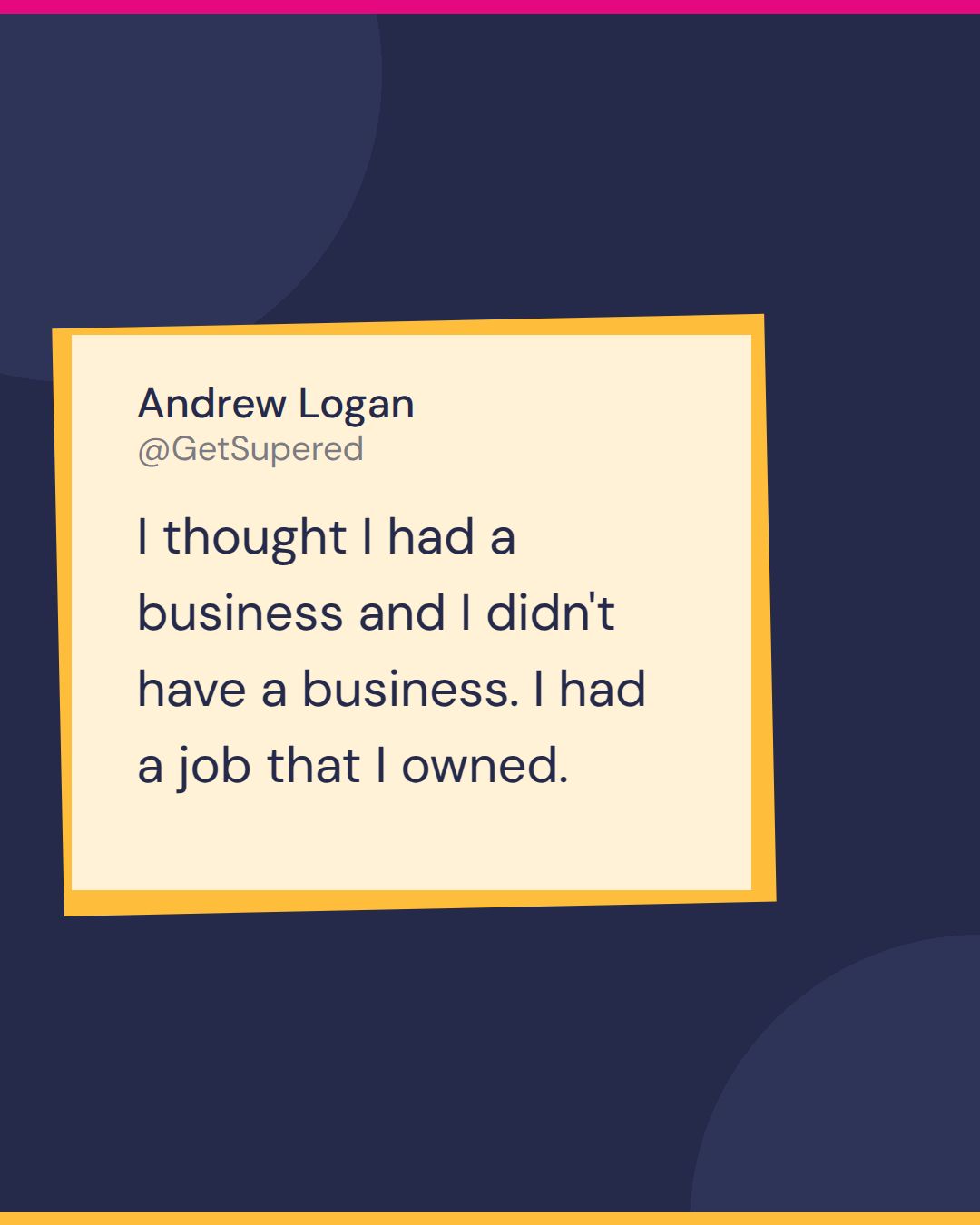
The line I remember best from our conversation is one Andrew said about himself. “For the first few years I thought I had a business and I didn’t have a business. I had a job that I owned.” Friends would ask what it was like working for himself. His answer: “Yeah, it’s great. I can work whatever 85 hours of the week that I choose to.”
The fix was a change in the first question he asked. “My first thought when there’s a problem or when there’s a task is how can I do this and really it should be who can do this.” Doing too much himself, he said, took its toll on his health and his family life, and he calls it the biggest mistake he made. If he could go back five years, he would bring people in faster.
He hires in two steps. The first interview is only about fit. He tries to “break the barrier down in that first 10-15 minutes” and get candidates talking plainly about what they liked and hated in past jobs, and what they do at the weekend. “It’s just pure gut,” he admits. The second step is evidence. Floww narrows a role to three, “ideally five at an absolute maximum,” and gives each candidate a paid task, sometimes a paid day in the office. Recruiters tell him, “I can’t believe you’re paying people to do that.” His answer: “it cost a fortune recruiting the wrong people and giving them a contract.”
The research sides with the paid task. Frank Schmidt and John Hunter’s review of 85 years of selection studies rated work sample tests among the strongest single predictors of job performance, with a validity of .54 (Schmidt and Hunter, Psychological Bulletin, 1998). The paid task also lets the candidate size up Floww. Andrew has learned that people who have never worked in an agency often don’t know what its pace feels like until they try it.
His advice to founders still doing it all: decide early whether you want to be a strong solo consultant or build a company, and if it is a company, “Take a calculated risk.” Then: “As soon as you can, bring on help cuz it’s transformative.” He adds an ideal employee profile to the ideal customer profile most founders already keep: the experience, seniority and location of the people you want, so you hire hands-on consultants when you need hands-on work.
Andrew Logan’s lessons on productized services
- A short menu. Three or four packages per hub, each with a name the whole team uses, and bespoke work on top only when needed.
- Software last. Map how the client’s customers buy and how the business runs before anyone opens HubSpot.
- The users in the room. The people who will live in the system help design it, down to the salesman with the paper reports.
- A postmortem after launch. Ask the end users, as well as the project leads, what the onboarding got wrong.
- Paid proof in hiring. Fit first, then a paid task for a shortlist of three to five.
- Hiring sooner. Andrew calls doing it all himself his biggest mistake, and he would bring people in faster if he could go back five years.
What we would do with Andrew’s lessons
If you run a services firm that still writes a fresh proposal for every client, start where Andrew did. List what you have sold in the last year, find the three or four offers your best projects share, name them, and train the team on the names. Move the software to the end of your onboarding, and put the people who will use it in the first workshop. When you hire, pay the shortlist to do a real task.
Andrew’s prospects keep asking him whether they should code their own CRM now that AI can write software. He has put more into HubSpot, not less, and says Floww is on track to double in size again. Floww also runs client delivery through Supered, which Andrew helped shape with product feedback; his team uses it to show each client the next steps of their project inside HubSpot. For the packaging side, read our HubSpot implementation playbook, and see how Supered works with HubSpot partners.
Frequently asked questions
What are productized services?+
Why do productized services help an agency grow?+
How do you get clients to adopt a new CRM?+
How should a small agency hire?+
What is the difference between a business and a job you own?+
Your process, running itself.
Turn the playbook into rep behavior.
More from Fast & Tierious

Starting a Consulting Business With No Experience and Nothing to Lose: Stephen Dodd's Story
Stephen Dodd
What Will Andrew Learned From 1,000 Picnics About Fixing an Owner-Dependent Business Before a Sale
Will Andrew