Agency Growth Strategy: Jake Fisher on Going Narrow to Grow
BridgeRev started with $10,000 and one HubSpot contract, grew slowly for a decade, then doubled after choosing to be world class at one thing. Jake Fisher's agency growth strategy: pick whom you serve, go narrow, and hire people better than you.
An agency growth strategy is the set of choices a services firm makes about whom it serves, what it is best at, and who it hires, which together decide how fast it can grow and what work it turns down.
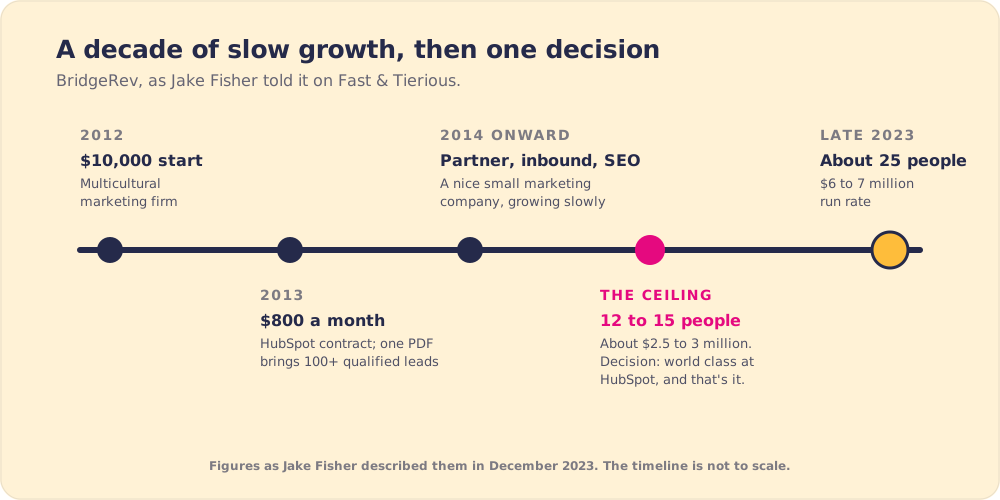
In 2013, Jake Fisher and Ashley Quintana “gulped hard” and signed an $800-a-month HubSpot contract. They had started their company a year earlier with $10,000. It was a multicultural marketing firm that helped businesses reach Latino immigrant families across language and cultural barriers, and it was doing maybe 12,000 or 15,000 in revenue. They had run through their personal networks. Their first inbound offer was a static PDF on common but fatal mistakes in marketing to Latinos, and it went up late because Jake labored over it until it was perfect. They put a couple hundred dollars into AdWords and got “more than a hundred qualified leads.”
That PDF started the company that became BridgeRev. Over the next decade it grew into a small, successful inbound agency, stalled at 12 to 15 people, then changed its agency growth strategy and roughly doubled, reaching Elite eight months after Diamond along the way. Jake told the whole arc on our third Fast & Tierious episode. His advice fits in a sentence and takes years to follow: decide whom you want to be a hero to, stop being too broad, and hire people better than you.
How did a $10,000 marketing firm become a HubSpot agency?
The leads made Jake and Ashley happy, and they closed business from them. Then Jake had a second thought: “if we could figure that out, that might be more valuable.” They pivoted into inbound marketing, joined the HubSpot partner program in 2014, and started a HubSpot user group in their town. “We just really kind of picked up the banner for the software,” Jake said. They had seen what the inbound method could do when it ran on software built for it.
For years the firm grew the slow way, with lead generation, lots of SEO, content, and a steady run of small-business clients. Jake called it “a nice small marketing company.” Then growth stopped. At 12 to 15 employees and, in his words, “around the 3 million, two and a half, three million,” BridgeRev hit a ceiling. He felt “we had a lot more to give.”
To whom do you want to be a hero?
Jake took the question from Strategic Coach, an entrepreneur program. “Sometimes the answer to that question can be very clarifying,” he said.
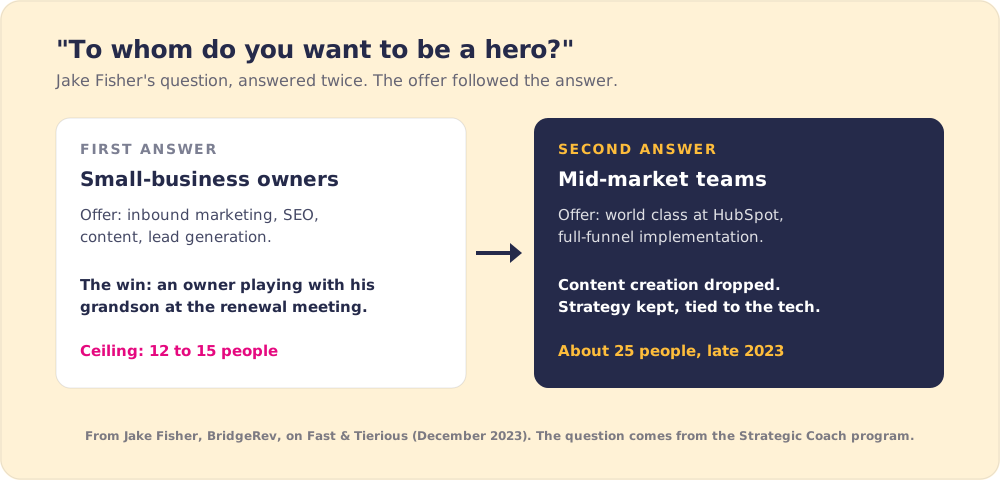
His first answer was small-business owners, and he told me about one of them. An older man who ran a family business came to BridgeRev worried about it. Sales were down, and the company was not selling much of the product it most wanted to sell. A year into the work, the renewal meeting was easy. At the next one, the owner sat in the back of the conference room playing with his new grandson, while the man he had hired to replace him ran the meeting. “That’s what we do,” Jake said. “That’s the kind of thing we’re doing for people, is changing their lives.”
Small-business owners gave BridgeRev a good firm and a ceiling at 12 to 15 people. As it grew, the answer moved to mid-market and lower-enterprise teams, “people that are trying to make their companies better.” On the episode I connected his question to Donald Miller’s StoryBrand, which asks who the hero of the story is and how you come alongside to guide them. Both start by naming a specific customer, and a firm that has not named one has nothing to build its plan around.
Why did BridgeRev stop being a marketing firm?
Serving mid-market teams meant a different company. BridgeRev had been “a marketing firm that was really, really good at HubSpot.” It decided to become “a company that’s really, like, outstanding, world class at HubSpot, and that’s it.” Content creation fell away. The firm kept strategy, framed around what the technology had to do to reach the client’s goals, and widened from B2B SEO into full-funnel implementation.
There had been an early sign. In 2015, their HubSpot channel consultant told Ashley that BridgeRev had built something in a customer’s portal that HubSpot had not expected anyone to try. Jake wore it like “a medal on our chest”: “we pushing it harder than they thought that it would be pushed.” He said on the episode that he did not think they had ever told anyone that story.
Jake did not need time to think about his biggest mistake. “I would never be too broad.” He named the fear that keeps founders broad. A firm with limited capital sees a good piece of work outside its niche and takes it, because saying no feels like giving away revenue it needs. His advice is to find “something that you can own and just go completely own it.”
He is sure enough of this to say “it’s a truth that will continue to be true even after we all pass.” The Hinge Research Institute, which studies growth across hundreds of firms each year, reports that “year after year, we see data correlating specialization with greater growth and profitability” (Hinge Marketing). Its 2026 study of 770 firms found high-growth firms growing four times faster than average, in a year when median growth fell to 9.9%, the lowest since 2018 (Hinge Research Institute, 2026).
For a HubSpot agency choosing an agency niche, Jake leaves the choice open. “If that’s an industry,” he said, it can be that, or “a lot of different kinds of things.” The test is whether the firm can be the best at it and turn down the rest.
What does hiring people better than you look like?
Once BridgeRev knew what it was, hiring decided how fast it grew. “The very best decision that Ashley and I made was we hired two managers” who were “fantastic,” Jake said. Those managers did much of the hard work of finding the right people and making sure they fit the culture, and the founders stayed out of their way.
The rule behind it was short: “always hire somebody that’s better than you.” The founders hired managers who were better than them at a lot of things, then asked those managers to hire people better still. “Ultimately, in theory, I want to be the biggest buffoon in the company,” Jake said. “I want everybody else to be smarter than me.”
Managers miss at this about half the time. Geoff Smart and Randy Street, in their hiring book Who, put managers’ hiring success rate at “a dismal 50 percent” and estimate that “the average hiring mistake costs fifteen times an employee’s base salary in hard costs and productivity loss” (Geoff Smart, Who excerpt). Jake’s rule also shapes the hires after the first. A manager who was hired for being better than the founder is then asked to hire people better than the manager.
By the time we talked, BridgeRev had about 25 people and a run rate Jake put at six to seven million, roughly double the old ceiling.
Why get outside counsel sooner?
Jake’s one regret about timing was help from outside. “I wish that we would have hired a business coach earlier,” he said. He meant someone who had already been where BridgeRev was headed and who could introduce the founders to peers facing the same problems. “I’m not talking about sales. I’m not talking about deals.” I told him I had heard the same from other partners, through groups like Vistage and EO or a coach met one on one.
The evidence supports him. Endeavor Insight studied nearly 700 New York tech founders and found that 33% of those mentored by successful entrepreneurs went on to become top performers, more than three times the rate of other New York tech companies (TechCrunch, 2015). BridgeRev spent years at 12 to 15 people before it changed course, and a coach who had built past that size might have shortened the wait.
Why does Jake think the timing favors focused agencies?
Jake watches golf on TV, and he used to wonder why slight players hit the ball 375 yards while “big muscly dudes” hit it shorter. He looked it up and learned about multiple hinge points. The waist twists, then the shoulders, then the wrists, and each turn adds speed to the one before.
He sees the same stack in the HubSpot market. HubSpot itself was growing “20 plus percent” a year. HubSpot, as he understood it, wanted to double the rate at which partners were attached to deals. And each partner doing “their own unique niche thing” was the third hinge. He expected the great operators, and he hoped BridgeRev was one, to do well over the next five years.
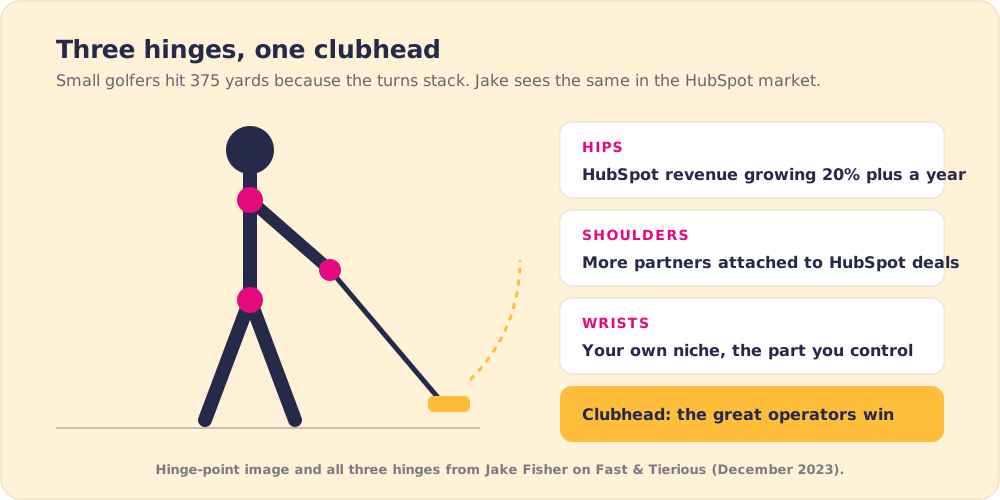
The first hinge is still turning. HubSpot reported second-quarter 2026 revenue of $911.7 million, up 20% year over year, across 306,446 customers, up 14% (HubSpot Q2 2026 results). On the episode I argued that there are not enough partners to serve that growth as HubSpot moves up market. An agency can do nothing about the first two hinges. It picks its own niche.
What agency growth strategy can you take from BridgeRev?
- The hero question. Name the clients you most want to help. BridgeRev’s answer moved from small-business owners to mid-market teams, and the offer followed.
- One thing, done world class. BridgeRev dropped content creation to be outstanding at HubSpot and nothing else.
- The discipline to say no. Jake’s never-again: never be too broad, even with limited capital.
- Managers better than the founders. Two strong managers first, then a rule that each hire is better than the person hiring.
- Outside counsel early. A coach or peer group who has already grown past the size you are stuck at.
- A niche of your own. HubSpot’s growth and partner attach rates are set elsewhere. Your niche is the hinge you choose.
What should a stalled agency do next?
Write down your answer to the hero question, then check every open proposal against it. Give the work that fits your best people, and refer the rest to a firm that does it well, even in a month when you need the money. Then hire a manager who is better than you at the job, and ask them to hire the same way. Jake’s firm grew slowly on good work for about a decade, and it doubled only after it chose its clients and hired people better than its founders.
BridgeRev’s story has moved on since we recorded. Clevyr acquired it in June 2025 and made it the firm’s CRM Strategies division, led by Ashley Quintana (Clevyr, 2025).
A narrower firm is also judged more on whether clients keep using what it builds. If you run a HubSpot agency and want your method to keep running in the client’s portal after go-live, that is what our partner program is for. To see how other partners describe their niches, browse the Supered partner directory.
For the delivery side of a focused practice, start with our HubSpot implementation guide, then read why CRM adoption decides whether a build survives.
Frequently asked questions
What is a good agency growth strategy for a small firm?+
What does 'to whom do you want to be a hero' mean?+
Should an agency niche down if it needs revenue?+
How do you hire people better than you?+
Is BridgeRev still independent?+
Your process, running itself.
Turn the playbook into rep behavior.
More from Fast & Tierious

Capacity Planning for Agencies: How Tom Richard Learned to Plan by Skill
Tom Richard
Founder-Led Sales: What Happened at RevPartners When Brendan Tolleson and I Stopped Selling
Brendan Tolleson