HubSpot Implementation: Build It Once, Install It Forever
Most HubSpot implementations are hand-built one client at a time, which is why they cost five figures and vary with whoever ran them. The history, the three layers, the productized model, what AI changes, and the migration case.
A HubSpot implementation is the setup of a portal's configuration and process, pipelines, properties, workflows, dashboards, and the motion the team runs, done either by hand per project or productized as installable packages that deploy a proven build into each new portal and measure whether the team runs it.
A master carpenter who builds every staircase from raw lumber is an artist. A master carpenter who builds every staircase from raw lumber when fifty houses need the same staircase is a bottleneck, and an expensive one, because the fiftieth staircase costs as much as the first and arrives no faster. That is the HubSpot implementation market as it has run for a decade: skilled partners hand-building, for each new client, sixty to eighty percent of the same portal they built last month, and pricing each rebuild as bespoke work because, mechanically, it was. It does not have to be anymore, and this guide is about what changed and what still decides whether an implementation was worth paying for.
The thesis to carry through every section: the configuration of a HubSpot portal, the pipelines, properties, workflows, and dashboards, was always the solved, repeatable part, and the layer that decides whether a build was worth paying for, the process the team runs inside it, is the part most projects hand over as a slide deck called training. Productizing the configuration is now possible and overdue. It does not solve the harder problem, and the reason it does not is the same reason a sales process on paper does not produce a sales process in the field, which is the spine of every pillar on this site.
Why are HubSpot implementations built by hand?
Because until recently there was no other way to deliver one, and the reason is a specific gap in the platform. HubSpot has no native deployment path between portals: no cross-portal workflow copy, no pipeline export, and sandbox promotion only for newly created assets in a paired portal, a boundary HubSpot's own deployment docs draw plainly. So every implementation began at the lumber pile, and the market priced accordingly. HubSpot's own onboarding, which is guidance rather than build work, carries mandatory one-time fees of roughly 1,500 to 7,000 dollars per hub by tier, and a Professional purchase across Marketing, Sales, and Service stacks about 6,000 dollars before a single workflow is built (VantagePoint, 2026, citing HubSpot's published pricing). Partner implementations then commonly run 5,000 to 25,000 dollars or more for mid-market scope, most of it skilled hours rebuilding foundations the partner has assembled many times.
Understanding how this came to be repays the detour, because the gap is a fossil of the platform's history rather than a design choice anyone defends. HubSpot began in 2006 as a marketing tool, added a CRM in 2014, and over the next decade grew into a multi-hub platform spanning marketing, sales, service, content, and operations. Each hub arrived with its own configuration surface, and the customer base grew faster than any tooling for moving a configuration from one portal to another. The platform optimized, sensibly, for a single company setting up a single portal once. It never optimized for the agency that sets up the same kind of portal forty times a year, because that was not the customer the early product was built around. The deployment gap is the residue of that order of events: the configuration became rich and deep long before any mechanism existed to move it, so the market filled the vacuum with skilled human hours, and a decade of pricing norms hardened around the assumption that those hours were unavoidable.
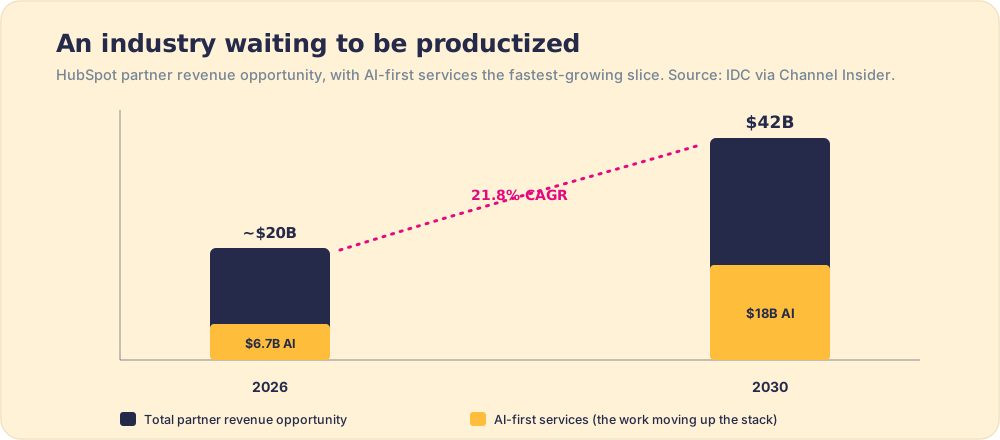
An ecosystem grew up around that hand-built reality, and it is large and growing faster than the core software. IDC projects the total revenue opportunity for HubSpot partners will more than double to 42 billion dollars by 2030, climbing at a 21.8 percent compound annual growth rate, with AI-first services the fastest-growing slice, projected to rise from 6.7 billion dollars in 2026 to 18 billion by 2030. Mid-market is where the money is moving: deals valued over 10,000 dollars grew 41 percent year over year in 2025, and HubSpot now serves roughly 299,000 customers with an app ecosystem of 3 million total installs, upmarket accounts running an average of more than 16 integrated apps. HubSpot's own leadership frames the partner layer as the engine of its growth rather than a channel afterthought. Duncan Lennox, HubSpot's Chief Product and Technology Officer, put it plainly in the 2026 HubSpot Partner Report: "We built our whole business on the notion of working with a thriving partner ecosystem. We're very motivated to make sure that we're not just building a product portfolio that solves our customer's problems, but that enables our partners to be successful as well." A market that size, doing work that is sixty percent repeatable, is the definition of an industry waiting to be productized, and the partners who productize first capture the margin the rebuild was donating.
The ecosystem exists for the same reason the implementation matters at all. HubSpot's own marketing claims that after one year its customers acquire 129 percent more leads, close 36 percent more deals, and see a 37 percent improvement in ticket-closure rates (HubSpot, "Why Choose HubSpot"). Read those numbers honestly and they describe an outcome, not a product feature: a customer who got the platform set up well and whose team ran it. The software does not acquire 129 percent more leads by sitting in a browser tab. Someone configured the lead capture, designed the nurture, defined the pipeline, and got reps to work it, and the gap between buying HubSpot and realizing those numbers is exactly the implementation. That gap is the partner ecosystem's entire reason for being, and it is why the platform's growth and the partner channel's growth move together: the tool creates the potential, and the implementation decides whether the potential is collected. A buyer who treats the purchase as the finish line has paid for the potential and budgeted nothing to collect it.
Notice the trade the math describes. A partner billing skilled hours for a foundation that is sixty percent repeatable is, in effect, charging full price for work that should compound and giving the compounding away for free. The first software client pays for the architect to figure out the right pipeline and the right property model; the second pays for the same figuring, even though the architect now knows the answer; the tenth pays again. Across a book of similar clients, the partner has rebuilt nearly the same portal ten times and banked the learning nowhere it can be resold. That is not a margin problem a partner can price their way out of, because the competition is doing the same thing, so the whole market clears at the cost of the rebuild. The only escape is to stop rebuilding, which means turning the repeatable foundation into an asset that installs, and that is precisely the tooling that did not exist for the platform's first decade and exists now.
What does a HubSpot implementation include?
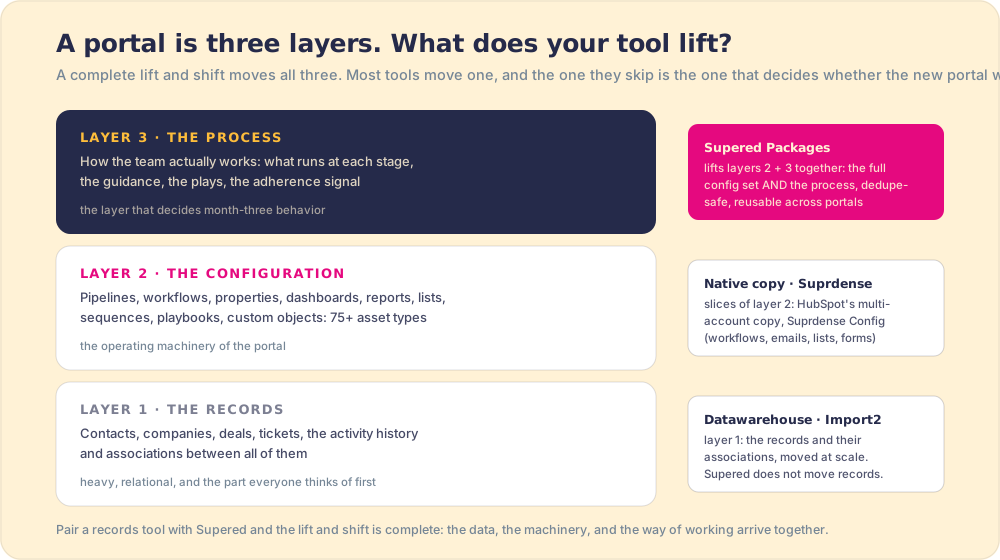
Three layers, and naming them exposes where projects go sideways.
- The configuration. Pipelines with stage exit criteria, properties and field groups, workflows, dashboards, reports, permission sets, scoring models. This is what most statements of work mean by "implementation," and the layer partners rebuild most repetitively.
- The data. Records imported clean: deduped in transit, associations intact, history preserved where it earns its keep. Different tooling entirely, covered in HubSpot migration services.
- The process. The motion the team will run inside the build: what happens at each stage, which fields matter and why, who owns which handoff, delivered where the work happens and measured. The layer that decides whether the other two were worth paying for, and the one most implementations hand over as a slide deck.
The configuration layer deserves a closer look, because the phrase "set up the portal" hides how much sits underneath it and why the work resists shortcuts even though it is repeatable. A HubSpot configuration is a connected structure, not a list of settings. The pipeline is a sequence of deal stages, but each stage carries exit criteria, required properties, and the workflows that fire when a deal enters or leaves it. The property model is the data schema of the whole business: contact, company, deal, ticket, and custom-object properties, grouped into field sets, governed by permissions, and referenced by every workflow, report, and list that touches a record. Workflows are the automation spine, enrolling records on property values, branching on logic, setting fields, sending emails that live in the content tool, and rotating leads by owner. Dashboards render reports that query those properties, lifecycle stages define the funnel the marketing and sales teams share, lead-scoring models weight the signals that route attention, and permission sets decide who can see and change what. A mid-market portal commonly carries dozens of workflows and well over a hundred properties across a handful of object types, and the assets reference one another so densely that no piece can be understood, or moved, in isolation. That density is why configuration is repeatable but not trivial: a competent architect knows the right shape, and reproducing the right shape by hand still takes skilled hours every time. It is also the reason the productized model is engineering rather than a copy-paste macro, a point the dependency discussion below makes concrete.
The third layer is where the field data points. In our survey of 198 sales leaders for The State of Sales Enablement, 89 percent of teams had a defined process and 36 percent saw it followed, and guidance reaching reps in the flow of work separated the teams at 49 percent of quota from those at 15 percent. A beautifully configured portal with an unadopted process is the most common deliverable in this industry, and from the client's chair it is hard to tell apart from a failed project with good dashboards.
The data layer deserves more than its one line, because it is where many implementations lose weeks they never planned for. Records do not lift cleanly on their own: contacts duplicate across systems, companies associate to the wrong deals, lifecycle stages mean different things in the old portal than the new one, and a decade of free-text fields hides the same value spelled five ways. The discipline is to dedupe in transit, preserve the associations that carry meaning, and keep only the history that earns its storage rather than hauling every dead record across out of a fear of losing something. Done well, the data layer is invisible at go-live and the reps trust what they see; done carelessly, it poisons the dashboards from day one, and no amount of clean configuration recovers a portal whose records lie. The tooling for this layer is different from the configuration tooling entirely, which is why it gets its own treatment in HubSpot migration services.
It helps to see why the third layer carries so much weight, because the instinct is to treat it as the soft, optional part and the configuration as the hard, technical work. The instinct has it backwards. Configuration is knowable, bounded, and inspectable: a workflow either fires or it does not, a property either exists or it does not, and any competent partner can verify the build against a checklist. The process layer is none of those things, because it depends on what reps do when no one is checking, under quota pressure with a live buyer on the line, when the clean new pipeline asks for a step the rep can skip with no immediate consequence. That is a behavior problem, and behavior problems do not resolve to a checklist. A portal can pass every configuration test and still fail the only test that matters, which is whether the team runs the motion the portal was built to support. The configuration is the instrument; the process is the music, and an instrument in tune that nobody plays makes no sound.
What are the common mistakes when scoping an implementation?
Implementations fail in a handful of recognizable ways, and almost all of them trace to the same root error: scoping the project around the layer that is easy to specify rather than the layer that decides the outcome. Name the failures and you have most of the diagnostic a buyer or a partner needs before a statement of work is signed.
- Configuration as the whole deliverable. The statement of work lists pipelines, properties, workflows, and dashboards, prices them by the hour, and treats the process the team will run as a training session at the end. This is the most common and most expensive error, because it ships two layers and a slide deck about the third, and the third is the one that decides whether the first two were worth paying for. A build scoped this way is complete on paper and unadopted in practice.
- The wishful process. The portal encodes the motion leadership wishes the team ran rather than the motion the winners really run, so no rep recognizes a real deal in it, and unrecognizable processes earn the adoption all unrecognizable things earn, which is none. The fix is to build the configuration around the motion captured from the team's best performers, not a best-practice template a consultant brought in a binder.
- Property sprawl. The portal ships with 214 properties because every stakeholder asked for a field, of which reps fill 40, and the rest decay into a junk drawer that makes the records look richer than they are. Each unused required field is a small tax on every deal, and the accumulation is a portal that punishes the behavior it was built to encourage.
- Integrations as an afterthought. The deal data lives in HubSpot, but the rep works in Gmail, Salesloft, and a dialer, and the implementation never closed the loop, so following the new process costs a tab switch, and friction reliably beats good intentions. A build that does not meet reps where they already work has lost before the training session begins.
- No adoption measurement. The project ends at go-live with no way to see, at the deal level, whether reps are running the build, which means the single question that predicts the project's value, is the process being followed, has no answer. You can only expect what you inspect, and an implementation with no adherence signal is a wish with good dashboards.
Read down that list and one pattern connects all five: each substitutes the convenient, specifiable thing, a field, a template, a configuration checklist, a training event, for the harder thing it was supposed to stand in for, a real change in what reps do every day. The craft of a good implementation, like the craft of a good sales process, is refusing those substitutions and scoping the project around the layer that resists them.
How do you productize a HubSpot implementation?
By building the portal once and installing it, instead of rebuilding it each time. The package mechanism removes the old tooling constraint: Supered's Package Builder carries 75-plus HubSpot asset types, workflows, pipelines, dashboards, reports, custom objects, scoring models, permission sets, fields across two dozen object types, plus the process layer, as installable packages. Build the best-practice portal once, package it with each asset's dependencies resolved automatically so it arrives able to function, and install it into any client portal dedupe-safe, where same-name assets are skipped rather than duplicated. The fiftieth staircase becomes an install plus customization, not a rebuild.
The reason this is harder than it sounds, and the reason naive copy-paste tools have never solved it, is a dependency problem worth understanding because it explains why the productized layer is real engineering rather than a macro. A HubSpot asset is rarely self-contained. A workflow enrolls records based on properties, sets other properties, sends emails that live in the content tool, and branches on values from custom objects. A dashboard renders reports that query properties that may not exist in the destination portal. Copy the workflow alone into a fresh portal and it lands broken, referencing properties and assets that are not there, which is why the visible tip of an implementation, the workflow you can see, sits on an iceberg of dependencies you cannot. A real package mechanism walks that dependency graph and brings the whole connected structure across in the right order, so the asset arrives able to function rather than arriving as a reference to things that do not exist. That graph-resolution is the difference between a deployment and a mess, and it is the technical work the lumber-pile pricing was paying skilled humans to redo by hand on every project. The full anatomy of that iceberg is in workflow dependencies, and the named-and-priced tool field, native copy, Suprdense, Datawarehouse.io, and the package layer, is mapped in copy HubSpot assets.
The economics move twice. Fewer hours per delivery, and the build itself becomes intellectual property that compounds, the thesis behind the partner program. It also changes who can deliver: implementations stop depending on the one senior architect who knows where everything goes, because the architect designs the playbook once and the whole team installs it. And consistency follows, for the same reason it does in selling: hand-built portals vary with whoever built them on whatever week, while installed packages do not, so the fiftieth client gets the same floor the first one did.
There is a structural reason this matters beyond the partner's margin, and it is the same insight that explains why so much enterprise software underdelivers. Hand-built work does not accumulate. A staircase the carpenter builds from raw lumber teaches the carpenter something, but the next client still pays for raw lumber, because the knowledge sits in the carpenter's head rather than in a reusable component. A productized build inverts that: the proven portal is an asset that gets better every time it is installed and corrected, so the partner's accumulated learning is captured in the package rather than evaporating between projects. The market has named this shift in its own language, and the language is telling. Zack Kass, a global AI advisor and former head of go-to-market at OpenAI, wrote in the 2026 HubSpot Partner Report that ecosystems "are no longer peripheral networks of partnerships. They become operating systems, the places where intelligence is applied, shaped, and made useful." A package library is exactly that: the place a partner's intelligence about how a good portal should be built is applied, shaped, and made reusable, rather than re-derived from the lumber pile on every engagement.
Put numbers on the margin to see why this is not a small efficiency but a change in the shape of the business. Hold the price a client pays roughly constant, because the market sets it and a single partner cannot move it far. On the hand-built path, the partner's cost is mostly senior hours, and those hours recur in full on every engagement: the foundation is rebuilt each time, so the cost of delivery barely falls from the first client to the fiftieth, and margin per client stays where the labor market pins it. On the productized path, the cost of the repeatable foundation is paid once, at the front, when the build is created and packaged. Each later install draws down that one investment and adds only the hours that genuinely differ, the data, the integrations, the client's process. Same revenue per client, falling cost per client, which means the margin widens with each install rather than holding flat. The partner who has installed the foundation forty times is selling something close to a product at the price of a service, while the hand-built shop next door is selling a service and absorbing a service's cost every single time. The hand-built shop cannot price its way to that margin, because its competitors are all rebuilding too, so the whole hand-built market clears at the cost of the rebuild. The only door out is to stop rebuilding, and the math says the partner who walks through it first compounds a lead that hours-based competitors cannot close by working harder.
A package library changes more than the unit economics; it changes what the firm owns. A service business that bills hours owns a calendar and a reputation, and when its senior people leave, much of the value walks out with them, because the expertise lived in their heads. A package library moves that expertise out of heads and into an asset the firm holds: the proven portal, refined across every prior client, is intellectual property that can be versioned, improved, and installed by anyone on the team rather than re-derived by the one architect who remembers how. That is the difference between a practice that scales with headcount and one that scales with installs. It also de-risks delivery in a way clients feel, because the fiftieth client receives a foundation corrected by forty-nine prior corrections rather than a fresh build carrying fresh, untested mistakes. The library is the thesis behind the partner program: turn the part of the work that repeats into an asset that appreciates, and spend human time only where human judgment is the scarce input.
What does hand-built versus productized delivery look like?
Abstractions argue; examples convince. Walk two deliveries side by side, both for the same kind of client, a 30-rep mid-market software company moving onto Sales and Service Hub Professional, and the difference stops being a theory about repeatable work and becomes a difference you can feel in the timeline, the invoice, and the ninety-day review.
Take the hand-built path first. The partner scopes a discovery phase, then begins at the lumber pile: building the pipeline and its stages, defining the properties, wiring the lead-rotation and deal-creation workflows, assembling the dashboards leadership asked for, and setting the permission tiers, most of it work the same partner did, in nearly the same shape, for the last three software clients. HubSpot's mandatory onboarding fee sits on top, roughly 1,500 to 7,000 dollars per hub by tier, and the partner's build commonly adds well into five figures for scope of this size (VantagePoint, citing HubSpot's published pricing). The senior architect who knows where everything goes is the bottleneck, so the timeline stretches to the calendar of one person. The project ends with a clean portal, a recorded training session, and a handover document. Three months later the dashboards report deals advancing on activity the reps logged, the win rate has not moved, and nobody can say from the data whether the build is being run, because adoption was never scoped as a measurable thing.
Now the productized path, same client. The partner installs a proven Sales-and-Service foundation built once and refined across prior software clients: the pipeline with exit criteria, the property model trimmed to the fields reps really fill, the standard workflows and dashboards, all deployed with each asset's dependencies resolved automatically and same-name assets skipped rather than duplicated. The configuration phase that consumed most of the hand-built timeline collapses to an install plus customization, which frees the partner's senior time for the layers that genuinely differ per client: the data migration, the integrations into the tools the reps already use, and the client's own process decisions. The process layer ships inside the install, surfacing each stage's next step where the work happens, with adherence visible from the first morning. At the ninety-day review the conversation is not "did everyone attend training" but "here is the adoption rate by stage, and here is the one stage that leaks," which is a conversation a partner can be paid for again.
There is a consistency dividend hiding in the comparison that buyers tend to miss. A hand-built portal is, by construction, a one-off: it reflects the architect's judgment on the week it was built, the requirements that happened to surface in discovery, and whatever shortcuts the timeline forced. The next client's portal, built by the same shop, differs in a dozen small ways nobody decided on purpose. A productized install removes that variance, because the same proven foundation lands for the fiftieth client that landed for the first, corrected by everything learned in between. Variance is not a cosmetic problem; it is a support and quality problem that compounds, because every divergent portal is a separate thing the partner has to remember how to maintain. The package model trades bespoke novelty, which clients rarely need in their pipeline plumbing, for reliability, which they always need.
The two deliveries are not different in skill; they are different in what the skill is spent on. The hand-built path spends senior hours re-deriving a foundation the partner already knows how to build. The productized path spends them on the parts no package can know in advance, the client's data, the client's integrations, the client's motion, and on the layer that decides adoption. The difference compounds: by the partner's tenth software client, the foundation has been corrected ten times and the partner's expertise lives in the package, while the hand-built shop is on its tenth trip to the lumber pile with the same architect and the same risk that this build varies from the last by whoever happened to assemble it. The deeper portal-to-portal mechanics are in copy HubSpot assets, and the dependency trap that makes naive copying fail is in workflow dependencies.
Is a bespoke build better for a complex client?
It is the fair objection, and it deserves the strongest version of itself before any answer. A reader who has run a real implementation is right to be suspicious of "build once, install everywhere," because they have seen the template that did not fit. The argument goes like this. Complex clients are complex precisely because they do not look like the reference portal: a manufacturer with a quote-to-cash motion across distributors, a healthcare company with consent and compliance rules baked into every workflow, a multi-entity business running several pipelines that must not contaminate each other's reporting. A productized foundation, the objection runs, is an average of past clients, and an average fits no one exactly. Force a genuinely unusual business onto a packaged build and you get a portal that is subtly wrong everywhere, which is worse than a portal built from the ground up to fit. Grant all of it. The objection is correct about everything it claims, and a partner who installs a package over a client whose motion the package was never built for has done the client a disservice dressed up as efficiency.
Now the answer, which does not defeat the objection so much as locate it correctly. The productized model never claimed the whole portal is the same across clients; it claimed the foundation is, and the foundation and the bespoke parts are different layers. Walk any complex portal and you find both. The manufacturer still needs a deal pipeline with inspectable exit criteria, a property model that is not sprawl, lead routing, dashboards, and permission tiers, and those are the same shape they are for any thirty-rep business, built right a hundred times before. What is genuinely bespoke is the quote-to-cash integration, the distributor object model, the compliance logic. The package model does not erase that bespoke work; it clears the repeatable foundation out of the way in an install so the senior hours are spent on the bespoke work instead of on rebuilding the pipeline for the hundred-and-first time. A bespoke build, by contrast, spends its scarce expert hours on both, and the foundation it hand-builds is no better for having been hand-built. It is only more expensive and more variable, carrying whatever fresh mistakes this build introduced that forty-nine prior corrections would have caught. The honest branch is therefore not bespoke-versus-productized for the whole portal. It is: install the foundation that is genuinely common, and spend the recovered, expensive hours going deeper on the parts that are genuinely unique than a hand-built budget could ever afford. The complex client is the strongest case for productizing the foundation, not the exception to it, because the complex client is exactly the one who cannot afford to waste senior time at the lumber pile.
Mark where the picture breaks, because it does break. If a client's needs are so unusual that even the foundation does not apply, a heavily customized object model with no pipeline resembling the reference, then there is little foundation to install and the engagement is bespoke by nature. That client exists, and a partner should say so rather than forcing a fit. The point is that this client is rare, and the market priced as if every client were this client, which is the error. Most mid-market portals are eighty percent common foundation and twenty percent genuine difference, and the productized model is the only one that lets a partner be fast on the eighty and lavish on the twenty.
Does this hold for tiny portals and enterprise migrations?
The thesis bends at the two ends of the size range, and naming how it bends is part of telling the truth about it. At the small end sits the simple portal: a ten-person company on Sales Hub Starter that needs one pipeline, a dozen properties, and a handful of workflows. Here the honest answer is that a productized install and a careful DIY setup land close together, because there is barely enough configuration to amortize a package over. HubSpot's templates and onboarding guidance, now assisted by Breeze, will carry a simple portal a long way, and a small team that follows them will get a working build. The package model's advantage is thin at this size and grows with complexity, which is the right way for an advantage to behave. The caution that survives even here is the process layer: a small team that gets a clean portal and no adopted motion fails the same way a large one does, only with fewer reps to mask it.
At the large end sits the migration from another platform, most often Salesforce, which in 2026 is the most common direction of travel as mid-market teams move toward simpler administration and lower total cost (IntegrateIQ, HubSpot Diamond Partner, 2026). A Salesforce-to-HubSpot move is not a portal copy; it is a translation between two different data models, and the gap is where the weeks go. Salesforce's object architecture, its custom objects, record types, and the automation built on them, does not map one-to-one onto HubSpot's, so the configuration has to be rebuilt in HubSpot's idiom rather than transferred. Partner guides commonly put a fifty-user migration in the range of fifteen thousand to fifty thousand dollars and six to twelve weeks of work depending on data volume and integration count, with the cost driven by data quality, custom-object modeling, and automation complexity rather than by the record count alone. The productized lesson still applies, sharpened: the foundation you are translating into can be a proven HubSpot build installed as a package, so the senior hours go to the genuinely hard translation work, the object mapping, the data cleanup, the integration rewiring, instead of to re-deriving what a good HubSpot pipeline looks like. And the migration is, again, the cheapest chance to redesign the process rather than relocate the old one, because a team changing platforms is already braced for change in a way they will not be again for years.
What does AI change about HubSpot implementation?
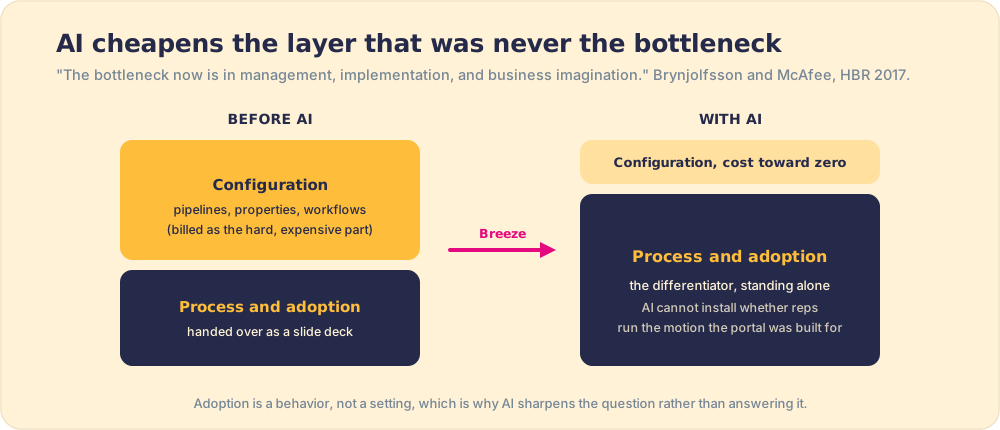
It automates the layer that was already cheap to repeat, which sharpens where the value sits. HubSpot's Breeze now ships a roster of agents: as of mid-2026 the Customer Agent, Prospecting Agent, and Data Agent are generally available, with a Customer Health Agent, a Company Research Agent, and a Closing Agent in beta, all discoverable in the Breeze marketplace and tunable in Breeze studio. The Customer Agent can run automated onboarding and guide setup, and the assistant can scaffold configuration faster than a person clicking through settings. Read that the way the rest of this site reads AI: it drives the cost of the repeatable, knowable layer toward zero. Configuration is exactly that layer. What AI cannot install for you is the thing that decides the project, whether the team runs the motion the portal was built for, because adoption is a behavior, not a setting. So AI does not make the process layer less important; it removes the last excuse for treating configuration as the hard part, and leaves the process layer standing alone as the differentiator.
It pays to be precise about what auto-onboarding does and does not solve, because the marketing language blurs the line and the blur is expensive. What it does solve is real and worth having: an agent can walk a new admin through setup, answer configuration questions in plain language, scaffold properties and workflows from a description, and resolve the routine support tickets that used to queue for a human. That is genuine compression of the cheap layer, and it is why HubSpot's own framing promises results "in hours, not months" for agent setup. What it does not solve is the layer underneath. An agent that configures a flawless pipeline has not decided which buyer commitment defines each stage, has not captured the motion the team's best reps run, and cannot make a rep perform discovery under quota pressure when skipping it carries no immediate cost. Onboarding automation produces a configured portal faster; it does not produce an adopted process, because the adopted process is a change in human behavior and the agent is changing settings. The two are as different as tuning a piano and teaching someone to play it. HubSpot is careful about the boundary in its own words: Breeze agents, the company says, run on their own but "you'll always stay in control with clear guardrails, approvals, and visibility every step of the way." That sentence is a governance claim, and it is the right one, because the safe rollout pattern the field has converged on, assist first and automate second, says the same thing in operational terms: do not let an agent automate a process the team has not adopted, and keep a human able to inspect whether the agent is following the process or merely producing activity.
This is not a new pattern so much as the latest instance of an old one, and the most useful frame for it is more than a decade old. When Erik Brynjolfsson and Andrew McAfee surveyed the business impact of machine learning for the Harvard Business Review in 2017, they reached a conclusion that lands harder now than it did then: "The bottleneck now is in management, implementation, and business imagination." The technology was not the constraint; the organizational change around it was. Brynjolfsson's earlier firm-level research, with Lorin Hitt and others, made the same point with numbers and added one that should stop any buyer who thinks the software is the expensive part. Studying the returns to information technology across hundreds of firms, he found that the companies capturing outsized gains were the ones that paired the technology with a cluster of complementary changes in how the organization worked: broader information sharing, decentralized decisions, pay linked to performance, the pruning of non-core processes, and heavier investment in training (Bresnahan, Brynjolfsson, and Hitt, NBER, 1999). The striking finding was the cost ratio: across the firms studied, those organizational and process changes were larger and more costly than the technology investments themselves. The tool was the cheap part. The redesign of the work around it, expensed in process and behavior rather than capitalized in software, was where most of the money and most of the difficulty lived. A HubSpot implementation is that pattern in miniature: the license and the configuration are the capitalized, cheapening part, and the complementary change, the team running a new motion, is the costly, slow, human part the platform cannot supply for you.
The direction of travel sharpens the point. Kass argues in the same HubSpot report that the browsable web of pages and APIs is giving way to an "agentic internet" built on shared context and systems of action, where agents, not people, increasingly do the navigating. In that world the configuration of a portal becomes something an agent reads and writes, which pushes its cost down further and faster, while the question of whether the resulting behavior serves the buyer becomes the scarce, human judgment no agent supplies. Apply that to a HubSpot portal and the conclusion is direct. An AI that scaffolds a flawless configuration in minutes has automated the part Brynjolfsson would call the easy part, the tool, and left untouched the part he would call the hard part, the complementary change in what the team does. The market sees the shift coming: IDC's projection that AI-first partner services will grow from 6.7 billion dollars in 2026 to 18 billion by 2030 is a bet that the work is moving up the stack, away from configuration and toward the deployment, productization, and operationalization that AI cannot do on its own. The risk for an implementation is precise. An agent that auto-advances a pipeline on detected activity, an email sent, a meeting booked, manufactures exactly the false confidence a commitment-based process exists to prevent, now at machine speed across the whole portal at once. The defense is the same discipline you apply to a rep: a stage advances on a verified buyer commitment whether a human or an agent proposes it, and you must be able to inspect whether the AI is following the process or gaming the activity. The 140-year-old principle the sales process guide traces holds here too: AI makes a good, adopted process compound faster and a vanity, configuration-only build lie faster, and it does not change what a good implementation is.
What if you are migrating an existing portal?
The same three layers and the same package mechanics apply, with one added discipline. A portal is a fossil record of every process decision a team ever made, including the abandoned ones: the 214 properties of which reps fill 40, the workflows nobody dares turn off. Migration day is the one day all of it is in your hands at once, which makes it the cheapest day you will ever have to leave the junk drawer behind. Lift the records faithfully with the tools built for them, lift the configuration that survives an audit, and redesign the process in transit rather than copying it, because relocating the mess as-is only buys the old behavior at a new address. The cloud world named these patterns decades ago, rehost, replatform, refactor, and the portal-specific version is argued in lift and shift applied to HubSpot, with the roads priced in migration services, the tools in copy HubSpot assets, the dependency trap in workflow dependencies, the M&A case in merge HubSpot portals, the rehearsal valve in sandbox to production, and the phases in the migration checklist.
A worked case makes the discipline concrete. Picture an acquirer consolidating two HubSpot portals after buying a smaller competitor, a common mid-market situation given that deals over 10,000 dollars are the fastest-growing slice of the partner market. The naive plan is to copy the acquired company's pipeline, properties, and workflows into the acquirer's portal so nothing is lost. The naive plan is also the expensive one, because it relocates two accumulated junk drawers into one larger junk drawer and doubles the property sprawl overnight. The disciplined plan treats the merge as the rare chance to redesign rather than relocate: the records lift faithfully with a tool built for them, the configuration is audited so only the assets that survive an honest review come across, and the combined process is rebuilt from how the best reps on both teams really sell, then installed as a package rather than hand-merged field by field. The migration becomes an implementation in disguise, and the same three layers govern it, with the process layer once again the one that decides whether the merged team runs the build or keeps two unreconciled ways of working under one roof. The M&A case in full is in merge HubSpot portals, and the rehearsal valve that catches surprises before cutover is in sandbox to production.
One mechanism trips nearly every migration, and it is worth naming because it surprises teams at the worst possible moment, cutover. HubSpot offers sandboxes so a team can rehearse a build before it touches production, which is sound practice. The catch is that sandbox-to-production promotion works only for assets created new in the sandbox; it is, in effect, a one-way valve that does not let you push changes back onto assets that already exist in production. So a team that rehearses a migration in a sandbox, then expects to promote the whole thing cleanly to the live portal, discovers at cutover that much of their work cannot be promoted the way they assumed, and they are reconfiguring by hand under deadline. The boundary is drawn plainly in HubSpot's deployment docs, and it is the same native-deployment gap that made implementations hand-built in the first place, showing up again at the migration stage. The package layer routes around the valve, because a package can install a proven build into the production portal directly rather than depending on sandbox promotion, and the full treatment of the trap is in sandbox to production. The lesson for a migration plan is to discover this boundary while scoping, not at cutover, because the day you find it determines whether it costs an afternoon of planning or a weekend of frantic rebuilding.
How to choose, and where to start
There are three ways to approach a HubSpot implementation, and naming them honestly is the start of choosing well.
- The hand-built engagement. A partner builds your portal from the lumber pile, prices it by skilled hours, and hands over a configuration plus a training session. It produces good work and bills for the rebuild of foundations the partner already knows how to build, so you pay full freight for the repeatable sixty percent and the timeline bends to one architect's calendar.
- The DIY or self-serve setup. You configure the portal in-house using HubSpot's templates and onboarding guidance, which works for a simple portal and stalls on the parts that need accumulated expertise: dependency-laden workflows, clean data migration, and a process designed for adoption rather than for a checklist.
- The productized install. A partner deploys a proven foundation as packages, spends the recovered hours on what genuinely differs, your data, your integrations, your motion, and ships the process layer measured from go-live. You pay for expertise applied to your specifics rather than for re-derivation of a foundation that should already exist.
If you are buying an implementation, weight the candidates by one ratio and one demand. The ratio: how much of your build is the partner's proven foundation versus built fresh for you, because a partner with a package library answers with a number and a faster timeline, while a partner without one is quoting you the lumber pile. The demand: insist the process layer ships as a measured, in-the-flow deliverable rather than a training session, and treat HubSpot's onboarding as a floor, not a substitute for build work. If you are a partner running implementations, productize or keep donating margin to the lumber pile: package the proven build, install it per client, spend the recovered weeks on the layers that genuinely differ, data, integrations, and the client's own process decisions, and hand over portals where adoption is a number you can show at the ninety-day review. That measured process layer, running where reps work, is what Supered is beyond the Package Builder, and how it works shows the mechanics.
The recommendation, stated flat: productize the configuration and never confuse productizing it with finishing the job. The configuration was always the solved, repeatable layer, and AI is finishing the work of driving its cost toward zero, so a partner or a buyer who treats it as the hard part is optimizing the part that no longer differentiates anyone. The work that decides whether an implementation was worth paying for is the layer AI cannot install and a package cannot fully carry: whether the team runs the motion the portal was built for. Build the portal once so the foundation stops costing what it did the first time, then spend every recovered hour on the process layer, delivered where reps work and measured deal by deal, because that is the layer Brynjolfsson's bottleneck of management and implementation has been describing for a decade, and the layer the field data keeps pointing to. A mediocre portal whose process the team runs beats a beautiful one whose process sits in a training deck, for the same reason a sales process run on every deal beats a brilliant one run on half: consistency is what the buyer feels and what the number stands on.
Read the cluster in order: migration services for the roads, copy HubSpot assets for the named-and-priced tools, workflow dependencies for the iceberg, lift and shift for the strategy, merge HubSpot portals for the M&A case, sandbox to production for the valve, and the partner program for the economics of running this as a practice.
HubSpot implementation FAQ
What does a HubSpot implementation include?+
How much does a HubSpot implementation cost?+
Why are HubSpot implementations priced like bespoke work?+
What does AI change about HubSpot implementation?+
Can you migrate an existing portal instead of rebuilding?+
What separates a HubSpot implementation that sticks?+
How long does a HubSpot implementation take?+
What is the most common reason a HubSpot implementation fails?+
Is a bespoke build better than a productized one for a complex client?+
Does HubSpot Breeze AI onboarding replace the need for an implementation partner?+
How is a Salesforce-to-HubSpot migration different from a fresh implementation?+
Stop rebuilding the staircase.