Client Onboarding: The First 90 Days Decide the Renewal
Client onboarding is the process that turns a signed contract into a live, renewing account.
The phases and owners are the easy half. The hard half is the team running the same process on every account, and that is where the renewal is won or lost.
Client onboarding is the process a services firm runs to bring a new client live, from kickoff through requirements, implementation, and training to the handoff into steady-state, across the first 90 days that decide whether the client renews.
The deal closes, the team celebrates, and a project is born. Someone clones the onboarding template, books the kickoff, and a tidy board appears with owners and due dates marching toward go-live. If you run a services firm, you have lived this scene. What happens over the next 90 days will do more for the account’s lifetime value than anything sales did to win it, and yet the pages that dominate this topic, HubSpot’s guide among them, treat client onboarding as an exercise in assembling better steps. Build the checklist, the advice goes, and the onboarding follows.
Our field data says the checklist was never the scarce part. In the State of Sales Enablement, a survey of 198 revenue leaders, 89 percent had a defined process and only 36 percent saw their teams follow it. Client onboarding is the process a services firm runs to bring a new client live, from kickoff through requirements, implementation, and training to the handoff into steady-state, across the first 90 days that decide whether the client renews. The half that decides the renewal is the run.
What is client onboarding?
It is the stretch between a signature and a client who is live, getting the value they paid for, and settled into a steady working rhythm with your team. For an agency that means the first campaigns shipping. For an implementation partner it means the system configured, the client’s team trained, and the account handed to whoever manages it long-term. The plan for that stretch is a client onboarding process; running the plan is client onboarding.
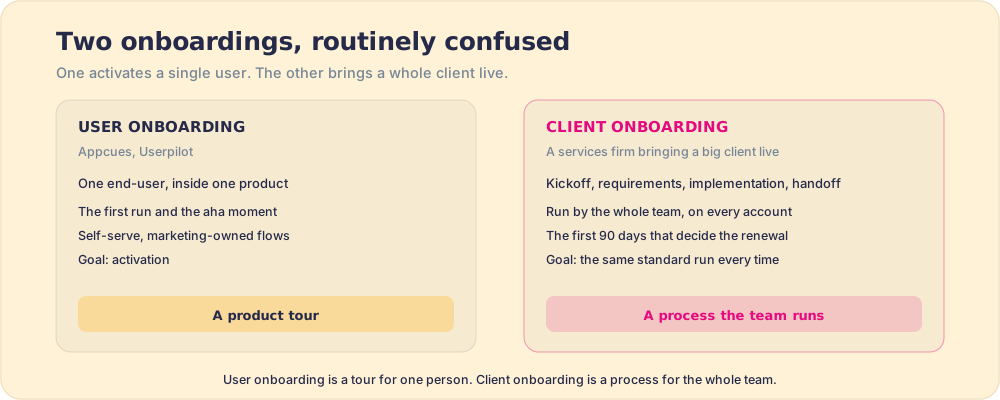
One clarification before anything else, because the word onboarding gets borrowed for two different jobs. User onboarding activates a single end-user inside a product: the welcome flow, the tooltip, the first-run aha. Appcues and Userpilot own that job, and it is a tour. Client onboarding is a team bringing a whole account live through a multi-phase process, where a bad start is a first impression the client cannot un-see. Many teams say customer onboarding for both, which is how a services firm ends up evaluating product-tour software for a team-process problem. The figure below draws the line, and the rest of this post stays on the client side of it.
Why does client onboarding decide retention?
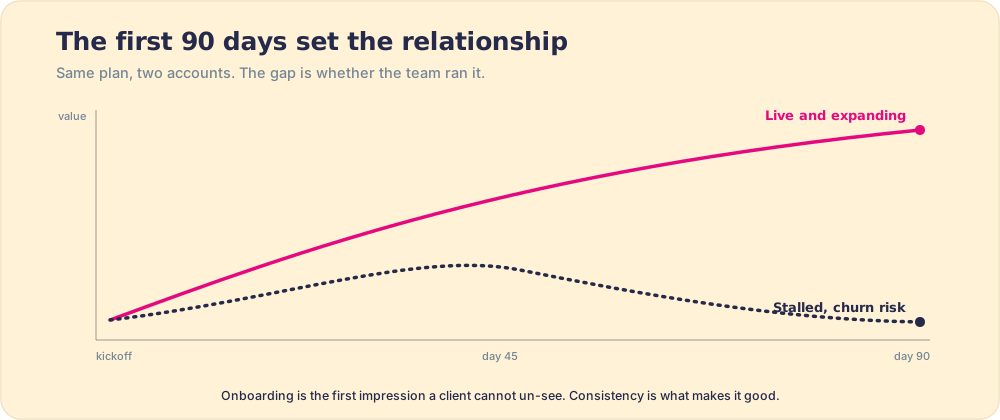
Because the money in a services relationship sits behind the renewal, and the renewal decision starts forming before the first invoice clears. Frederick Reichheld’s work at Bain found that raising customer retention by five points can lift profit anywhere from 25 to 95 percent (Reichheld and Sasser, Harvard Business Review), which makes the early relationship the stretch where a point of effort moves the most profit. And the opening carries more weight than its length suggests: Wyzowl’s onboarding research found that the overwhelming majority of people have abandoned a product because they could not figure out how to use it (Wyzowl onboarding statistics). A confused user deletes an app. A confused client sits through three more status calls, forms a verdict, and shops the renewal.
The client never sees your process document. They see the run: whether the kickoff asked sharp questions, whether requirements were captured once instead of three times, whether the person on the fourth call knew what was said on the first. Consistency is a buyer-facing quality. When your hundredth account gets the same onboarding your marquee account got, the client experiences your firm as competent, and the renewal conversation inherits whatever the first 90 days established.
What are the phases of a client onboarding process?
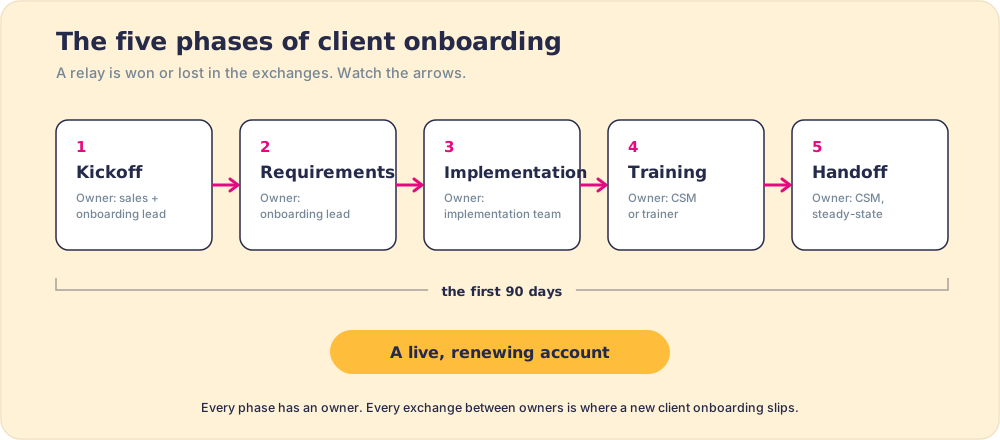
Five, whatever the local names, in agencies, implementation partners, and managed-service firms alike. Think of them as legs of a relay. A relay is won or lost in the exchanges: each runner knows their own leg cold, and the baton still hits the track between the runners. The phases are the straightaways. The exchanges between owners are where a new client onboarding slips.
Kickoff. The first working session after the signature. Sales is in the room to hand over context, the onboarding lead takes the wheel, and the client meets the team that will deliver what they were sold. The single highest-risk exchange of the whole relay happens right here, from the seller to the delivery team, and we wrote about it separately in the sales-to-customer-success handoff: everything the client said during the sale either arrives at this meeting or gets asked again, and asking again is the first withdrawal from the trust account.
Requirements. The onboarding lead turns what was sold into what will be built: goals made measurable, access granted, constraints named, success defined in the client’s words. Skipping depth here does not save time; it relocates the time into rework during implementation, with interest.
Implementation. The build. Configuration, migration, integration, the campaign, whatever the engagement is. This phase eats most of the calendar and, oddly, carries the least relationship risk, because it is the leg where teams are already strongest.
Training. The client’s team learns to work with what was built. This phase decides whether the value survives contact with the client’s own habits, the central problem in customer enablement, and it is the phase most often compressed when the timeline slips.
Handoff. The onboarding team steps back and the steady-state owner, usually the CSM, steps in, with the account’s full history in hand. Done well, the client barely notices. Done badly, the client repeats themselves to a stranger in month four.
What does a customer onboarding checklist look like for a software implementation?
A customer onboarding checklist for a software implementation is the five-phase process above with technical gates bolted to it: an access and data inventory before anything is configured, a test migration before the real one, user acceptance before go-live, and an adoption check after it. The difference from a services engagement is where things hide. Software looks finished in a demo and fails in production, so every phase on this checklist ends on a state you can verify in the system, never on a meeting that took place.
The stakes have moved in the vendor’s direction. Rocketlane’s 2024 survey of more than 850 onboarding professionals found that 42 percent of companies now charge for implementation (Rocketlane, 2024), so the client is paying for the onboarding as a line item and grading it like one. And the classic way implementations go wrong is scope that surfaces late: Panorama Consulting’s 2026 ERP Report found more than a quarter of organizations exceeded their project budgets, with additional technology needs the leading cause (Panorama Consulting, March 2026). Technical discovery is the phase that catches those needs while they are still a line in a plan.
| Stage | What the checklist covers | Exit criterion (verifiable) |
|---|---|---|
| 1. Handoff and kickoff | Sales handoff reviewed; success criteria written in the client’s words; executive sponsor and client admin named; timeline agreed | A signed success plan with one measurable outcome and a date |
| 2. Technical discovery | Admin access and SSO; data inventory (objects, record counts, source systems); integration list; security review | Every data source and integration has an owner and a decision: migrate, integrate, or retire |
| 3. Configuration and test migration | Build in a sandbox; field mapping signed; a sample of records loaded; integrations tested end to end | The client confirms test records match the source |
| 4. User acceptance and training | The client runs real scenarios; role-based training for end users; the client admin trained to self-serve | UAT signed; each named user has completed one real task in the live system |
| 5. Go-live and hypercare | Cutover plan with a rollback path; full migration; reconciliation; a daily check during hypercare | Record counts reconcile and no severity-one issue is open |
| 6. Adoption check and handoff | Usage reviewed against the success criteria; open issues and renewal risks passed to the CSM | The client confirms first value in writing; the CSM accepts the account |
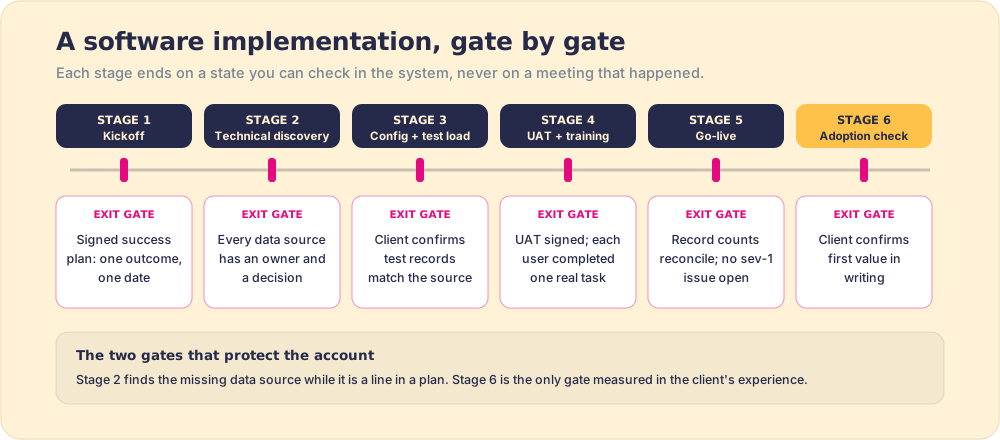
Two gates do most of the protecting. Stage 2 is where a data source the sale never mentioned turns up, and finding it there costs a conversation, while finding it at go-live costs the timeline. Stage 6 is the one most implementation teams skip, because the project closed at go-live and the team has moved on; it is also the only gate measured in the client’s experience rather than the vendor’s. Writing exit criteria that hold up is its own skill, worked through in the client onboarding process post, and the general, engagement-agnostic version of this list is the client onboarding checklist.
The checklist does not escape the problem the rest of this post describes. An implementation checklist run from memory on the twelfth project of the quarter drifts like any other standard, which is why the same move applies: put the next gate in front of the person at the moment they reach it, and track per account which gates closed.
Who owns each phase of client onboarding?
Titles vary by firm; the assignment rule does not. Every phase gets exactly one accountable owner, and every exchange between owners gets written down.
- Kickoff: sales plus the onboarding lead, jointly, for one meeting only. Sales delivers context and exits.
- Requirements: the onboarding lead. One person owns the record of what success means.
- Implementation: the implementation team, with the onboarding lead still accountable for the account.
- Training: the CSM or a dedicated trainer, because the person teaching the client should be a person the client will keep.
- Handoff: the CSM, receiving a documented history rather than a calendar invite.
The rule sounds bureaucratic and is the opposite. Shared ownership is how a step becomes optional: when the exchange belongs to both runners at once, each assumes the other has the baton.
What metrics should client onboarding track?
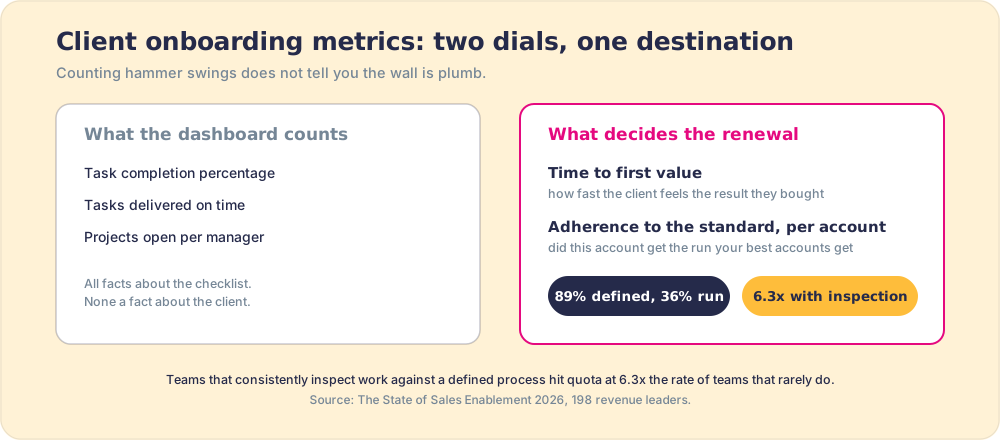
Start with the metric to retire. Task-completion percentage is the default dial on every onboarding dashboard, and it measures the checklist rather than the client. A board can read 100 percent complete while the kickoff skipped the discovery questions and the training session was a recording the client never opened. Counting completed tasks is counting hammer swings. It tells you the crew was busy. It does not tell you the wall is plumb, and the client renews on the wall.
Two metrics deserve the attention instead. The first is time to first value: the days between signature and the client feeling the result they bought. It predicts renewal because it is measured in the client’s experience. The second is adherence to the standard, per account: did this account receive the run your best accounts get, phase by phase, and where did it drift while the drift was still cheap to fix. Adherence is the leading indicator; time to first value is the outcome it produces.
The field data on inspection makes the case bluntly. In the same State of Sales Enablement survey, teams that consistently inspect work against a defined process hit quota at 6.3 times the rate of teams that rarely do. That number comes from sales teams, and the mechanism it captures, a standard is only real to the degree someone checks it, applies to any team running a repeated process across accounts.
Why do client onboarding processes fail?
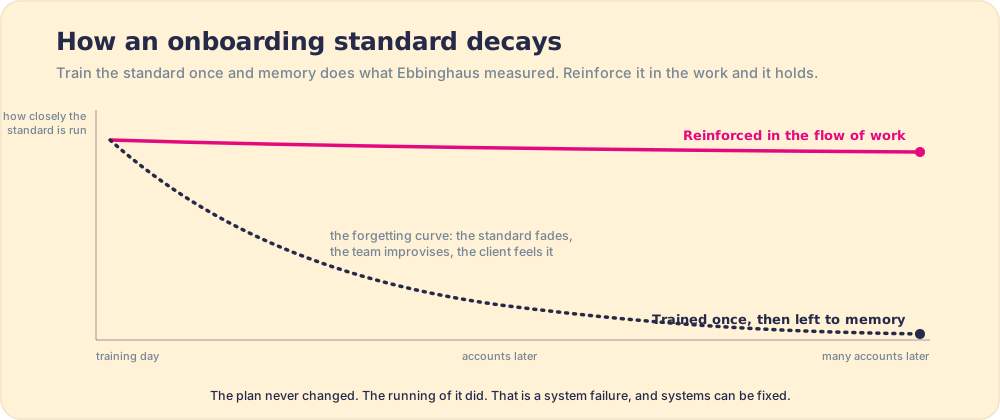
Almost never for lack of a document. The 89-versus-36 gap is a 53-point canyon between defined and followed, and the mechanism that digs it has been measured for 140 years. In the 1880s Hermann Ebbinghaus tested his own memory and found that without reinforcement, most of what we learn fades within days, the curve now called the forgetting curve, and one that researchers replicated as recently as 2015. Train the onboarding standard at an all-hands, and Ebbinghaus starts collecting immediately. By the fifth account after the training, the steps that made the last onboarding excellent are half-remembered, and the team improvises.
A standard behaves like a footpath across a field. Walked daily, it stays bare and obvious, and even a new hire can follow it without a map. Left unwalked for a season, the grass closes over it, and every crossing becomes a fresh act of navigation. Each person’s route drifts a little from the last, no single walker chose to abandon the path, and yet six months on, no path exists. The plan never changed. The walking of it did.
Name the usual failure modes and each one traces back to that decay or to friction in the system:
- The heroic-owner pattern. One senior person runs flawless onboardings from memory while the rest of the team approximates, so quality tracks staffing instead of process.
- The stale template. The engagement evolved, the client onboarding template did not, and the team learned to ignore the parts that no longer fit, then generalized the ignoring.
- The compressed back half. Implementation overruns, so training and handoff get squeezed, which trades the phases that protect the renewal for the phase that was already safest.
- The invisible drift. Adherence per account goes unmeasured, so the first person to notice the process was skipped is the client.
Note what is absent from that list: lazy people. When a team stops following a process, the cause is friction, late delivery of the next step, or missing measurement. The fix is always to the system. Blaming the team fixes nothing and teaches people to hide the drift.
How do you systematize client onboarding?
Three moves, in order, and the order matters because each one is worthless without the one before it.
Move one: write the standard once. A client onboarding checklist for the steps, a template for the reusable structure, owners named per phase. Capture how your best onboarding runs today, because the winning motion already exists inside your team; the job is to spread that motion rather than import a template the team never believed in.
Move two: deliver each step in the flow of work. The standard has to reach the person at the moment they are doing the step, inside the tools where the account already lives, because a process that requires a trip to another tab loses to the improvised version every time. Move two answers the forgetting curve directly: Ebbinghaus’s cure was spaced reinforcement, and surfacing the next step during the work is reinforcement on exactly the schedule the work demands.
Move three: measure adherence per account. Watch whether each account got the standard run and where it drifted, so a manager sees the slip in week two instead of hearing about it in the renewal call. Supered sits here. It is the Business Logic Layer for teams that run accounts through a process, surfacing the next onboarding step in the flow of work, inside the tools the team already uses, and measuring adherence account by account, so the hundredth client gets the run the first one got.
What does a client onboarding stack include?
Less than the category pages suggest, and the right buy depends on which half of onboarding is failing. Four kinds of tool show up in a client onboarding stack, and we compare the products in each in our guide to client onboarding software:
- Project and portal tools. Rocketlane, GUIDEcx, and general project tools such as Asana hold the plan, the task list, and a client-facing view of progress.
- The CRM. HubSpot or Salesforce holds the account, the deal history, and the handoff notes, and it is where the team already works.
- Product-tour tools. Appcues and Userpilot run user onboarding inside a product. Useful, and a different job from bringing an account live.
- A run layer. The piece a plan-plus-CRM stack lacks: something that delivers the next step to the person doing it and measures, account by account, whether the standard happened. Supered does this inside HubSpot and Salesforce.
The first two store the plan well. Neither tells you whether the hundredth account got the run the first one got, which is the test our software comparison measures every option against.
A quick recap
- The definition. Client onboarding is a services firm bringing a whole account live across roughly 90 days: kickoff, requirements, implementation, training, handoff. A different job from user onboarding, which tours one end-user through a product.
- The stakes. Five points of retention moves profit 25 to 95 percent (Reichheld, Bain), and retention is set in the opening stretch, where the client sees your run rather than your document.
- The failure mechanism. Standards decay on the schedule Ebbinghaus measured, which is how 89 percent of teams end up with a defined process and only 36 percent see it followed.
- The metrics. Time to first value and adherence to the standard per account. Task-completion percentage measures the checklist.
- The fix. Write the standard once, deliver each step in the flow of work, measure adherence per account. Inspection-consistent teams hit their number at 6.3x the rate.
What we recommend
Take stock of which half you are missing, because the two halves call for different work. If no written standard exists, write one this week from your best recent onboarding, and resist the urge to buy anything until it is on paper; the documents are the cheap, fast half, and our posts on the checklist and template will get you there in an afternoon.
If the standard exists and the runs still vary account to account, more documentation is the one investment guaranteed to change nothing, because the binding constraint is behavioral and the forgetting curve does not read memos. The teams that win the renewal are the ones where the standard reaches each person mid-work and someone can see, per account, whether it ran. The data through this post points one direction: defined-versus-followed is a 53-point gap, and inspection-consistent teams perform at 6.3x. Close the delivery gap and the measurement gap, in that order, and the first 90 days start working for you instead of against you. If that second half is the one you are missing, book a demo and we will show you what adherence per account looks like in practice.
Frequently asked questions
What is client onboarding?+
How long should client onboarding take?+
Who should own client onboarding?+
What is the difference between client onboarding and customer onboarding?+
What should a customer onboarding checklist include for a software implementation?+
What tools does a client onboarding team need?+
What metrics should client onboarding track?+
Your process, running itself.