Starting a Consulting Business With No Experience and Nothing to Lose: Stephen Dodd's Story
Navy flight deck, eight years in a kitchen, a COVID layoff, then a mortgage-industry layoff. Stephen Dodd on starting a consulting business with no experience when you doubt you are smart enough, why he was already selling, and why he stopped doing favors.
Starting a consulting business with no experience can work if you already have a skill someone pays for: Stephen Dodd had never consulted when he launched We Go ESS, and his first clients came from HubSpot work he had done as an in-house admin.
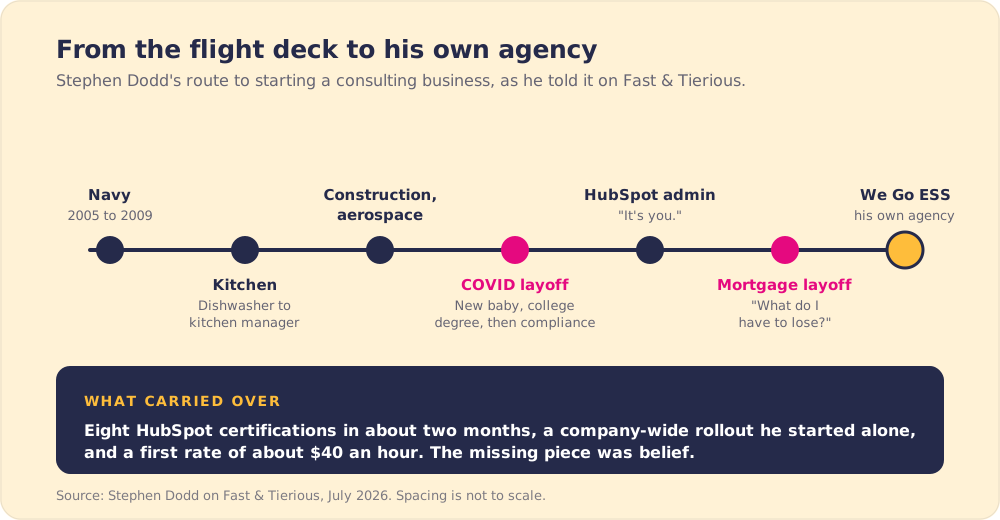
Stephen Dodd graduated from high school and left for the Navy less than a month later. He spent four years on an aircraft flight deck, came home in 2009, and took the only job on offer: dishwasher. He worked up to line cook and ran a restaurant kitchen for eight years, then did construction, then built compressors at an aerospace company until COVID took that job, right after he finished college and right after his baby was born. He had no plan for starting a consulting business, and no experience that looked like consulting. He runs one now: We Go ESS (Elevated Sprocket Solutions), a HubSpot agency that reached Gold this year.
Stephen told me the whole story when he came on Fast & Tierious, and he was frank about the parts that scared him. If you are good at a piece of software and wondering whether anyone would pay you for it, he has three things to tell you. He waited too long to believe he could do it. He was already selling before he admitted it. And he has stopped doing favors.
Why did Stephen think he wasn’t smart enough?
After the COVID layoff, a mortgage company hired him into its legal department to do compliance. A year and a half later someone at a second mortgage firm asked, “Hey, do you want to manage our CRM?” His job was compliance, and he had never run a CRM. He said yes anyway. A month into the job the company decided to move to HubSpot, a product he says he had never heard of, and he asked who else was on the team. “No,” they told him. “It’s you.”
So he went to HubSpot Academy and earned eight certifications in about two months. He moved sales onto HubSpot, then marketing, then operations, then a robotics team. The company gave him two people to help. That was his whole HubSpot education: a deadline, a free course library, and no teammate to ask.
When he talks about that stretch, he talks about doubt more than software: “I’ve always loved tech, but I never thought I was smart enough.” Even after the Navy, he said, “I still doubted myself.” What changed him was proof: “I’ve proven it to myself. I thought I couldn’t. Somebody gave me a chance.”
Albert Bandura, the Stanford psychologist, studied where that kind of belief comes from. His work on self-efficacy found that things you have done yourself are the most dependable source of confidence for the next task, stronger than encouragement or watching someone else (Bandura, Psychological Review, 1977). Stephen had rolled HubSpot out across a whole company, starting alone. He still did not go out on his own until someone laid him off.
The layoff came in the 2022 to 2024 rate swing, when his side of the mortgage industry was cut. “What do I have to lose?” he asked himself. “I’m unemployed. So why not start something?” He admits he was “really really scared, really really nervous.” He had reason to be: of U.S. establishments born in 2013, 79.6% were still open a year later and 50.6% after five years (BLS Business Employment Dynamics).
The first lesson he draws is the one he wishes he had heard sooner: “I would have given myself grace earlier on. Believed in myself more.” Asked what that means in practice, he said it means “taking a chance and a risk” and “not allowing fear” to decide.
Where did the first two clients come from?
HubSearch, a recruiting agency that works with HubSpot agencies, sent Stephen his first client, then his second. He did well by them, and work started flowing both ways. Then came small jobs: “I just need this fixed or no retainers, just hourly.” He charged about $40 an hour.
He did not hold out for a better rate. After HubSearch came referrals, LinkedIn, and a partner platform he helped launch alongside about a dozen other consultants. His summary of the growth: “baby steps.”
If you know one platform well, the recruiters, agencies and vendor teams around it already need extra hands, and they are easier to reach than strangers. Stephen did not buy ads or build a funnel in his first year. He took the jobs the HubSpot recruiters and agencies sent him and did them well enough to get the next one.
Were you already selling without knowing it?
For years Stephen stayed out of HubSpot’s paid partner program. He gave two reasons. The first was money: “the obstacle was definitely I didn’t want to pay.” The second was a picture in his head: “Partners are like these huge agencies. That’s what I thought of them.” He was one person doing hands-on work. “I’m not really selling anything,” he told himself.
Partway through our conversation he stopped and corrected himself: “as a provider, I’ve been selling without me even knowing it, like a subscription or an upgrade.” When he told a client that the workflow they wanted needed a higher HubSpot edition, the client bought it. I told him he had probably made another partner money over the years on deals someone else got credit for. “Absolutely,” he said.
The economist Richard Thaler wrote about this habit in 1980. People weigh money they pay out of pocket more heavily than money they fail to collect, even when the amounts match (Thaler, Journal of Economic Behavior and Organization, 1980). Stephen could see the partner fee on his statement every month. He never saw a line for the upgrades his clients bought on his advice.
When he did join, he changed how he handled those recommendations. He did not get pushier about it.
- A covered seat. HubSpot now charges for seats. Stephen tells clients he takes the admin seat on himself as their partner, and “they kind of perk up a little bit.”
- A written upgrade case. When a client needs a higher edition, he writes why into the proposal. A HubSpot rep read one and told him it took “a lot of legwork off of her.” The client “signed in 5 minutes.”
- His own portal at work. He bought Marketing Hub for We Go ESS so the fee washed out, and started using his own CRM to generate leads for the first time.
“Do what’s right for your client,” he said. “You don’t have to pressure.” His wife’s line on the revenue share is the one he repeats: “it’s free money, but it’s not free money.”
What does a free favor cost a new consultant?
When I asked Stephen what he would never do again, he answered in one word: “Favors.”
It starts with a client asking, “can you do this for a friend of mine?” The friend doesn’t have the money right now. You are still establishing yourself, so you say sure, and the ask sounds tiny: “build an email or something.” Then, Stephen said, “it turns out to be a bigger thing than that,” and “you’re kind of like feel locked in and obligated because you don’t want to burn the bridge.”
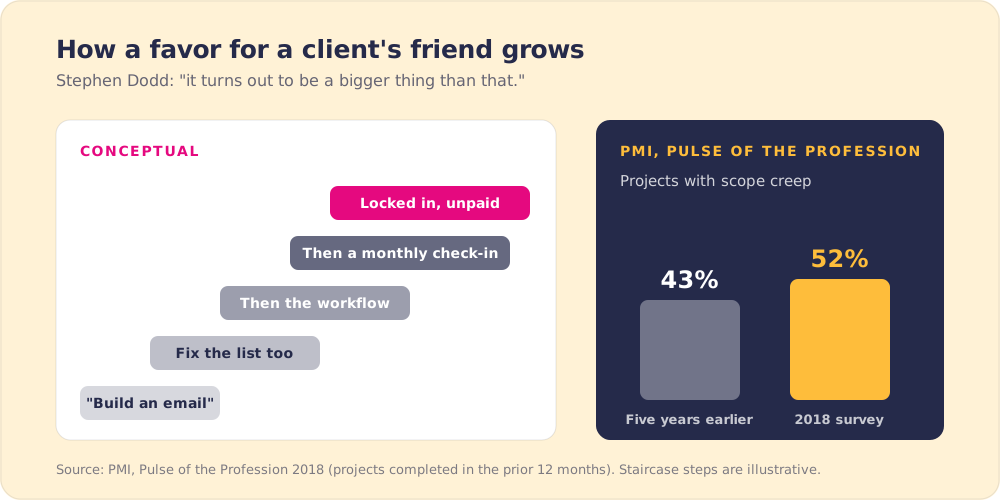
Project managers see the same drift on paid work. PMI’s 2018 Pulse of the Profession found 52% of projects completed in the prior 12 months experienced scope creep or uncontrolled changes, up from 43% five years before (PMI, 2018). Those projects had written charters. Stephen’s favors had nothing written down, so neither side could say when the job was done.
Stephen’s rule now is short: “Don’t do things for free.” He allows that a new consultant might do one or two favors while figuring out whether he has something to offer. After that, my suggestion on the call was to tell the friend you would love to help, and then “let’s have a discussion on something called the cost.” Naming a price makes both of you say what the job is, and that gives the work an end.
Stephen Dodd’s lessons for starting a consulting business
- Earlier grace. Stephen had run a company-wide rollout before he believed he could consult. Write down what you have already done and decide from that list.
- Clients from the platform’s circle. His first two clients came from a HubSpot recruiter, the next from referrals and LinkedIn. Start with the people who already hire for your platform.
- Paid small jobs. Hourly fixes at about $40 an hour got him references for bigger work.
- Counted recommendations. He had been telling clients which edition to buy for years. Now he writes the reason into the proposal and gets credit for it.
- Priced favors. Quote the small ask before you start it, so both sides know where it ends.
Where do you begin when starting a consulting business with no experience?
Stephen had never billed a client when he started. He had moved a whole company onto HubSpot by himself, sales first, then marketing, operations and a robotics team, and earned eight certifications doing it. None of that was called consulting at the time. It was still the proof he needed that he could do the same work for someone else, and it took a layoff before he treated it that way.
If you are an in-house admin thinking about going out on your own, we would follow Stephen’s order and skip his delay. Write down the rollouts you have already run. Stephen’s company-wide HubSpot move was a strong first pitch for years before he used it. Find the recruiters and agencies around your platform before you spend on marketing. Price the first small job, and every one after it. Once clients start buying on your advice, join the vendor’s program so that advice shows up in your revenue.
Stephen’s one-year goal is a small team and more time with his family, while he stays “a nitty-gritty guy” in the work. Hiring means writing down how he does things so someone else can do them too. Our HubSpot implementation playbook covers how to package it, the client onboarding process post covers how to design the first 90 days backward from renewal, and Supered’s page for HubSpot partners shows how we help partners productize that service.
Frequently asked questions
How do you get your first clients when starting a consulting business with no experience?+
Can you start a consulting business with no experience?+
How do consultants avoid scope creep?+
Is it worth paying to join a software vendor's partner program as a solo consultant?+
What should a solo consultant aim for in year two?+
Your process, running itself.
Turn the playbook into rep behavior.
More from Fast & Tierious

Agency Referral Program: How Rebecca Gonzalez Rebuilt Orange Marketing After Her One Source Dried Up
Rebecca Gonzalez
How to Scale a Marketing Agency: Caleb Phillips on Time, Money, Capacity and the $1M Wall
Caleb Phillips