Sales and Marketing Conflict: What Sara Hanlon Learned From Both Sides
Sara Hanlon started in cold calling, ran sales and marketing as a CRO before the title was common, and built Peer Sales Agency to be the marketing team salespeople love. Her lessons on sales and marketing conflict, free-rein projects, and working backward from wins.
Sales and marketing conflict is the friction between two teams that share one revenue goal but plan, measure and run their work separately, and Sara Hanlon's view is that it ends when both run one model built from the wins.
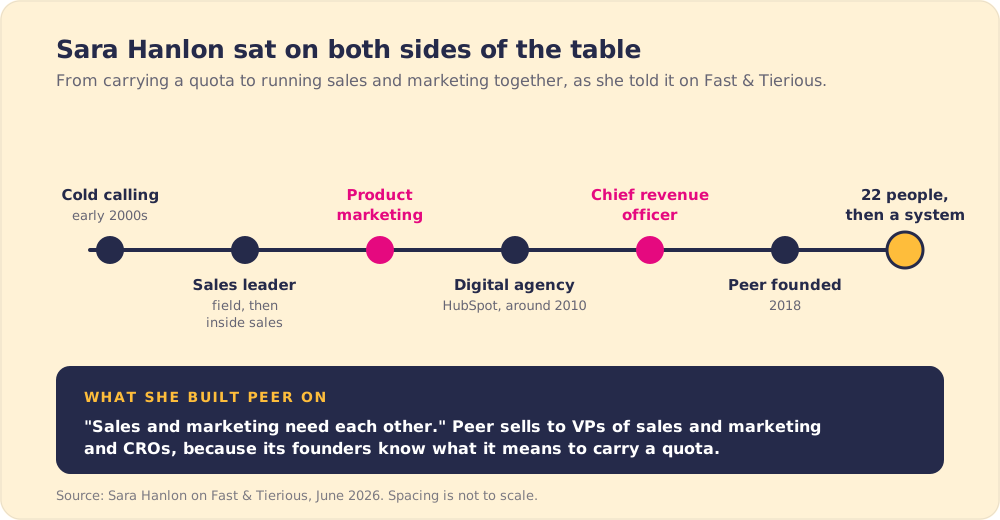
Sara Hanlon started her career “smiling and dialing.” In the early 2000s, she said, “we used TeleMagic as our CRM,” and the job fit in one line: “Get a list, hammer the phone, get people to buy from you. That was me.” She went on to lead a sales team, then an inside sales team, then moved over to product marketing. Years later a company asked which title she wanted, CMO or chief sales officer. “And I was like no, I want chief revenue officer.” She had worked on both sides of the sales and marketing conflict by then, and she wanted to run the two teams as one.
She told me the rest of the story on our Fast & Tierious interview. Sara is co-founder and CEO of Peer Sales Agency in Omaha, a HubSpot partner that describes itself as the marketing team salespeople love. Three things she learned apply well beyond agencies: the two teams need one goal, letting each team work its own way made her company unprofitable, and the fix came from studying her best client wins.
Why do sales and marketing need each other?
As a CRO, Sara brought HubSpot into her company and wrote the manual as she went: “here’s how you set this up,” how to get sales running on it, how to get marketing running on it, and “Here’s how you bring the two together.” Then she thought, “I should do this. Like we should build an agency around this.” Peer started in 2018 and went all in on HubSpot in 2021 or 2022.
Peer sells to the people Sara used to be. “Sales and marketing need each other,” she said. The agency targets VPs of sales and marketing, CROs and chief sales officers, “because we understand what it means to carry a quota.” Many of its clients are mid-size manufacturers and professional services firms run by salespeople. They “saw marketing as a thing that maybe they should be doing to grow,” Sara said, but in “a very intermittent situation.” Marketing got a call when a trade show was coming up: “I need new banners.” I added the other request those teams make: “Where’s my trade show list?”
Harvard Business Review covered the older explanations for the feud. Philip Kotler, Neil Rackham and Suj Krishnaswamy named two causes: money, since both teams fight over one budget, and culture, since the two functions attract different people and measure success differently. They also wrote down the blame loop word for word: “When sales are disappointing, Marketing blames the sales force for its poor execution of an otherwise brilliant rollout plan” (Kotler, Rackham and Krishnaswamy, HBR, 2006).
Sara’s clients add a third cause. When marketing only works on request, for banners and a list before a show, it never sets goals alongside sales. At the end of the year neither team can show what the other contributed, and each blames the other for the gap.
Why did 22 people make Peer less profitable?
Sara learned her next lesson inside her own agency. “It’s one thing to just hire people and just throw bodies at a problem,” she said. By the end of 2023, “we had 22 people on staff, full-time employees on staff. And we were not profitable.”
Peer had a clear process for what clients saw, stage by stage. Behind it, each team could “run their projects the way they wanted to run them,” picking from 10 to 15 tactics for any one client outcome, with its own tools and its own cadence. Crystal Mackling, now Sara’s business partner and in Sara’s words a whiz at operations, pushed back: “we need to put a system in place. Like we need to systematize this.”
Each new expert Peer hired brought a personal way of working. Payroll went up and the results for clients stayed uneven. Sara sees the same thing in her clients’ revenue teams. Marketing picks its tactics, sales picks its own, and no one is in charge of the point where a lead passes from one team to the other.
The lead handoff is where the damage is easiest to measure. James Oldroyd, Kristina McElheran and David Elkington audited 2,241 US companies in 2011 and found 37% answered an inbound web lead within an hour, 24% took more than 24 hours, and 23% never responded. Firms that answered within an hour were nearly seven times as likely to qualify the lead as firms that waited even one hour longer (Oldroyd, McElheran and Elkington, HBR, 2011). In our own survey, 16% of respondents named handoffs as the phase where deals break down most often (The State of Sales Enablement 2026).
How do you end sales and marketing conflict?
Peer’s rebuild took months. When I asked her to boil it down, Sara said: “we looked at our best use case, our best case studies.” Then: “Let’s reverse engineer what worked for them.” Peer had one advantage. “We are really good at time tracking,” she said, so the team could see “how much this thing cost us to deliver.” The best results, the tactics behind them and the cost of each went into one model.
Then Peer rebuilt the company around that model. Sara listed the questions they worked through: “what are we really, really good at, and how do we systematize the offering around what we’re really, really good at?” “What’s our discovery process to sell it?” What does onboarding look like, and what meeting cadence gets clients results? “It’s an overhaul,” she said. Peer also narrowed its focus to professional services and manufacturing, the clients who had stayed longest and done best.
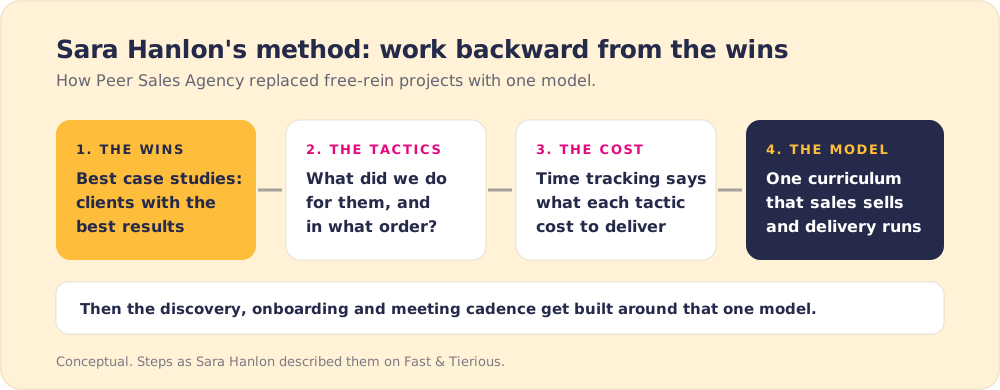
Her method helps with the conflict because both teams start from the same list of closed deals and happy clients. A marketer and a salesperson can argue for an hour about which tactics matter. It is harder to argue with a written record of what worked on the ten best accounts and what it cost. Gartner’s research on marketing leaders shows what happens without that shared starting point: 84% of CMOs reported high strategic dysfunction, meaning confusion and conflict from objectives that were unclear, too many, or at odds, and those organizations were 36% less likely to report strong performance (Gartner, 2025).
The change paid off at Peer. “We’re very profitable now and have been since we made that change,” Sara said.

What does a partnership need to survive?
Sara’s second hard moment was personal. “I bought out my business partner,” she said, the co-founder she started with in 2018. She chose her words with care. Agency work “is an up-and-down business,” she said, and it takes passion to keep going. She was clear it was no knock on her former partner. “It’s just a matter of aligning on where are we going, and are we both in that spot?” Since the buyout she is “re-energized about where we’re headed.”
She did not go it alone. Crystal, at Peer from nearly the beginning, became her business partner. “I’m not sure I’m a solo founder kind of girl,” Sara said. I am not a solo founder either, and I told her the lesson I took from RevPartners: co-founding is worth it, and “You need prenups.”
Her next moves bring in more outside help. “I hired a woman who was at an elite agency,” Sara said, to bring that experience in-house. She is also leaning on other HubSpot partners who do work Peer does not, and asking them: “How can you help me serve my client? How can we all win?”
Sara Hanlon’s lessons on sales and marketing conflict
- A single number for both teams. Sales and marketing need each other. A leader over both, or an agency that thinks like one, keeps them working toward the same target.
- Marketing on a steady cadence. A marketing team called in for trade-show banners never plans with sales. Regular work tied to the sales goal replaces the on-and-off pattern.
- One delivery model. Ten to 15 tactics per outcome, chosen team by team, drove Peer’s costs up at 22 people. A single model built from the best clients made it profitable.
- The best wins as the starting point. Reverse engineer the best case studies, then price each tactic with time tracking.
- Partners who want the same future. Sara’s test for a co-founder or a partner agency is whether you both agree on where the company is going.
What would Sara do sooner?
“I wish I would have operationalized that better,” Sara said. She would have stopped “continuing to just hire more people to solve a problem,” tracked what worked for the best clients, and built from there. She knows why it waited. A young agency needs revenue before it can be choosy. I put that stage bluntly on the call: “you need to go be a mosquito and suck everyone’s blood to live,” until you learn what you are good at and who you like serving. Then you systematize. “I just wish we had done it sooner,” she said.
Our recommendation follows hers. If your sales and marketing teams are fighting, stop adding people or tactics and pull up your last ten wins. Write down what both teams did on those deals, what it cost, and in what order. Make that the process both teams run, and have a manager check the handoff on each new lead. Our post on sales and marketing alignment covers the signs that show whether it is working, and lead qualification covers the handoff itself. Sara’s agency builds models like this for clients as a HubSpot partner; see how Supered works with HubSpot partners to put that kind of model in front of reps inside the CRM.
Frequently asked questions
What causes sales and marketing conflict?+
How do you fix sales and marketing conflict?+
Where does sales and marketing conflict do the most damage?+
Why did Sara Hanlon's agency become unprofitable at 22 people?+
Who should lead sales and marketing together?+
Your process, running itself.
Turn the playbook into rep behavior.
More from Fast & Tierious

Productized Services: How Andrew Logan Grew Floww Digital 240% in a Year
Andrew Logan
What Will Andrew Learned From 1,000 Picnics About Fixing an Owner-Dependent Business Before a Sale
Will Andrew