Quota Attainment: The Number Lives in Your Median Rep, Not Your Stars
When quota attainment falls, the reflex is to raise the target, add pipeline, or hire better reps. Attainment is a distribution problem, and the upside is in the wide middle of the team, not the few stars at the top.
Quota attainment is the share of reps hitting their sales target, and it is governed by the distribution of rep performance rather than the target itself, so the largest gains come from lifting the wide middle of the team, not from raising quotas or copying the few top reps.
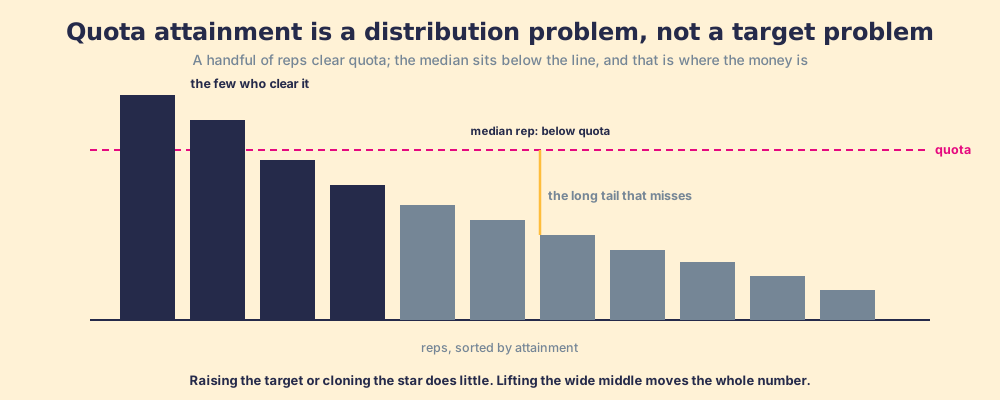
When quota attainment slips, three reflexes fire in order: raise the number, pour in more pipeline, hire better reps. All three target the edges of the problem and miss its center. Quota attainment is not a single number you can push on directly; it is the visible result of a distribution, the spread of performance across your whole team. A few reps clear quota comfortably, a long tail sits below it, and the median rep, the one in the middle, is often under target. That median rep, multiplied across the team, is where the number truly lives. Raise the target and you move the line everyone is measured against without moving a single rep toward it. The upside was never at the top of the team or in the target. It is in the wide middle.
Quota attainment is the share of reps hitting their sales target, and it is governed by the distribution of rep performance rather than the target itself, so the largest gains come from lifting the wide middle of the team, not from raising quotas or copying the few top performers. See it as a distribution, and the right lever becomes obvious.
Why is quota attainment falling?
Because the spread between the few who consistently run the winning behaviors and the many who do not is widening, and that pulls the median down. Across the industry, the share of reps hitting quota has been sliding for years. Salesforce’s State of Sales research has put the figure at roughly 28 percent of reps expected to miss quota, and other trackers put the share making target at well under half on many teams (Salesforce, State of Sales). The easy explanations, targets too high, reps too weak, are mostly wrong, because they describe the edges. The real story is in the shape of the curve. A small group of reps reliably qualifies hard, multi-threads, and follows through, and clears quota. A large group knows to do those things and does them inconsistently, and lands below the line. As deals get more complex, with the bigger buying groups described in the B2B sales process, the cost of that inconsistency rises, and the median rep falls further behind.
It helps to see why a distribution behaves this way, because the instinct to fixate on the top of the team is a statistical mistake before it is a managerial one. Sales attainment is a long-tailed distribution: a few reps far above the line, a long body of reps clustered below it. When you average a distribution shaped like that, the mean is dragged upward by the stars and tells you almost nothing about where the bulk of your team sits. The median, the rep in the exact middle, is the honest summary, and on most teams the median rep is under quota. That single fact reframes the whole problem. The company’s number is not the average rep’s performance times headcount. It is the sum of the whole curve, and the curve has far more mass in its sagging middle than in its bright tail.
This is the same root cause as the knowing-doing gap: the median rep is not short on knowledge, but short on consistent execution of what they already know. Attainment falls not because the team forgot how to sell, but because the winning behaviors are run unevenly across the distribution, and the unevenness shows up as a sagging middle.
Why do raising the quota and cloning the star fail?
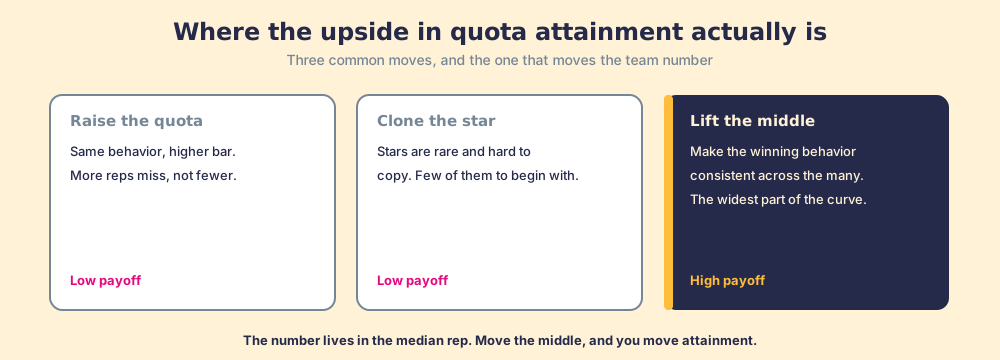
Because both act on the thin parts of the distribution and leave the thick part untouched. Raising the quota changes the bar without changing any rep’s behavior, so the only result is that more reps miss a higher line. Cloning the top performer is the more seductive mistake: study the star, bottle what they do, spread it. But stars are statistically rare and notoriously hard to replicate, so even a successful cloning program moves a handful of people. The arithmetic is small because the population is small.
The median rep is where the arithmetic gets large. The middle of the distribution holds most of your team, and moving each of those reps a modest amount, by making the standard winning behaviors consistent, sums to a far bigger gain than manufacturing a few more stars. This is the well-known payoff of the B-player (Delong and Vijayaraghavan, in Harvard Business Review): the largest pool of improvable performance is not at the top, it is in the broad middle that already sits close to quota and needs only to run the right behaviors reliably.
- Raising the quota: low payoff. Same behavior, higher bar, so more reps miss. The target moved; the team did not.
- Cloning the star: low payoff. Stars are rare and hard to copy, so the gain is a few people at most.
- Lifting the middle: high payoff. Make the winning behavior consistent across the many, the widest part of the curve, and the whole number moves.
How do you lift the middle of the distribution?
Make the winning behaviors consistent for the reps who already know them. The median rep does not need more training; they need the standard run on each deal to become the default rather than the exception. That means naming the specific behaviors that separate the reps who clear quota, surfacing them in the flow of work so the median rep does them in the moment, and measuring whether they happened, so inconsistency becomes visible and coachable. This is the loop in sales performance management and sales process adoption, applied where it pays most: the wide middle of the team. You are not trying to create stars. You are trying to make the median rep run the star’s behaviors consistently, which moves a large number of people a meaningful amount, and that is what lifts attainment.
Why does moving the middle beat moving the stars, in the arithmetic?
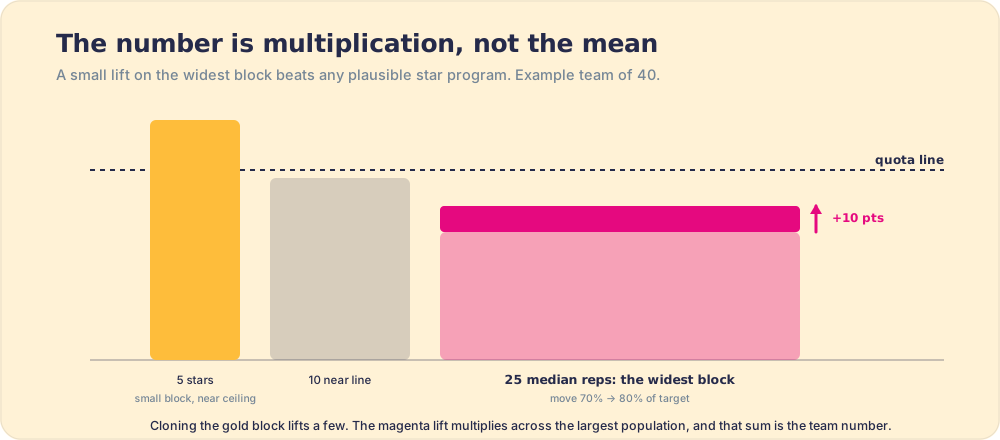
The case for the median rep is not sentiment about fairness to the middle of the team. It is multiplication. Work a rough example. Say a team of forty reps has five stars well over quota, ten reps near the line, and twenty-five in a broad middle running at roughly 70 percent of target, with a tail of stragglers below them. The two instinctive moves barely touch the team number. Cloning a star, even if it worked, lifts a handful of people from an already small group, so the gain is small because the population is small. Squeezing more out of the existing stars runs into a ceiling, because they are near their own limit. Now move the twenty-five middle reps from 70 percent to 80 percent of target. That is a 10-point lift, applied to the single largest block of the team, and it adds more absolute revenue than any plausible star program, because the gain is a modest per-rep improvement multiplied by the widest part of the curve. To improve quota attainment, you do not need a few reps to get dramatically better. You need the many to get a little better and stay there.
This is why the percent of reps hitting quota responds to the median and ignores the target. The target sets where the line is drawn. The distribution decides how many reps clear it. Raising the line moves zero reps across; lifting the body of the distribution moves a crowd across at once. Sales quota attainment is a counting problem on a distribution, and the only lever that touches the count is the one that lifts the part of the curve where most reps stand.
What we recommend
Read quota attainment as a distribution, because that is what it is, and the reading tells you where to push. The instinct to raise the target, add pipeline, or clone the top rep all act on the edges, the target line and the thin tails, and leave the median rep, where most of your team and most of your upside sit, exactly where they were. Attainment falls because the winning behaviors are run inconsistently across the middle of the distribution, and it rises when you make those behaviors consistent there. So name the behaviors that separate the reps who clear quota, equip them in the flow of work for the median rep, and measure whether they happen. You will not get there by setting a higher bar or hoping for more stars. You get there by moving the middle, because the team number is a sum across the curve, and the curve is widest where it matters most.
From here: the consistency problem underneath in the knowing-doing gap, the adherence that lifts the middle in sales process adoption, the management loop in sales performance management, and the wider frame in the sales execution gap.
Frequently asked questions
What is quota attainment?+
Why is quota attainment declining?+
How do you improve quota attainment?+
Why does cloning your top rep not work?+
Your process, running itself.