Sales Contest Ideas: Run Them Wrong and They Drain the Motivation They Borrow
Sales contest ideas are easy to find and easy to get wrong.
The behavioral science says a badly designed contest can leave reps less motivated than before. Here is how to design one that adds energy.
Sales contest ideas are formats for short-term incentives that energize a sales team, and the effective ones reward a behavior worth building and support reps' autonomy and mastery, because a contest tied to a gameable metric can crowd out the motivation it meant to add.
Sales contest ideas are the easiest thing in sales management to generate and one of the easiest to get wrong. Spin a wheel, run a leaderboard, dangle a trip, and the energy in the room goes up for a week. The trouble is what the behavioral science says happens underneath, and over the longer run: a contest designed the usual way, a prize for the rep with the biggest number, can leave a team less motivated than before it started. The prize can do worse than fail; it can drain the drive it was borrowing. Learn the mechanism before you run the next one.
Sales contest ideas are formats for short-term incentives that energize a sales team, and the effective ones reward a behavior worth building and support reps’ autonomy and mastery, because a contest tied to a gameable metric can crowd out the intrinsic motivation it was meant to add. The design, not the prize, decides which way it goes.
Why do sales contests backfire?
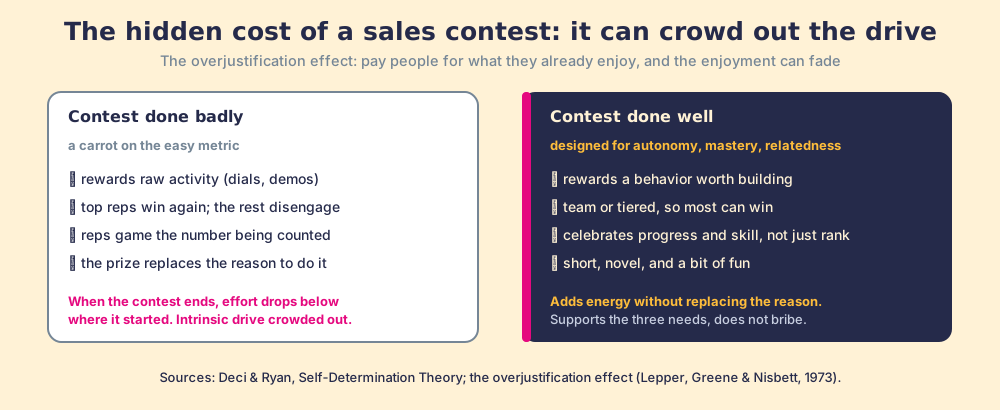
For two reasons that compound, and both have names in the research. The first is Goodhart’s Law: when a measure becomes a target, it stops being a good measure. Put a prize on dials, and reps make hollow dials; put it on demos booked, and reps book demos that should never have happened. The contest gets exactly what it counted and not what it wanted, the same trap that catches any single-metric incentive.
The second is deeper and less obvious: the overjustification effect. Psychologists Mark Lepper, David Greene, and Richard Nisbett showed in a famous 1973 experiment that children who already loved drawing drew less once they were given a reward for it, because the reward reframed the activity as something you do for the prize rather than for itself (Lepper, Greene & Nisbett, 1973). The external motivator crowded out the internal one. Attach a contest to work a rep already found meaningful, and you risk the same swap: the prize becomes the reason, and when the prize is gone, the reason is too, so effort settles below where it began. A winner-takes-all contest on a vanity metric triggers both failures at once.
Why does the standard contest only motivate the reps who were already winning?
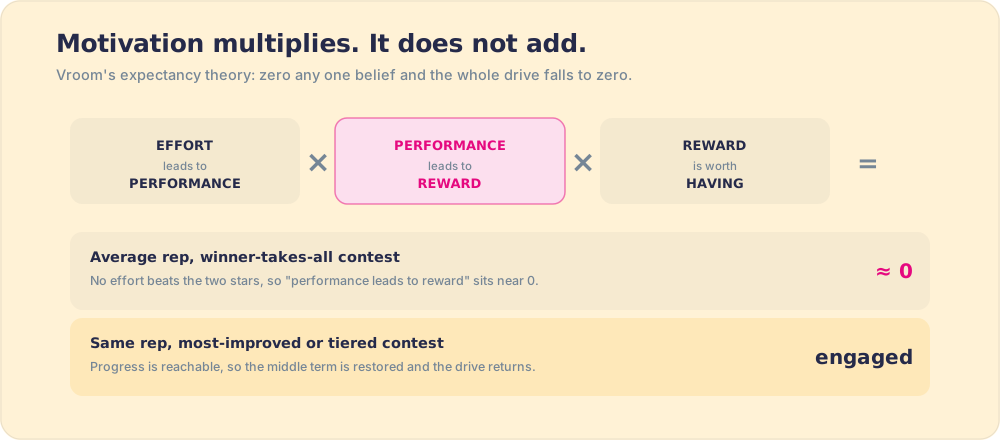
There is a third failure, less obvious than the other two, and it does more damage than either over a year. A winner-takes-all contest on raw output is a contest the top reps were always going to win, and the rest of the floor can see it on day one. The middle and bottom of the team do the math in about a minute: the trip to Cabo is going to the same two people it always goes to, so why spend any extra effort chasing a prize that is already spoken for? The contest meant to lift the whole team lifts only the two reps who were already at full throttle. The rest checked out before it began.
The behavioral economics has a name for the mechanism: expectancy theory, from Victor Vroom. Motivation to pursue a reward is the product of three beliefs, that effort will produce performance, that performance will produce the reward, and that the reward is worth having. Multiply, do not add, so if any one term is near zero the whole motivation is near zero. For the average rep in a top-heavy contest, the middle term collapses: no realistic amount of effort gets them past the two stars, so the expectancy that performance yields the reward sits near zero, and the product with it. So a most-improved or tiered format outperforms a leaderboard, and kindness has nothing to do with it. The format restores the broken term in Vroom’s equation, by making the reward genuinely reachable for the people whose effort was up for grabs. The stars were never the swing votes. The middle was, and the standard contest tells the middle not to bother.
What sales contest ideas motivate a team?
Design for what motivation science says people need. Edward Deci and Richard Ryan’s Self-Determination Theory holds that durable motivation rests on three needs: autonomy (control over how you work), mastery (getting visibly better), and relatedness (belonging to a group). The sales contest ideas for teams that work support those needs rather than overriding them.
- Team-based races. Pit small teams against each other so reps pull each other up. This serves relatedness, and it stops the contest from being a private win for the one rep who was always going to win.
- Most-improved, not most-total. Reward the biggest jump rather than the highest absolute number. This serves mastery and gives the middle of the team, where coaching pays most, a reason to engage.
- Behavior bingo. Reward running the process, discovery booked, next step set, a stuck deal revived, rather than raw output. This points the energy at the behavior you want to become a habit.
- Short and novel. Keep contests brief and varied so they stay fun and do not become an expected entitlement, which is when the overjustification trap snaps shut.
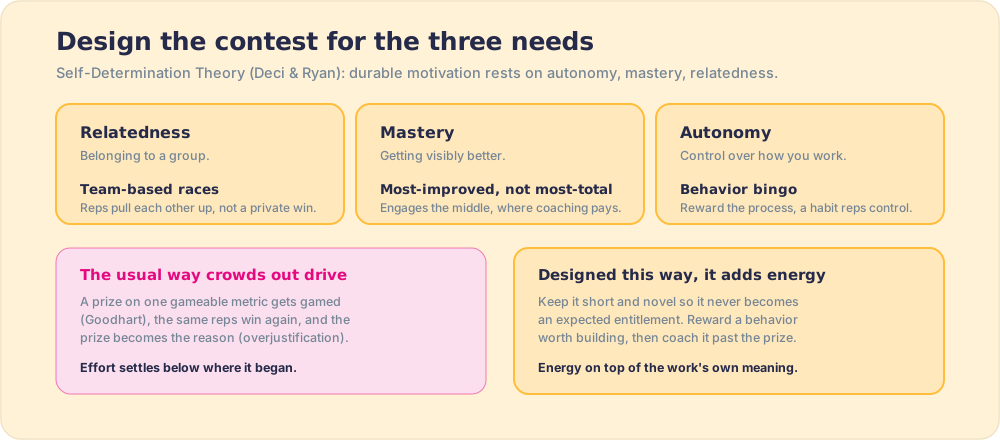
What these sales competition ideas share is that they add energy on top of the work’s own meaning instead of substituting for it. They are sales incentive ideas designed to support motivation, not to purchase it. Each one repairs a specific failure. The team-based race fixes the social-comparison damage a leaderboard does, because Deci and Ryan’s research on relatedness shows people sustain effort when they feel they belong to a group pursuing something together, and a leaderboard turns colleagues into rivals. Most-improved fixes the expectancy collapse, because progress is reachable for any rep while rank is reachable for two. Behavior bingo fixes Goodhart, because rewarding the running of the process (discovery booked, next step set) is much harder to game than rewarding a raw count, and it points the energy at the habit you want to keep after the prize is gone.
The deeper engine of lasting performance is still coaching and a process worth running, covered in the sales coaching guide; a contest is seasoning, not the meal. A contest can light a behavior on fire for a week. Only coaching and reinforcement keep it lit, which is why the most durable use of a contest is to spotlight a behavior you then make the standard, not to substitute a prize for the patient work of building a habit.
What we recommend
Run sales contests, but design them against the two failure modes the science names. Never put the prize on a single gameable metric, because Goodhart guarantees you will get the hollow version of it, and never let a standing contest become the reason reps do work they already valued, because the overjustification effect will hollow out their drive. Instead, reward a behavior worth building, structure the contest as team-based or most-improved so the whole team has a path to win, celebrate progress and mastery rather than rank alone, and keep it short and novel. A contest built this way adds a burst of energy on top of motivation that already exists. A contest built the usual way spends down that motivation for a week of noise. The prize was never the point; the behavior it leaves behind is.
From here: the lasting engine in the sales coaching guide, why single-metric targets get gamed in sales performance management, the meeting that announces it in sales meeting ideas, and the process worth rewarding in sales process adoption.
Frequently asked questions
What are good sales contest ideas?+
Do sales contests work?+
Why do sales contests sometimes backfire?+
How do you design a sales contest that motivates the whole team?+
Why does a winner-takes-all contest only motivate the top reps?+
Your process, running itself.