Outbound Sales Strategy: A Fixed Budget of Touches, Spent Where It Pays
An outbound sales strategy is a budget.
A rep has about 2,350 touches a month, so the strategy is which accounts get them, through which plays, in what order, and how you will know which plays closed.
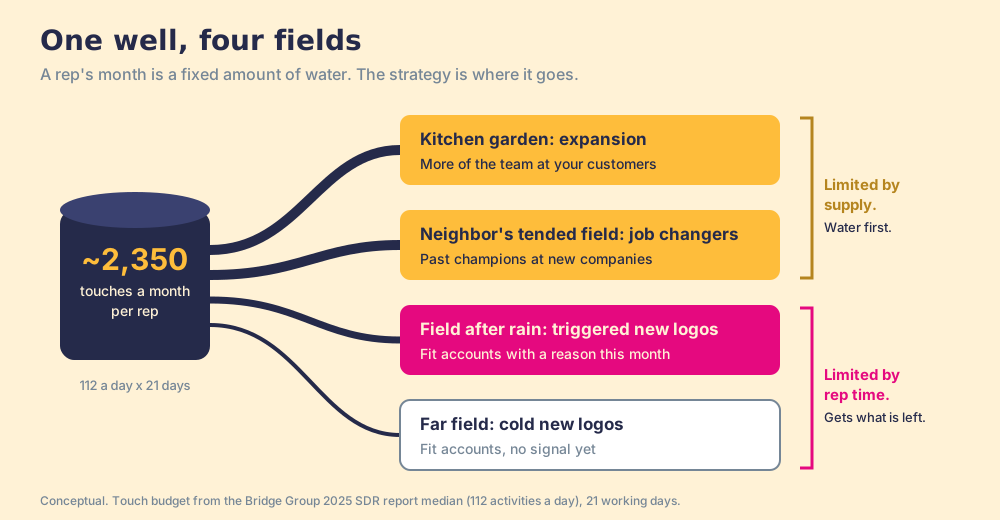
An outbound sales strategy is the plan for which accounts and people your reps contact first, through which plays and cadence, sized to the touches each rep can make in a month and measured all the way to closed.
How to build an outbound sales strategy
- 1
Count the touches each rep has
Multiply daily activities by working days to get a monthly touch budget per rep, then divide by people per account times touches per person to get how many accounts one rep can work.
- 2
Tier the ideal customer profile to fit the budget
Split target accounts into a small Tier 1 that gets research and six or more people, a signal-led Tier 2, and a light Tier 3, sized so the touches add up to the budget.
- 3
Fill the supply-limited plays first
Give touches to expansion at customers and to past champions who changed jobs before anything else, because their supply is small and their cost per dollar is lower.
- 4
Give the rest to new logos, triggered before cold
Spend the remaining touches on new-logo accounts with a reason to call this month, then on cold Tier 3 accounts.
- 5
Set a cadence per tier
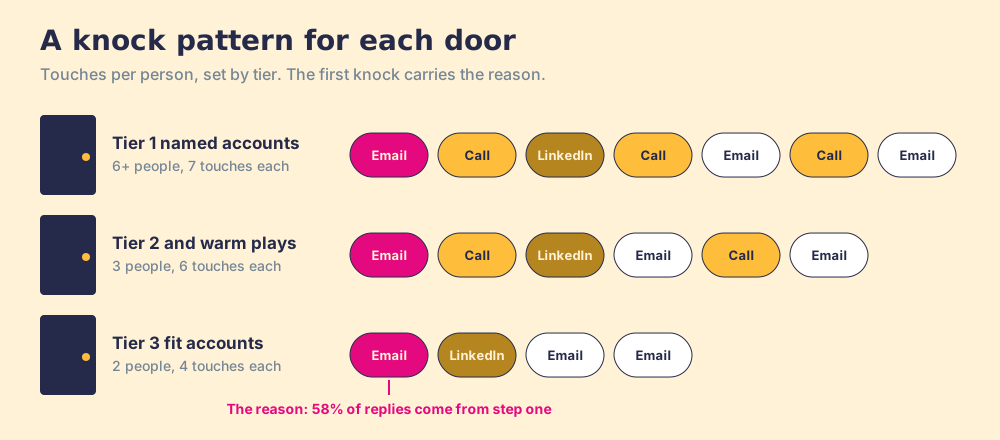
Four to seven touches per person across email, phone, and LinkedIn, more for Tier 1, with a first message that states the reason for reaching out.
- 6
Measure by play and tier to closed
Tag every contact with its play and tier and report found, worked, replied, opportunity, and closed for each, then move touches toward the plays that close.
A farmer with one well and four fields does not argue about whether to water. He argues about where. The well gives a fixed number of buckets a day, and a bucket poured on the far field is a bucket the kitchen garden did not get. A sales rep’s month works the same way. At the Bridge Group’s 2025 median of 112 activities a day, a rep has about 2,350 touches in a month, and not one more.
An outbound sales strategy is the plan for which accounts and people your reps contact first, through which plays and cadence, sized to the touches each rep can make in a month and measured all the way to closed. The guides that rank for the term list tactics: social selling, referrals, AI research, A/B testing. The tactics are fine. None of them starts from the size of the well, and the size of the well decides almost everything else.
The short version, for a sales leader building one:
- The budget. About 2,350 touches per rep per month, which buys roughly 130 accounts at three people and six touches each.
- The order. Expansion and job changers first, because they are cheaper per dollar and limited in supply. New logos with a reason to call next. Cold accounts last.
- The measure. Found, worked, replied, opportunity, and closed, reported by play, so next month’s buckets go to the field that grew something.
What is an outbound sales strategy, and what do the top guides leave out?
Outbound starts with the seller choosing the buyer; what outbound sales is covers that split and the economics of an SDR seat. The strategy question comes next: which accounts get the reach, and in what order.
Outreach’s guide, which ranks on page one, offers six outbound sales strategies: AI-powered research, conversation intelligence, LinkedIn social selling, referrals, A/B-tested sequences, and team selling (Outreach, updated July 21, 2026). Salesmotion’s guide builds from the ideal customer profile to channels, stack, and measurement (Salesmotion, updated February 17, 2026). Both treat strategy as a menu, and a menu with no budget orders everything. We treat it as allocation: the touches are finite, the plays return different amounts per touch, and some plays run out of supply long before the rep runs out of hours.
How many accounts can one rep work in a month?
Start with the well. The Bridge Group’s 2025 SDR report, covering 351 B2B companies, puts the median day at 112 activities: 44 phone, 41 email, 19 LinkedIn, and 8 text or other (Bridge Group). Over 21 working days that is about 2,352 touches a month.
Now the cost of one account. Instantly’s Cold Email Benchmark Report 2026, built on billions of cold emails sent in 2025, puts the useful range at four to seven touches per person (Instantly, January 12, 2026). Reach three people at an account with six touches each and one account costs 18 touches.
Divide and the arithmetic, ours, comes out like this:
- The middle case. 2,352 touches divided by 18 per account is about 130 accounts a month.
- The light case. Three people at four touches each is 12 per account, or about 195 accounts.
- The heavy case. Three people at seven touches each is 21 per account, or about 110 accounts.
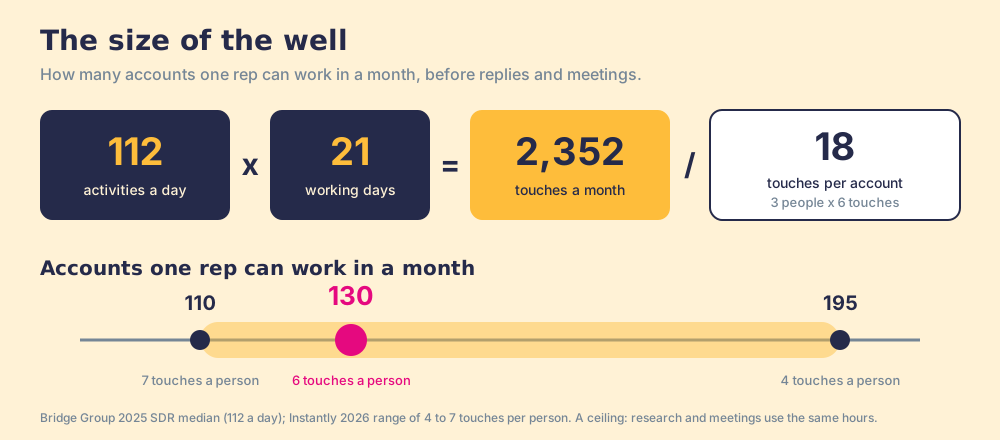
Treat 130 as a ceiling: follow-ups, research, and meetings come out of the same day, and a full-cycle AE has a much smaller well. The number is useful because it is small. A territory of 2,000 accounts handed to one rep is a plan to reach each of them about once every fifteen months.
How do you tier an ICP for outbound prospecting?
Your ideal customer profile says who could buy. Tiers say how much of the well each gets, and the case for unequal shares comes from how value is distributed. Robert Kaplan and V.G. Narayanan found that “the most profitable 20 percent of customers generate between 150 percent and 300 percent of total profits,” while the least profitable lose money (Kaplan and Narayanan, 2001, via Wikipedia). If value is that lopsided after the sale, effort should be lopsided before it.
Three tiers cover outbound prospecting for most mid-market teams:
- Tier 1, a handful of named accounts. The best fit by your closed-won data, worth an hour of research each, six or more people reached, seven touches apiece. Our account-based prospecting guide covers how to run these.
- Tier 2, accounts with a reason this month. A fit account plus a trigger: a new leader, a funding round, a hiring spree, a tool they dropped last month. Three people, six touches.
- Tier 3, fit accounts with no signal yet. Two people, four touches, and a short first message. This tier exists to find out which accounts move.
The budget sets the Tier 1 count. Ten Tier 1 accounts at six people and seven touches each use 420 touches, close to a fifth of the month, before a single Tier 2 account gets an email.
Where do the lists come from?
A strategy names the accounts; the list puts people and contact details against them. Rep-built lists suit Tier 1 and Tier 2, where the reason for each name is the point: Gartner’s survey of 632 B2B buyers found “73% of B2B buyers actively avoid suppliers who send irrelevant outreach” (Gartner, June 25, 2025), and the person who chose a name can say why it is relevant. Ops-built segments suit Tier 3. Bought files suit almost nothing; the lead list guide explains why.
Two limits apply to anyone building one. LinkedIn “currently doesn’t offer the option to export account and lead information from Sales Navigator into a CSV or XLS file” (LinkedIn Help). And a single contact database misses people, while Clay’s waterfall asks provider after provider across “200+ data and AI vendors” on one contract (Clay, checked October 2, 2026), which is why we chose Clay as our only data provider.
Which outbound plays should run first?
A play is a repeatable reason to contact a set of people: why them, why now, and what the first message says. The plays do not return the same amount per bucket, and the evidence lines up in a clear order.
- Expansion at customers. Benchmarkit’s 2025 SaaS benchmarks put the median expansion CAC ratio at “$1.00” against “$2.00 of Sales and Marketing expense to acquire $1.00 of New Customer ARR,” and found expansion makes up 40% of total new ARR at the median, over 50% above $50M in ARR (Benchmarkit). A dollar of expansion costs half as much to win.
- Job changers. A past champion who moves to a new company carries the relationship with them. Deepak Somaya, Ian Williamson, and Natalia Lorinkova, studying attorneys who moved between law firms and Fortune 500 clients, argued “that movement of employees both to and from clients may enhance firm performance” (Academy of Management Journal, 2008). Job change tracking covers the tools.
- Triggered new logos. A fit account with a reason to call this month. Gong’s data shows “a 2.1x higher success rate for salespeople who state their reason for calling” (Gong), and a trigger is a reason the buyer can check.
- Cold new logos. Fit with no signal. Instantly’s 2026 benchmark puts the average cold email reply rate at 3.43%, the top 10% of senders at 10.7% or better, and “58% of all replies are generated from step one.” Cold works, at a lower yield per bucket.
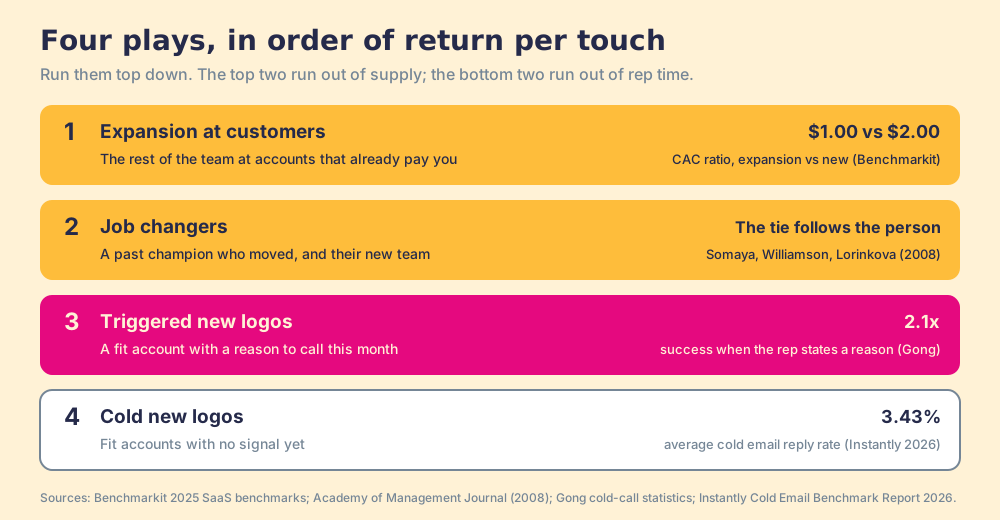
The order has a useful catch. The warm plays are limited by supply: you have only so many customers, and UserGems says 2% to 4% of tracked contacts change jobs in a month (UserGems), so 500 tracked champions produce 10 to 20 moves (our arithmetic on the vendor’s figure). New-logo plays are limited by rep capacity instead. So the strategy fills the supply-limited plays first, every month, and gives what is left to new logos, triggered before cold.
The table shows one month for one rep built that way. The supply figures are an example; the touch arithmetic follows from the capacity math above.
| Play | Supply this month (example) | People × touches | Touches |
|---|---|---|---|
| Job changers | 15 moves (3% of 500 tracked champions) | 3 × 6 | 270 |
| Expansion | 20 customer accounts | 3 × 6 | 360 |
| Tier 1 new logos | 10 named accounts | 6 × 7 | 420 |
| Tier 2 new logos | 40 triggered accounts | 3 × 6 | 720 |
| Tier 3 new logos | 72 fit accounts | 2 × 4 | 576 |
| Total | 157 accounts | 2,346 of 2,352 |
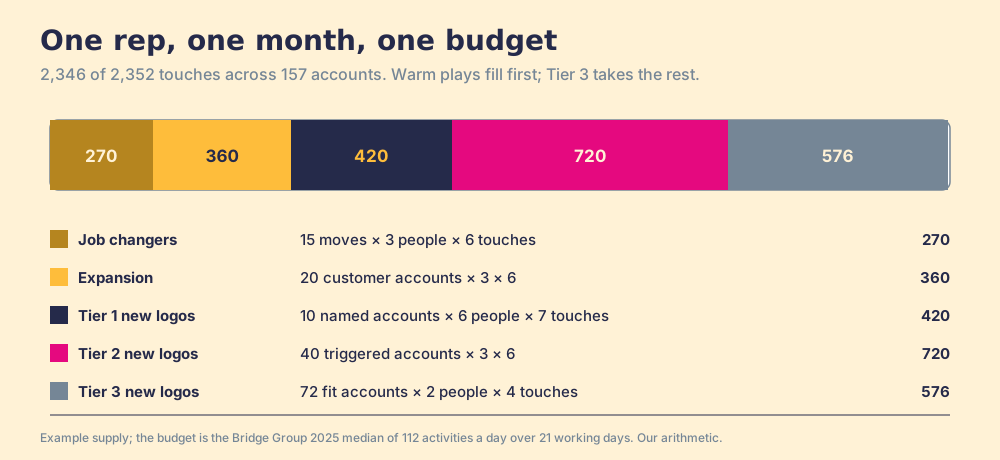
Add ten Tier 1 accounts and 420 touches leave Tier 3, about 52 accounts’ worth. The table shows that cost before the month starts.
The arithmetic is the reason to write a strategy down.
What cadence fits each tier?
Cadence is how the touches for one person are spaced and mixed; the sales cadence guide covers the design. For strategy, three rules carry most of the weight.
- A first message with a reason. Instantly found 58% of replies come from step one, and Gong found a 2.1x higher success rate when the rep states the reason for calling. The first touch carries the play’s reason, in the buyer’s terms.
- Touches set by tier. Seven for Tier 1, six for Tier 2 and the warm plays, four for Tier 3. More touches go where a reply is worth more.
- Channels mixed by the person. The Bridge Group’s median day runs 44 calls, 41 emails, and 19 LinkedIn touches. A Tier 1 buying committee gets all three; Tier 3 can run mostly on email.
Cadence is a door with a knock pattern. Two knocks and a pause, a note under the door, one more knock a week later. A Tier 1 door gets the full pattern; a Tier 3 door gets two knocks and a note. Knocking forty times is how you meet the neighbors you did not want to meet, and Gartner’s 73% is that neighborhood talking.
How do you measure an outbound sales strategy?
The farmer weighs the harvest field by field. The usual outbound report counts buckets carried: activities, emails sent, meetings booked. The Bridge Group is candid about where its own benchmark stops: “Pipeline figures represent raw pipeline generated, not forecast or closed-won revenue.” A strategy needs the weighing done by field.
Tag each contact with the play and tier that sourced it, as a CRM field every tool writes to, then report five counts per play:
| Count | What it answers | Who defines it |
|---|---|---|
| Found | Did the list get built to plan? | The plan’s account counts |
| Worked | Did the people on it get a first touch? | Your team, for example a first touch within five days |
| Replied | Did the play’s reason land? | Any human reply |
| Opportunity | Did it turn into a real deal? | Your stage definition |
| Closed | Did it win, and what did it win? | Your closed-won definition |
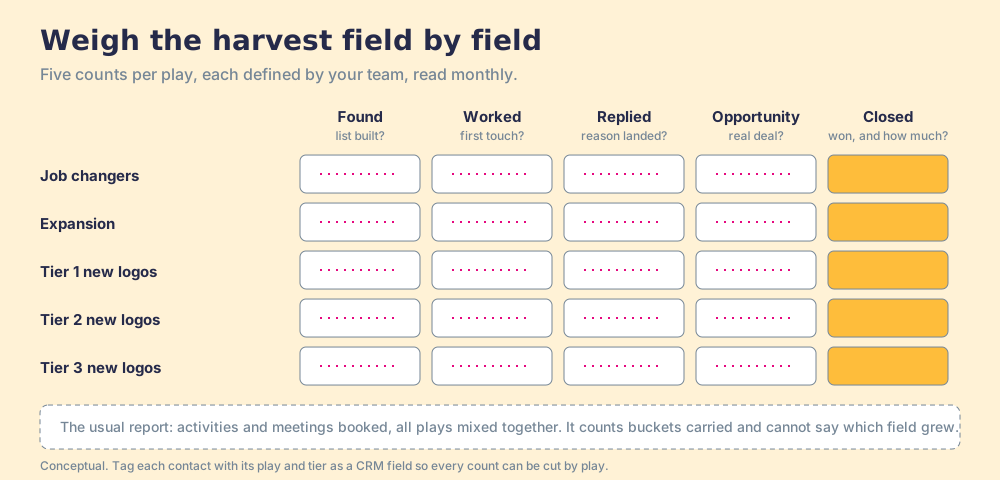
The worked column is where most strategies break, and it breaks for system reasons. A list that lands in the CRM with no next step and no owner sitting next to it gets touched late or never, and the leader finds out when pipeline comes up short. A first-touch count is how a leader tells a play that failed because its reason was wrong from a play that failed because the list sat untouched, and only the first is a reason to drop the play.
Read the table monthly and move touches. If Tier 2 closes and Tier 3 replies without closing, next month gives Tier 2 more accounts. After a few months the ICP gets rewritten from what closed.
Where does Supered Prospector fit in an outbound sales strategy?
Each play is a list to build and people to find. Supered Prospector puts both in the rep’s hands for teams that already run Clay. The GTM engineer builds each play once as a flow: a Clay table or function, and a destination in the CRM or your sales engagement tool. Reps never open Clay. They pick the flow from the Supered Chrome extension, wherever they already are.
- The rep’s starting point. A LinkedIn profile, a Sales Navigator list, a company’s website, or a HubSpot, Salesforce, or Pipedrive record.
- The plays as buttons. New logos: the rep picks the campaign on any lead and the table loads the sequence. Expansion: find the rest of the team at a customer. Job changers: push a past champion and their new team into a sequence. Research: check ICP fit and pull the buying committee you defined.
- The duplicate check. Before pushing, the rep sees the matching CRM record, who owns it, and whether the person was prospected before.
- Found, worked, closed. The leader sees whose lists got worked and whose did not, and every lead ends the way your process says: Qualified, Recycled, or Disqualified.
Prospector works within LinkedIn’s terms and does not copy search results in bulk; the contact data comes from Clay’s waterfall on the customer’s Clay account. Supered does not bring its own database. It brings Clay’s waterfall, which is every database, routed. Clay governs the data. Supered governs the motion. Prospector costs $45 per rep per month, billed annually, from one rep, on your Clay plan and credits; Clay’s Growth plan is $446 a month billed annually or $495 billed monthly (Clay pricing, checked October 2, 2026). The leader’s view is on Prospector for sales leaders, and the product on the Prospector page.
Choose something else if:
- No Clay account. Prospector needs one. A single database such as Apollo is the simpler start.
- Ops builds every list. If reps never build lists, Clay’s own CRM sync on the Growth plan pushes segments without a rep-side tool.
- AI-written outreach. Prospector does not draft or send emails; it hands people to your CRM and sequencer.
Why trust this guide?
Before Supered I started RevPartners, a HubSpot partner that did only sales implementations, sold roughly twice as much Sales Hub as any other partner, and reached HubSpot’s Elite tier in 13 months. We ran RevOps as a service for clients, which meant writing outbound plans from the fractional-CRO seat and then watching which ones survived contact with a rep’s calendar. Supered is the #1 sales enablement app on the HubSpot marketplace, rated 5.0 from 122 reviews there and 4.9 out of 5 from 81 reviews on G2 (checked October 1, 2026). The disclosure: we make Prospector, and it appears above for teams on Clay.
What we recommend for your outbound sales strategy
Write the strategy as a budget. Count the touches, about 2,350 per rep per month at the Bridge Group medians. Fill expansion and job changers first, because Benchmarkit’s medians say a dollar of expansion costs half as much and their supply runs out before the rep’s time does. Give the rest to new logos, triggered before cold, with a Tier 1 small enough that the table adds up. Then weigh the harvest by play and move next month’s touches toward what closed.
Two common alternatives deserve a fair hearing:
- The territory dump. Two thousand accounts per rep and a long sequence for all of them. It fills activity reports and reaches each account about once every fifteen months. Keep it, if at all, for testing a new segment.
- The tactics menu. A new channel or tool each month, with no budget behind it. Tactics belong inside the plan; on their own they spend the well on whatever is newest.
If your team runs Clay, Prospector turns each play into a button the rep runs where they work. Next, read outbound lead generation for the step-by-step build and sender rules, account-based prospecting for running Tier 1, and the sales prospecting guide for the whole motion.
Frequently asked questions
What is an outbound sales strategy?+
How many accounts can one rep prospect in a month?+
What are the best outbound sales strategies?+
What is the difference between outbound prospecting and an outbound sales strategy?+
How do you measure an outbound sales strategy?+
Where does Supered Prospector fit in an outbound sales strategy?+
Your Clay waterfall, where reps already work.