Account-Based Prospecting: The Buyer Is a Jury, So Count the Jurors
Account-based prospecting changes the unit of work from the person to the account.
How many accounts one rep can carry, how to pick them, how to reach the buying committee before the first meeting, and the account-level numbers that show it working.
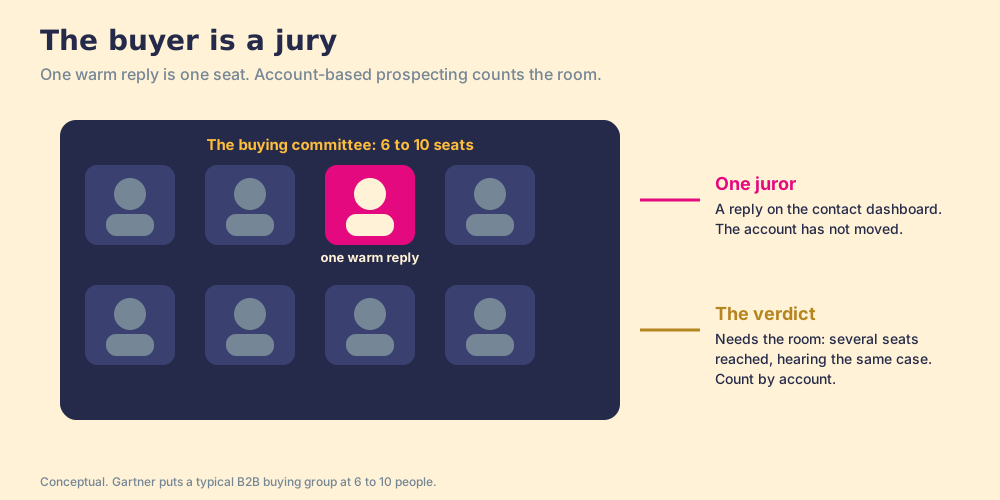
Account-based prospecting is outbound in which a rep picks a short list of named accounts first, then finds and contacts several people on each buying committee, and measures progress by account rather than by contact.
How to run account-based prospecting
- 1
Size the account list to the rep
Divide the rep's monthly touches by people per account times touches per person; at six people and six touches, one rep carries about 65 accounts a month.
- 2
Score accounts on fit, timing, and access
Give each candidate account points for matching closed-won deals, for a trigger this month, and for an existing thread in, and keep the top of the list.
- 3
Map the committee seats per segment
From won deals, write the roles that sign off in each segment, such as champion, decision-maker, user, and ratifier, and the titles that fill them.
- 4
Find and verify the people for each seat
Name the person in each seat at each account and fetch a verified email and phone before the first touch.
- 5
Enter low, then widen
Start with the likely champion and a peer, bring in the executive around the third touch, and reach the ratifier before any proposal.
- 6
Measure by account
Report committee coverage, threads engaged, engaged accounts, account-to-opportunity rate, and days to the second thread.
A trial lawyer who comes home pleased because juror four smiled at her has learned something small. Juror four is one vote of twelve, and the verdict needs the room. Account-based prospecting starts from the same arithmetic. The buyer is a committee, and a warm reply from one person at an account is one juror.
Account-based prospecting is outbound in which a rep picks a short list of named accounts first, then finds and contacts several people on each buying committee, and measures progress by account rather than by contact. The guides that rank for the term agree on the first half: fewer accounts, deeper research. Fewer of them deal with the consequence. Once the account is the unit, the contact-level numbers on a typical outbound dashboard (reply rate, meetings per rep) can climb while the program fails, because they count smiling jurors.
The short version:
- The size. About 65 accounts a month per rep, at six people and six touches each, from the Bridge Group’s median activity.
- The choice. Score accounts on fit, timing, and access, and keep the top of the list.
- The room. Map the seats that sign off in each segment from your own won deals, and reach several before the first meeting.
- The count. Coverage, threads engaged, and engaged accounts with two or more people, then opportunities.
What is account-based prospecting, and how is it different from ABM?
Account-based marketing is marketing’s program aimed at named accounts: ads, content, events. It is a budget line. The ABM Leadership Alliance and Momentum ITSMA’s sixth benchmark, a survey of nearly 300 ABM leaders, found “28% of marketing budget dedicated to” ABM in 2022 (Demandbase, December 13, 2022). Account-based prospecting is the rep’s half of the same idea: finding the people at those accounts, reaching them, and getting the first meeting. When the SDR team runs it, some companies call it account based sales development.
UserGems’s guide, which ranks on page one, draws the line at deal stage: “Account-based prospecting is what you do when there’s no active opportunity” (UserGems, updated August 3, 2026). We agree, and the line matters. Once an opportunity exists, the work becomes multithreading a live deal. Before it exists, the job is getting into the room at all.
The same guide puts the narrowing plainly: “50 companies likely to buy, not 500 random prospects hoping for replies.” The math below lands in the same place, from a different direction. Where we part from it is the next step: the guide’s committee size, “3 to 27 people,” is sourced to Reddit, and we would build the committee from your own won deals instead.
Why does account-based prospecting count accounts instead of replies?
Because the committee decides, and committees behave differently from people. CEB, now part of Gartner, surveyed 3,000 buying-group members and found the likelihood of a purchase falls as the group grows: 81% with one decision-maker, 55% with two, around 60% with three or four, 53% with five, and 31% with six or more (CEB, The Challenger Customer deck, 2015). Karl Schmidt, Brent Adamson, and Anna Bird described that buying authority as resting with groups “all of whom have veto power” (HBR, 2015).
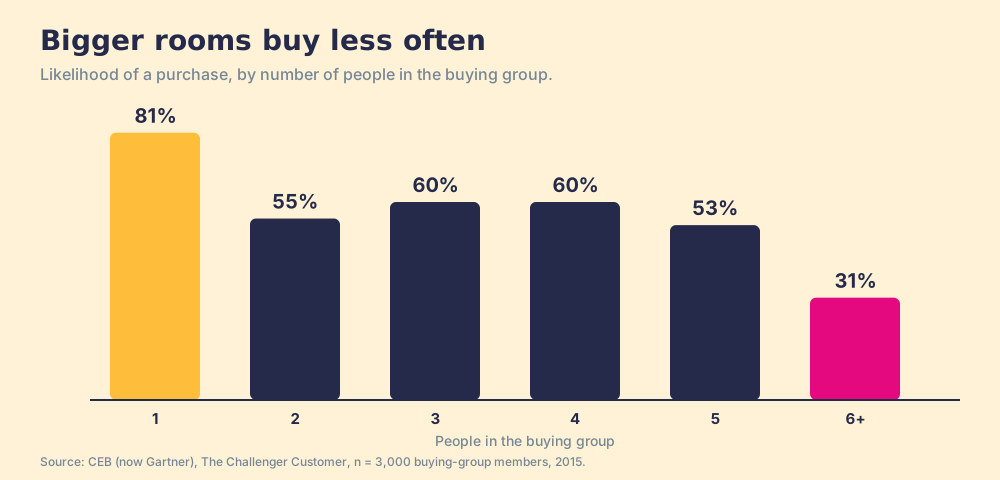
The groups are not shrinking. Forrester’s 2026 State of Business Buying found “the typical buying decision now includes 13 internal stakeholders and nine external influencers” (Forrester, January 21, 2026). Gartner’s research puts a typical buying group at 6 to 10 people, spending about 17% of the buying time with all suppliers combined (Gartner).
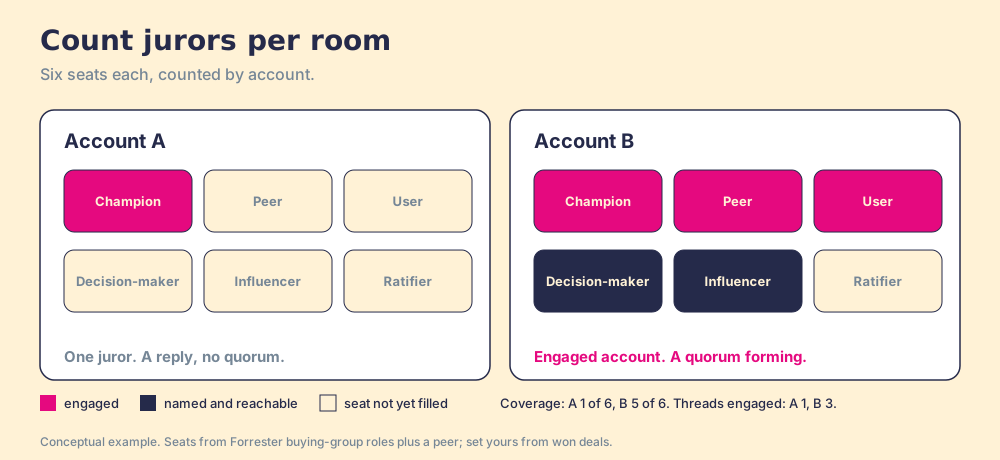
Put those together and the contact-level dashboard misleads in a specific way. A rep who sends 300 emails to one person at each of 300 accounts and gets nine replies has nine jurors at nine accounts. A rep who reaches five people at each of 60 accounts and gets the same nine replies, three of them at the same account, has one account with a quorum forming. Same reply count.
Far different odds of a verdict. The B2B buying committee guide goes deeper on why bigger rooms stall.
The jury picture breaks in one place. A real jury hears the evidence together and may not talk to the lawyers. A buying group can be met one person at a time, and should be, as long as the people end up hearing the same case.
How many accounts can one rep prospect this way?
Size the list to the rep, and the arithmetic is short. The Bridge Group’s 2025 SDR report puts the median day at 112 activities (Bridge Group), about 2,352 touches over 21 working days. Instantly’s 2026 benchmark puts the working range at four to seven touches per person (Instantly). Reach six people at six touches each and one account costs 36 touches. That leaves room for about 65 accounts a month (our arithmetic).
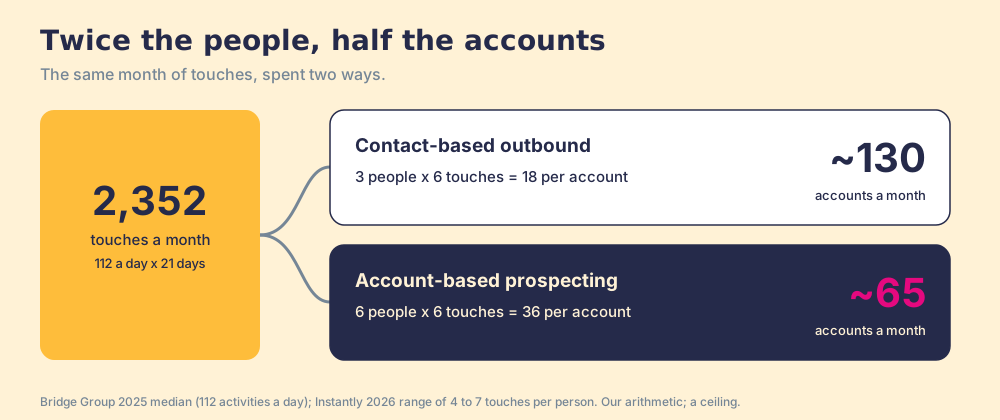
Sixty-five is a ceiling, and a generous one. Research time, meetings, and follow-ups to replies come out of the same day, so a rep running real account research lands closer to UserGems’s 50. A list of 300 named accounts per rep reaches each of them about once every five months. A team that calls that account-based is running contact-based outbound with a shorter list.
How do you choose which accounts to prospect?
Choosing an account is like choosing a house to buy. You want one worth having, a seller ready to move, and someone who will let you in to look. Fit, timing, and access. Score each candidate account from 0 to 2 on all three and work the list from the top.
- Fit. How closely the account matches the deals you won, by your ideal customer profile: industry, size, the system they run, the problem you solve. Two points for a near twin of a closed-won customer.
- Timing. A trigger this month: a new leader in the buying role, a funding round, a hiring spree in the team you serve, a contract with a rival coming up. Gong’s data shows “a 2.1x higher success rate for salespeople who state their reason for calling” (Gong), and a trigger is the reason.
- Access. A thread already in: a past champion who now works there, a customer’s former employee, a contact already in your CRM, a shared investor. Somaya, Williamson, and Lorinkova argued “that movement of employees both to and from clients may enhance firm performance” (Academy of Management Journal, 2008). The person who knew you carries the relationship in. Job change tracking covers how to find them.
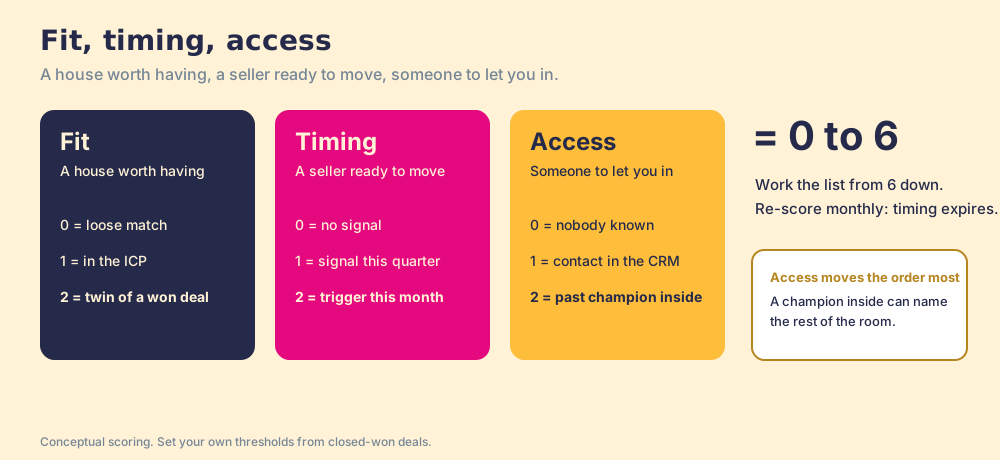
Access changes the order more than the other two. A good-fit account with no trigger and a past champion inside beats a perfect-fit account where you have no contact, because the champion can tell you who else sits in the room. Re-score monthly; timing expires.
How do you reach the buying committee before the first meeting?
Start by writing the seats. Forrester names five buying-group roles: champion, decision-maker, influencer, user, and ratifier, the last being the person handling “the settlement of terms, conditions, and pricing” (Forrester). Pull your last won deals in a segment and write which titles filled which seats. A 50-person company might have three seats; a 2,000-person company might have eight, with security and procurement among them.
Then fill the seats with names and verified contact details before the first touch. Sales Navigator finds the titles, though LinkedIn “currently doesn’t offer the option to export account and lead information from Sales Navigator into a CSV or XLS file” (LinkedIn Help). A single contact database misses some seats; a waterfall asks provider after provider, and Clay’s covers “200+ data and AI vendors” on one contract (Clay, checked October 2, 2026).
The order of entry matters as much as the count. Gong studied more than a million executive sales cycles and found “win rates drop by roughly 6% when an evaluation starts with an executive,” with “a 5% increase when executives are involved around the third touchpoint” (Gong, February 13, 2026). So the pattern for a cold account:
- The likely champion and a peer. Two people who feel the problem, reached in the same week with the same reason. Two replies from one team are the start of a problem statement.
- The executive, later. Around the third touch, with something the champion has confirmed.
- The ratifier before any proposal. Procurement and security, introduced through the champion. Forrester found procurement professionals are decision-makers in 53% of business buying cycles, “engaging from the start of the process.”
How do you measure account-based prospecting?
Count jurors per room. Five numbers, all at the account level:
| Metric | What it counts | What it tells you |
|---|---|---|
| Committee coverage | Seats with a named, reachable person, out of the seats defined for the segment | Whether the rep can reach the room at all |
| Threads engaged | People at the account who replied or met | Depth inside one account |
| Engaged accounts | Accounts with two or more people engaged | Whether a quorum is forming |
| Account-to-opportunity rate | Engaged accounts that became opportunities | Whether engagement turns into deals |
| Days to second thread | Time from the first engaged person to the second | How fast the rep widens the room |
The engaged-accounts threshold of two is ours; set your own from won deals. Gong Labs’s analysis of 1.8 million deals closed in 2024 found won deals carry “twice as many buyer contacts” as lost ones (Gong, April 28, 2025), and part of that gap is a winning deal pulling people in late, so treat the count as a direction to push and keep it off the quota sheet.
Read the coverage column first, because the other four depend on it. When coverage is low, the problem is supply: the rep cannot find the names or the numbers, and the fix is in the system, making the names cheap to find. When coverage is high and engaged accounts are flat, the problem is the message or the entry order.
Where does Supered Prospector fit in account-based prospecting?
Filling the seats is where a rep’s account hour goes: the company site in one tab, Navigator in a second, a database in a third, the CRM in a fourth to check who already owns the contact. Supered Prospector puts that research play one click from the account the rep has open, for teams that already run Clay. The GTM engineer builds the buying-committee flow once; reps never open Clay.
- The rep’s starting point. A company’s website, a HubSpot, Salesforce, or Pipedrive record, a LinkedIn profile, or a Sales Navigator list.
- The research play. Check ICP fit and pull the buying committee you defined, with the lookup tuned to your titles, departments, and seniority.
- The CRM check. Before pushing, the rep sees the matching CRM record, who owns it, and whether the person was prospected before, so two reps do not work the same room.
- The push. People land in the CRM on the account, or a whole list goes into a Clay workflow, with verified emails and phones from Clay’s waterfall.
- Found, worked, closed. The leader sees which account lists got worked, and every lead ends the way your process says: Qualified, Recycled, or Disqualified.
Prospector works within LinkedIn’s terms and does not copy search results in bulk; the contact data comes from Clay’s waterfall on the customer’s Clay account. Supered does not bring its own database. It brings Clay’s waterfall, which is every database, routed, and that is why we chose Clay as our only data provider. Prospector runs inside the Supered Chrome extension and costs $45 per rep per month, billed annually, from one rep, on your Clay plan and credits. What the rep sees is on Prospector for reps, and the product on the Prospector page.
Choose something else if:
- No Clay account. Prospector needs one. A single database with a CRM integration is the simpler start.
- An ABM ad program as the goal. Prospector finds and routes people for reps; it does not run account-based ads or intent scoring.
- No one to build the committee flow. RevPartners, the company I founded, is a Clay Elite Studio Partner that builds and tunes Clay tables with teams that want help.
Why trust this guide?
Before Supered I started RevPartners, a HubSpot partner that did only sales implementations, sold roughly twice as much Sales Hub as any other partner, and reached HubSpot’s Elite tier in 13 months. Running RevOps as a service for clients, I watched named-account lists of several hundred per rep get called account-based and worked one contact at a time. Supered is the #1 sales enablement app on the HubSpot marketplace, rated 5.0 from 122 reviews there and 4.9 out of 5 from 81 reviews on G2 (checked October 1, 2026). The disclosure: we make Prospector, and it appears above for teams on Clay.
What we recommend for account-based prospecting
Make the account the unit, all the way through. Size the list to about 65 accounts per rep, because six people at six touches each is what the Bridge Group’s median day can pay for. Choose by fit, timing, and access, with access weighted more than most scorecards weight it. Write the committee seats from your own won deals, fill them before the first touch, and enter with the champion and a peer before the executive, as Gong’s timing data suggests. Then count jurors per room: coverage, threads engaged, and accounts with two or more people engaged.
Two alternatives deserve a fair hearing:
- Contact-based outbound with a named list. Hundreds of accounts, one person each. It produces replies and a tidy dashboard, and CEB’s 81%-to-31% curve says the single juror rarely carries the room. Keep it for Tier 3.
- ABM without reps. Ads and content to the account list. It warms the room and cannot fill it; someone still has to reach the people by name.
If your team runs Clay, Prospector puts the committee one click from the account. Next, read the outbound sales strategy for where account-based fits in a rep’s month, multithreading sales for the deal once it opens, and the sales prospecting guide for the whole motion.
Frequently asked questions
What is account-based prospecting?+
What is the difference between account-based prospecting and account-based marketing?+
How many accounts should a rep prospect at once in an account-based model?+
How many people should you contact at each account?+
What metrics should you use for account-based prospecting?+
Where does Supered Prospector fit in account-based prospecting?+
Your Clay waterfall, where reps already work.