LinkedIn Content Strategy From the Mayor of Inbound: Rob Jones on AI and Real Content
Rob Jones worked in a children's behavioral health facility, played blackjack, sold cars and fought fires before he became the Mayor of Inbound. He explains how he plays the LinkedIn game without taking it to heart, and why AI helps most when you already have the skill.
A LinkedIn content strategy is a plan for what you post, how often and why, and for Rob Jones it starts with mindset: treat the platform as both a game and a place with real people, and judge yourself by the habit, not the likes.
Rob Jones once won about $26,000 in one night playing blackjack. He was angry at his job at a children’s behavioral health facility, so he quit the following Monday and gambled semi-professionally for about a year. Then he went back to the same facility for another two and a half years. He has also sold cars, internet service and insurance, coached CrossFit and worked as a firefighter.
Today he is the Mayor of Inbound, the man in the orange suit who makes music parodies about HubSpot, and he runs brand and content on my team. Lindsey Smith and Cameron Conner had him on Becoming an Admin to ask about his LinkedIn content strategy and what he thinks AI is doing to content.
How did Rob Jones become the Mayor of Inbound?
“Like most good things, it was completely by accident,” Rob said. He started college in biological engineering, switched to journalism, and graduated with a psychology degree and a minor in Spanish.
The HubSpot part began at his wedding reception, which he held at his house. I was there, and I told him that if he was still looking for a job, we had something opening at RevPartners and I would make sure he got an interview.
He failed it.
“It’s one of the worst, hardest, most difficult interviews I’ve ever been a part of,” he said. At the time he thought HubSpot was a dirty mark on a car tire. The interview allowed unlimited attempts, so he kept coming back. “I didn’t learn much, but I adapted quickly.”
He started as an intern, and part of the job was to make videos and “just see if see if that hits.” It did. Five years ago, Weird Al style parodies were rare on LinkedIn, and his took off. Since then he has sat next to HubSpot CEO Yamini Rangan at a partner advisory meeting at INBOUND, and Dharmesh Shah has sent him emails and comments about his videos.
He puts that down to curiosity more than skill. “It’s more than anything willing to be ignorant in a positive way,” he said. “Very curious about people. Very unassuming and willing listen and find out.”
Why treat LinkedIn as real and fake at the same time?
His first advice for a new creator was “don’t take advice from me.” Then he gave some anyway. “You have to treat it both like it’s real and fake at the same time. Like it very much is a game.”
The game is the algorithm, and lately he likes it less. “It seems more predatory to me,” he said. “I would rather some small group of people get a joke and get a song reference and get a bit that I’m doing rather than just make content to appease a machine lord.”
The people are the real side. “Life-changing things, as cringe as this can sound, can happen from social media in particular LinkedIn,” Rob said. Some of his best-performing posts were stories he assumed nobody would care about, like how a psych major and former firefighter ended up in HubSpot. Strangers wrote to tell him they had a similar story.
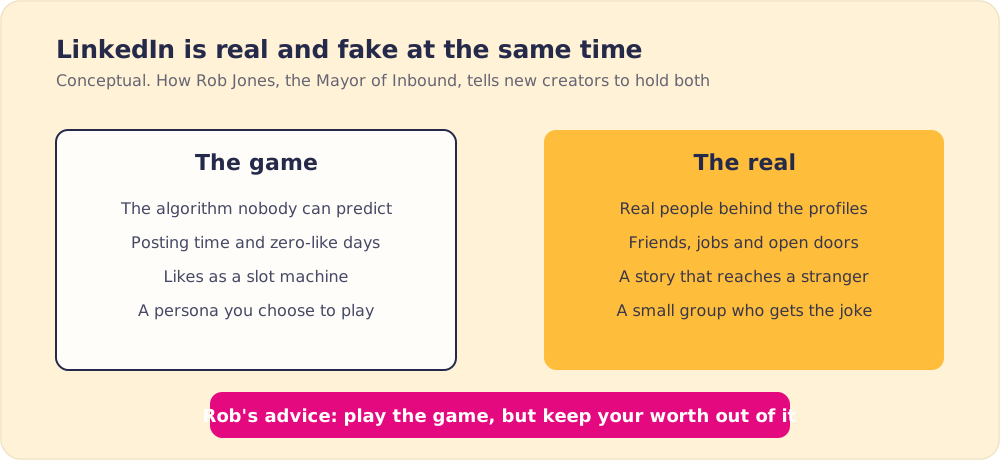
He thinks you get the good part “if you just again are kind of understanding it exists but aren’t making your your life about that.”
What makes a LinkedIn content strategy work?
Put together, Rob’s answers amount to a short list for anyone in revenue or RevOps building a personal brand on LinkedIn:
- A persona you picked on purpose. Rob built the Mayor of Inbound before he knew how the algorithm worked, and it stuck because it was his.
- An audience small enough to get the joke. He writes for the people who catch the song reference.
- Your own stories. His strongest posts were personal. He sees much of LinkedIn filling with posts “recycled from other platforms.”
- Speed with an opinion. “Marketing should be reactive,” he said. Memes work because people already care about the thing they riff on.
- A habit judged by effort. Likes swing with the time of day, so he judges his LinkedIn posting by whether it happened.
Does AI cheapen content creation?
“How much time do we have?” Rob said when the hosts asked about AI content creation. He has no patience for purity tests. “Did you use it to write it? Did you use it to edit it? Did you use spell check? Cuz that’s AI now.” He asks for “discernment and judgment.”
He had tested where AI falls short. He wrote a fake email with nine John Mayer song references in it and asked an AI to summarize it. The summary never mentioned John Mayer. He also recorded a pretend meeting with himself, and the meeting recorder dutifully noted that the “customer” was excited about a next call. “You cannot fabricate or AI emotionality,” he said. “You can approximate it.”
He compares AI art, including music from tools like Suno, to a child’s refrigerator drawings. “They matter to you, but nobody else gives a about them,” he said. He has also seen people swing back toward things made by hand, like a deliberately rough event flyer with no AI in it that did well because “somebody took the time to do it and it to me represented effort.”
He is writing into a feed where that effort is getting scarce. Originality.ai classified 81.2% of 5,000 public long-form LinkedIn posts from July 2026 as likely AI, up from roughly half in late 2024 (Originality.ai). His John Mayer post got zero likes, by his own account. A person reading for ten seconds would have caught the joke. The machine did not. “Effort is still important,” Rob said. “Like massively important.”
Is AI like steroids for content creators?
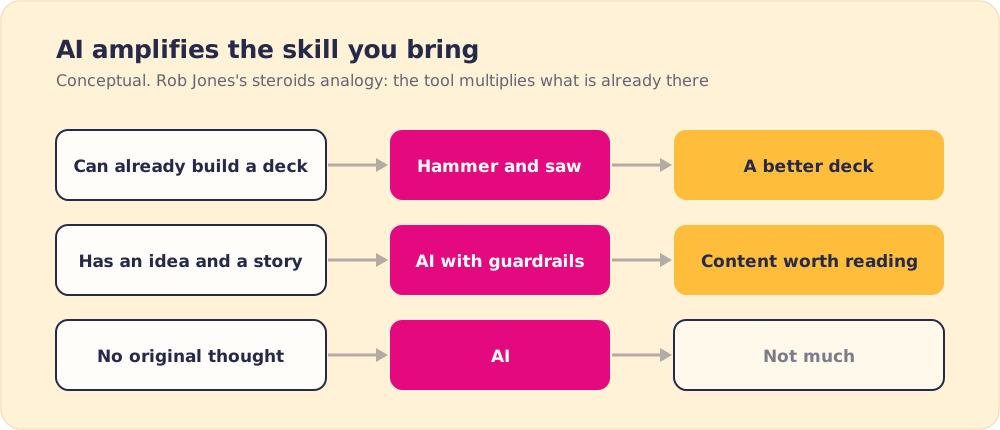
One of the hosts mentioned an earlier guest who had compared AI to the steroids Barry Bonds and Mark McGwire allegedly took: the boost worked because they could already hit. Rob agreed and applied it to every tool. “Give me a hammer, I will not be able to build a deck,” he said. “Give somebody that can already build a deck a hammer or a saw, they’re going to be better at that.”
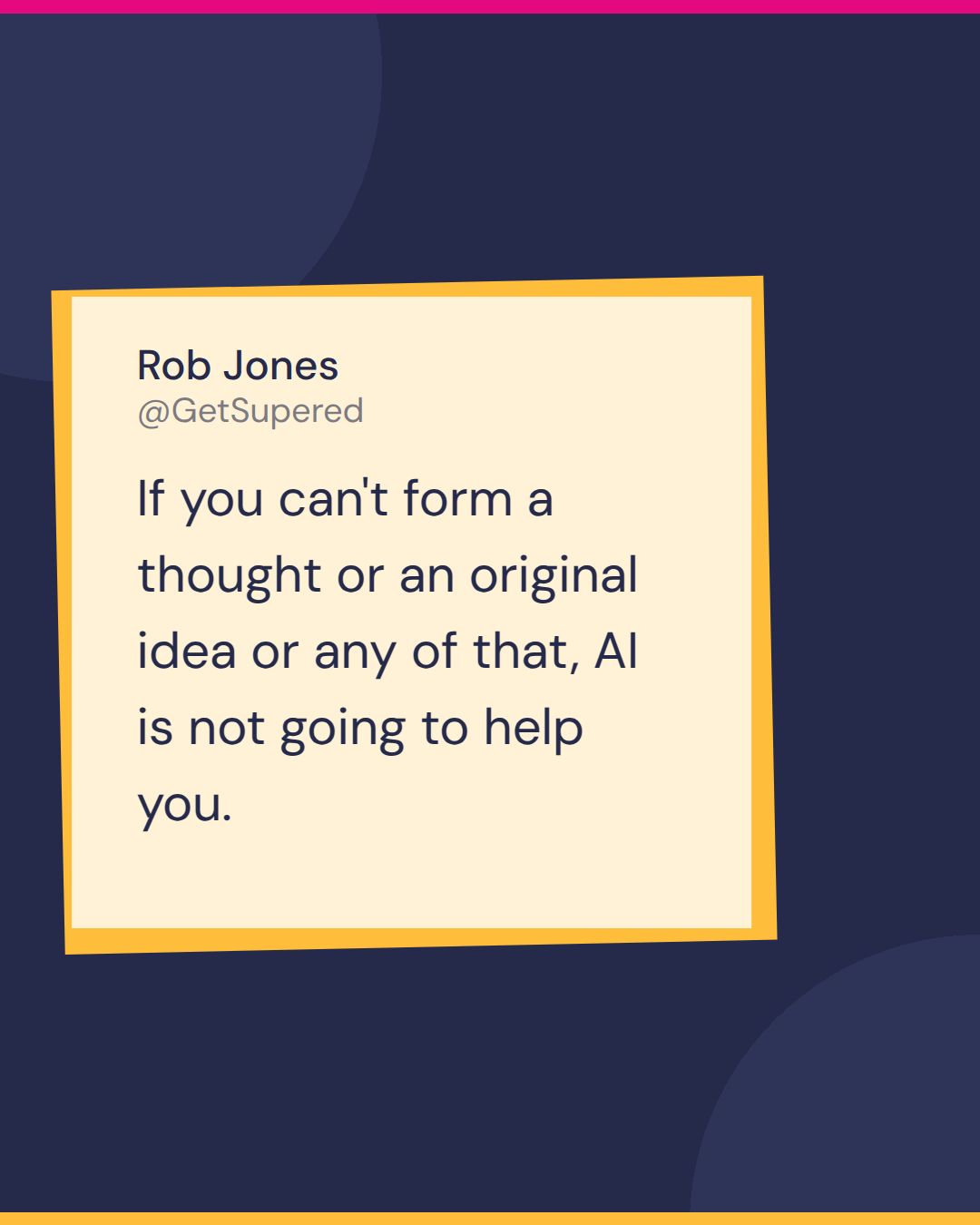
“They already had skill, steroids just amplified it. If you can’t form a thought or an original idea or any of that, AI is not going to help you. If you can’t put together a cohesive storyline or tell stories, AI is not going to help you as much as it would help somebody that is already proficient.”
He sees it in code too. He can build a pop-up app in Claude in five minutes, but when Steve, one of our engineers, uses the same tool, the result is “a hundred times plus better” because Steve already has the skill. In writing, the skill shows in how you prompt and set limits, which Claude calls scaffolding: “do this, always do this, do not do this, include, exclude.”
One experiment pushes back on part of this. Shakked Noy and Whitney Zhang gave 453 college-educated professionals writing tasks, half with ChatGPT. Time fell 40%, graded quality rose 18%, and the gap between stronger and weaker writers narrowed (Noy and Zhang, Science, 2023). AI does help weaker writers with polish. But the tasks in that study came with a brief that said what to write. Rob is talking about the step before the brief, where someone has to have the thought and the story. Our guide to generative AI for sales draws the same line for sales teams.
Where should a new creator start?
Rob offered two ways in. You can produce without worrying about the outcome, or you can get your mindset right first. For the first, he told a gym story. On his first day back after a long break, he walked in, scanned his badge, and left. “I’m not feeling it. But that helps to create a habit.”
He recommends the second. At RevPartners he ran a content creator cohort, and the first version graded each post on its metrics. With a psychology degree behind him, he did not like that design. “That is the cocaine rats. That is dopamine. That is a slot machine,” he said. “If you base your efficacy, your self-worth, or any of that on the results of something that you’re just starting, it’s not going to go good for your mental health.”
Habits also take a while to form. In Phillippa Lally’s study at University College London, 96 volunteers took an average of 66 days before a new daily behavior became automatic, with a range of 18 to 254 days (Lally et al., 2010). Two weeks of likes tell you very little about a habit at that stage. “If you’re going to create content for a week, do whatever you want,” Rob said. If you want it to last, “I would get your mindset and the way that you’re going to approach it right first.”
What Rob Jones has learned about LinkedIn and AI
- A career built by accident. Blackjack, firefighting and a failed interview led to an internship where making videos was part of the job.
- A feed that is real and fake. The algorithm is a game worth playing, and the people behind the profiles are real.
- Discernment over purity tests. Spell check is AI now. The test is whether a person’s effort and judgment show.
- AI as an amplifier. It multiplies skill and ideas you already have. Noy and Zhang found it helps weaker writers with polish, and the idea still has to be yours.
- Mindset before metrics. Likes work like a slot machine, and Lally’s volunteers took an average of 66 days to form a habit.
What should a sales or RevOps leader take from Rob’s LinkedIn advice?
If you lead a sales or RevOps team and want a presence on LinkedIn, Rob’s advice is concrete. Decide who you are writing for and keep that group small. Write the stories only you can tell. Use AI to edit and speed up the work, and keep the idea your own. Judge the first two months by whether you showed up each week, and look at likes after that.
AI sales outreach sent at volume hits the same problem Rob sees in the feed, and sales enablement content pays off only when a rep uses it. Our guide to AI sales enablement starts with the behavior before the model. At Supered we build that way too: the process first, then AI inside the rep’s work to help them run it.
Rob has made a career out of work that looks like someone made it. His hammer-and-deck line is the test I would use on any AI tool, for a feed or a sales team: find out what skill it is multiplying before you buy it.
Frequently asked questions
What is the best content strategy for LinkedIn?+
Should you use AI to write LinkedIn posts?+
How do I start posting on LinkedIn as a beginner?+
Is AI-generated content bad for LinkedIn?+
Does AI help weaker writers more than strong ones?+
Your process, running itself.
Turn the playbook into rep behavior.
More from Becoming Admin

LinkedIn Prospecting Without the Slop: How Michael of First Touch Books Meetings With Digital Eye Contact
Michael
RevOps Specialist the Long Way Around: Travis on Degrees, Mastery and Knowing Your Lane
Travis