HubSpot Lead Scoring: Why Casey Hawkins Now Puts Fit First
A year ago Casey Hawkins said engagement mattered more than fit. Then buyers started researching in AI tools, the engagement data thinned out, and she rebuilt how she scores leads in HubSpot.
HubSpot lead scoring is the HubSpot tool that ranks contacts, companies and deals with a fit score (who the record is), an engagement score (what it has done) or a combined score, so sales knows whom to call first.
For years Casey Hawkins gave the same answer on lead scoring, and she gave it in public. “If you had asked me this a year ago,” she said, “you can find many recordings of me saying the fit score is the less important of the two.” Casey is a HubSpot coach and a marketing ops and sales ops consultant. She started using HubSpot in 2017 at a marketing agency and, as she put it, never really stopped.
In 2026 she changed that answer. She explained why on Becoming Admin, talking HubSpot lead scoring with Lindsey Smith and Cameron Conner. Cameron started the conversation by saying fit scores are “not always going to be helpful,” especially when a company does not have much good fit data.
Why did Casey Hawkins change her mind on fit scores?
Casey first defined the two scores. The fit score “is going to be referring to the properties on the record,” and engagement “is going to be referring to what that record was doing,” meaning any activity on it.
A year earlier she would have agreed with Cameron. Fit data, she said then, “oftentimes is unreliable, we don’t even have the data.”
The engagement side is what changed. “Sitting today, July of 2026 we’re seeing way less engagement data than we’d seen previously,” she said, “because people are not navigating websites as much as they’re engaging with AI.” Buyers are “doing more of their research before they even hit your website and before you’d have any of that engagement data recorded.”
Pew Research Center tracked real browsing in March 2025: Google users who saw an AI summary clicked a traditional result in 8% of visits, and users who saw none clicked in 15% (Pew Research Center, 2025). 6sense’s 2024 Buyer Experience Report found B2B buyers are nearly 70% through their purchase before they engage a seller, and 81% already have a preferred vendor at first contact (Demand Gen Report on the 6sense 2024 Buyer Experience Report). An engagement score counts what happens on your site. Less of the buying happens there now.
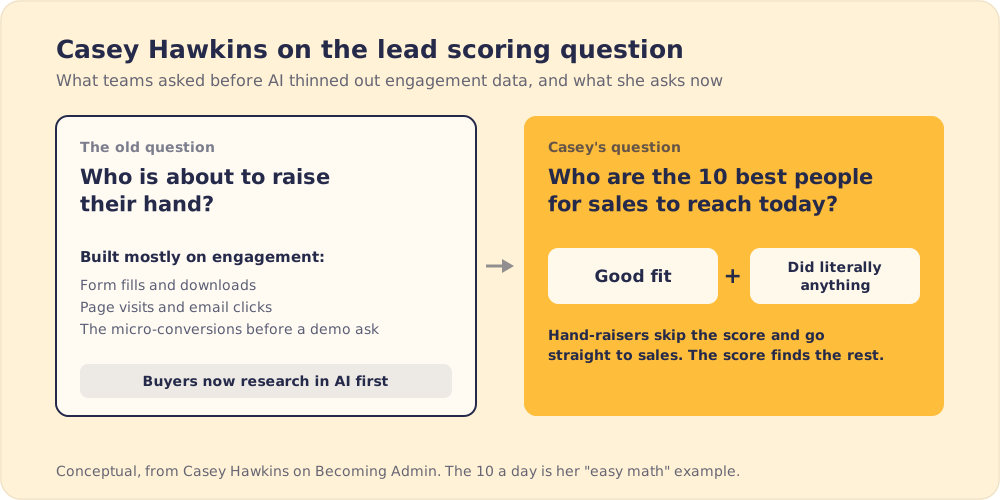
So Casey leans “way more on like is this person a good fit and then have they done literally anything?” Once you narrow on those two, she said, “your list is obtainable for your sales team.”
What should a lead score find, if a hand-raiser already goes to sales?
Casey has also changed her mind about what a score is for. Teams tell her, “I know there’s people who are really close to hand-raising in my system. I just don’t know who they are.” She knows why they ask. “What everyone wants out of lead scoring is who is almost boiling.”
The hand-raisers, in her view, are the simple case. “If they’re going to hand-raise, they’re going to hand-raise, you’re going to pass those hand-raisers off to your sales team. That’s the easy part.” The people just short of raising a hand are harder, because what they look like “changes day-to-day, week-to-week.” Her conclusion: “the idea of waiting for these certain behaviors that show someone’s about to raise their hand is kind of an illusion.”
She would rather size the list to the team. “So, your sales team can reach out to, let’s say, 10 people a day just for easy math. Then, we want to find the 10 best people for that sale for the sales team to reach out to today.” Some days those ten will be hotter than others, and she is fine with that.
The hosts asked which client question she would retire first. She picked “what resources are people downloading before they raise their hand.” People download fewer resources “because people are using AI” to get the same information, and more of it comes from video. On gating content, she said “if you’re focused on getting your content, then you’re missing a lot of visibility and a lot of nurturing that’s going to happen without getting your content.”
How do you set up HubSpot lead scoring the way Casey does?
HubSpot’s scoring tool offers engagement, fit and combined scores for contacts and companies. Deals get combined scores only. Contact scores need Marketing Hub Professional or Enterprise, company scores need Marketing Hub or Sales Hub Professional or Enterprise, and deal scores need Sales Hub Professional or Enterprise. Engagement points can decay every 1, 3, 6 or 12 months (HubSpot Knowledge Base).
Built from what Casey said, a setup has five parts:
- Fit first. The fit score carries most of the weight, built from the properties of buyers who have closed.
- A low bar for engagement. Any real activity counts, since much of the research now happens where your tracking code cannot see it.
- A separate lane for hand-raisers. A demo request or “talk to sales” form goes straight to a rep and never waits on a score.
- A list sized to capacity. If reps can reach 10 people a day, the threshold should surface about 10 good ones.
- An agreement with sales. Marketing and sales decide together what a scored lead gets compared with a hand-raiser, which Casey said takes “some real honest conversations between sales and marketing.”
The last part matters because handoffs are where many deals go wrong. In The State of Sales Enablement 2026, 16% of respondents named handoffs as the most frequent place deals break down (The State of Sales Enablement 2026). If sales never agreed to the score, the first scored lead they ignore will show it. Bring sales and marketing alignment into the scoring project at the first meeting.
How do you prioritize enrichment on a limited budget?
The hosts raised the budget problem. A fit score needs data, and many companies cannot pay to enrich every record. Casey chooses. For her B2B clients she narrows to “the dream 100, 200, 50, whatever companies” and enriches from there.
She also uses buyer intent, “one of my favorite newish features in HubSpot.” It flags companies that are hiring executives, laying people off or expanding. HubSpot’s documentation says it can also surface company news such as funding rounds, product launches and mergers (HubSpot Knowledge Base). She gave an example: “I see that Netflix just hired a new CMO. I sell marketing capabilities. I should be reaching out to the marketing people.”
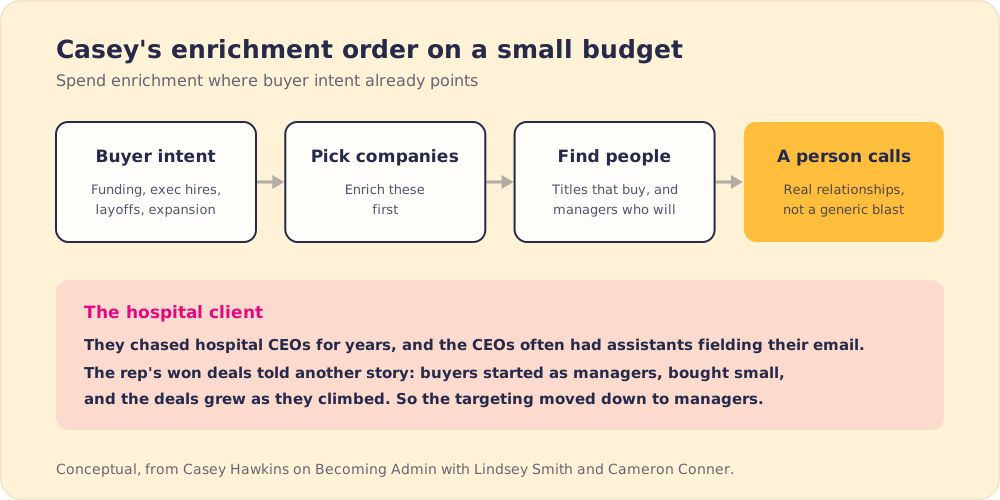
Then she told a story about a client that sold equipment to hospitals. For years the client told her the hospital CEO was the person to reach. The CEOs had assistants screening their email, and the team got almost nowhere. Then a rep explained how his deals had gone. Most started with a manager who bought something small, and “as they moved up the ladder, his actual like deal sizes grew.” The team started targeting managers, “knowing that those deals might look smaller right now, but that’s how we’re going to like grow.” Our guide to HubSpot data enrichment covers getting the underlying records right.
Can’t ChatGPT just do this?
Cameron said he had been asked exactly that: couldn’t ChatGPT do the analysis and the strategy? Casey called AI “a great starting point,” with a limit. “If you take the human out of the loop, it’s going to fall flat.” She admitted that on busy days she passes “way more off to AI than I should” and finds context missing later. Ask an AI tool about the hospital deals and it “might say, ‘Your biggest deals are coming from C-level at hospitals.’” Only the rep knew those buyers had been managers when the deals began.
Lindsey called it “bad data in, bad data out with AI.” An admin who treats AI as a partner, she said, “you will be a lethal admin.”
Casey gave a small example of where AI fits. Cleaning a spreadsheet of event leads used to be an intern’s job. Now she would still give it to the intern, who runs it through AI, and the time saved goes to deciding “what should we be emailing these event attendees rather than spending two hours cleaning a spreadsheet.” Cameron said AI raises the baseline for admins, since custom-coded workflow actions that used to need a developer are now within reach. Casey called those actions her kryptonite for years. “And now Breeze does them for me.”
For the next 6 to 12 months, she told admins to learn HubSpot’s new tools even when the old ones feel like home. The morning Agent Hub was announced, she asked its agentic automation builder to send 60% of leads to one person and 40% to another. It wrote the custom-coded action and built the workflow.
What Casey Hawkins learned about HubSpot lead scoring
- A reversed position. A year ago she ranked fit below engagement. With less engagement data to see, fit now carries the score.
- A list sized to the team. If sales can reach 10 people a day, the score should find the best 10 for today.
- Hand-raisers in their own lane. Anyone who asks for sales goes to sales without waiting on a number.
- Enrichment by intent. Executive hires, layoffs, expansion and funding decide which companies get enriched first.
- The rep’s memory. Closed-won data pointed at CEOs. The rep knew the buyers had started as managers.
- AI with a person in the loop. AI cleans the spreadsheet and writes the custom code. A person decides whom to call.
What should a HubSpot admin change in their lead scoring this quarter?
Start with the fit properties of the deals you closed last year, and rebuild the score around them. Lower the bar for engagement, send hand-raisers straight to sales, and set the threshold so the daily list matches what reps can work. Casey dropped a position she had defended on the record because buyers changed how they research. A score built in 2023 deserves the same second look.
Then sit down with sales, agree on what a scored lead receives, and check each week whether reps worked the list, as you would with any other lead qualification rule.
Frequently asked questions
What is the difference between a fit score and an engagement score in HubSpot?+
Is fit or engagement more important in HubSpot lead scoring?+
Which HubSpot plans include lead scoring?+
How many leads should a lead score send to sales?+
Does gated content still work for lead scoring?+
How do you prioritize data enrichment on a small budget?+
Your process, running itself.
Turn the playbook into rep behavior.
More from Becoming Admin

RevOps Specialist the Long Way Around: Travis on Degrees, Mastery and Knowing Your Lane
Travis
HubSpot Leads vs Contacts: Why Danielle Urban Moves Early Deal Stages Into Leads
Danielle Urban