ChatGPT for Sales: A Brilliant Drafter That Has Never Seen Your Deal
ChatGPT for sales is treated as a magic prompt away from replacing the rep. The truth is sharper: it is fluent at selling in general and blind to your specific deal, and that line decides every good use.
ChatGPT for sales means using a general AI chatbot to draft outreach, summarize calls, and rehearse conversations, and its value is bounded by a context gap: the model knows selling in general but not your buyer, playbook, or pricing, so it drafts well and fails at judgment.
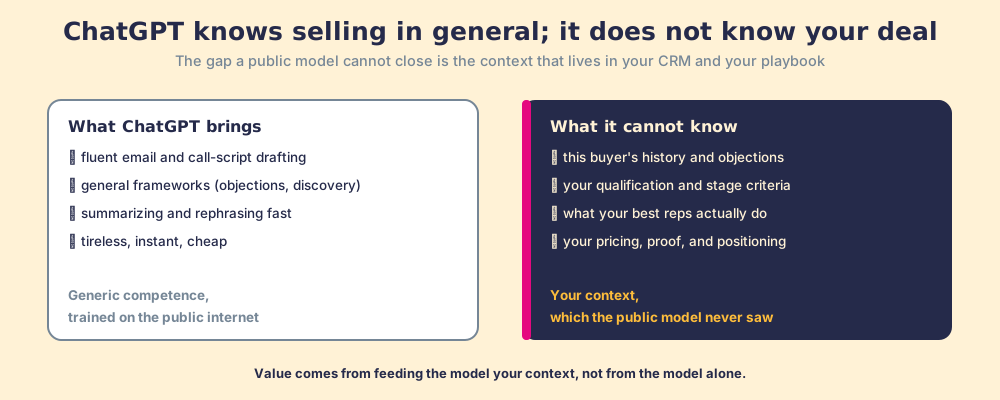
The internet is full of mega-prompts promising that ChatGPT will replace your sales team if you paste the right 800-word instruction. It will not, and understanding why is the difference between using ChatGPT well and flooding your buyers with forgettable email. A public language model is extraordinary at one thing: selling in general. It has read more sales books, email templates, and call frameworks than any human ever could. And it is blind to the one thing that wins deals: your specific deal. It has never met your buyer, read your playbook, or seen your pricing. Each good use of ChatGPT in sales lives on the right side of that line, and each bad one ignores it.
ChatGPT for sales means using a general-purpose AI chatbot to draft outreach, summarize calls, and rehearse conversations, and its value is bounded by a context gap: the model knows selling in general but not your buyer, playbook, or pricing, so it accelerates drafting and fails at judgment. Stay on the right side of that gap, and it is a genuine force multiplier.
One clarification, because the names blur. ChatGPT works rep-side, helping the seller draft, summarize, and rehearse. That is a different tool from real-time conversational AI, which talks to the buyer at the front door of a deal and books the meeting. This post is about the rep-side use.
Why can ChatGPT not close deals on its own?
Because the economic value in a sale is in the context the model cannot see. The MIT economist David Autor draws the key distinction for any automation: a tool either substitutes for human work or complements it, and which one depends on whether the tool can do the whole job or only a piece (Autor, on automation and labor). ChatGPT substitutes well for the generic, repeatable piece of selling, the first draft, the rephrase, the summary, because that piece is well represented in its training data. It complements, but cannot replace, the part that requires your context: knowing that this buyer pushed back on price last quarter, that your champion has changed roles, that your qualification framework flags this deal as weak. That information is private. It lives in your CRM and your reps’ heads, and a model trained on the public internet has never seen a byte of it.
This is why the “magic prompt” fantasy fails. No prompt, however long, can give a public model the context it was never trained on. The value-creating knowledge in your business is precisely the knowledge ChatGPT lacks, which means the model is a brilliant generalist applied to a specialist’s job. It can write you a competent cold email for “a SaaS company.” It cannot write the email that lands, because the email that lands depends on everything the model does not know.
There is a name for the gap, and it comes from the people who build these systems, not from sales. A language model predicts the most likely next word from patterns in its training data. It has no model of truth, only a model of plausibility, which is why researchers describe its confident fabrications as hallucination (Ji et al., on hallucination in language models, ACM Computing Surveys 2023). A hallucination is the same machinery that drafts a fluent email producing a fluent fact that happens to be false. The model is not lying, because lying requires knowing the truth and choosing against it. It is doing exactly what it was built to do, which is sound right, and sounding right about your buyer is precisely the place where sounding right and being right come apart. Hand it a question that depends on your private context and it will not say “I do not know that.” It will invent something plausible, in your voice, and a rep who pastes it unchecked has told a buyer something the company never said.
Where does ChatGPT genuinely help a rep?
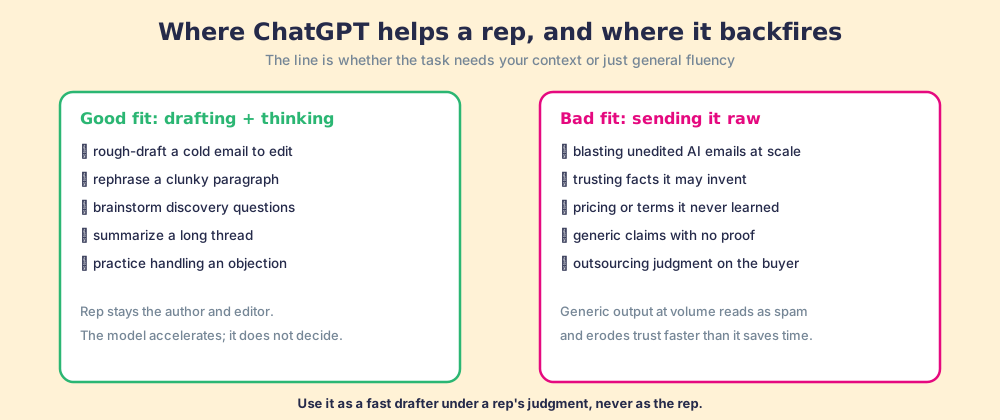
On the tasks that need fluency, not your context, and where the rep stays the author. There is real value here, so the point is not to dismiss the tool but to aim it. Used as a fast drafter under a rep’s judgment, it removes friction from the blank page and the clunky rewrite. Used as a substitute for the rep’s judgment, it produces generic output that, sent at volume, actively repels buyers.
We watched that second failure mode play out in AI sales outreach: as AI flooded inboxes with competent, context-free email, average cold-email reply rates fell to 3.43%. The model did not make the outreach worse one message at a time; it made it worse in aggregate by making generic email free to produce, so everyone produced it, and buyers stopped reading. That is the warning label on raw ChatGPT output: the easier it is to generate, the less a buyer rewards it. ChatGPT for sales emails follows a cruel rule of supply and demand. The moment a thing becomes free to produce, its market value falls to near zero, and a personalized-looking email that took a model four seconds is worth roughly what four seconds of effort is worth to the person reading it.
- Good fit: drafting and thinking. Rough-draft an email to edit, rephrase a paragraph, brainstorm discovery questions, summarize a thread, rehearse an objection. The rep edits and owns the result.
- Bad fit: sending it raw. Blasting unedited AI email, trusting facts it may invent, asking for pricing it never learned, making generic claims with no proof. The model is doing the rep’s job, badly.
- The dividing line. Does the task need general fluency or your specific context? Fluency, hand it to the model. Context and judgment, keep it with the rep.
What are good ChatGPT sales prompts, and why do most fail?
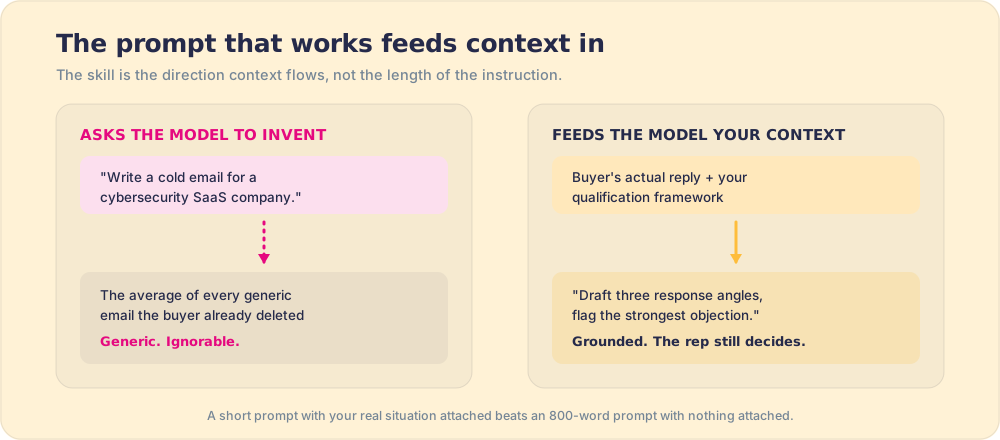
The difference between a useful chatgpt sales prompt and a useless one is which direction the context flows. A bad prompt asks the model to invent context it does not have: “write a cold email for a cybersecurity SaaS.” The model has no choice but to reach for the average of every cybersecurity email it ever read, which is the email your buyer has already deleted nine times this week. A good prompt feeds the model your context and asks it to operate on that: “here is the buyer’s two-line reply, here is our qualification framework, draft three response angles and flag which one tests the strongest objection.” Same model, opposite result, because the second prompt closes the context gap instead of papering over it.
That is the whole skill of using ChatGPT in sales, and it inverts the popular advice. The mega-prompts circulating online try to make the model smarter by making the instruction longer. The real lever is making the model better informed by handing it the specific situation. A short prompt with your real transcript attached beats an 800-word prompt with nothing attached every time, because the constraint was never the model’s eloquence. It was always the model’s blindness to your deal.
- Feed context, do not request it. Paste the buyer’s actual words, your real value proposition, your true qualification criteria. The model operates well on what you give it and invents badly on what you withhold.
- Ask for drafts and pressure-tests, not decisions. “Tighten this paragraph,” “where is this deal weak against MEDDIC,” “give me three objection responses to react to.” The rep still chooses.
- Verify every fact before it leaves the building. Any statistic, product detail, or claim the model produces is a plausibility guess until a human confirms it. Treat unverified output the way you would treat a confident new hire on day one.
How should a team roll out ChatGPT for sales?
Govern the context gap rather than the tool. The instinct is to ban it (reps use it anyway) or to hand out a prompt library and hope (you get generic email at scale). The better path is to make your context easy to feed the model: standardize the chatgpt sales prompts that paste in the buyer’s actual reply, your real qualification framework, your true value proposition, so the output is grounded in your situation rather than the model’s generic priors. And keep a human edit step non-negotiable, because the model’s confident inventions and context-free claims have to be caught before they reach a buyer. The goal is not maximum AI usage; it is AI pointed at the tasks where fluency helps and fenced off from the tasks where only your context and a rep’s judgment will do.
What we recommend
Stop chasing the prompt that turns ChatGPT into a closer, because no prompt can give a public model the private context that wins deals. The model is a superb generalist, fluent at the repeatable parts of selling and blind to your buyer, your playbook, and your pricing. So use it exactly there: as a fast drafter and thinking partner on tasks that need general fluency, with a rep as the author and editor on every output that reaches a buyer. Fence it off from the judgment calls that depend on your context, and never let its frictionless, generic output go out at volume, because buyers have already learned to ignore precisely that. ChatGPT does not replace the rep. It removes the rep’s busywork, so the rep can spend judgment where the model has none.
From here: why generic volume backfires in AI sales outreach, the assistant pattern done right in AI sales assistant, the honest take on jobs in will AI replace sales jobs, and the wider frame in AI sales enablement.
Frequently asked questions
How do you use ChatGPT for sales?+
Can ChatGPT replace salespeople?+
What are the risks of using ChatGPT in sales?+
What are good ChatGPT sales prompts?+
Your process, running itself.