HubSpot for Healthcare, From a Founder Who Grew Up in the Billing Office
Italo Leiva grew up in doctors' offices, failed with his first invention, and built Peddle into a HubSpot agency for healthcare. His lessons on revenue cycles, real customers, and culture you write down.
HubSpot for healthcare is the use of HubSpot's CRM and marketing tools by medical practices and healthcare companies to win and serve patients or clients, with HIPAA-covered data stored only on Enterprise subscriptions set up for sensitive data.
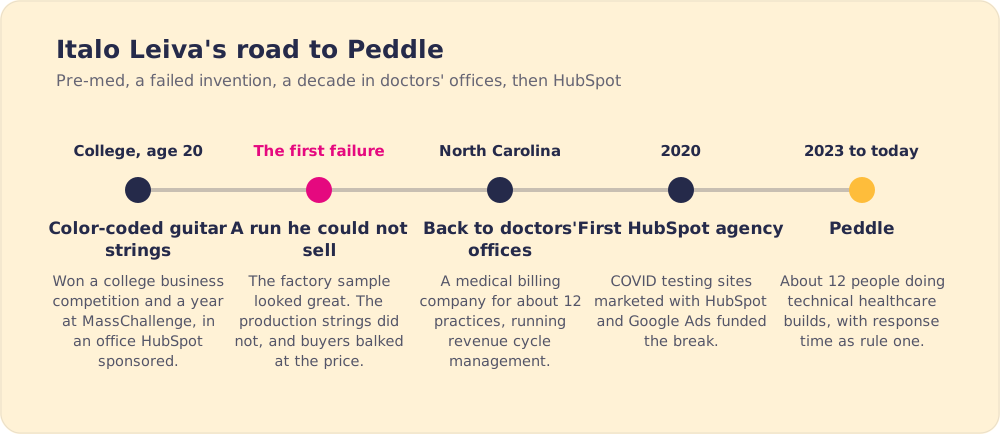
At 20, Italo Leiva was supposed to be headed to medical school. He had taken the MCAT. His brother was an MD and his parents were nurse practitioners. Instead he spent a year in Boston, in a startup office on the Seaport waterfront, being coached by software founders who drove their yachts to work. “No brainer,” he said. “I know where I’m going.”
A decade later he runs Peddle, a HubSpot agency known for deep technical builds in healthcare. If you are weighing HubSpot for healthcare, his route matters: before he touched a CRM he ran operations for doctors’ offices and grew a medical billing company. He walked me through all of it on Fast & Tierious, from the guitar strings that failed to the culture rules he now writes down. Three of his lessons carry over to any practice or agency: healthcare has tracked revenue as a process for decades, a real customer has already spent money on the problem, and a culture only spreads when someone writes it down and repeats it.
Why does Italo say healthcare ran RevOps first?
The invention came first. In college Italo was pre-med and also a gigging musician who had to learn songs fast. A psychology class taught him that people remember more when they tie a thing to more senses, which is why a jingle sticks and a phone number doesn’t. So he put colors on guitar strings and wrote software that colored the sheet music to match. I told him he had made Guitar Hero in real life, and he said that’s what everybody said. It won a college business competition, prizes worth about $50,000, and a place at MassChallenge.
Then a manufacturer in China sent him samples that looked great. He put down $20,000 to $40,000, and the strings that came back were unsellable. He also admits he didn’t know how to size a market or set a price. “It really hurt my pride a lot,” he said. He went home to North Carolina and back into doctors’ offices, this time running operations. He automated the admin work, connected the systems, picked up marketing to get more patients in the door, and built a medical billing company that served about 12 practices across the state.
Healthcare calls that billing work revenue cycle management, and Italo argues it was revenue operations long before software companies named it. Before a patient books, staff check that the practice is in network. Some visits need prior authorization from another doctor. After the visit, someone codes the claim and files it against a deadline. “If it goes 90 days without being paid then it’s called timely filing, they’re not going to pay it.”
So a billing office tracks every claim from the first phone call to the deposit, because a missed date costs a known amount of money. The misses are common. Experian Health’s State of Claims 2025 found that 41% of providers face claim denial rates of 10% or higher (Experian Health, 2025). Italo brought that habit with him when he moved into HubSpot work.
What does HubSpot for healthcare look like now?
Until late 2024, HubSpot offered no HIPAA support. On October 11, 2024, it announced HIPAA support and sensitive data tools, and its EVP of Product, Andy Pitre, said storing sensitive data “has been the top customer request across industries” (HubSpot, 2024). HubSpot’s knowledge base limits sensitive data to Enterprise subscriptions, and an admin has to mark the account as a HIPAA covered entity or business associate (HubSpot Knowledge Base).
With HubSpot HIPAA support in place, a practice can keep patient inquiries in the CRM legally. It still has to answer them, route them and follow up on time, and that part is where Italo’s billing years show. He sets up a healthcare CRM the way a billing office runs its claims, with the deadline in plain view. We cover the setup side in our guide to HubSpot implementation.
What is Italo’s test for a real customer?
Italo says it took him about five years to work out why the strings failed. The answer made him, in his words, “a very Lean Startup guy,” with his own method for not failing, or at least for failing fast without big losses. His method starts from one question for anyone who says they have a problem: what have you already spent on it?
When someone has the pain and “they spent their own money trying to fix the problem, that’s a customer.” When someone says they have the problem but never paid to solve it, “they’re just talking.” The prospect he wants sounds like this, in his example: “I spent $2,000 doing it, I had the solution together, it still doesn’t work perfectly.”
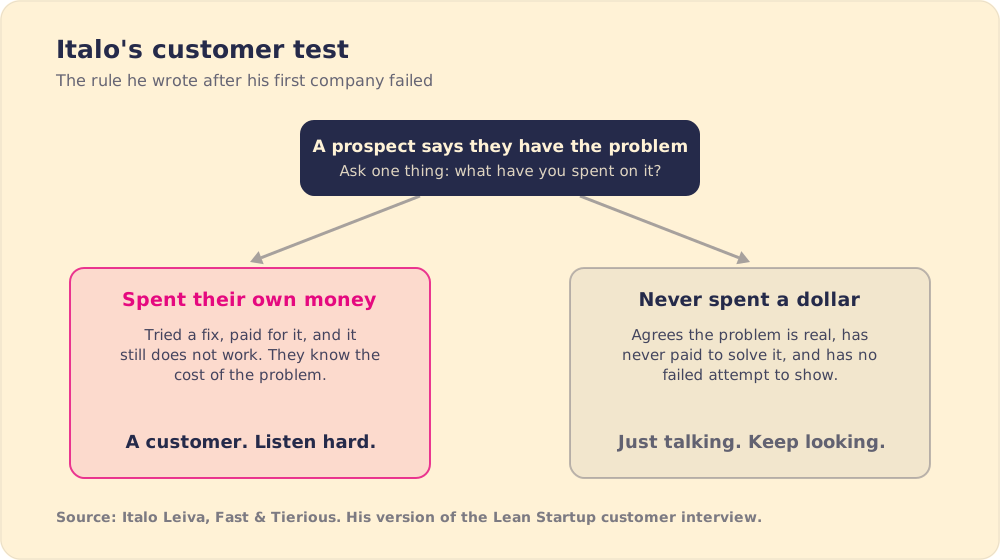
His first product never had that evidence behind it. He had a prize and a clever idea, and no buyers who had already paid to learn guitar faster with color. CB Insights’ 2026 analysis of 431 venture-backed shutdowns found 43% cited poor product-market fit. Running out of capital came first at 70%, though the analysts call cash “almost always the final cause of death, not the root problem” (CB Insights, 2026).
The test fits healthcare well, because practices have spent money on this problem for years: billing services, marketing vendors, and systems that don’t talk to each other. Italo sat at those desks. For an agency founder, the working version is one line on a first call: show me what you have already bought to fix this.
If they have bought nothing, keep the call short.
Why wasn’t leading by example enough to build Peddle’s culture?
Italo tried that first. He assumed the team would learn how he treats clients by watching him. “I thought maybe just by leading or by doing it people would pick it up. It’s not enough. We need to document it, we need to have a few meetings on it, we need to have it like constantly reinforced.”
The first rule he wrote down is response time. Many of Peddle’s clients are small practices and family businesses, and he talks about a slow reply as a worry he is putting on someone.

“This is their business,” he said. “A lot of them small businesses, how they feed their family.” Speed also wins the work. In an audit of 2,241 US companies, firms that tried to reach a web lead within an hour were nearly 7x as likely to qualify it as firms that waited longer (Harvard Business Review, 2011).
Some of what he had to write down surprised him. He came to us at RevPartners to ask how we had scaled our culture, and part of our answer was teaching people how to run a meeting: how to open it, how to take notes, how to follow up afterward. “I would have never thought I need to teach someone how to hold a meeting,” he said. Starting that January, Peddle documented its processes one step at a time.
Writing a rule down is the first half; checking that it happens is the second. In the State of Sales Enablement 2026, 48% of reps on the most closely inspected teams hit 76 to 100% of quota, against 6% on teams that are rarely inspected (The State of Sales Enablement 2026). At Peddle, that checking is the “constantly reinforced” part of Italo’s rule.
He also pointed to a piece of the revenue flywheel that service businesses tend to leave off the diagram. Marketing brings leads, sales closes them, delivery serves them, and then you need more people to serve more leads. He called it “this hidden part of the revops circle”: hiring and training, because some of your best people will leave to start companies of their own.
He is glad when they do. He wants the training ready before they go.
What would Italo never do again?
He would never again chase revenue first and write things down later. “I really should have taken the time to like document the processes as I went,” he said. As the RevOps guy, he put his energy into making revenue predictable and assumed he would handle the rest as it came in. Back-documenting a running agency was painful, and it turned up processes he had thought were fine that needed cutting. His warning is about the belief that “the money will fix all the problems later, because it doesn’t.”
His second regret is building alone for too long. He has run companies with a partner and without one, and the partnered ones moved faster. He is now bringing senior people in with equity, and he credits the publisher Felix Dennis with the push to find a business partner.
Italo’s own line: “the one plus one should make 11.”
Peddle has more leads than it can take, and Italo keeps the focus on the hard, technical builds and passes simpler work to other partners. “If we did this to be rich, we would have just done the easy part.”
Italo Leiva’s lessons for healthcare and agency founders
- Healthcare’s revenue discipline. Revenue cycle management tracked each dollar from the first call to the paid claim long before SaaS called it RevOps. Put that same deadline on the front of the funnel.
- The spent-money test. In Italo’s rule, a prospect who has paid to fix the problem is a customer, and one who has only described it is talking.
- Culture in writing. Leading by example did not carry Peddle’s standards to the team. Documents, a few meetings and steady reinforcement did.
- Response time as rule one. For a small practice, a slow reply from its agency is a worry about how the family gets fed.
- Documentation as you go. Italo back-documented a running agency and found processes he had to cut. He would write them as he built them next time.
What should a practice or agency take from Peddle?
If you run a practice and are weighing HubSpot for healthcare, settle the legal side with your compliance counsel and the Enterprise sensitive data settings. Then put your effort where Italo puts his: a written response window, rules the team sees while they work, and a regular check on what slipped. If you run an agency, take his customer test into your next discovery call, and start documenting this month instead of after the next growth spurt.
Supered helps with the second half of that advice. It shows the next step inside HubSpot while the work is happening, which is where Italo wanted Peddle’s processes to live. If you are a partner building an agency like his, start at our partner page. For more on getting a team to use the CRM they have, read our piece on CRM adoption, and for the first weeks in a new portal, the HubSpot onboarding checklist.
Frequently asked questions
Is HubSpot HIPAA compliant?+
What is HubSpot for healthcare used for?+
Why does Italo Leiva say healthcare had RevOps first?+
How fast should a practice respond to a new patient inquiry?+
What would Peddle's founder do differently?+
Your process, running itself.