A HubSpot Retainer Sold by the Day: Lessons From CRM Squad's Eli Zheleva
Four recruiters kept meeting companies paying for CRMs their teams had stopped using, so they started CRM Squad. Eli Zheleva on zombie subscriptions, the day-rate HubSpot retainer most clients buy, unreliable freelancers, and the admin hire she wishes she made first.
A HubSpot retainer is an ongoing agreement in which a company pays a consultant or agency a recurring fee for continuing HubSpot work, and at CRM Squad 85 to 90% of clients buy one at a negotiated day rate that reaches the whole team.
CRM Squad started with something its four founders kept running into. All of them came from recruitment, some in-house and some agency-side, and “we have been exposed to so many businesses over the years,” Eli Zheleva said. Again and again they met companies that had bought a CRM with the best intentions and were still paying for it every month, long after it had stopped doing anything for them. Eli, co-founder and Chief Problem Solver, calls these “zombie subscriptions.”
The founders built a HubSpot consultancy around fixing them, and most clients now pay for it through a HubSpot retainer. Two and a half years in, CRM Squad had eight people, about 80% of its revenue tied to HubSpot in some way, and a plan to reach 10 or 11 by the end of the year. It went from Gold to Platinum in about five months, and the month we recorded, HubSpot named Eli a community champion.
She told me how they got there on an early episode of Fast & Tierious. Her lessons are useful to anyone building a consultancy, and to anyone hiring one: start with the CRM the client already owns, sell time with the whole team, keep your promises in-house, and get the founder an assistant early.
What does a HubSpot CRM consultant fix that the original build missed?
Eli described what the founders saw from recruitment. Companies buy the product, and then “either the champion is no longer there, other things happen, there’s not high adoption.” The subscription keeps renewing, and the business keeps paying for software that no longer does anything for it.
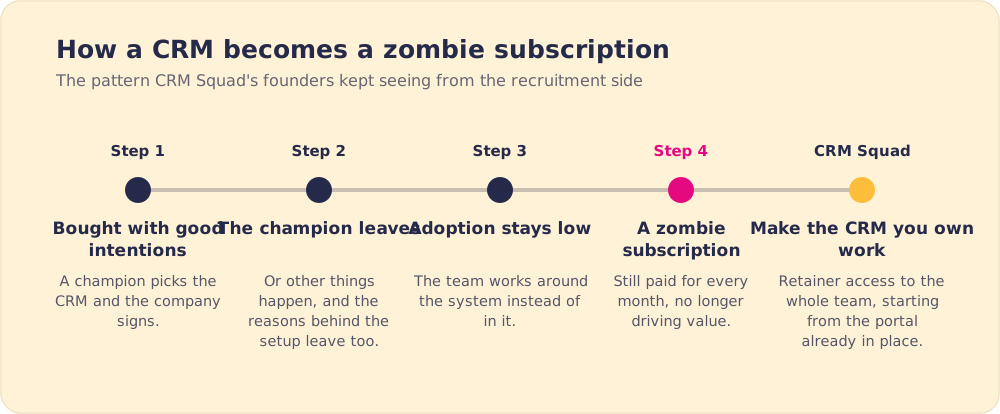
Zylo’s 2025 SaaS Management Index found organizations wasting an average of $21M a year on unused SaaS licenses, up 14.2% year over year (Zylo, 2025). People also move on. The median US wage and salary worker had been with their employer 4.1 years as of January 2026 (US Bureau of Labor Statistics, 2026), and when the person who chose the CRM leaves, the reasons behind its fields and stages often leave with them. Our own survey asked why sales tools go unused: 55% said reps do not see the value, 51% said managers do not reinforce the tool, and 48% said it is not built into the workflow (The State of Sales Enablement 2026).
So CRM Squad went after companies that already had a CRM. The founding idea, in Eli’s words, was to help companies that already have a CRM in place and “just don’t know how to make the most of it.” Often the CRM is how they get in the door even when the main service is something else. Some clients hire them for performance marketing, which they then measure and nurture inside the client’s HubSpot.
The founders support Salesforce, Dynamics, Zoho, Pipedrive, and monday.com too. They made HubSpot the focus because they expected it to grow and because “the interface is easy to use, so we felt that the adoption rate will be higher.” As a startup, she said, they had to be careful where their time went, and that meant picking one platform.
If you already pay for HubSpot and your team avoids it, look for a consultant who starts from the portal you have and asks how your team works today, before anyone proposes a rebuild. Our 7-day HubSpot audit is one place to begin, and our piece on CRM adoption covers why teams drift away from the tool.
How does a HubSpot retainer work at CRM Squad?
A HubSpot retainer means the client pays the agency on a recurring basis and the agency keeps working in the client’s portal, instead of starting and stopping with each project. Agencies shape it differently. Some promise a monthly list of tasks and some sell a bank of hours.
Eli sells days of the team’s time. It took CRM Squad a while to get there.
The founders are good at a lot of things, and that made packaging their first hard problem. For the first year and a half, the go-to-market was, in her words, “let’s see how we can help you.” They only wrote their service offerings down, to put them on the website, about a year before we spoke. She credits that step with much of the growth since.
Today 85 to 90% of clients are on retainer, at a day rate CRM Squad negotiates with each one. A retainer gives the client access to the whole team. That includes a co-founder who built and sold his own recruitment company, whose advice on growing a business Eli says almost no other HubSpot agency could offer. The day rate does not change with the task or the industry.
She learned the model as a freelancer, when prospects asked what her fee covered. “I can sort out your SEO, I can train your team, I can make your coffee. It’s going to be expensive coffee, but I can make you coffee.”
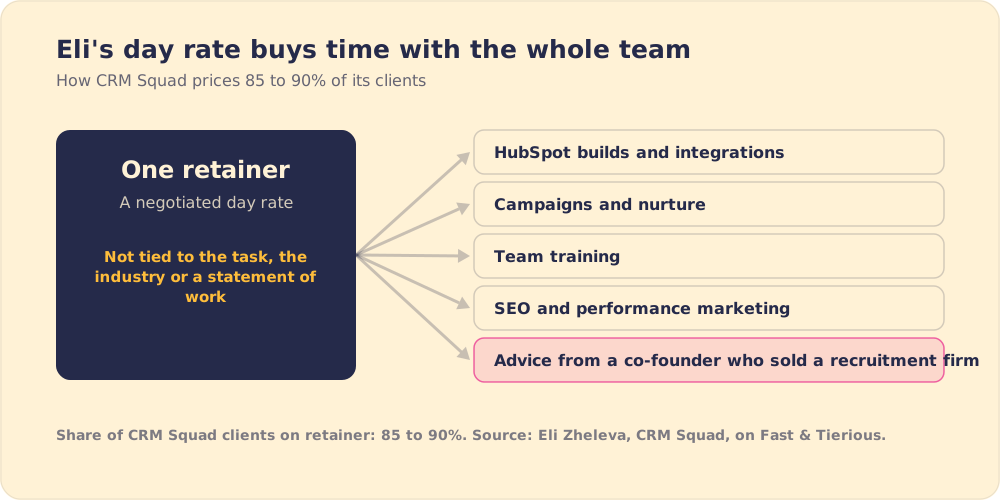
Under the joke is a plain idea. The client pays for the team’s time and lets the team decide, with them, where it goes. “We’re here to add value, that’s the ultimate goal, not to be shoehorned into statement of work,” she said, though she allows that a statement of work is sometimes required. She works the same way as a mentor in the UK government’s Help to Grow scheme, where she coaches owners on whatever will help their business most.
The founders also chose to grow slowly. CRM Squad was “very strategic on not to grow too fast,” Eli said, because it took time to settle what the firm offered. They wanted new hires to arrive knowing what CRM Squad does and how they could add to it.
Why can’t an agency outsource its promises?
In the early days much of CRM Squad’s work was project-based, because clients were testing them out, so the firm leaned on freelancers. Eli described how that went wrong. A call with a client goes well, the client asks for something extra, and the team says yes, planning to hand it to a freelancer. Then the freelancers go silent. One quoted £100 an hour, which she found “quite ambitious,” and never replied once CRM Squad sent the project.
The client still expected the work, so the team did it. “We wouldn’t jeopardize our name in front of the client,” she said, “so the late nights, the weekends, all that.” Her guess about the silent freelancers is blunt: they had oversold what they could do and got scared when the scope arrived.
The fix came from the founders’ own trade. They ran a full interview process for the first couple of hires, then started hiring people they had worked with at previous companies, people whose work they had already seen. Four recruiters ended up trusting a track record over a pitch.
What does an admin hire buy a founder?
When I asked what she wished CRM Squad had done sooner, Eli did not name a sales hire or a product. She named an assistant.
For the first year, the founders did everything: sales, marketing, finance, payroll, quotes. She kept “lists upon lists upon lists of tasks,” and many of them were follow-ups on follow-ups. None of it needed HubSpot skills. “It just takes my cognitive capacity,” she said. With six or seven meetings a day, the notes from a morning call might wait until 6 p.m. to go into the system, and she admits, “hand on heart,” that a couple of things slipped over the years. CRM Squad now has a project management system, and she recently hired a virtual assistant service.
Sophie Leroy’s experiments on attention explain the cost. She found that “it is difficult for people to transition their attention away from an unfinished task and their subsequent task performance suffers” (Organizational Behavior and Human Decision Processes, 2009). Seven unanswered follow-ups come along into the next client call, whether the consultant wants them there or not.
Eli did not frame any of this as regret. Asked what she would never do again, she said every step was “a learning opportunity,” and that the firm paid for the lessons and came out stronger. Her goals for the year were to take CRM Squad past the 1 million revenue mark and to hold every certification in HubSpot Academy herself. She already had 35, and earned 17 of them in a single certification week.
What Eli Zheleva has learned building CRM Squad
- The CRM the client already owns. Zombie subscriptions are a market: paid for, barely used, and waiting for someone to make them work.
- Time with the whole team. A day-rate retainer lets the client and the consultant decide together where the hours go, instead of fixing a scope before anyone understands the problem.
- Promises kept in-house. When a freelancer disappears, the agency’s name is still on the promise, so hire people whose work you have seen.
- An assistant early. Follow-ups and meeting notes need no HubSpot skill, and they eat the attention the client work needs.
- Growth at the pace of the offer. Writing down the offer before growing the team let new hires join a company that knew what it did.
What should you ask before signing a HubSpot retainer?
If you are about to sign a HubSpot retainer, bring your existing portal and ask what they would fix before what they would rebuild. Ask how they price, and whether you are buying their judgment or a fixed list of tasks. Ask who does the work if a subcontractor falls through. Eli had clear answers to all three, and the consultant you hire should too.
If you are building a HubSpot partner consultancy, copy her order: write down the offer, then grow the team, and hire the assistant sooner than feels comfortable. Supered helps with the part she cares about most, keeping a client’s team working in the HubSpot they already pay for by showing the next step inside the CRM while they work. Partners can learn more on our partner page. For the business case behind that work, read our guide to CRM ROI.
Frequently asked questions
What does a HubSpot CRM consultant do?+
What is a zombie subscription?+
How does a HubSpot retainer work?+
What should a HubSpot retainer include?+
Should a HubSpot consultant be tool agnostic?+
When should a small agency hire an admin or virtual assistant?+
Your process, running itself.


