HubSpot Certifications and the Borg: How Heather Trains Geekly Media's Team
Heather's Geekly Media never lacked demand. It lacked people who knew both HubSpot and property management. How she used HubSpot certifications, where they stopped, and the standard she and Michael built before training anyone.
HubSpot certifications are free credentials from HubSpot Academy that confirm a person knows how HubSpot works; they prove tool knowledge and leave industry expertise and a firm's own way of delivering to be taught separately.
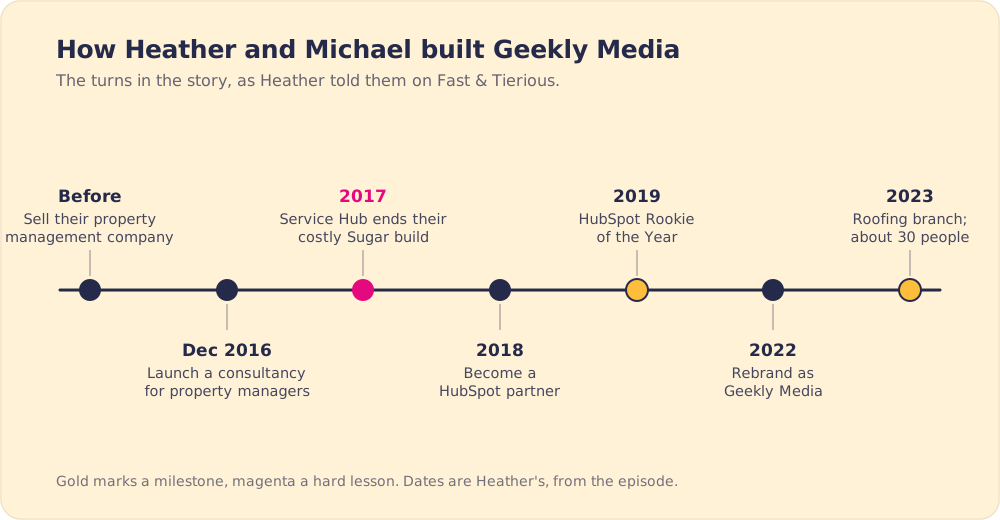
The first time Heather asked HubSpot to build with them, HubSpot told her to go away. She and her husband Michael had sold their single-family property management company and started consulting for property managers. They needed one system where clients could hear from them and carry out their advice. They explained the plan, and HubSpot’s answer, as Heather tells it, was “real estate’s out we don’t do real estate.” They looked elsewhere, found nothing, and came back: “just let us try.” Years later, HubSpot advertises to the real estate industry.
Heather told me that story on Fast & Tierious. She is co-founder of Geekly Media, a HubSpot partner of about 30 people that serves the housing industry and was HubSpot’s Rookie of the Year in 2019. Much of our conversation was about hiring, and about where HubSpot certifications helped her team and where they stopped. Geekly rarely ran short of clients. It often ran short of people who could deliver. Her answer was to standardize the product before training anyone on it, to hire people who knew the industry as well as the tool, and to turn down tempting work even inside her niche.
How did a property management couple end up building on HubSpot?
Heather fought it at first. When Michael joined the consultancy full-time, he started shopping for platforms, Sugar and Salesforce among them. “I kept telling him we’re not a technology firm,” she said. “I need you to focus.”
They decided to build their own system inside a white-labeled Sugar instance. They hired developers and spent, in Heather’s words (she said it twice), “an embarrassing amount of money.” Then HubSpot released Service Hub in 2017, with ticketing, and the project had no reason to exist. “I’m like flipping tables,” she said. They became a HubSpot partner in 2018.
They held on to the niche even when it caused confusion. HubSpot kept sending them leads from outside property management, people who landed on the website and wondered how they got there. In 2022 the firm rebranded as Geekly Media. Its main product is PMOS, a property management operating system built inside HubSpot, and it is hard to build because the industry is complicated. Michael likes to say property management is “like eight businesses in one”: a leasing company, a maintenance company, a cleaning company and a locksmith at once. “Every door you add you’re adding at least two more humans that you have to talk to,” Heather said.
What does “Borg” mean at Geekly Media?
The first version of PMOS was built fresh for each client. Heather’s description: “sure welcome to McDonald’s what do you want on your burger.” Each client got a different build, and some took Geekly’s people years to finish. She called standardizing PMOS the hardest problem the firm faced.
Michael’s fix came from science fiction. He wanted to “Borg” PMOS, to pull every build into one shape. Heather says none of the team knew what a Borg was, herself included. New hires still search “what is Borg in HubSpot,” and Heather admitted they “fail to tell them” it is a made-up word. The idea worked anyway. Geekly brought each build to about 80 to 85% the same, and left 15 to 20% to customize “within reason.”
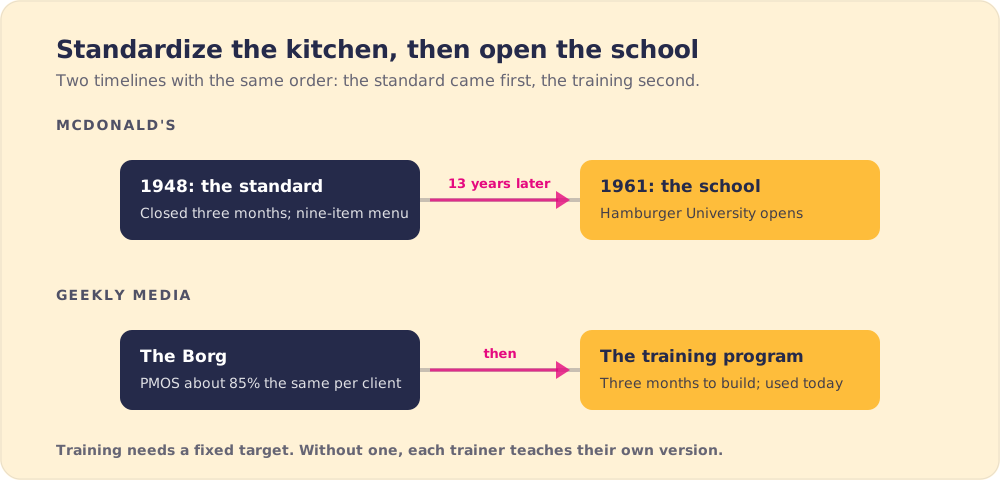
McDonald’s, as it happens, went through the same sequence. In 1948 the McDonald brothers closed their San Bernardino restaurant for three months and reopened with a menu cut to nine of their most profitable items (Wikipedia; McDonald’s history). Hamburger University, the company’s training school, opened in 1961, 13 years after the menu was fixed. Geekly also settled the product first and built the school after.
Why weren’t HubSpot certifications enough for Geekly’s hires?
Geekly had more work than people to do it. Heather described the hiring choice in one breath: “do we go get somebody with PM experience and train HubSpot or do we go get somebody with HubSpot experience and train PM neither were easy.”
HubSpot certifications cover the HubSpot half. HubSpot is careful about what they prove: “Certifications confirm that your team has the knowledge” (HubSpot Solutions Partner credentials). They come from HubSpot Academy, which HubSpot calls its “free, self-paced learning and training resource” (HubSpot Academy FAQ). A certified admin can find their way around the portal. They still have to learn what a leasing agent does all day and how Geekly builds PMOS.
Geekly found part of the answer among its own clients. A few of them sold their property management businesses, and some of their staff came to work at Geekly, bringing years in the industry with them. Then Michael, Heather said, “spent three months doing absolutely nothing but creating our training program.” The firm still uses it, updated along the way. It has moved from Teachable to LearnUpon, which connects to HubSpot, with a custom intranet next to it.
Michael could build that program because the Borg had already happened. With PMOS about 85% the same from client to client, he had one way of building to teach. Before the Borg, a new hire would have learned whichever version their senior colleague happened to build.
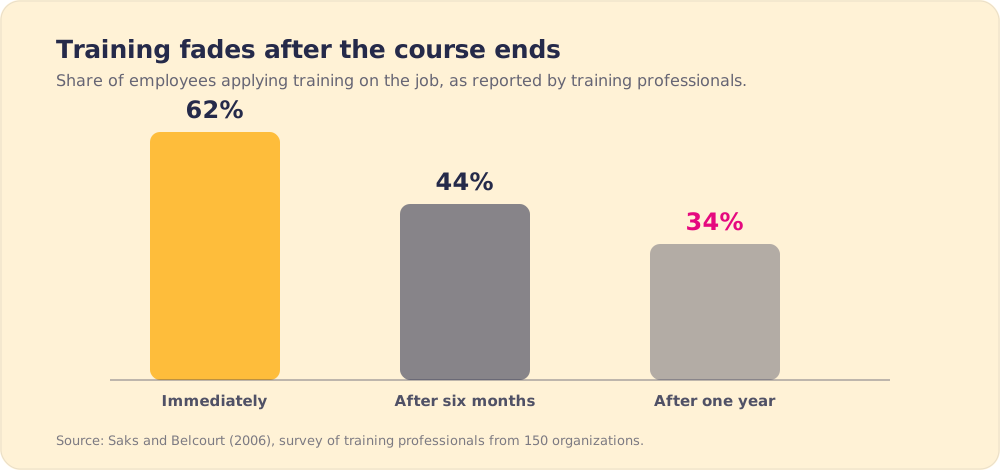
A course by itself also fades. When Alan Saks and Monica Belcourt surveyed training professionals from 150 organizations, they reported that 62% of employees applied training on the job immediately, 44% after six months, and 34% after one year (Saks and Belcourt, Human Resource Management, 2006). Geekly’s program teaches the same build the new hire will do on their first client, so the lesson and the daily work stay close together.
Our survey of sales leaders found something similar. In The State of Sales Enablement 2026, the amount of training varied little between teams hitting quota and teams missing it. Execution consistency varied a lot: 3.83 out of 5 for teams in the top quota band against 3.00 in the bottom (The State of Sales Enablement 2026). Clients pay for work done the house way, and our post on the knowing-doing gap covers why knowing the steps and doing them drift apart.
Why does Heather say no to shiny objects?
I asked Heather for the one thing a partner should never do. She named “shiny object syndrome,” and she meant it inside a niche too: “trying to be everything to everyone even within your Niche is a mistake.” Geekly still slips sometimes. “The price tags are too big,” she said, and the demand is sitting right there.
She thinks about what a new product costs to stand up. A new operating system needs its own build, its own training program and its own way to check the work. “You’re basically building another business at that point,” she said. So Geekly is not building more operating systems. It is improving PMOS and the systems it already sells.
On the episode I compared a second product to a second baby: people have one because they forget how painful the first birth was. A second product needs “a good reason with a business plan because you’re starting another business,” I said. Heather: “exactly you really are and you’ve got to staff it and support it.”
Niching was also her answer when I asked what she wished she had done sooner. Heather and Michael used to run a separate local marketing agency, and they eventually folded it into the housing business. Turning away everything outside housing scared her. “It was the best decision we ever made,” she said.
The one new line Geekly did add grew out of work it was already doing. Years of roofing clients became their own branch in 2023, with a product built for roofers, and it is the firm’s big bet. Heather was frank about the risk: if it fails, Geekly will pivot, and “we’re really good at pivoting um sometimes too good.”
What keeps a founder up at night at 30 people?
Heather calls herself “a professional worrier.” Cash flow is always on her mind, because “there’s always another resource I want to add.” Her biggest worry is quality control, and she was quick to say her people are not the cause: “the team is incredible and it’s not them that’s the problem.” What worries her is losing sight of the work as the firm grows. “I swear I’m like a dog sometimes out of sight it might as well be dead,” she said.
Geekly runs on EOS to keep that view, and the Borg helps. When a build is supposed to be 85% the same as the last one, a reviewer can spot the part that drifted. With a one-off build, the reviewer is guessing.
Her parting advice to new partners was to “go in eyes wide open.” She described “a love question mark relationship with HubSpot these days,” and said a firm should decide early whether it will be a HubSpot agency through and through or pay for the developers to integrate with anything.
Heather’s lessons on training a HubSpot team
- HubSpot certifications as the floor. They confirm tool knowledge and give a new hire a shared vocabulary from HubSpot Academy.
- Industry knowledge hired in. Geekly recruited people from its own clients’ property management firms to bring the domain with them.
- A standard before a school. The Borg made PMOS about 85% the same per client, which gave Michael a fixed target for three months of building the training program.
- Focus inside the niche. A new operating system is a new business with its own build, training and review.
- Visibility at 30 people. Heather’s worry is whether the work matches the standard where she cannot see it.
How should a HubSpot partner use HubSpot certifications?
We would follow Heather’s order. Require HubSpot certifications at hire or in the first few weeks, because the shared vocabulary saves time. Hire for the industry, or teach it separately, using people who have worked in it. Then spend the real effort on a written house standard and a program that trains to it. Hours of HubSpot partner training go further once there is one way of building for a new person to learn.
The last step is the one that keeps Heather up: seeing whether the work matches the standard. Geekly built its productized offers (seats, implementation and ongoing management) on Supered, and her team calls them its “supered” products. HubSpot partners in our partner program use Supered to put the house standard inside HubSpot, so a new hire sees the next step while doing the work and a founder can see where a build drifted.
If you are deciding what a credential should prove before you require it, read our take on what a sales certification proves. For the factory-floor version of Geekly’s Borg, read about standard work.
Frequently asked questions
What are HubSpot certifications?+
Are HubSpot certifications worth it for a new hire?+
Do HubSpot certifications expire?+
Are HubSpot certifications free?+
How should a HubSpot partner train new hires?+
Your process, running itself.

