Standard Work: The Floor You Improve From, Not the Cage
Standard work sounds like rigidity. Taiichi Ohno meant the opposite: it is the stable floor that makes improvement possible, because you cannot improve a process nobody runs the same way.
Standard work is the documented, agreed-upon best-known way to do a task, and in the Toyota Production System it is not a cage but the stable floor that makes improvement possible, because a process nobody runs the same way cannot be measured or improved.
Say “standard work” to a room of talented people and watch them flinch. They hear a cage, a script, a manager who does not trust them to think. It is one of the most useful ideas in the history of operations, and it is buried under one of the most persistent misreadings, because the man who built the idea meant almost the exact opposite of what the phrase suggests. Taiichi Ohno did not invent standard work to freeze people in place. He invented it so they could climb.
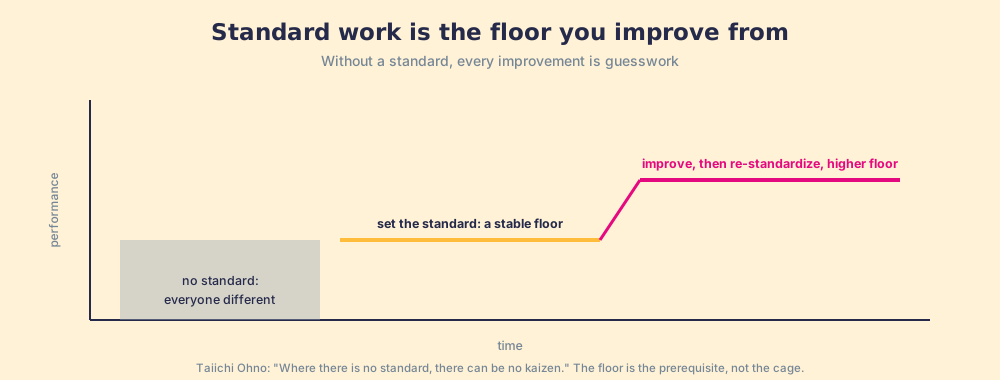
Standard work is the documented, agreed-upon best-known way to do a task, and in the Toyota Production System it is not a cage but the stable floor that makes improvement possible, because a process nobody runs the same way cannot be measured or improved. Hold the floor image. It is the whole reframing, and it turns a constraint into a launchpad.
The flinch is worth taking seriously, because it is half right. There is a version of standardization that does cage people, and the field has lived through it. Frederick Taylor’s scientific management, a century ago, handed the standard down from an engineer with a stopwatch to a worker who was told to obey it and not think. That is the ghost in the room when someone hears “standard work,” and the resentment is earned. Ohno’s standardized work, which became the heart of standard work in lean, inverted Taylor on the one point that matters: the standard is not handed down, it is captured from the people doing the work, and it is theirs to improve. Taylor’s worker was a pair of hands. Ohno’s worker is the author of the next standard. Same word, opposite philosophy, and almost everyone who flinches is flinching at Taylor while we are talking about Ohno.
What is standard work, and what are its three elements?
Standard work came out of the Toyota Production System, where Ohno defined it precisely as three elements working together, not a vague “do it this way” (Toyota Production System / standardized work).
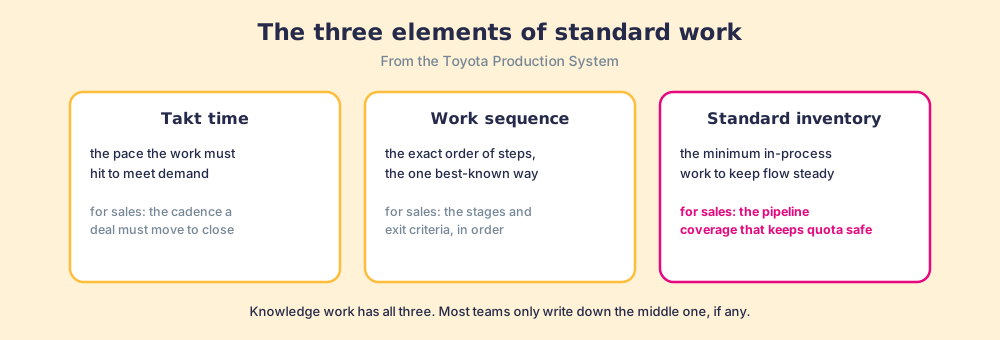
- Takt time. The pace the work must hit to meet demand. In sales, this is the cadence a deal must move at to close in time, the rhythm a healthy pipeline keeps.
- Work sequence. The exact order of steps, the single best-known way to do the task. In sales, this is the stages and the exit criteria, in order.
- Standard inventory. The minimum work-in-process needed to keep flow steady. In sales, this is the pipeline coverage that keeps quota safe without flooding reps.
All three apply to knowledge work, not just to a factory line. The reason most teams write down only the work sequence, if they write anything, is that the other two feel like someone else’s job. They are the same job.
Why is standard work the prerequisite to improvement?
Because improvement is measured against a baseline, and without a standard there is no baseline, only noise. Ohno put it in a line worth quoting in full: “Where there is no standard, there can be no kaizen” (Taiichi Ohno, Toyota Production System, 1988). His protege Masaaki Imai, who carried kaizen to the West, sharpened the same point: “There can be no improvement where there are no standards. The starting point of any improvement is to know exactly where you stand” (Imai, Kaizen, 1986). If ten reps run a deal ten different ways, and the close rate moves, you cannot say which way caused it, or whether anything caused it. You are guessing. Set the standard, and a change becomes a measurable experiment: run the new method, compare it to the floor, keep it if it wins, and re-standardize at the higher level.
There is hard evidence that a written standard, actually run, changes outcomes in exactly this way, and it comes from a setting more demanding than a sales floor. When the World Health Organization introduced a 19-item surgical safety checklist across eight hospitals, inpatient death rates fell from 1.5 percent to 0.8 percent and major complications fell from 11 percent to 7 percent (Haynes et al., New England Journal of Medicine, 2009). The surgeons already knew the steps. The checklist was standard work, a fixed sequence run the same way every time, and the gain came not from new knowledge but from making the known steps consistent enough that a deviation became visible. That is the mechanism: a standard turns variation into signal.
This is the deep reason consistency beats brilliance. A mediocre process run the same way by everyone can be measured and improved into a good one. A brilliant process run differently by everyone cannot be measured at all, so it never improves and never spreads. The standard is what makes talent repeatable and improvement possible, which is the argument laid out in sales process adoption.
How do you set standard work for knowledge work without killing judgment?
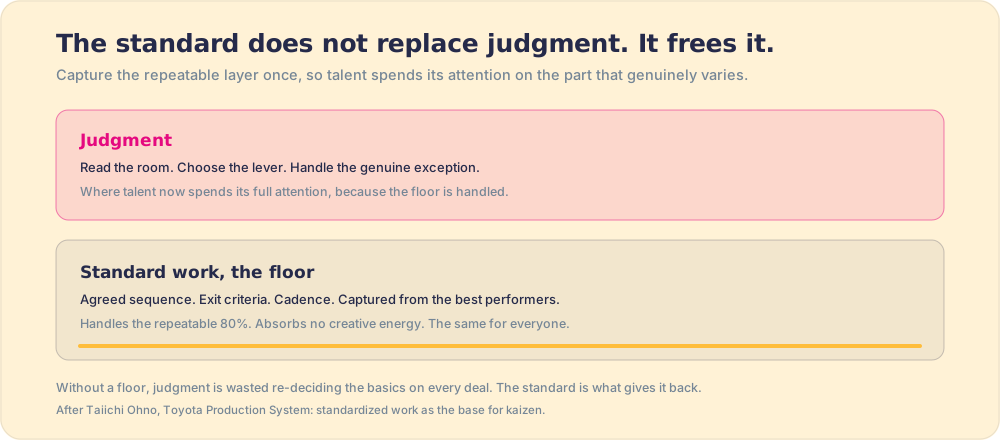
The fear is that standardizing knowledge work flattens the judgment that makes it valuable. It is a fair fear, and the answer is in how Ohno did it, not in pretending the fear is silly. Capture the best-known way from your best people rather than inventing it, and standardize within a segment, not rigidly across genuinely different motions. The standard should hold where the work is the same (a mid-market deal of a given size) and flex where it genuinely differs. Most of what feels like irreducible variation between reps turns out, on inspection, to be undocumented preference rather than real difference, and that is the part standard work captures. The genuine judgment, reading a room, choosing which lever to pull, sits on top of the standard, not under it.
Then deliver it at the moment of work and inspect adherence, because a standard nobody runs is not a standard. This is where the lean idea meets a hard limitation of paper: Ohno could post standardized work at the station because the work happened at the station. Knowledge work happens across a dozen tabs, so the standard has to travel to the moment, not wait on a wiki for someone to remember it exists.
The cost of skipping this step is measurable. In the State of Sales Enablement, across 198 sales leaders, 89 percent had a defined process and only 36 percent saw their reps follow it. That 53-point gap is a standard that was written and never run, which by Ohno’s definition is not a standard at all, just a document. And the teams that closed it were rewarded: where the process reached people in the flow of the work, quota attainment was 49 percent, against 15 percent where it did not.
What we recommend
Treat standard work as the floor, not the ceiling, because that is what Ohno built it to be. Write down all three elements for the work that is genuinely repeatable, takt, sequence, and inventory, and pull the standard from your best performers rather than a template nobody believes in. Standardize within a segment and leave real differences alone, so the standard earns trust instead of resentment. Then improve against it deliberately: change one thing, measure it against the floor, and re-standardize when it wins. The teams that fear standard work as a cage never get to improve, because they never had a baseline to improve from. The standard is the first step to doing anything well, and the launchpad for doing it better.
From here: the adoption argument in sales process adoption, the documentation method in process documentation, and the improvement loop in process improvement.
Frequently asked questions
What is standard work?+
What are the three elements of standard work?+
Does standard work stifle creativity and improvement?+
How does standard work apply to sales and knowledge work?+
Your process, running itself.