RevOps Agency Lessons From Colten's First Year at elefante
Colten flew to Brazil on a one-way ticket, freelanced on Upwork, and co-founded elefante RevOps the month his daughter was born. What he learned about partners, hiring, and process in the first year of a RevOps agency.
A RevOps agency is an outside firm that designs, builds, and often runs the revenue operations layer (process, CRM, data, and reporting) that connects a company's marketing, sales, and customer success teams.
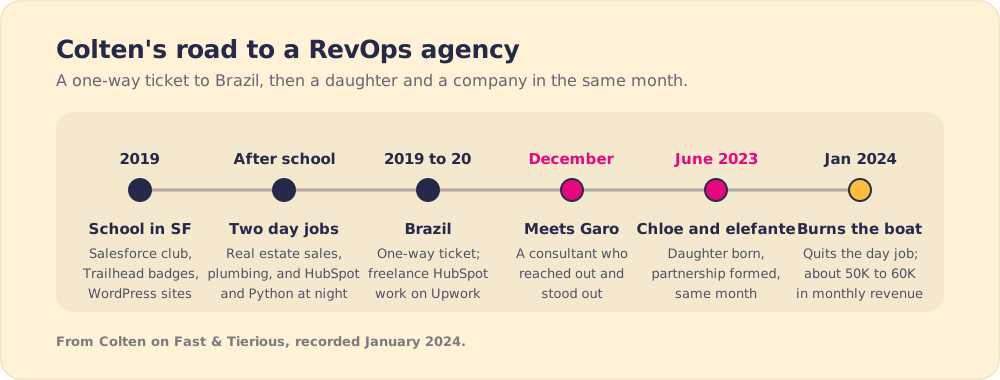
Colten flew to Brazil without a return ticket. He had a marketing degree from school in San Francisco, a stack of Salesforce Trailhead badges, and a habit of learning HubSpot and Python at night while he sold commercial real estate and worked construction and plumbing jobs by day. In Brazil he freelanced as a HubSpot consultant on Upwork. Within a few years he had a daughter, a co-founder, and a RevOps agency, and the daughter and the agency arrived in the same month.
Colten, co-founder and CEO of elefante RevOps, joined me on Fast & Tierious in January 2024, a few days after he quit his day job. elefante had placed 15th in HubSpot’s Rookie of the Year list and reached Platinum about seven months after joining the partner program. He was still learning how to run a RevOps agency, and he talked about it that way, including the parts he would do differently.
What does a RevOps agency do, and why did Colten start one?
A RevOps agency is an outside firm that designs, builds, and often runs the revenue operations layer (process, CRM, data, and reporting) that connects a company’s marketing, sales, and customer success teams. A revenue operations agency usually sells two kinds of work: fixed-fee revops consulting projects, such as an audit or a HubSpot implementation, and monthly retainers where the agency works as a fractional RevOps team. Demand has been building for years: in 2021 Gartner predicted that 75% of the highest-growth companies would deploy a RevOps model by 2025.
Colten came to HubSpot from the Salesforce side, and he switched because HubSpot was easier to teach. “What really stood out with me was the simplicity of HubSpot compared to Salesforce,” he said. “It was just really easy for me to pick up and be able to teach others how to use the platform.” He kept one habit from the other camp, and offered it as advice to anyone learning: take a Salesforce admin course on Trailhead first, then come to HubSpot, “and you will know how to use HubSpot better and you will appreciate it more.”
The turn from freelancer to founder came with his daughter. He had been living in Brazil for about two years when he and his partner learned they were expecting. “That was my oh moment,” he said. “I got to get my things together.” He took a full-time job and kept doing HubSpot work on the side. That December, a consultant named Garo Aroian reached out about working together on projects, and Colten noticed quickly that Garo was “night and day compared to other contractors I’ve worked with.” The family moved back to the United States in April, Chloe was born in June, and the same month Colten and Garo formed the partnership that became elefante RevOps.
Why does Colten tell founders to partner early?
Colten never pictured elefante as a solo shop. “I knew that I wanted this to be something big and I couldn’t do it alone,” he said. “You can do more in numbers if you can find the right people.”

His conditions are specific. “I would suggest partnering early if you find someone that has the same energy, has the same vibe, can grind and work hard with you,” he said. Garo became what Colten called “a soundboard,” the person he bounces ideas off before moving on. He also talked about the harder days: “There’s a lot of lows, there’s a lot of ups, and it’s great sharing all of it together.”
Colten’s point about speed has support. The Startup Genome Project’s study of more than 3,200 startups found that solo founders took 3.6 times longer to reach the scale stage than a founding team of two (Startup Genome Report Extra on Premature Scaling, 2012). I started my own HubSpot partner with a co-founder, and I told Colten what I noticed: when someone is running beside you, you speed up a little, and now and then you have to look at each other and agree to slow down.
Colten picked his co-founder on pace and work ethic first. He and Garo had both freelanced on Upwork, so each knew the other could find and keep clients alone. They had already worked projects together for six months before they formed the company.
What would Colten never do again when hiring for a RevOps agency?
Colten’s hardest lesson came from contractors. “One thing I would not do again is let anyone too close to the core of the business,” he said. “I would not bring contractors especially too close to how you’re operating your business.” elefante had grown on 1099 contractors. The change he was making in 2024 was toward W2 employees, “who they can feel like this is their business just as much as it’s like our business.”
He was candid that hiring was his weak spot. “It’s hard finding people who can work like Garo and I do,” he said, and he was already looking at bringing in someone for people operations to help.
So he hired slowly. elefante wanted a senior salesperson to take over pre-sales and help pick a niche, and Colten admitted why he started him fractional: “Frankly we couldn’t afford him.” He also liked what the slower start did for the firm. Bringing the hire on part time first “helps with us not moving too fast and breaking things and not being able to recover.”
The Startup Genome research found the same risk at scale. Of the high-growth startups it studied, 74% failed because they scaled prematurely, adding people and spending ahead of what the business could support. Colten’s fractional hire let elefante see the salesperson’s work for a few months before committing to a full salary. If you run a RevOps agency, you can do the same with your next senior hire: a fractional contract with a defined scope, converted once the work and the fit hold up.
Which processes did Colten wish he had written down earlier?
Asked what he would do sooner, Colten answered in one word: process. “I think we did the best we could to build our processes and SOPs on how we do things,” he said, “but structurally I wish we did that earlier just so we had our systems laid out for us internally as well as externally with our clients.”
He split the work in two. On the pre-sales side, the founders wrote SOPs “on exactly how we go through the process of qualifying leads and then closing leads into customers,” so the new sales hire could ramp on a written process. On the post-sales side, the handoff lands with Colten or Garo, who both moved into customer success. The delivery SOP builds a ClickUp board, loads the scoped tasks, and sets the client on bi-weekly sprints, with the full scope agreed on the discovery call. Colten also named the effect on clients: the process makes the buyer “comfortable with understanding what they’re going to get.”
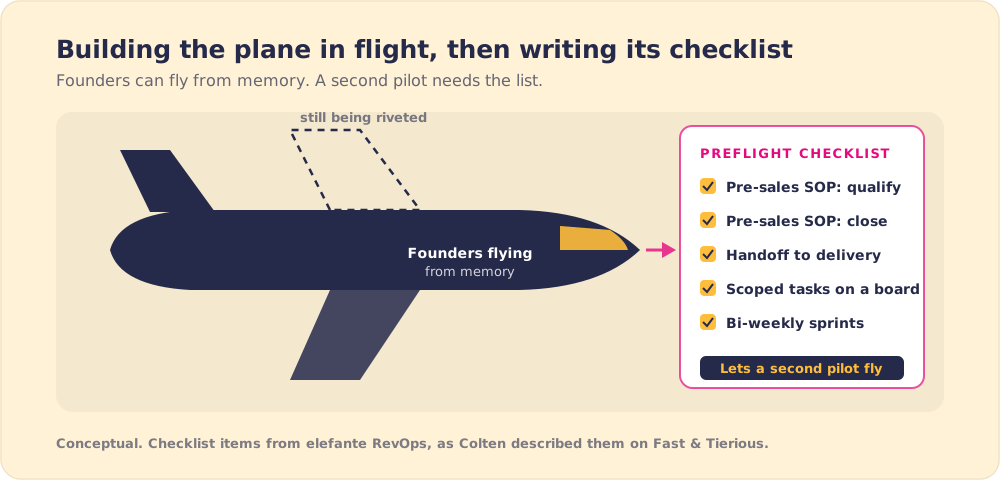
His image for elefante’s early months was a plane still under construction in the air: “we’re learning and building the plane as we’re going.” Pilots wrote their answer to a version of that problem long ago. After the Boeing Model 299 crashed at Wright Field in 1935 because an expert crew forgot to release the control locks, Boeing’s pilots wrote the preflight checklist, a short list any trained crew could run the same way. Medicine later measured the same move: a 19-item surgical safety checklist cut deaths from 1.5% to 0.8% across eight hospitals, with the same surgeons (Haynes et al., New England Journal of Medicine, 2009).
Colten’s two SOPs cover two stages that come up often when revenue teams say where deals go wrong. In The State of Sales Enablement 2026, 16% of respondents named handoffs as the stage where deal execution breaks down most, and another 16% named qualification. elefante keeps its delivery SOP inside the ClickUp board the team opens each day, so the steps are in front of whoever runs the handoff.
How should you apply Colten’s lessons to your own RevOps agency?
- A co-founder at your pace. Colten found Garo through client work and tested the fit on real projects for six months before forming the company.
- A small inner circle. Contractors still do client work at elefante, but the core of how the firm runs stays with full-time employees.
- A fractional first step. The senior sales hire started part time because elefante could not yet afford him full time.
- A written pre-sales process. Qualification and closing steps on paper, so the first sales hire ramps on the founders’ method.
- A written handoff. A board, scoped tasks, the scope set on the discovery call, and a steady sprint rhythm the client can see.
What came next for elefante?
Colten left the episode with three goals for 2024: double to six full-time people, reach 1.2 million in revenue, and earn the next partner level by December. He also planned to niche down, citing another partner who had grown by serving one industry deeply, because a firm that knows an industry’s problems arrives “two steps ahead.”
elefante’s site now lists HubSpot’s Customer First award for North America in 2024, 2025, and 2026 and more than 200 verified reviews on G2 and HubSpot (elefante RevOps). You can see how elefante works with Supered on our elefante partner page.
If you are building a RevOps agency now, our recommendation follows Colten’s order. Find a partner who matches your pace. Keep the core close while you hire slowly. And write the pre-sales and handoff process before you think you need it, because the first person you hire will need it on day one. Supered helps HubSpot partners put that written process inside the CRM where their team and their clients work; the partner program covers how.
For the next step, read our guide to how to write an SOP people follow, which takes the pre-sales and handoff documents Colten described and makes them stick.
Frequently asked questions
What does a RevOps agency do?+
How do you start a RevOps agency?+
Should a RevOps agency use contractors or employees?+
What processes should a new RevOps agency document first?+
Is it better to start a RevOps agency with a co-founder?+
Your process, running itself.