Sales Certification: What the Credential Actually Proves
A sales certification proves a rep finished a curriculum and passed a test. Teams read it as a sign the rep can run the method on a real deal. It is not. Here is the gap between the credential and the competence, and how to close it.
A sales certification is a credential that proves a rep completed a curriculum and passed a test on a selling method, which makes it a signal of declarative knowledge, what the rep can recall, and not a signal of whether the rep can run that method with a real buyer in the room.
Hand a sales leader two reps, one certified in your chosen method and one not, and ask which is the safer bet to put on a hard deal. Most will point to the certified rep without a pause. The certificate feels like proof. It went on a wall, it took a course and a test, and somewhere in the file there is a passing score. Then the certified rep gets on the call, the buyer pushes back in a way the curriculum never covered, and the rep reaches for a script that is not there. The credential was real. The competence was assumed. That gap between what a sales certification proves and what we read into it is one of the most expensive habits in enablement, and it is worth taking apart honestly.
A sales certification is a credential that proves a rep completed a curriculum and passed a test on a selling method, which makes it a signal of declarative knowledge, what the rep can recall, and not a signal of whether the rep can run that method with a real buyer in the room. Get that distinction right and the whole question of whether sales certifications are worth it answers itself.
What does a sales certification prove?
Start with what is genuinely true, because the case against the credential is only credible once the case for it is granted in full. A good sales certification does three real things. It builds a knowledge floor, a level of method literacy every rep on the team clears, so no one starts from a blank page. It creates a shared vocabulary, so when a manager says “you skipped the economic buyer” the rep knows which step that names. And it supplies motivation, a deadline and a passing bar that make a rep study a method properly instead of skimming a deck. A team where everyone has passed the same MEDDIC or SPIN certification speaks one language, and that alone removes a lot of friction. If anyone tells you certifications accomplish nothing, they are wrong, and they have not watched a team without a common method try to coach each other.
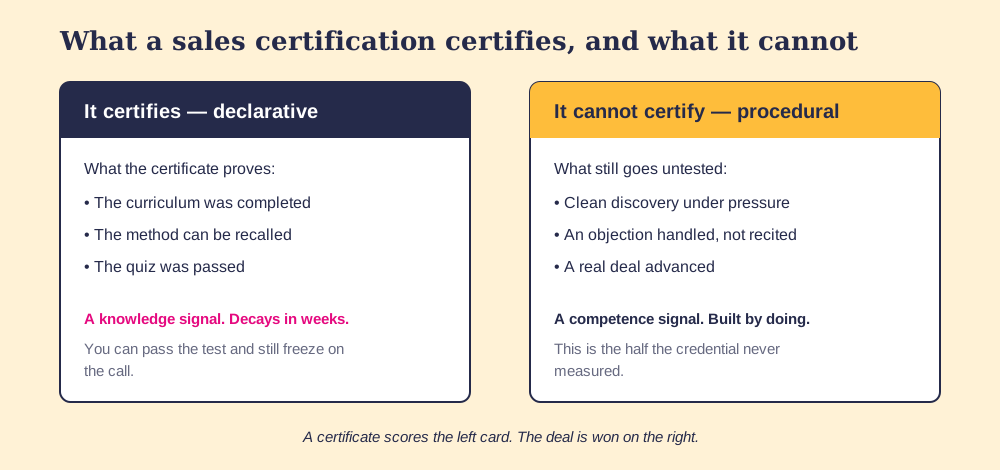
Here is where it turns. Each of those benefits is a knowledge benefit. The floor is a knowledge floor, the vocabulary is a knowledge vocabulary, the motivation is motivation to learn. A certification is, by its mechanism, a test of what the rep can state. Selling is not something a rep states. It is something a rep does, in real time, with a skeptical human on the other end. Cognitive psychology has named this split for decades: declarative knowledge is knowing-that, the facts and rules you can recite, and procedural knowledge is knowing-how, the skill you can perform. They are stored and built differently, and one does not convert into the other by passing a quiz. You can know every rule of swimming and sink. The certificate scores the rules. The buyer meets the swimmer.
Why doesn’t a sales certification predict performance?
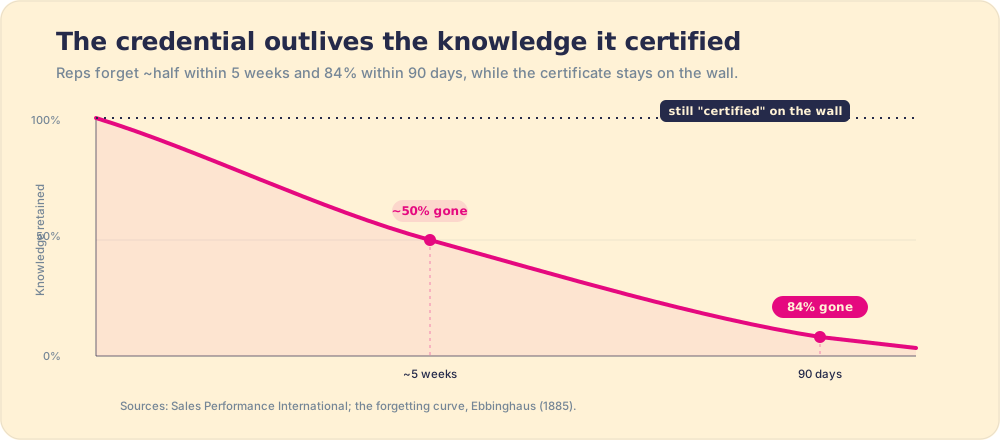
Because the thing it measures evaporates, and the thing it claims to vouch for was never tested. Take the evaporation first. Hermann Ebbinghaus mapped the forgetting curve in 1885, and the shape is unkind to anything taught as an event: most of what is learned in a sitting is gone within days. Sales Performance International, studying sales programs specifically, found that reps forget about half of what they learned within roughly five weeks and 84 percent of it within 90 days. So the certificate hanging on the wall in March is, by June, vouching for knowledge that has largely left the building. The rep is still “certified.” The knowledge it certified is not still there.
Now the deeper problem, the one no amount of refreshing fixes. Even if the rep retained every word, retention is the wrong currency. Skill is procedural, and procedural skill is built one way: by doing the thing, repeatedly, with feedback, under conditions close to the real ones. This is the most replicated finding in the science of expertise. Anders Ericsson’s 1993 study of violinists established that expert performance tracks accumulated deliberate practice, focused repetition with immediate feedback, not hours of instruction (Ericsson, Krampe & Tesch-Römer, Psychological Review, 1993). A certification course has almost none of those ingredients. It has instruction and a test. The test confirms the instruction landed; it says nothing about whether the rep can perform.
Frank Cespedes of Harvard Business School has made the case for years: most sales training is an event, disconnected from the selling context and rarely reinforced, so it fails on its own terms (Cespedes, “Your Sales Training Is Probably Lackluster,” HBR, 2017). US companies pour roughly $15 to $20 billion a year into sales training, about $1,459 per rep, and a certificate at the end of that spend is the receipt, not the result. It proves the money bought a course the rep completed. It does not prove the rep changed. This is the same engine behind the knowing-doing gap that sits under most enablement disappointment: we keep buying knowledge and expecting behavior.
Are sales certifications worth it, then?
Yes, and the answer has to be honest about both halves. A certification is worth what it is: the cheapest reliable way to put a shared method and a knowledge floor under a whole team at once. For onboarding a new cohort, for getting forty reps speaking one language, for giving a rep the structured push to learn a framework properly, the best sales certifications earn their cost, and the strongest sales certification programs are built to do exactly that. No role-play scales that fast, and no manager has the hours to teach the BANT or MEDDIC ground rules to each new hire from scratch.
What is not worth it is the silent upgrade we perform on the credential, the move from “this rep knows the method” to “this rep can sell with it.” That upgrade is the failure. It lets a leader mistake a ready rep for a certified one, when readiness is the procedural competence and the certificate measured only the knowledge. It tells a manager the coaching is done, when the coaching has not started. And it bends the budget toward more courses and more credentials, fighting the forgetting curve and losing, when the lever that moves selling sits somewhere the test never looks.
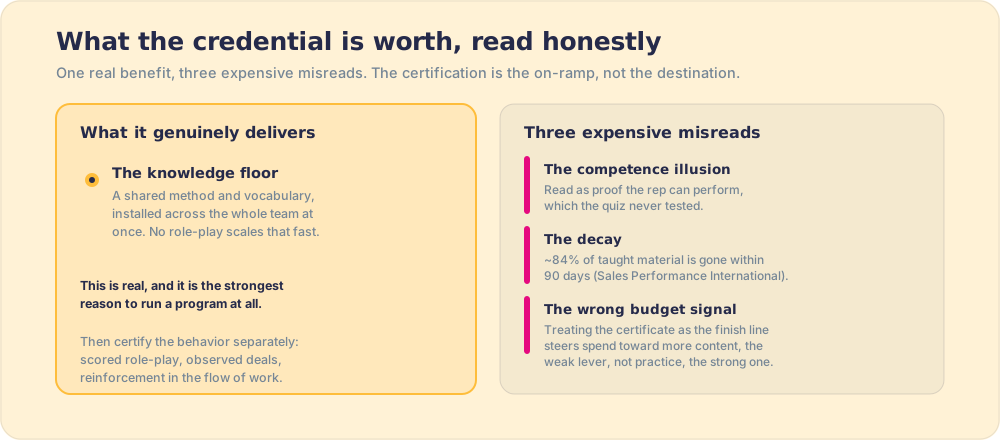
- The knowledge floor. A certification reliably installs a shared method and vocabulary across a team. This is real, and it is the strongest reason to run a program at all.
- The competence illusion. The credential gets read as proof the rep can perform, which it never tested. This is the expensive misread, and it is where a sales certification substitutes for inspection without anyone deciding it should.
- The decay. Roughly 84 percent of taught material is gone within 90 days (Sales Performance International), so even the knowledge the certificate vouches for fades unless something reinforces it.
- The wrong budget signal. Treating the certificate as the finish line steers spend toward more content, the weak lever, instead of toward practice and reinforcement, the strong one.
How do you make a sales certification mean competence?
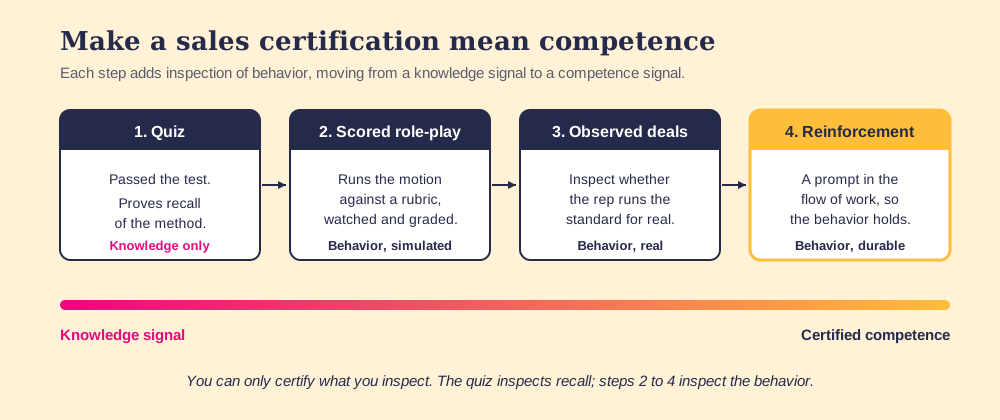
Keep the certification. Then make it certify the thing that matters by adding inspection of behavior, because you can only certify what you inspect. The curriculum and the quiz stay, doing their honest job of installing the knowledge floor. After that, the credential earns its meaning in three more steps, each one moving the signal from “this rep knows” toward “this rep does.”
- Scored role-play. Before the certificate is granted, the rep runs the motion against a rubric, watched and graded, not on a multiple-choice screen. A simulated deal is a poor substitute for a real one, but it is a far better proxy for competence than a quiz, because it tests performance under at least some pressure.
- Observation of real-deal behavior. Inspect whether the certified rep runs the standard once they are selling, deal by deal, the way the best sales coaching programs already watch real calls rather than self-reports. This is the step that turns a credential into evidence, and the one most programs skip entirely.
- Reinforcement in the flow of work. Deliver the right prompt the instant the rep needs it, while the work is in motion, so the behavior holds instead of decaying with the rest of the course. A cue at the moment of action does what a certificate on a wall cannot: it lands where the skill is used.
When a certified rep still does not run the method, the reading is almost never that the rep is lazy or forgot the training. It is that the right action was not easy, not visible, and not reinforced while they worked. That is a system to fix, not a person to blame. The fix is to make the standard explicit, observe whether it happens, and put the prompt where the work is. This is precisely why we train on output, not input: the input is what the rep knows, and a certification measures it well; the output is what the rep does, and only inspection of behavior can certify that.
What to do with your certification budget
There are three ways to spend, and they pay back differently. You can run more certification programs and collect more credentials, which buys a knowledge floor and then watches 84 percent of it leave within 90 days. You can treat the certificate as the proof of competence and skip the inspection, which is the cheapest option and the one that produces certified reps who freeze on the call. Or you can keep the certification for what it is genuinely good at, the shared method and the knowledge floor, and spend the rest on the part that builds competence: scored role-play, observation of real deals, and reinforcement at the moment of work.
We recommend the third, without hedging, because it is the only spend that matches how procedural skill is built. The certification is the on-ramp, not the destination. Its job is to install the method; the job of turning that method into reliable behavior belongs to practice, inspection, and a prompt that reaches the rep in the moment the question arises, which is the role sales training software is finally being judged on. Supered exists to be that layer, the Behavior Layer, surfacing the standard and the next best step the instant the rep needs it, in the flow of work, so the certified method becomes the run method.
The credential is not the problem. A sales certification is a fine thing to hand a rep, and a poor thing to mistake for proof they can sell. It certifies what the rep knows. Certify what the rep does, and the wall will finally tell the truth.
Frequently asked questions
What is a sales certification?+
Are sales certifications worth it?+
What are the best sales certifications?+
Do sales certifications make reps better at selling?+
How do you make a sales certification mean competence?+
Your process, running itself.