B2B Intent Data: What It Sees, How Old It Is, and Who Acts on It
What B2B intent data is, the four kinds and what each sees, what providers cost from a few hundred dollars to $68,591 a year, why a surge is up to three weeks old when it lands, and the rule that sends each signal to one rep.
B2B intent data is behavioral evidence that a company is researching a problem, product category or vendor, collected from your website, partner sites such as review platforms, or publisher networks, and scored so sales can see which accounts are in market.
A fire lookout spends the summer in a glass room on a mountain, watching a hundred miles of forest for smoke. When she sees a thin grey column rising from a far ridge, she knows three things and does not know three others. She knows something is burning, roughly where, and that it was not burning last week. She does not know what is burning, who is standing next to it, or which crew will drive out to look. Her report is worth exactly as much as the dispatch that follows it.
B2B intent data is behavioral evidence that a company is researching a problem, product category or vendor, collected from your website, partner sites such as review platforms, or publisher networks, and scored so sales can see which accounts are in market. It is the lookout’s report, and it has the same three blind spots. The short version of this guide:
- A company, rarely a person. Most intent data names the account. HubSpot’s own help center says its Buyer Intent identifies the company behind a visit by IP address, not the individual.
- An old signal. Bombora, which built the third-party category, scores a surge on the most recent three weeks of research. By the time a rep sees it, the smoke has been rising for a while.
- No crew on the order. The providers sell the sighting. The value sits in the rule that sends it to one rep with a play and a deadline, and that rule is yours to write.
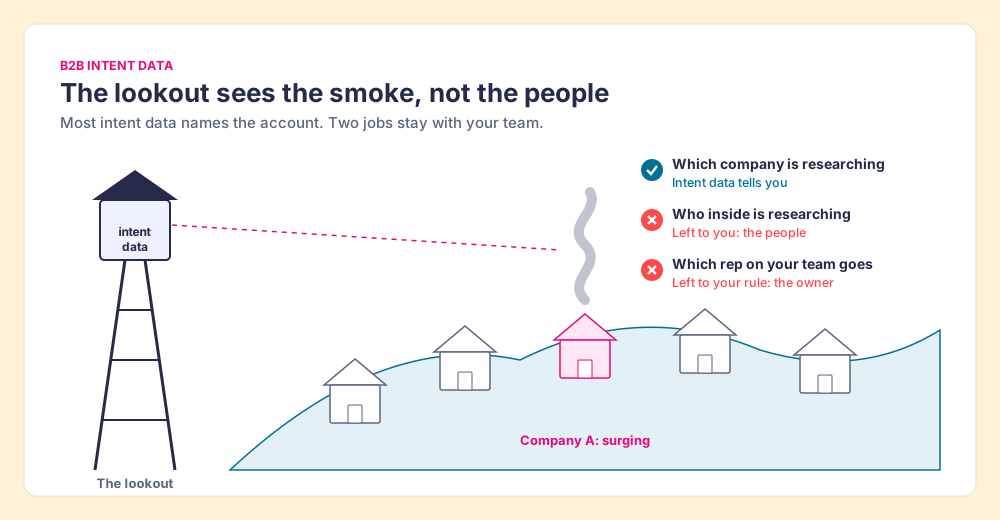
The pages that rank for this term define the three data types, list a dozen providers and stop at the sighting. Percepture’s provider list says it plainly: intent data tells you something is happening, “but not who to contact or what to say.” This guide covers the definitions and the providers with prices, then the two questions those pages leave open: how old a signal is by the time it reaches a rep, and who acts on it.
What is B2B intent data?
The plainest answer to what is intent data comes from a company that scores it, caveat included. Demandbase defines B2B intent data as “behavioral information that indicates an account may be researching topics related to a business problem, product, or solution,” and in the same breath warns that intent is a signal and “not proof that someone is ready to buy” (Demandbase, answered August 11, 2026). Read every intent score with that sentence in mind.
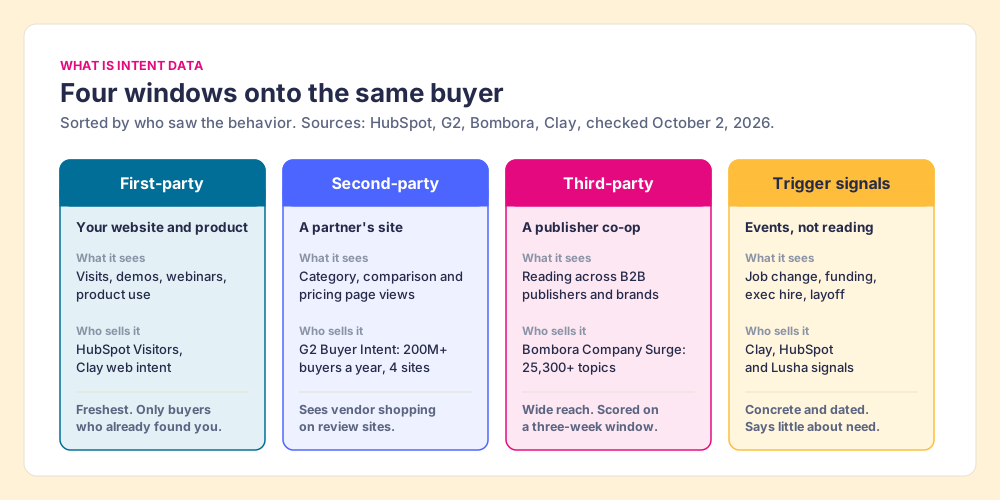
The data comes in four kinds, sorted by who saw the behavior:
- First-party intent. Activity on your own website, product, emails and webinars. You own it, it is the freshest, and it only covers buyers who already found you. HubSpot calls its version Visitors; Clay calls it web intent.
- Second-party intent. A partner’s first-party data, sold to you. G2’s Buyer Intent captures “category research, competitor comparisons, pricing page visits,” across what G2 says is more than 200 million buyers a year on G2, Capterra, Software Advice and GetApp (G2).
- Third-party intent. Reading behavior pooled across a network of publishers you never visit. Bombora “continuously monitors company research activity against 25,300+ topics” across a co-op of B2B publishers and brands (Bombora).
- Trigger signals. Events, not reading: a job change, a funding round, an executive hire, a layoff. HubSpot’s list runs from funding rounds to office closures and IPOs (HubSpot, updated September 24, 2026). Job change tracking is the most common trigger play, and we cover it in its own guide.
One mechanism in third-party scoring explains why intent scores confuse sales teams. Bombora measures how much more a company reads than it usually does. Its method uses “relative, account-specific scoring that compares the most recent three weeks of activity against a 12-week historical baseline.” A thermometer works the same way: 99 degrees is a fever for one patient and a normal morning for another. A large company that researches CRM software all year long never surges on the topic, and a 200-person firm that suddenly starts reading about it does. A surge measures a change in behavior. Read it as a ranking of who reads the most and a rep will chase the wrong accounts.
Why does buyer intent data matter now?
Because buyers do most of the work before they talk to anyone, and intent data is the only view into that stretch.
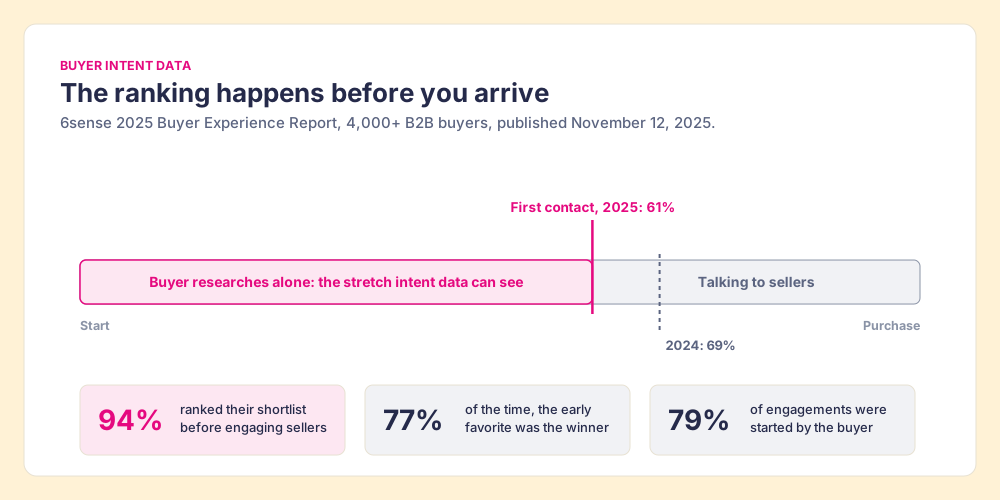
6sense surveyed more than 4,000 B2B buyers for its 2025 Buyer Experience Report (6sense, published November 12, 2025). The findings, in order:
- Buyers start the conversation. Buyers initiated 79% of engagements with sellers in 2025, against 82% in prior years.
- First contact comes late. The point of first contact moved from about 69% of the way through the buying process in 2024 to 61% in 2025. Earlier, and still past halfway.
- The shortlist is ranked before you arrive. 94% of buyers said they ordered their shortlist by preference before engaging with sellers.
- The early favorite usually wins. The vendor that led the selection phase was the final winner 77% of the time.
Gartner puts the buying group at 6 to 10 people (Gartner), so that ranked shortlist is a committee’s opinion, formed in private. Put the numbers together and the case for buyer intent data is short: the ranking that decides most deals happens in the first 61% of the process, where the buyer is reading and you are invisible. Intent data is a window onto that stretch. A rep who reaches a researching account while the shortlist is still forming has a chance to be on it; a rep who waits for the inbound form meets a buyer who ranked the vendors weeks ago.
One limit on the picture: 6sense sells intent data, and a survey that finds buyers hide from sellers suits its product. The method is a large multi-region survey, published with year-over-year comparisons, and the direction matches Gartner’s long-standing finding that buyers spend a small share of their process with suppliers. Lean on the direction more than the decimal.
How old is an intent signal when it reaches a rep?
Older than the dashboard makes it look, and the age matters more than any other property of the signal.
Look up at night and the star you see is light that left it long ago. The star may have changed since; you are reading its past. A third-party surge works the same way. Bombora’s score compares the last three weeks of research against the account’s own 12 weeks of normal, so a surge that appears today summarizes reading that started up to three weeks back. Then the signal travels: from the provider into a platform, from the platform into the CRM, from the CRM into a list someone reviews. The comparison stops at one point. A company still in the middle of research keeps glowing, so an old surge can still point at a live buyer. It cannot tell you whether the buyer’s shortlist was ranked last Tuesday.
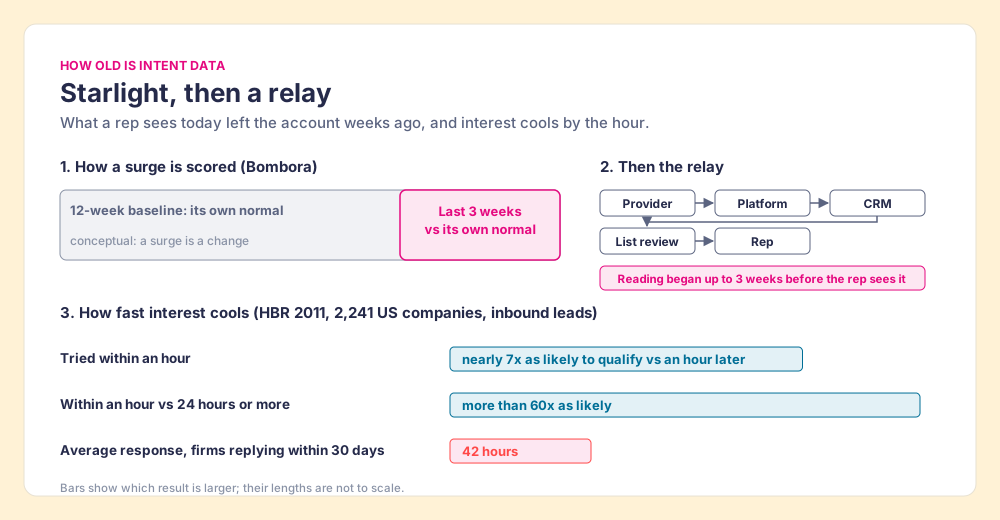
How fast does interest cool? No one has published a decay curve for third-party intent, so borrow the best study on the nearest thing. In “The Short Life of Online Sales Leads,” James Oldroyd, Kristina McElheran and David Elkington audited 2,241 US companies and found that firms that tried to contact a lead within an hour were “nearly seven times as likely to qualify the lead” as firms that waited even an hour longer, and more than 60 times as likely as firms that waited 24 hours or longer (Harvard Business Review, 2011). The average response time, among the companies that responded within 30 days, was 42 hours. Those were inbound leads, people who raised their hand, and an intent surge is weaker evidence than a form fill. The direction still holds: interest is perishable, and every hop between the signal and the rep spends some of it.
The same article names why companies were slow, and the list reads like a description of how many teams handle intent data today. The authors found firms “retrieving leads from CRM systems’ databases daily rather than continuously,” sales forces “focused on generating their own leads rather than reacting quickly to customer-driven signs of interest,” and “rules for distributing sales leads among agents and partners based on geography and ‘fairness.’” Swap “leads” for “intent signals” and change nothing else. A weekly intent report reviewed in a pipeline meeting is the daily database pull, slowed down. The speed to lead guide covers the inbound version of the same clock.
Which intent data provider fits your team?
The providers differ less in what they detect than in what they bundle around it. Here are the main options by kind, with the price evidence we could find, checked October 2, 2026:
| Provider | Kind of intent | What it names | Price evidence | Fits |
|---|---|---|---|---|
| Bombora Company Surge | Third-party co-op, 25,300+ topics | Account, plus persona-level research | Vendr median $25,000/yr (35 purchases) | Teams that want the raw feed in their own tools |
| 6sense | Platform: third-party plus first-party, with ads and orchestration | Account and buying stage | Vendr median $62,440/yr (385 purchases) | Larger marketing-led ABM programs |
| Demandbase | Platform: same shape as 6sense | Account | Vendr median $68,591/yr (187 purchases) | Larger marketing-led ABM programs |
| G2 Buyer Intent | Second-party, review-site research | Account, by category and competitor viewed | Quote only | Software sellers whose buyers shop on G2 |
| HubSpot Buyer Intent | First-party visitors, research network, signals | Company by IP, not the individual | 10 credits per company per month for signal monitoring | HubSpot teams starting from zero |
| Clay | Trigger signals from Launch; web intent on Growth; any provider in its marketplace | Company or person, depending on the signal | Launch $167/mo, Growth $446/mo, billed yearly | Teams with a GTM engineer who routes signals into tables |
| Data vendors with intent add-ons | Cognism Pro (Bombora topics); RocketReach (Intentsify topics) | Account | Inside the vendor’s own contract | Teams already buying that vendor’s contacts |
Sources: Vendr marketplace pages for Bombora, 6sense and Demandbase; HubSpot’s credits catalog; Clay pricing; Cognism’s pricing page (Pro lists “up to 12 intent topics from a library of over 11,000 options,” checked October 1, 2026); RocketReach’s February 17, 2026 release on expanding intent with Intentsify’s “35,000+ intent topics.”
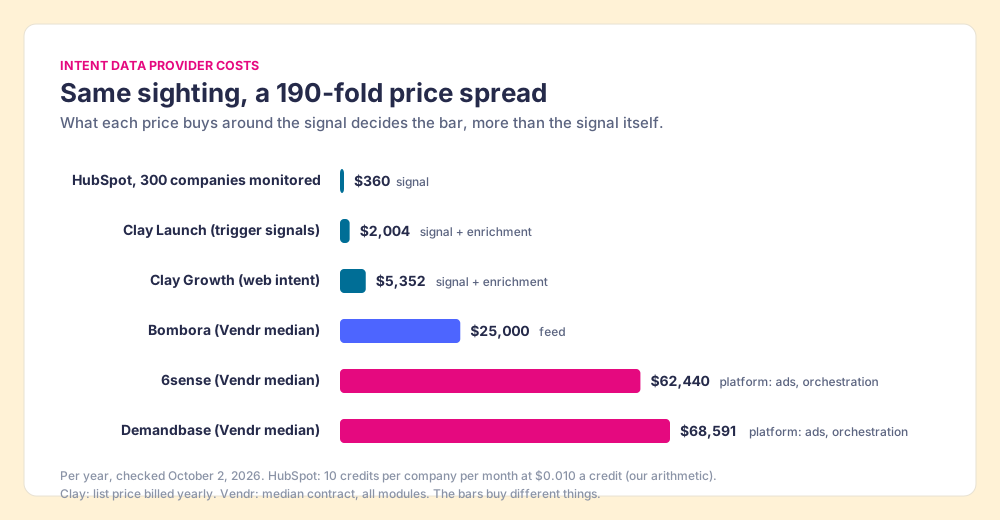
The spread is wide, and the bars measure different purchases. A 6sense or Demandbase contract buys a platform with advertising, orchestration and services inside it. A Bombora contract buys the feed, which then needs somewhere to go. Clay’s Growth plan, $5,352 a year billed yearly, buys web intent signals plus 6,000 data credits a month for enriching what the signals find. HubSpot’s credit catalog charges 10 credits to monitor one company for intent signals for one month and sells pay-as-you-go credits at $0.010 each, so watching 300 companies costs $30 a month, $360 a year (our arithmetic), and Sales Hub Professional includes 3,000 credits a month, enough for those 300 if the credits do nothing else.
Sorted by the job, the choice gets shorter:
- A HubSpot team with no intent data today. Turn on HubSpot’s Buyer Intent first. It costs credits you may already have, and it teaches the team whether anyone acts on a signal before you pay five figures for more of them.
- A marketing team running account-based advertising. 6sense or Demandbase, because the ads and orchestration are the point and the intent data feeds them.
- A software company whose buyers compare vendors on review sites. G2 Buyer Intent sees the comparison and pricing page views no publisher co-op sees.
- A team that runs Clay. Signals and web intent come with the plan, the marketplace covers the third-party feeds, and the GTM engineer decides where each signal goes. The missing piece is on the rep’s side, and the next two sections cover it.
The sales intelligence vendors that bundle intent into a contact database are the weakest fit for a team that already has Clay: you buy the same sighting twice. Our sales intelligence platforms guide sorts those vendors by the job they do.
What should a rep do when an intent signal fires?
Go back to the lookout. When she calls in smoke, the dispatcher hands the order to a named crew, with the coordinates, the equipment to bring and a time to be on site. In many sales teams, intent data goes to a board anyone can read: a dashboard, a weekly list, a Slack channel. The first rep to notice may take it, a second may take it too, or it may sit.
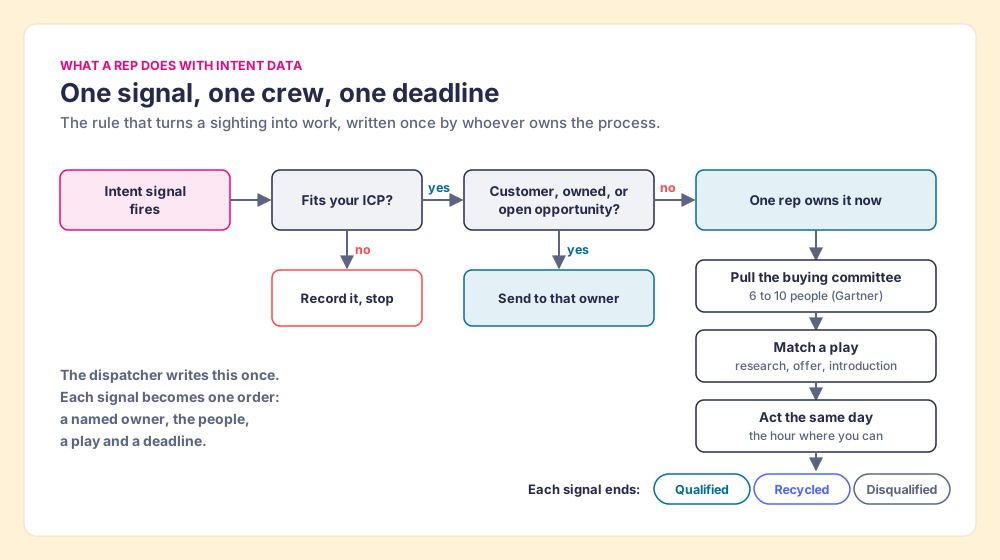
The fix is a dispatch rule, written once by the person who owns the process, that turns each signal into one order:
- The fit check. Does the account match your ideal customer profile? A surge at a company you cannot sell to is smoke on someone else’s land. Record it and move on. What is an ICP covers the definition to check against.
- The owner check. Is the account a customer, owned by another rep, or in an open opportunity? Then the signal goes to that owner alone. A second rep calling into a live account is two crews arriving at the same fire from opposite directions.
- The people. The signal names a company; the rep needs the 6 to 10 people Gartner says sit in a buying group. Pull the buying committee your team defined, by title and seniority. The B2B buying committee guide covers who those people are.
- The play. Match the signal to a play: a surge on your category gets the research play, a pricing-page visit gets a direct offer, a new executive gets an introduction. The play decides the sequence and the message.
- The deadline. The same day the signal reaches the owner. HBR’s hour is out of reach for a three-week surge, but the 42-hour average the authors found is the habit to avoid.
- The ending. The signal ends one of three ways: qualified into pipeline, recycled for later, or disqualified with a reason. A signal with no ending was never worked.
When reps ignore intent signals, the usual diagnosis is that they do not trust the data. Sometimes that is fair; Demandbase itself says a surge is not proof. More often the signal arrived in a place the rep does not work, without an owner, without the people, and without a play, so acting on it meant an hour of research before the first email. The system handed the rep homework and called it a lead. Fix the system: put the signal, the owner check and the people where the rep already is, and make the right next action one click.
Where does Supered Prospector fit with intent data?
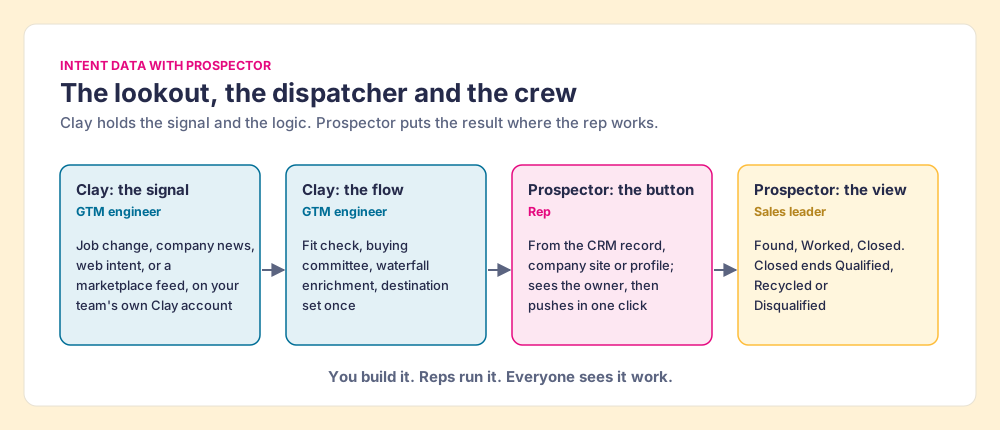
Clay plus Supered is the best way for a sales team to prospect: GTM engineers build in Clay, reps never open Clay. For intent data, the split is clean. Clay holds the signals and the logic. Prospector puts the result in the rep’s hands at the moment the signal matters.
- The GTM engineer’s signal and flow. The signal runs in Clay on your team’s own account: job changes and company news from Launch, web intent from Growth, or a third-party feed from Clay’s marketplace of 200+ providers. The engineer builds the flow once: check fit, pull the buying committee with the titles and seniority your team set, enrich emails and phones through Clay’s waterfall, and send the people to a sequence or to the CRM on the account. Prospector turns that flow into a named button reps pick from a Push menu. “Your logic stays yours: waterfalls, tiers, tags, and sequence variables.” Prospector for GTM engineers shows the builder’s side.
- The rep’s button. The rep opens the account’s HubSpot, Salesforce or Pipedrive record, the company’s website, or a contact’s LinkedIn profile, and sees the matching CRM record, who owns it, and a flag when a teammate already prospected the person. If another rep owns the account, it goes to them. If not, the rep runs the research play to check fit and pull the committee, then pushes the people into a sequence in one click. The next step your process sets for a worked prospect reaches the rep in the CRM.
- The leader’s view. Each list is Found, Worked or Closed, and a closed lead ends the way your process says: Qualified, Recycled or Disqualified. A sales leader sees which signal-driven lists got worked and which turned into pipeline, which is how the intent and Clay budget earns its renewal. Prospector for sales leaders covers that view.
Prospector works within LinkedIn’s terms and does not copy search results in bulk; the contact data comes from Clay’s waterfall on the customer’s Clay account. Supered does not bring its own database or its own intent data. It brings Clay’s waterfall across 200+ providers, which is every database, routed, and that is why we chose Clay as our only data provider. Prospector runs inside the Supered Chrome extension and costs $45 per rep per month, billed annually, from one rep, on your Clay plan and credits. Start fast with the Supered Clay template, or bring your own tables. The rep loop is on the sourcing use case, the product on the Prospector page, and the extension options in the Clay Chrome extension guide.
Choose something else if:
- No Clay account. Prospector needs one. HubSpot’s Buyer Intent is the low-cost start on a HubSpot portal, and a data vendor with an intent add-on keeps the signal and the contacts in one contract.
- An advertising-led ABM program. 6sense or Demandbase run the ads and the orchestration that Prospector does not.
- No one to build the Clay side. RevPartners, the company I founded, is a Clay Elite Studio Partner that builds and tunes Clay tables with teams that want help.
Why trust this guide?
Before Supered I started RevPartners, a HubSpot partner that did only sales implementations, sold roughly twice as much Sales Hub as any other partner, and reached HubSpot’s Elite tier in 13 months. We ran RevOps as a service for our clients, and more than one of them bought an intent feed, piped it into the CRM, and found months later that the surging accounts had no owner and no next step. Supered is the #1 sales enablement app on the HubSpot marketplace, rated 5.0 from 122 reviews there and 4.9 out of 5 from 81 reviews on G2 (checked October 1, 2026). The disclosure: we make Prospector, and it appears above for teams that run Clay.
What we recommend
Buy the cheapest intent data that covers your buyers, and spend the effort you saved on the dispatch rule. For a team that runs Clay, we recommend Clay’s signals and web intent on the plan you have, a third-party feed from the marketplace only if your buyers research on publisher sites, and a rule that sends each signal to one owner who acts the same day from the record they already have open. Three findings from this guide carry the recommendation:
- The window is early and short. 6sense found first contact at 61% of the buying process and 94% of shortlists ranked before buyers engaged sellers, so intent data is worth having for the stretch you cannot otherwise see.
- The signal is already old. Bombora scores a surge on three weeks of research, and HBR’s audit found interest cools by the hour, so every hop between the signal and the rep spends value you paid for.
- The sighting is a commodity next to the dispatch. The same company-level signal costs $360 a year on HubSpot credits and a median $68,591 inside Demandbase; what decides whether either pays back is whether a named rep acts on it.
Teams without Clay have fair routes: HubSpot’s Buyer Intent to start, G2 for software buyers, 6sense or Demandbase for an advertising-led program. Whichever you pick, ask the vendor one question before you sign: when a signal fires, whose name is on it, and by when?
An intent signal names a company; a deal needs the people in it. The B2B buying committee guide is the next read for finding the 6 to 10 people who sign, and the lead routing guide covers the ownership rules that keep two reps off the same account.
Frequently asked questions
What is intent data?+
What are the types of B2B intent data?+
How much does B2B intent data cost?+
Who are the main intent data providers?+
How fast should sales act on intent data?+
Does Supered Prospector provide intent data?+
Your Clay waterfall, where reps already work.