B2B Buying Committee: Who Signs, Who Can Stop It, and How to Map Yours
What a B2B buying committee is, why the published counts run from 2 people to 22, why bigger committees buy less often, and how to map the committee for each segment you sell to, from your own won deals.
A B2B buying committee is the group of people inside a company who decide a purchase together: the people who sign, the people who can stop it, and the people whose opinion shapes it.
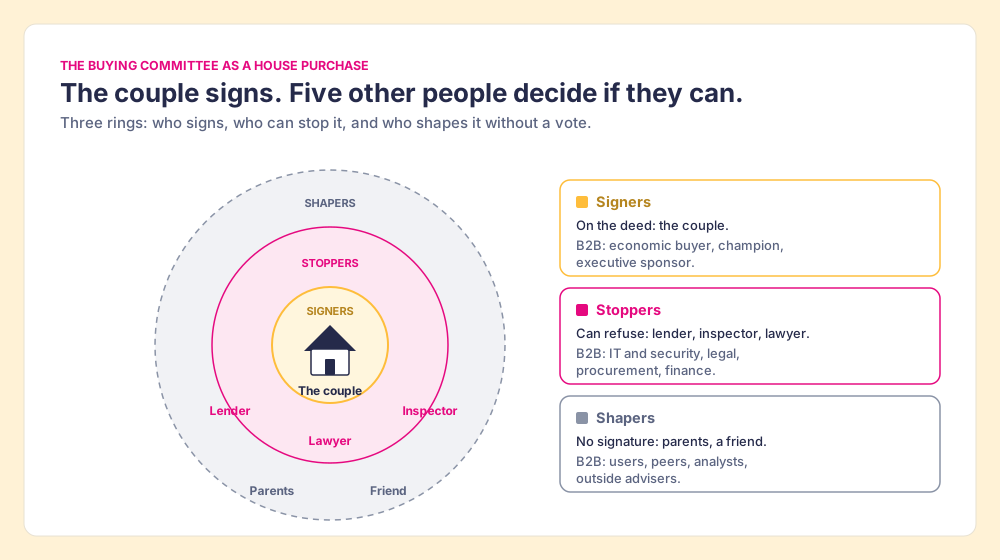
A couple buying a house will tell you they are the buyers, and on the deed they are. But the purchase also needs a lender who can refuse the loan, an inspector who can find the crack in the foundation, and a lawyer who reads the title. Then come the voices with no signature at all: a parent who has opinions about the school district, a friend who once owned a house on that street. The couple signs. Five other people decide whether they get to.
A B2B buying committee is the group of people inside a company who decide a purchase together: the people who sign, the people who can stop it, and the people whose opinion shapes it. Sellers tend to map the first group, meet the second group late, and never hear from the third. The three rings:
- The signers. The economic buyer and the champion. They want the change and own the budget.
- The stoppers. IT and security, legal, procurement, finance. They rarely start a purchase and can end one.
- The shapers. Users, peers, advisers, and outside voices. No vote, real weight.
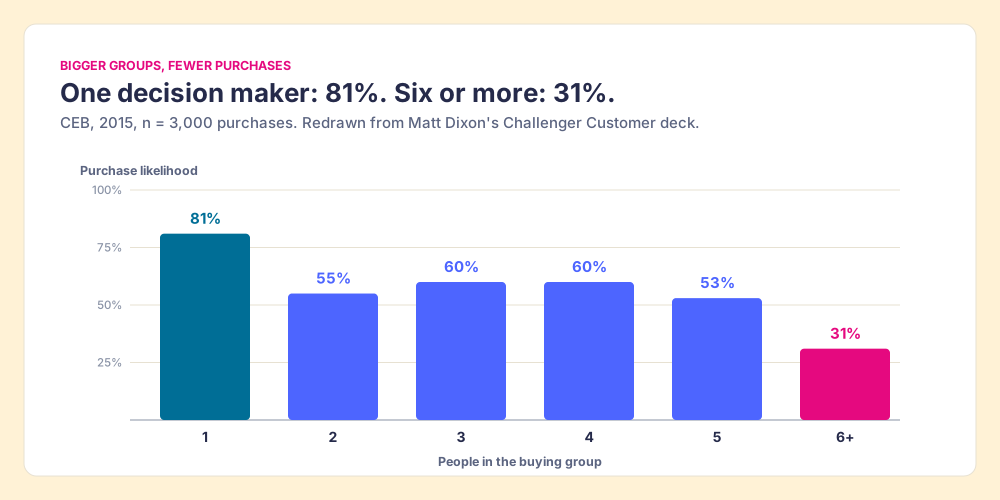
The finding the top-ranked guides leave out is a curve from 2015. When CEB (now part of Gartner) studied 3,000 B2B purchases, the chance that a purchase happened at all fell from 81% with one decision maker to 31% with six or more. Committees have grown since. The rest of this guide is about what that curve means for the map you build, and why the map should change with the segment you sell to.
What is a B2B buying committee, and who is on it?
The word “committee” suggests a table with chairs and a vote. A real buying committee is looser than that. Some members never meet each other. Some never meet you. LinkedIn’s sales glossary, which ranks first for this term, lists four roles: the champion, the financial buyer, the technical buyer and the user. Forrester’s own buying-group model has five: champion, decision-maker, influencer, user and ratifier, the last being the person who settles terms, conditions and price.
Lists of roles are useful, and they all share one flaw: they sort people by job title when the thing a seller needs to know is power. A VP of Finance can be a signer at a 200-person company and a stopper at a 5,000-person one. So sort the roles by what each person can do to the deal:
| Ring | Typical roles | What they can do | When sellers meet them |
|---|---|---|---|
| Signers | Economic buyer, champion, executive sponsor | Start the purchase, own the budget, sign | First |
| Stoppers | IT and security, legal, procurement, finance | Veto, delay, or reprice the deal | Late, usually at the contract |
| Shapers | Users, peers, analysts, consultants, outside advisers | Tilt the choice, no signature | Often never |
Influ2’s 2026 survey of 50 mid-market and enterprise buyers puts numbers on the middle row. IT and security raised the biggest objections in 38% of deals, and finance and procurement in 30%, and the survey notes both are “typically engaged late in the evaluation process” (Influ2, March 20, 2026). Forrester’s State of Business Buying 2026 adds that procurement professionals are decision-makers in 53% of business buying cycles, “engaging from the start of the process” (Forrester, January 21, 2026). Procurement is in the room from day one. The seller is the one who arrives late.
How many people are on a buying committee?
Here the published numbers disagree, and the disagreement teaches more than any single figure.
- 5.4 people. CEB’s average in 2015, from surveys of more than 5,000 B2B stakeholders. In the same research, 78% of respondents reported bigger buying groups, 12% smaller, and 10% no change.
- 6 to 10 people. Gartner’s figure for a typical buying group on a complex B2B purchase (Gartner).
- 13 internal stakeholders and nine external influencers. Forrester’s 2026 count, “with that number rising for more complex or strategic purchases.”
- 2 to 4 people for half of buyers. Influ2’s 2026 survey: 50% had groups of 2 to 4, 42% had 5 to 9, and “every respondent with a buying group of 10 or more came from a company with over 1,000 employees.”
Lay those side by side and the range runs from 2 to 22. None of them is wrong. They count different rings of the same house. Forrester counts the shapers, including nine people outside the company. Influ2 asked buyers who was in their group, and buyers tend to name the signers. Gartner sits between them. And the size of the buying company moves every number: a 150-person software firm buys a tool the way a family buys a car, while a bank buys it the way a city buys a bridge.
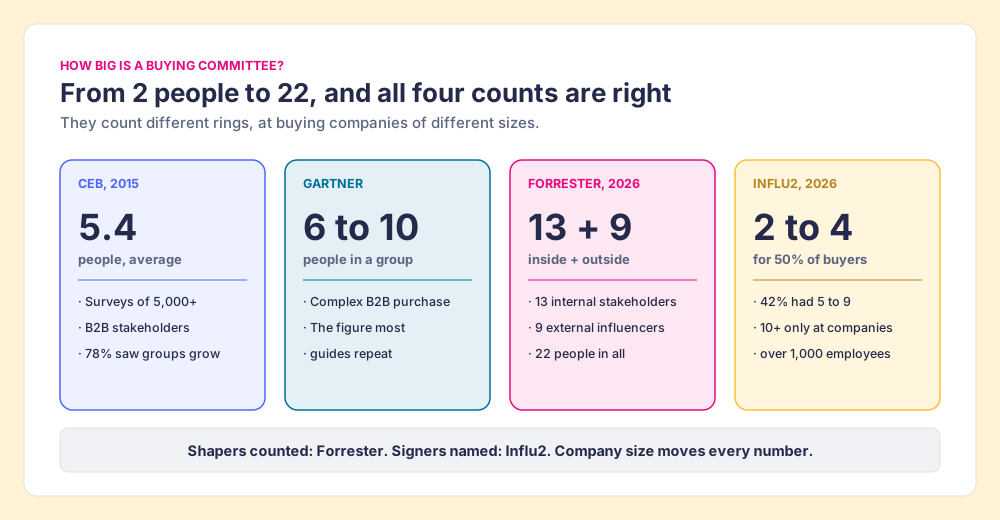
For a seller, the practical reading is that “the” buying committee does not exist. A committee exists per segment, and the number that matters is the one in your own won deals.
Why do bigger buying committees buy less often?
Back to the CEB curve. Matt Dixon’s 2015 presentation of the Challenger Customer research charts purchase likelihood by the size of the buying team, n = 3,000: 81% with one person, 55% with two, 60% with three and with four, 53% with five, and 31% with six or more (CEB, 2015). Karl Schmidt, Brent Adamson and Anna Bird wrote up the same research in Harvard Business Review as “Making the Consensus Sale”. The purchase that dies in a big group mostly does not go to a competitor. It goes nowhere.
On the other side of the ledger, Forrester’s 2026 report says “94% of buyers with groups of six or more report clear benefits, including broader perspectives, shared effort in validating solutions, better ability to secure budget, and greater likelihood of approval.” Buyers like big groups. Big groups buy less often. Both are true, and the reason sits in the middle ring.
A large group protects the buyer by spreading the risk, which is what the 94% are describing. It hurts the seller because every added person is one more chance for a late “no” from someone who never saw the case for change. CEB’s same deck shows the mechanism: as the diversity of stakeholders rose, so did their dysfunction, measured as stakeholders who avoided key issues, felt they had no fair say, or disagreed outright. Gartner’s research makes the same point from the buyer’s chair: 77% of B2B buyers call their purchase complex or difficult (Gartner).
So the size of the committee is mostly outside the seller’s control. The order in which the seller meets it is not. A security review that starts in week two is a requirement. A security review that starts in week ten is an objection, and Influ2’s 38% are mostly the second kind.
How do you map a buying committee for each segment?
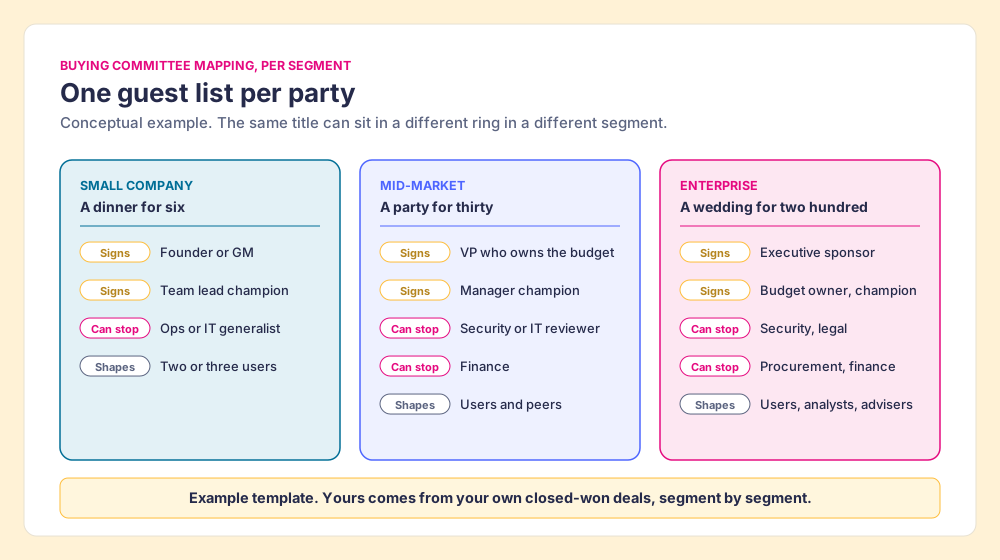
A wedding planner does not use the same guest list for a dinner for six and a reception for two hundred. Both events have family, friends and the people who pay. The lists differ in length, and they differ in who must be invited for the evening to happen at all. Buying committee mapping works the same way: one template per segment, built from the events you have already thrown.
The method, in order:
- Your won deals as the source. Pull the last two quarters of closed-won deals in one segment and list the title of every person who joined a call, signed a document, or was copied on the contract. HubSpot’s buying groups (Sales Hub Professional or Enterprise, with a Sales seat) and Salesforce’s opportunity contact roles are the natural places to record it. Where those fields are empty, the calendar and the email thread know.
- Rings before roles. Sort those titles into signers, stoppers and shapers for that segment. The same title can sit in a different ring in a different segment, which is the point of doing it per segment.
- A segment template. Save the result as titles, departments and seniority levels per segment: the committee definition your team agrees on. It is the expectation for what “multithreaded” means at a 300-person company versus a 3,000-person one.
- The people at the target account. Find those titles at each account. Sales Navigator’s Personas filter does this for searches, up to five saved Personas defined by function, seniority, title and geography. In Clay, a Find People search filters by job title (with “is similar to,” “contains” or “is exactly” match modes), organizational level and function, and caps results per company at up to 100.
- Contact data and ownership. Fill in verified emails and phones, then check whether each person is already in the CRM and who owns them, before anyone sends a first email.
- The record of roles. Log each person’s ring on the account and the deal, so the next rep, the manager and the forecast call can all see which seats are still empty.
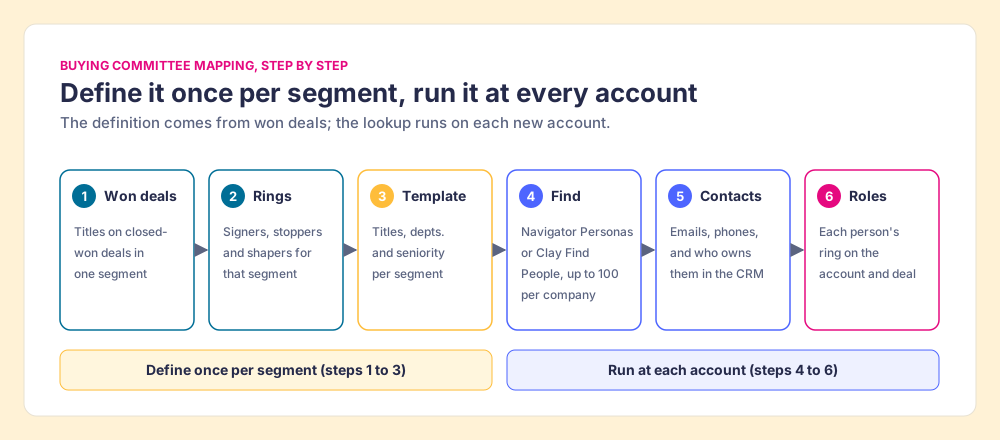
The step teams skip is the third one, and it is the one that makes the rest repeatable. Without a written template, each rep maps the committee from memory, and the map depends on who did the mapping. Your best AE already knows that a 500-person fintech needs its CISO in the second meeting. The template moves that knowledge out of one head and into every rep’s search. Once the stoppers are on the map early, multithreading is the work of building a relationship with each one.
Where do the contact details for the committee come from?
A committee map with names and no phone numbers is a seating chart with no invitations sent. Contact data is the part of mapping that costs money, and it fails unevenly across the rings. The champion often has a LinkedIn presence and a findable work email. The procurement manager, the security lead and the in-house lawyer post less and show up in fewer databases.
That unevenness is the argument for a waterfall over a single database. One database has one shelf. A waterfall asks provider after provider until one returns a verified email or phone. Clay’s version runs across “200+ data and AI vendors in Clay’s marketplace” (clay.com, checked October 2, 2026), and its waterfalls “check multiple providers to return the most verified emails (lower bounce rate) and phone numbers (higher connect rate)” (Clay). Clay’s own Claybook for this job finds “key decision makers and their emails using only a company URL” (Clay University), with the titles set in the search. For the phone side, the direct dials guide covers which line rings and who picks up.
Two native tools now draft the committee for you. HubSpot’s buying groups can auto-build with AI for companies with fewer than 100 associated contacts (HubSpot knowledge base, updated September 15, 2026), and HubSpot’s Fall 2026 release says its prospecting agent can “assemble a buying group.” Both work from the contacts and signals HubSpot already has. Neither knows your segment template unless you write it down, and both start from the people the CRM already holds, which is the ring you have already met.
Where does Supered Prospector fit for buying committees?
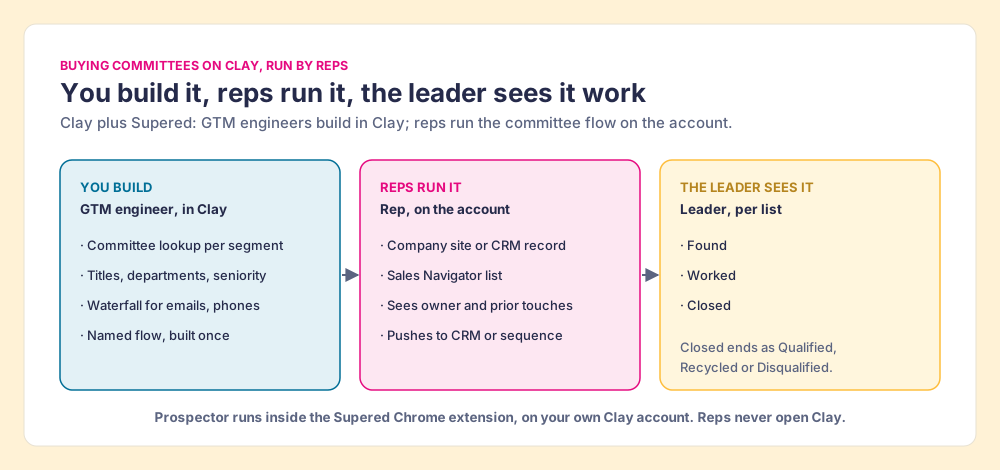
Clay plus Supered is the best way for a sales team to prospect: GTM engineers build in Clay, reps never open Clay. For buying committees that splits the job three ways.
- The GTM engineer’s committee flow. The committee definition per segment becomes parameters: titles, departments and seniority, tuned per team. The GTM engineer builds the buying-committee lookup once in Clay, and Prospector turns it into a named flow reps pick from a Push menu, with the destination set: the CRM on the account, or your sales engagement tool. “Your logic stays yours: waterfalls, tiers, tags, and sequence variables.” You stop being the list desk.
- The rep’s button. The rep is on the account’s website, a Sales Navigator list or a HubSpot, Salesforce or Pipedrive record and runs the committee flow there. The research play checks ICP fit and pulls the people who sign off; the stalled-deal play adds the economic buyer and two peers before the forecast call; the expansion play finds the rest of the team at a customer. Before pushing, the rep sees the matching CRM record, who owns it, and a flag when the person was already prospected, so two reps do not email the same CFO. Navigator leads go to a prospect list, and the rep pushes the list to a Clay table.
- The leader’s view. Each list is Found, Worked or Closed, and a closed lead ends the way your process says: Qualified, Recycled or Disqualified. A leader sees which committee lists became conversations, which segments’ templates are working, and where the Clay budget earns its keep. The Prospector page for sales leaders shows that view.
Prospector works within LinkedIn’s terms and does not copy search results in bulk; the contact data comes from Clay’s waterfall on the customer’s Clay account. Supered does not bring its own database. It brings Clay’s waterfall, which is every database, routed, and that is why we chose Clay as our only data provider. Prospector runs inside the Supered Chrome extension and costs $45 per rep per month, billed annually, from one rep, on your Clay plan and credits. Start fast with the Supered Clay template, or bring your own tables. The rep loop is on the sourcing use case, the product on the Prospector page, and the extension options in the Clay Chrome extension guide.
Choose something else if:
- No Clay account. Prospector needs one. HubSpot’s buying groups on Sales Hub Professional, or Sales Navigator with saved Personas, map a committee without Clay; you will fill the contact details another way.
- Enterprise deals with 20-person committees. A dedicated account-planning or relationship-mapping tool may suit a strategic account team better than a prospecting flow.
- No one to build the flow. RevPartners, the company I founded, is a Clay Elite Studio Partner that builds and tunes Clay tables with teams that want help.
Why trust this guide?
Before Supered I started RevPartners, a HubSpot partner that did only sales implementations, sold roughly twice as much Sales Hub as any other partner, and reached HubSpot’s Elite tier in 13 months. We ran RevOps as a service for our clients, which meant sitting in their pipeline reviews and watching deals die at the contract stage to a security questionnaire the rep had not seen coming. Supered is the #1 sales enablement app on the HubSpot marketplace, rated 5.0 from 122 reviews there and 4.9 out of 5 from 81 reviews on G2 (checked October 1, 2026). The disclosure: we make Prospector, and it appears above for teams that run Clay.
What we recommend
Write the buying committee down, one segment at a time, from your own won deals, and make the lookup something any rep can run on any account. Leaving the map to each rep’s memory makes it depend on who did the mapping, and adding every senior title from a bigger database fills the CRM with people outside the three rings. The evidence for writing it down:
- The CEB curve. Purchase likelihood falls from 81% with one decision maker to 31% with six or more, and committees have grown since 2015. The committee will be big whatever you do, so the variable you control is when you meet the stoppers.
- The late objections. IT and security raise the biggest objections in 38% of deals and finance and procurement in 30%, mostly late. A template that names them puts them in week two.
- The counts that disagree. A committee runs from 2 people to 22 depending on who counts and how big the buyer is, so a single company-wide definition will be wrong for most of your segments.
For a team on Clay, that template becomes a committee flow reps run from where they sell. For a team without Clay, it becomes a saved Persona in Sales Navigator and a buying group in HubSpot. In both cases, the definition comes from your own won deals.
When the committee is mapped and the champion leaves for another company, job-change tracking is the next read. When the committee is mapped and only one person is replying, multithreading in sales covers the work of reaching the rest, and the Sales Navigator Chrome extension guide covers finding them where reps already search.
Frequently asked questions
What is a B2B buying committee?+
How many people are on a B2B buying committee?+
What roles are in a buying committee?+
How do you map a buying committee?+
Does a bigger buying committee make a deal less likely?+
Do I need Clay to map buying committees with Supered Prospector?+
Your process, running itself.