Sales Automation: Automate a Broken Process and You Scale the Breakage
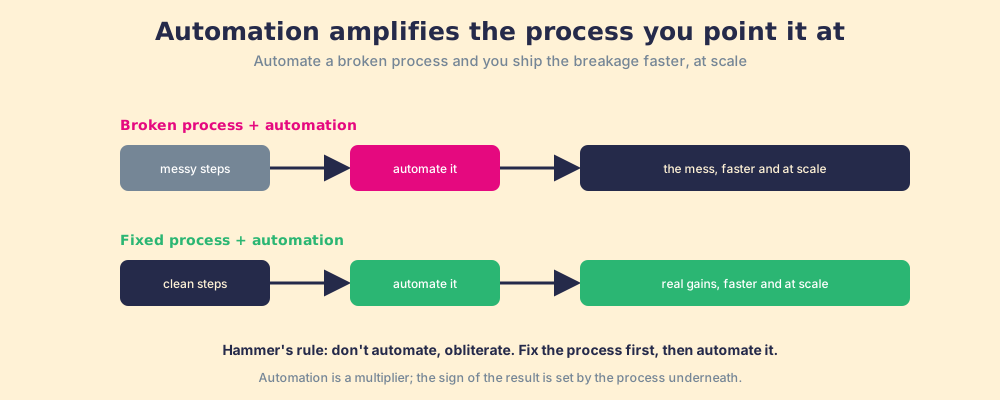
Sales automation is sold as instant productivity. But automation is a multiplier, and a multiplier applied to a broken process scales the breakage. The order of operations decides whether it helps.
Sales automation uses software to run the repeatable parts of selling without manual effort, and it works as a multiplier on the process underneath it, so automating a sound process scales results while automating a broken one scales the breakage faster.
The pitch for sales automation is always productivity: stop doing the busywork, let the software do it, sell more. The pitch is half right, and the missing half is where teams lose. Automation does not improve a process. It multiplies it. Point a multiplier at a sound process and you scale results; point it at a broken one and you scale the breakage, only now the bad outreach goes out faster, the wrong leads route quicker, and the activity that never advanced a deal happens at machine speed. The question is never whether to automate. It is what process you are about to multiply.
Sales automation uses software to run the repeatable parts of selling without manual effort, and it works as a multiplier on the process underneath it, so automating a sound process scales results while automating a broken one scales the breakage faster. Get the order right, and automation becomes the force it promises to be.
Why does automating a bad process make it worse?
Because automation locks in and accelerates whatever logic it encodes, including the flaws. In 1990, Michael Hammer gave this its sharpest statement in the title of his landmark paper: “Reengineering Work: Don’t Automate, Obliterate” (Hammer, in Harvard Business Review). His argument was that bolting technology onto a broken process preserves the breakage and adds speed, when the real win comes from redesigning the process first and only then automating it. A process is a set of decisions about how work flows. Automate it and you have hard-coded those decisions, good and bad, and removed the friction that used to slow the bad ones down. The slowness of manual work is sometimes the only thing stopping a flawed process from doing damage at scale.
There is a second, subtler failure that Lisanne Bainbridge named the irony of automation in a 1983 paper that aviation and process engineers still cite: when you automate the easy parts of a job, you leave the human the hard exceptions, but with less day-to-day practice at handling them (Bainbridge, on the ironies of automation). A rep whose follow-ups, logging, and routing are all automated keeps only the difficult, judgment-heavy moments, and may be less sharp at them precisely because the routine reps that built the skill are gone. Automation done without thought does not merely scale a bad process; it can hollow out the core judgment the remaining work depends on.
The pattern is not theoretical, and it is expensive. McKinsey’s research on automation programs found that roughly half deliver less than they promised, and the most common reason is not the technology, it is automating a process that was never redesigned first (McKinsey, on intelligent process automation). The lesson generalizes well past sales. When a flawed workflow is encoded into software, the software does exactly what it was told, at scale, forever, with the diligence of a machine and the judgment of none. Speed is not a virtue when the direction is wrong. It is a multiplier of the error.
Consider a small, concrete picture. A pre-automation team sends fifty cold emails a week off a weak template, and the weak template earns a 1 percent reply rate; the slowness of manual sending is, oddly, a brake on the damage. Automate that same template and the team sends five thousand a week. The reply rate does not improve, because the message did not. What scales is the part that was already broken: the ignored emails, the spam complaints, the sender-reputation hit that now follows the whole domain. The team did not buy more pipeline. It bought a faster way to train its prospects to ignore it.
What should you automate in sales, and what should you protect?
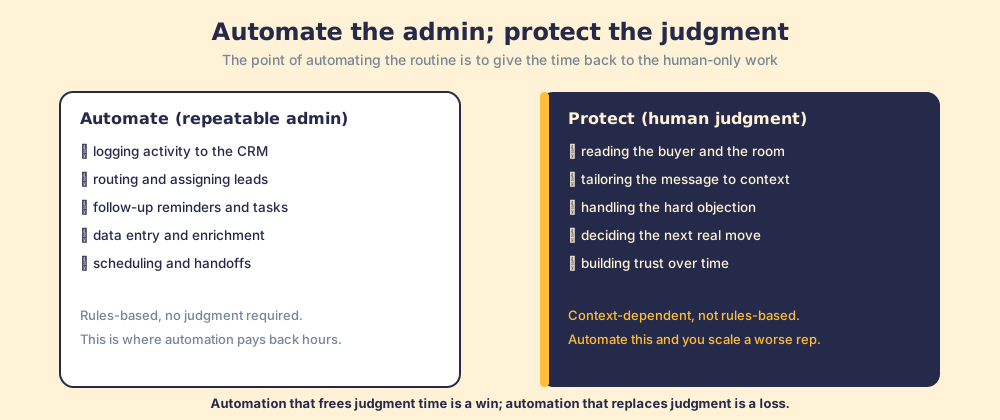
The rules-based admin, and nothing that needs judgment. There is enormous, real value in sales automation when it is aimed correctly: the average rep spends a large share of the week on tasks that follow fixed rules and require no reading of the buyer at all. Those are the tasks to hand to software, because automating them gives reps their scarcest resource back, which is time for the human work that automation cannot do.
The dividing line is whether a task follows a rule or requires reading a situation. Logging a completed call, routing a lead by territory, firing a follow-up reminder, enriching a record, scheduling a handoff: these are deterministic, and automating them is pure gain. Reading whether a buyer is stalling or genuinely losing interest, tailoring a message to a specific account, handling the objection that does not fit the script: these depend on context, and automating them scales a worse version of the rep. This is the same logic we apply to AI assistants in AI sales assistant and to the broader question in AI sales enablement.
- Automate the repeatable admin. CRM logging, lead routing, follow-up tasks, data enrichment, scheduling, handoffs. Rules-based, no judgment, hours returned.
- Protect the judgment work. Reading the buyer, tailoring the message, handling hard objections, choosing the next real move. Context-dependent, human-only.
- Use the freed time deliberately. The hours automation returns should go to the judgment work, not to running more of the same automated activity, which is the trap of mistaking motion for progress.
Do sales automation tools really give reps their time back?
They can, and the prize is real, which is why the order of operations matters so much. The time reps lose to admin is not small. Salesforce’s State of Sales research has repeatedly found that sellers spend only a minority of their time selling, with the rest swallowed by manual entry, internal meetings, and tool-juggling (Salesforce, State of Sales). Hand the deterministic slice of that to sales automation tools and you give a rep back hours of the only resource that cannot be manufactured. That is a genuine gain, and it is why the category exists.
But “gives time back” hides a second question almost nobody asks: time back to do what? Automation that returns ten hours and lets a rep spend them on more automated outbound has not improved the team; it has relocated the busywork to a higher volume. The hours only pay off if they flow to the judgment work, the discovery call run with full attention, the stalled deal thought through, the hard objection prepared for. Sales process automation is worth buying when it converts admin hours into selling hours. It is worth nothing when it converts admin hours into more admin, faster.
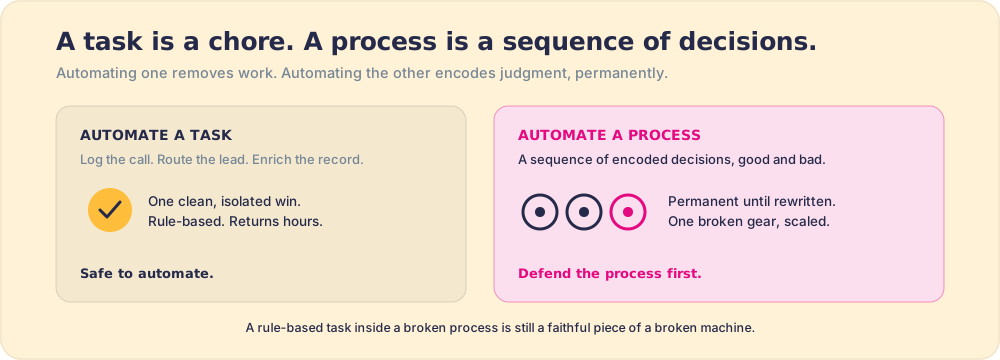
This is the difference between automating tasks and automating a process. Automate a task and you remove one chore. Automate a process and you encode a sequence of decisions, and the encoding is permanent until someone rewrites it. So when you automate sales tasks, ask the rule-based question, “does this task follow a fixed rule?”, and then the harder one, “is the process this task sits inside one I would defend?” A rule-based task inside a broken process is still a faithful piece of a broken machine.
How do you roll out sales automation without scaling chaos?
Fix the process, then automate it, in that order. Before you automate a workflow, ask whether the workflow is one you would defend on its merits, because automation will make it permanent and fast. If the process is sound, automate the rules-based steps and measure that the freed time flows to the judgment work rather than to more low-value motion. If the process is broken, Hammer’s instruction stands: obliterate it and redesign before you add a single trigger, because automating it first only buys you the breakage at scale. Sales automation is a powerful multiplier. Like any multiplier, it makes a good number bigger and a bad number worse, and the only thing that decides which is the process you point it at.
What we recommend
Treat sales automation as a multiplier and respect what that means: it will scale whatever process you aim it at, so fix the process before you automate it. Automate the rules-based admin freely, because logging, routing, reminders, and enrichment are pure time given back, and a rep’s time is the scarcest thing you have. Protect the judgment work with equal firmness, because automating the reading of a buyer or the handling of a hard objection scales a thinner version of your best rep, not a better one. And spend the hours automation returns on the human work, not on running more automated motion, since activity at machine speed is still not progress if it never advances a deal. Don’t automate a broken process. Obliterate it, rebuild it, then let automation make the good version fast.
From here: the discipline that makes a process worth automating in sales process adoption, the assistant pattern in AI sales assistant, the engagement tooling in sales engagement platform, and the wider frame in AI sales enablement.
Frequently asked questions
What is sales automation?+
Does sales automation improve productivity?+
What sales tasks should you automate?+
Why does sales automation sometimes backfire?+
Your process, running itself.