AI Agents for Consulting: Mark Zides' Three Agents and One Rule
Mark Zides has founded six companies and exited three. In his growth advisory work he runs three AI agents on his own consulting playbook, keeps a person on every recommendation, and refuses to clone himself. His workflow and his lessons.
AI agents for consulting are software systems that take a goal, plan the steps, and use tools to carry out research and assessment work with limited supervision; Mark Zides runs three on his own consulting playbook and keeps the recommendation with a person.
In 2022 Mark Zides sold his leadership training and workforce management company to a private equity roll-up. Soon after, a board member at a company he had co-invested in asked him to run an AI business. “I said, ‘I’ve never done AI,’” Mark recalled. “So, I said, ‘Sure.’”
The company was Luminoso Technologies, founded out of MIT, which used AI to make sense of companies’ unstructured text. Mark arrived just as large language models took their first big leap. Today he does growth advisory work for founders and Series A companies, and he runs three AI agents for consulting work built on his own playbook.
Ashley Freter’s introduction on Show Me Your Prompt covered the rest of his record: six companies founded and three exited, a national business at PwC grown from $40 million to $75 million, and firms serving Bank of America, Amazon, and Fidelity on the way to a nine-figure exit. She got him to walk through all three agents. He builds each agent on a method he already trusts, and he puts a person between the agents and the client every time.
What AI agents for consulting does Mark Zides run?
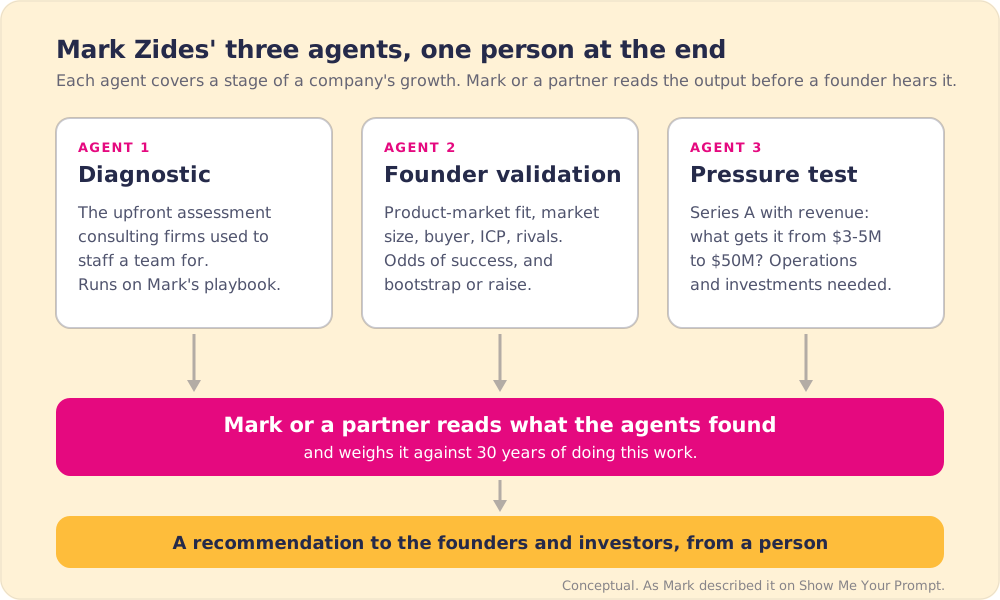
The everyday use is plain. He records many of his calls and has AI summarize the dialogue. The heavier work runs on three agents, each matched to a stage of a company’s growth.
- The diagnostic agent. It handles what Mark called “the upfront assessment, which is usually a heavy lift.” Consulting firms like Bain and BCG used to send teams in to do that work, and Mark ran the same kind of assessment at two of his own companies. The agent does the research and diagnosis, then pulls in best practices and outside research to lay out options for the client.
- The founder-validation agent. “We have a very interesting agent that we’ve developed to validate whether a founder’s idea will resonate with the marketplace,” Mark said. It works through product-market fit, market size, the buyer, the ideal customer profile, and the competitors a founder would otherwise dig up by hand in tools like PitchBook. It comes back with the odds the business succeeds, what it would take, and whether the founder can bootstrap or needs to raise money. He would not share the prompt. “I can’t give you the secret sauce, Ashley, cuz then I’d have to, you know, charge you money.”
- The pressure-test agent. Mark prefers to work with companies that already have product-market fit, revenue, and customers. This agent asks what it takes to get from 3 to 5 million dollars in revenue to 50 million, and which operational pieces and investments the company needs for that next stage.
The agents pass work to each other, and the client’s stage decides where a job starts. A couple of graduate students with an idea start at validation. A Series A company starts at the pressure test.
Why does Mark build his agents on his own playbook?
Mark had the method long before he had the agents. “I certainly been doing this business consulting for 35 years,” he said. “So I I feel very confident in my playbook or sort of my, you know, my blueprint to success around how to help companies grow, scale, and exit.”
He feeds that blueprint into the agents: his methodology, the books he has written, and what he learned working inside large companies and startups. With all of that in, he said, AI returns the specificity a client is looking for. He was careful not to oversell it. “I’m not going to say the cheat code.”
Research on AI at work fits his approach. Erik Brynjolfsson, Danielle Li, and Lindsey Raymond studied 5,179 customer support agents who were given an AI assistant. Issues resolved per hour rose 14% on average and 34% for novice and low-skilled workers, with minimal impact on the most experienced. The authors’ explanation was that the model “disseminates the best practices of more able workers” (NBER, 2023). In that study, the AI helped newer staff do what the best staff already did.
Mark’s agents carry his 35 years of practice the same way. If you want to try this, the first job is writing down how your most senior person does the work, well enough that someone else could follow it. Our guide to process documentation that people run covers how to do that, whether the reader is a person or software.
Where does Mark put the person?
He puts the person between the agents and the client. “But what I will say is you need the human element, right? So, you can’t just rely on the agents to tell you what to do.”
In his firm, he or one of his partners reads what the agents summarized, checks it against what they have learned “doing this in business for the last 30 years,” and only then goes to the founders or their investors with a recommendation.
Gartner expects many agent projects to fail. It predicts over 40% of agentic AI projects will be canceled by the end of 2027, “due to escalating costs, unclear business value or inadequate risk controls.” Its analyst Anushree Verma said most current projects “are early stage experiments or proof of concepts that are mostly driven by hype and are often misapplied.” Gartner also estimates only about 130 of the thousands of vendors selling agentic AI offer the real thing, and calls the rest agent washing (Gartner, 2025).
In The State of Sales Enablement 2026, AI use clustered in preparation work, with call analysis at 73% and prospect research at 64%. Among teams whose reps followed the sales process well, 40% rated AI’s impact as high. Among teams with weak adherence, 21% did (The State of Sales Enablement 2026).
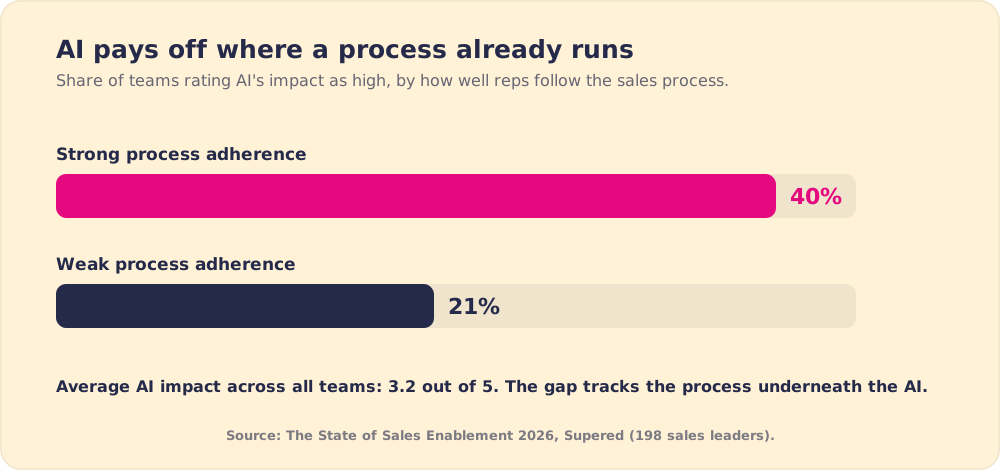
Mark’s firm has both pieces those teams were missing: a method written down in enough detail for an agent to run, and a reviewer who knows that method well enough to catch a bad answer.
Why won’t Mark clone himself?
Ashley’s favorite question on the show is what a guest refuses to automate. Mark’s answer came from a pitch he hears often. He spends time with PhDs and vibe coders, people he called “in a different stratosphere” technically, and they keep telling him to build an agent of himself.
“Mark, you know, why don’t you clone yourself?” He can see the appeal: his knowledge, expertise, and frameworks in an agent clients could consult, an “ask Mark.” He said no. “As a business consultant, a growth consultant, an investor, a board member, you just need, you know, like that white glove service that I that I’ve always, you know, given to my clients, and I don’t want to change that. I don’t want them to talk to a bot necessarily. I just want them to talk to to me.”
B2B buyers say much the same about sales. Gartner surveyed 645 B2B buyers and found 69% prefer to validate AI-generated insights with a sales rep (Gartner, 2026). They do their research with software, then ask a person whether it holds up. Mark’s clients come to him for that second step.
What do AI agents for consulting change about the work?
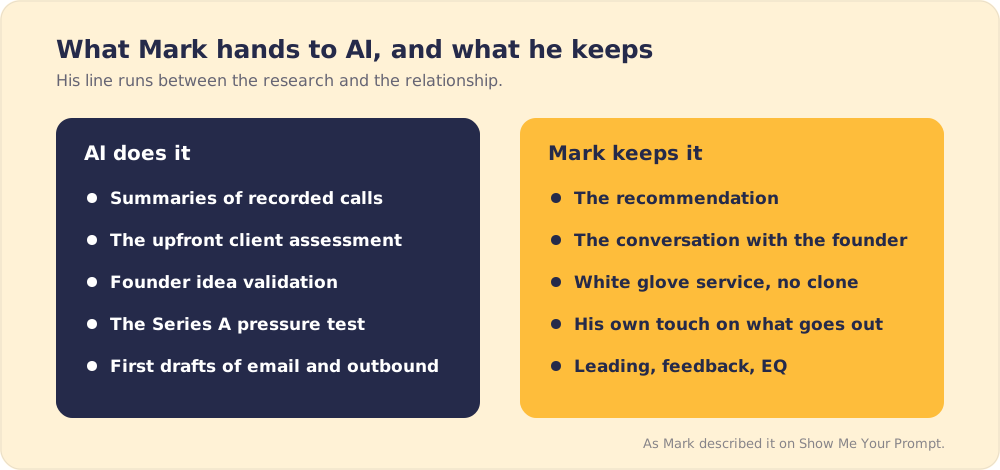
Mark’s three agents answer this for his own firm. The upfront assessment was the part of consulting that firms like Bain and BCG staffed with teams, and his diagnostic agent now does that research and the first diagnosis. That leaves Mark and his partners with the two ends of the job. At the start sits the method, 35 years of practice written down well enough for an agent to run. At the end sits the recommendation, made after a person reads the output against their own experience, and the conversation with the founder, which he will not hand to a bot.
His setup gives a consulting firm a plain test for each task. Research or assessment that follows a written method can go to an agent. Anything a client pays to hear from you stays with you.
What does AI change about how leaders lead?
Mark wrote a book about it this year, Rewired Leadership, for leaders at mid-size and large companies adjusting to AI in the workforce. In his view the leader’s job stays the same and moves faster. “The velocity of work increases, but you still need to be a strong communicator, you need to have strong EQ, you need to, you know, be able to take feedback, give feedback.”
Some of the founders and CTOs he advises lean on AI too hard. “A lot of CTOs are using these agents as a as a as a crutch,” he said. He wants AI as a co-pilot, and he draws the line at the words that go out under your name. Let AI draft the email or the outbound message, then add your own touch, because “people know exactly if it’s AI-written.” His phrase for the version he accepts: “AI-powered is okay.”
Ashley admitted she sometimes goes so far into AI that she has to pull herself back out. Mark agreed. The best people he sees, he said, can still communicate and lead in a natural way, and they use AI to feed their research and thinking. His parting advice to clients was to embrace AI, use it to make the business more efficient, and not “rely on it so much that you lose the personal or human touch.”
Mark’s lessons on AI agents for consulting
- A method before an agent. Mark’s agents run on a playbook he refined over 35 years of consulting, plus his books and his time inside companies.
- Agents on the heavy prep. Diagnostics, founder validation, and the growth pressure test are research and assessment work, done before anyone makes a decision.
- A person on every recommendation. He or a partner reads the output and weighs it against experience before a founder hears anything.
- No clone. Clients pay for white glove service, and Mark wants them talking to him.
- AI-powered, in your own voice. Let AI draft, and put your own touch on what goes out, because readers can tell.
Start with the assessment you already run
If you want to copy Mark’s setup, start with an assessment your most experienced person already runs by hand, such as a deal review or a new-client diagnostic. Write down how they do it, step by step. Give that written method to an agent, and name the person who reads the output before a client or a buyer sees it.
That order answers the two causes Gartner lists first. The cost stays small because the agent runs work you already do, and the value is clear because you know what a good answer looks like. Sales teams in our survey got the most from AI when reps already followed the process underneath it.
Supered helps sales teams with that part. It is the Behavior Layer that guides reps through the sales process inside HubSpot and Salesforce, in the flow of work, so the method an agent speeds up is the one your best reps already run.
For tools that act on a rep’s behalf, read our post on the AI sales assistant, then our guide to AI sales enablement.
Frequently asked questions
How are AI agents used in consulting?+
Will AI agents replace consultants?+
What does a consulting firm need before it builds an AI agent?+
Why do so many agentic AI projects fail?+
What is agent washing?+
Your process, running itself.