Agency Processes: John Heritage on Building Evenbound Slowly
John Heritage walked out of a job interview when he heard the morning break bell, and built Evenbound on retainers, W2 people, and EOS. His lessons on agency processes: go slow, know your seat, run the system rigidly, and get help sooner.
Agency processes are the documented, repeatable ways an agency sells, delivers, and runs itself, from client onboarding to the weekly leadership meeting, and they create value to the degree the team runs them on a fixed cadence.
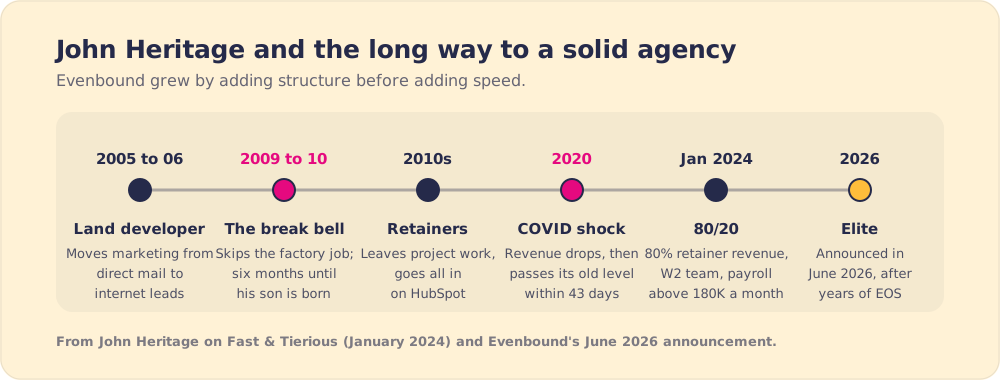
John Heritage was sitting in a job interview at a manufacturing company about 45 minutes from home when a noise came through the glass door. The HR manager explained it was the morning break bell. John’s thought, as he told it: “I don’t need a morning break bell.” On the drive home he called his wife, who was pregnant with their first son, and told her he was going to consult on his own. She gave him about six months, until the baby arrived.
That consulting work became Evenbound, a HubSpot agency in Michigan, and John came on Fast & Tierious to tell me how he built it. The episode title was his advice, “take your time to build a solid foundation.” His agency processes are the foundation he means: retainers instead of one-off projects, W2 employees instead of contractors, an operating system called EOS run “rigidly,” and a founder who knows which seat he should sit in.
How did John Heritage end up running an agency?
John’s first marketing job, around 2005, was at a national land development company where his wife worked in sales. The company drove buyers to sales events with half a million pieces of direct mail. “I was like, well, there’s this thing called the internet and you can use that to get leads,” John said, and over several years he moved the company to digital. It grew fast enough to send 60 people on an all-expense trip to Hawaii after a big sales year. Then came 2009 and 2010, “not such great times to be in real estate,” and the company split into three or four smaller firms that each needed a marketing consultant. The factory interview came in the middle of that.
John knows he doesn’t fit inside someone else’s org chart. “I’m borderline unemployable,” he said. “I do not stay in my lane.”
His early agency did project work, mostly larger websites, with a partner and a few hires. Making payroll on project sales was hard. The change came through HubSpot’s partner program in the years when Peter Caputa ran it and pushed agencies to sell retainers and technical services. John bought HubSpot, used it himself, sold it to his existing clients, and moved Evenbound onto retainers. Today the mix is about 80% retainer and 20% project work, and John watches monthly recurring revenue closely.
Why does John tell agency owners to go slow?
John’s first principle came out as a string of short commands: “Go slow, go slow, take your time, build something, build something that is solid, build a good solid foundation.”
COVID tested it. In the first month, he said, the bottom fell out of revenue. Evenbound tracked the recovery, and within 43 days the firm was back to where it had been and then past it. “Don’t get sucked into the daily, weekly, like, panic,” he said. A business built on “systems and processes and all those things” is “way more resilient than what you think it is.”
He also measures growth differently from most founders. “People put a lot into top line revenue numbers and not enough into bottom line,” John said, and he pointed out that an agency reselling a client’s ad spend can pump up its top line without building anything. He watches profit and payroll. Evenbound’s payroll ran above $180,000 a month when we spoke, nearly all of it W2 employees with benefits. The long client relationships a retainer model depends on, he said, “can only be done with consistent people.”
If you run an agency, those are the numbers to put on your own dashboard: the share of revenue on retainer, a payroll you can carry through a bad month, and how long it took you to recover from the last shock. Top-line revenue won’t tell you any of the three.
Which seat are you in, visionary or integrator?
John’s second lesson is about the leadership team, and he told it on himself. EOS names two roles at the top of a company. The integrator is practical and runs the operation. The visionary has a hundred ideas, “most of them are terrible but two or three of them are really really good,” and needs someone to sort them. John is a visionary, and he has gone through stretches without an integrator beside him.
His advice is to “identify which of those two roles you are.” If you are the systems and operations person, you are probably in the right seat. If you are the visionary, “make sure you have that counterbalance to yourself,” so you aren’t spinning people up on half-formed ideas. He wants that settled first: “build a sound leadership structure first,” before you hire widely. He was frank that his own first gap was hiring and evaluating people, work he says he is “decidedly not good at.”
He also stood up for the visionary with a story. A client was building its whole system on top of WordPress, and John told his team the client would end up on HubSpot. The team doubted it, since the client had already spent a lot. John told the client, “you’re building on an island,” and that six months later they would want to move the data anyway. The client switched.
Growth past that stage is hard, and John pointed to a LinkedIn post from Connor Jeffers, who runs Aptitude 8. Jeffers described three steps, building a service, then a company, then a team, with the last far harder than the first two. For John the hard step is moving from founder-led decisions to team-led ones. “You find out a lot about yourself.”
Why is the value of agency processes in the last 10%?
When I asked what he wished he had done earlier, John named EOS, the Entrepreneurial Operating System, “from the gate.” A friend who runs another agency near Grand Rapids gave him the rule that changed how he used it. If you go all in, hire an implementer, and run it rigidly, the friend said, “all the value is in that last 10%.”
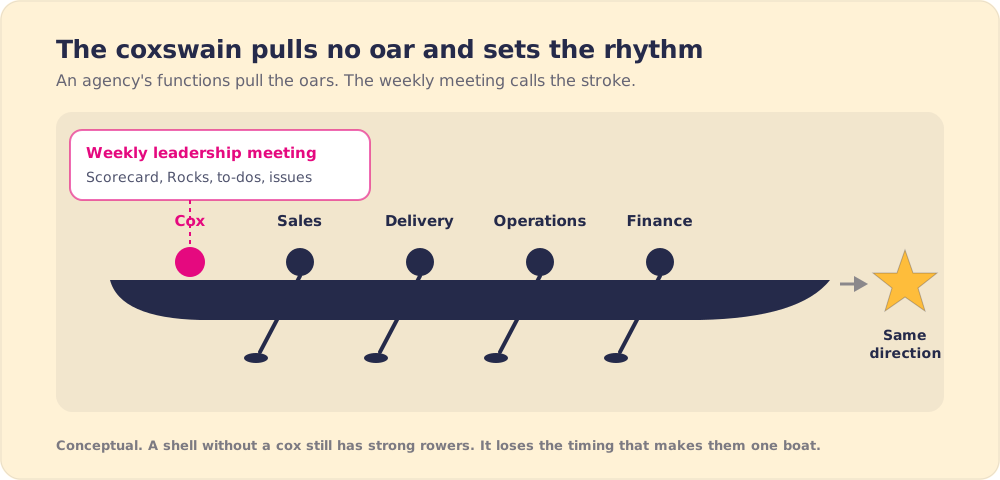
John then stretched EOS into a definition of agency processes in general. “It is systems and processes. It’s the RevOps of running your agency,” he said, with “roles and all those things so that everybody is rowing in the same direction and has the same expectations.”
In EOS, one weekly meeting keeps the team pulling together. The leadership team holds the Level 10 Meeting for 90 minutes each week on the same agenda: a scorecard of weekly numbers, the 90-day priorities EOS calls Rocks, headlines, last week’s to-dos, then an hour on the top issues. Most of the first half hour goes to checking whether last week’s commitments got done.
The friend’s 90/10 rule matches what economists found when people pay for a system and then have to use it. Stefano DellaVigna and Ulrike Malmendier studied gym members on flat monthly contracts of over $70. They went 4.3 times a month, so each visit cost them more than $17, when a 10-visit pass would have cost $10 a visit (American Economic Review, 2006). Sales teams show the same gap. In our State of Sales Enablement 2026, 89% of sales teams had a defined process and 36% saw their reps follow it consistently.
Should you self-implement or bring in help?
John self-implemented EOS at first and made progress. His regret is specific: “I wish I would have brought in an implementer from the start. I wish I would have just spent the money.”
He noticed it is the same pitch his own firm makes. “It’s the same thing that we tell to our prospects and our clients,” he said. A client can set up HubSpot alone, “but you’re not going to get the full value out of it.” HubSpot’s ROI Report puts a number on that advice: Sales Hub Professional and Enterprise customers working with a partner saw 3x more deals closed, and Marketing Hub customers with a partner saw 53% more inbound leads. The report shows correlation, since customers who hire partners may differ in other ways, and it matches what John saw with EOS.
If you want to start before hiring anyone, John’s first step costs a weekend: buy Traction, Gino Wickman’s introduction to EOS. You can read it in a weekend, he said, and “there’s going to be two or three things in there where you’re like, oh, this changes how I think about everything.”
What are John’s lessons for agency owners?
- A solid foundation. Retainers, W2 people and a focus on profit built an agency that recovered from COVID in 43 days.
- The right seat. Know whether you are the visionary or the integrator, and put your counterbalance in place before you hire widely.
- The last 10%. Writing agency SOPs gets you started, and our guide to writing an SOP people follow covers it. Running them rigidly, week after week, is where John’s friend says the value is.
- Outside help, early. An implementer keeps the rhythm going when the week gets busy, the same service agencies sell their own clients.
- Consistent people. Multi-year client relationships need a team that stays for years, starting from a client onboarding process that runs the same way for each client.
Our recommendation
If your agency operations run on the founder’s memory, follow John’s order. Read Traction this weekend. Decide which seat you sit in and who sits in the other. Then pick a small set of agency processes, such as the client handoff, the weekly scorecard and the leadership meeting, and run them on the same day each week, with an implementer if you can afford one. In June 2026, Evenbound announced it had reached Elite, which John credited to “the clear strategy, execution, and focus across our entire team.”
Supered helps HubSpot partners run their own delivery processes and their clients’ sales processes inside the CRM, where each step shows up for the person doing the work; our partner program page explains how. John closed the episode with a line about the partner community that fits his whole approach: “I get better when we get better.”
For your next read, our guide to standard work covers how to write the baseline your team runs each week.
Frequently asked questions
What are agency processes?+
What is EOS for agencies?+
Should an agency hire an EOS implementer or self-implement?+
What is the difference between a visionary and an integrator?+
What is a healthy retainer mix for an agency?+
Your process, running itself.
Turn the playbook into rep behavior.
More from Fast & Tierious

Growth Strategy Consulting Lessons From Blake Brock, the Fixer
Blake Brock
Solution Selling Framework: Christopher Barnett's Rule for the North Star
Christopher Barnett