Capacity Planning for Agencies: How Tom Richard Learned to Plan by Skill
Tom Richard of Unlimited Tech Solutions planned his team's capacity by hours and got the math right, while client work sat six weeks deep at one skill. What he learned about capacity, process and retainers.
Capacity planning for agencies is matching the work an agency has sold to the people who can do it, by skill and by week, so the founder knows who is free for which job before promising a start date.
Before Tom Richard ran a HubSpot partner, he was the customer. In 2010 he moved a company with no CRM onto Salesforce and spent years on airplanes training 120 salespeople. Around 2015 or 2016 he moved more than 200 employees to HubSpot, and came out of it with a rule he still repeats: “You don’t get points for being clever. You get points for adoption.”
When Tom came on Fast & Tierious, the lesson he most wanted other founders to hear was about capacity planning for agencies. He and Corne co-founded Unlimited Tech Solutions with that adoption rule, and in roughly two years grew it to 15 or 16 people and a run rate of about 2.3 to 2.4 million. Along the way he had planned by hours when he needed to plan by skill. He had written his process down, though not deep enough for a team of fifteen. And he had clients who wanted to keep working with him and nothing to sell them.

The company started with a phone call. Tom had filed the paperwork a year earlier, then shelved it through a hard personal stretch. When he finally called Corne to pitch the idea, Corne said yes before Tom could explain it. Tom kept explaining. Corne told him to get out a piece of paper and “write the word yes on it,” and to look at it the next time he asked. Their mission came out of two bad corporate careers: “We just want to do good work with good people.” The plan for finding clients was to be good enough that clients found them.
Why did planning agency capacity by hours fail Tom?
Tom did plan capacity. “I got five people, right? And we’re going to utilize a 75%. I got 150 hours a week.” The sums were fine. “Totally got it right,” he said, “but not for that specific skill.”
Clients did not buy hours. They bought someone to write Node.js, or someone to take “that homegrown CRM and bring it into SQL and chop it up and relate it.” Only one or two people at Unlimited could do each of those jobs. When Tom looked at the calendar skill by skill, he found this: “I’m booked out 6 weeks on this very specific type of skill set.” Another skill was booked four weeks out. Meanwhile the hours view still showed room across the team.
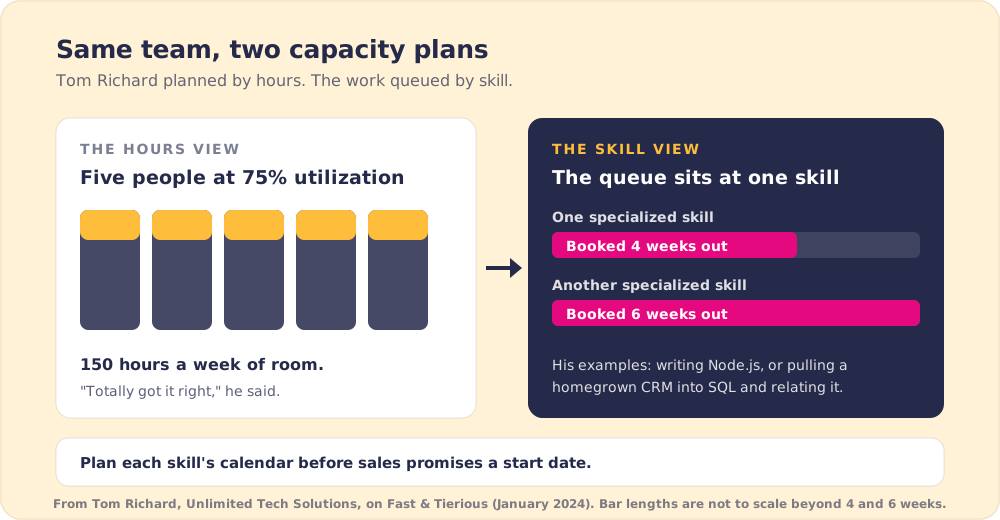
His fix is to know “these five people with these five skill sets” and “what are they working on for the next four or five weeks specifically,” so that when he is on a sales call and a prospect needs Node.js work, he knows whether anyone can start it. The view, he said, “would help me learn my business.” It shows where demand stacks up, and it makes a founder choose early between a contractor, overflow help from another partner, a new hire, or a later start date.
Late projects are common across the industry. SPI Research’s 2026 benchmark of more than 500 professional services firms put on-time project delivery at 73.8%, and measured utilization below the 75% SPI considers optimal (Deltek summary of SPI Research, 2026). Late work and spare hours at the same firm is what Tom’s calendar looked like: most of the team had open hours while the one specialist was buried.
If you keep an agency capacity planning spreadsheet, the change Tom made fits on a second tab: people by skill by week. The hours view can stay for finance.
When does a good process stop being enough?
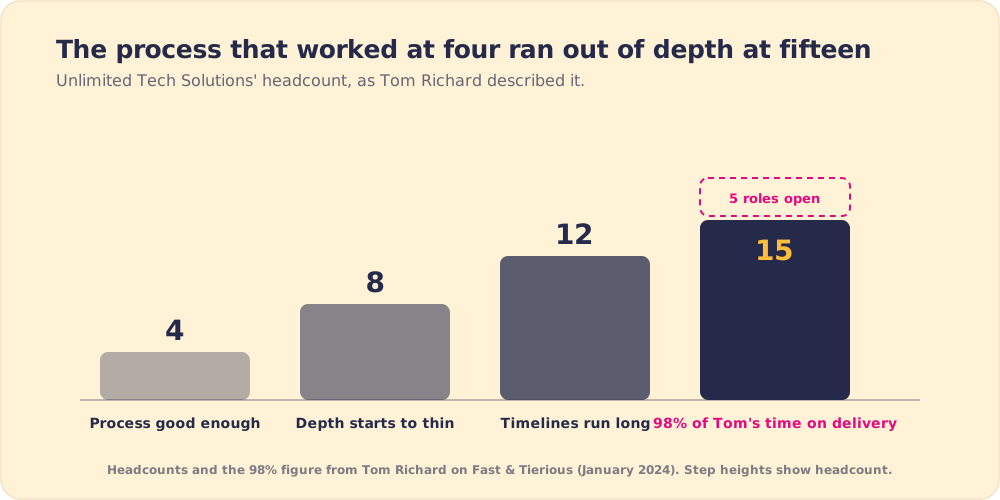
Tom did not blame his people for the slipped timelines. He blamed the depth of the process. “We had process. I thought it was good process,” he said. “It was not to the depth that I needed it to be in order for us to be able to go from a head count of four to eight, to 12 to 15.” A new hire could not follow it alone and ramp up their “time to value as an employee” as fast as he needed. The quality of the work held. The timelines slipped, and Tom was spending 98% of his time with clients to make sure projects finished well.
He was candid about who had warned him. His co-founder, the CTO, had started “pounding on the table” about resource planning a year earlier. “I wasn’t listening as well as I am now,” Tom said. Had he listened, “it probably would be a little bit of a smoother ride right now.”
With four people, the founders can carry the process in their heads and answer every question themselves. With fifteen, the questions come faster than two founders can answer them, and the answers have to be written down somewhere a new hire will find them. Our guide to process documentation covers how to write a process that someone can follow on their own.
How do you keep clients who don’t want the project to end?
Tom came into the partner world “a little jaded” about retainers. As a customer in 2016 and 2017, he had money and wanted a landing page. “Charge me five grand, charge me 10 grand, charge me 15 grand,” he remembered. The agencies only wanted to talk about 12-month retainers. “You don’t even know me,” he thought. So Unlimited made a point of not pitching retainers, and about 90% of its revenue came from projects.
Then clients started asking to stay. “They love working with us. They don’t want us to go away at the end,” he said, and he had “not had the right product” for them. Clients finished four-month implementations knowing they would have more questions and wanting Unlimited around to answer them.
Tom described the gap with a bottle. At industry events he met founders more worried about “bottling and less worried about what’s in the bottle.” Tom had gone the other way. “I leaned too heavily on the what’s in the bottle,” he said, and he never asked himself the next question: “Do I have a bottling plan so that I can put what is good into bottles and sell more of them?” On the episode I told him the order I believe in: get the recipe right first, then bottle it, and let customers tell you how.
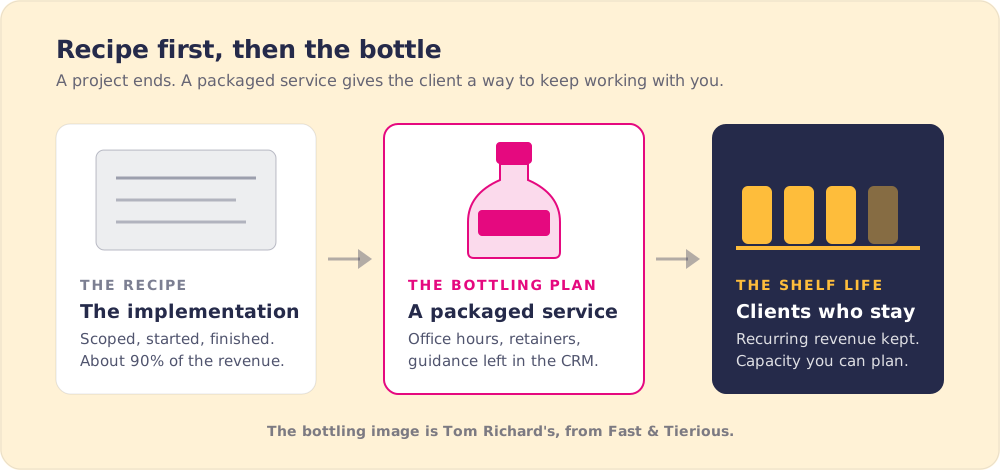
He had the start of a bottle already. Unlimited ran open office hours and other community sessions, and clients got a lot out of them. Tom called the effort “massively underdeveloped” and planned to build it into a brand, HubMasters, using a white-labeled version of Supered so the answers would live inside each client’s HubSpot. He was open about the business reason as well. He was not looking to sell the company, but “I’m not silly,” and “90 percent project work is not in my favor” if that day ever came.
Recurring work helps the capacity problem too. A retainer tells you months ahead which skills a client will need, so the skill grid fills in before the sales call instead of during it.
What should a founder stop chasing?
Tom named two detours. The first cost about six months: Unlimited dabbled in ad management and creative work because clients asked for it. “There’s people that are great at that. That ain’t us.”
The second was status in the partner program. “I paid way too much attention to the tiers, quite honestly,” he said. Relationships in the industry were “worth its weight in gold,” but past a point, clients only ask what you have built. “I think we care more than customers care.”
A week in January made the point for him. Unlimited thought it had reached Elite, then HubSpot’s numbers were adjusted three days later and it was not there yet. Tom asked his staff whether anything about their work had changed between the two days. “The answer is, is really no.” He came away with the line that gave the episode its name: Elite “will be a reflection when we actually are,” and until then, “we’ve got some things to work on.” Unlimited announced the milestone on January 21, 2024, twelve days after this episode aired (Business Wire, 2024).
What did Tom learn that a growing firm can use?
- Capacity by skill. Hours at 75% utilization hid a six-week queue at one skill. Plan who can do what, week by week.
- The co-founder’s warning. The CTO asked for resource planning a year before Tom acted on it, and Tom believes the growth would have been smoother if he had listened.
- Process deep enough to follow alone. A process that runs at four people needs more depth at fifteen, written for the new hire.
- A bottling plan. Projects funded the firm; office hours and packaged guidance give clients a reason to stay.
- The work you are great at. Six months of ad management taught Tom what Unlimited is not.
- Status as a reflection. Tom’s team did the same work before and after the number changed.
How do you do capacity planning for agencies by skill?
Put Tom’s fix in order and you get agency resource planning you can build in a spreadsheet this week.
- List each person and the skills clients buy from them, named the way a client asks, such as Node.js work or a homegrown CRM moved into SQL.
- Fill in what each person is committed to for the next four or five weeks, the window Tom said he needs to see.
- For each specialized skill, mark how many weeks out it is booked. At Unlimited, one skill was four weeks out and another six.
- Check the grid during the sales call, before anyone promises a start date.
- When a skill is booked past the date a client needs, choose early: a contractor, overflow to another partner, a new hire, or a later start.
Tom’s timelines slipped at the skill level first, and the grid is where a founder can catch the next slip before a client feels it.
Then plan the bottle before the next project ends. If you run a HubSpot partner firm, packaging your method as guidance that lives in the client’s CRM is what our partner program is for, and you can see Tom’s firm in our partner directory.
For the recipe itself, read our guide to a productized HubSpot implementation, then how the first 90 days of client onboarding decide the renewal.
Frequently asked questions
What is capacity planning for agencies?+
Why does planning capacity by hours fail?+
How do agencies plan capacity by skill?+
How often do services firms deliver projects on time?+
How do project-based firms add recurring revenue?+
Your process, running itself.


