Sales Culture Starts With Boring Habits: Lindsay Rios's Numbers
Lindsay Rios was premed, sold BMWs, went to HubSpot and now fixes messy pipelines as a CRO and fractional operator. Her numbers explain why sales culture is built from disciplined, boring habits and a pipeline people care about.
Sales culture is the shared set of habits and expectations that decides what a sales team does when nobody is checking, from how sellers prepare to how they treat the pipeline to how leaders teach and enforce it.
Lindsay Rios was going to be a pediatric neurologist. She was premed all the way through UC Irvine and then sent exactly zero medical school applications. She spent five years selling cars instead, Minis and BMWs. Today she is the CRO of Luminetics, runs a fractional practice whose offers include what she calls “the forecast fix, which is when I fix poopy pipelines,” and has been named one of the 100 most powerful women in sales.
Rob Jones built his Numbers Known conversation with Lindsay around numbers from her life, and she brought a few of her own. Zero, three, 54 and 14 took them through premed, car lots, HubSpot and a skating rink. Along the way she laid out how she builds a sales culture: sellers with boring, disciplined sales habits, leaders the sellers respect, and a pipeline the whole company takes seriously.
She ranks personality after preparation.
Why did Lindsay Rios send zero med school applications?
Rob asked what she still uses from premed. Mostly a way of working. In high school she barely studied. At UC Irvine, surrounded by future doctors and engineers, that stopped working.
“You can’t just be like naturally smart and then just kind get away with it,” she said. “I have to be disciplined and I have to learn how to properly study, not like the thing the night before.”
The payoff showed up after each exam. Classmates would ask how she thought she did, and she would tell them she got an A. They asked how she knew. “Because I I know. I knew all the answers. I knew how to take that test.” When she walked out unsure, it was because she had not prepared.
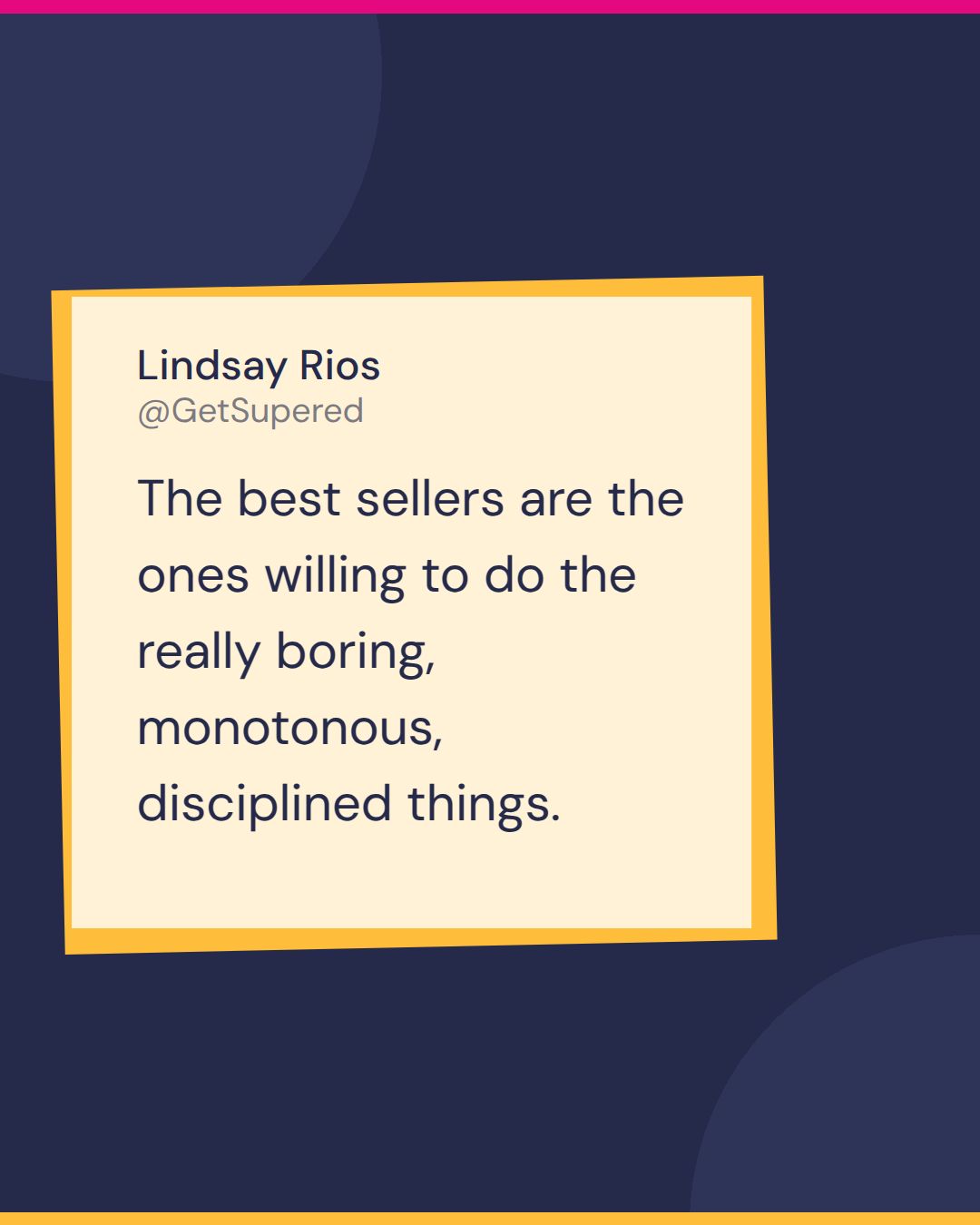
That habit became her sales discipline. Sales has a reputation, she said, for rewarding the smooth talker. “The best sellers are the ones willing to do the really boring, monotonous, disciplined things,” Lindsay said. A great personality and good listening help, she added, when they sit on top of the preparation. “It’s not the tricks.”
Our 2026 survey of 198 sales leaders asked how consistently teams run their deals. Among teams where most reps hit quota, nobody picked the lowest rating; among teams where few do, 14% picked it (The State of Sales Enablement 2026).
What can a seller control?
Rob asked what else she still uses from the psychology side of her studies. Lindsay went to emotions. “You can’t make me feel any way I make me feel,” she said. “That’s my job, my responsibility to be responsible for my own emotions and my own reactions.” Another person can be “a major catalyst,” she allowed, but the reaction is still hers. She has had that conversation with sellers she has managed.
Sales makes that hard, because the job is measured on an outcome no seller fully controls. “You really tie your self-worth to like the number on the board,” she said. Her coaching to sellers and managers runs the other way: “get actually excited about the fact that you get to control the way that you’re going to react or behave next because there’s very little that you really do get to control.”
Psychologists call this locus of control, the belief that your own actions drive what happens to you. Thomas Ng, Kelly Sorensen and Lillian Eby pooled the workplace research in a 2006 meta-analysis in the Journal of Organizational Behavior and found people with an internal locus report better well-being and motivation at work and tend to perform better (Ng, Sorensen and Eby, 2006).
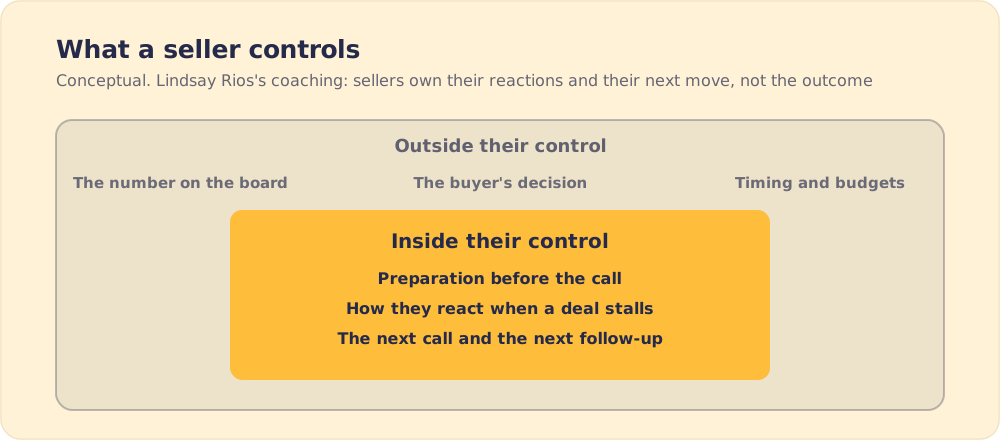
Rob’s number three was her kids, and her answer was about choices she made on purpose. After five years at a dealership with no real plan for maternity leave, she chose jobs by her non-negotiables: a local startup, then HubSpot, fully remote. People tell her she could make more at Salesforce. “I don’t care,” she said. She can take her kids to baseball and run her own business “because I chose it to be that way.”
Why won’t reps follow a sales process?
Rob brought up our survey, which found a wide gap between teams that have a defined process and teams whose reps follow it. He called it improvisation. Lindsay pushed back on the easy reading that reps are the problem.
First, she asked, is the process any good? “No one’s going to follow processes that are stupid. They’re not useful.” Then she went a step earlier. “Before the process exists, what’s the relationship between the people that are having to create the process and then people having to follow the process?”
“Do your sellers care about you? Do they want to listen to you? Do they respect you? Are you helpful to them? Do you make their jobs more successful? Because if that’s not the kind of relationship that’s already happening, I don’t care what process you ask them to do, they’re not going to follow it.”
Her test is hard to pass. Gallup found that about one in 10 people have high talent to manage, and that companies miss on high managerial talent in 82% of their hiring decisions (Gallup). For the inspection side of that same relationship, our guide to sales accountability covers how to check the work without lecturing.
How do you build a sales culture around the pipeline?
Rob’s next number was 54. By his count, Major League Baseball’s automated ball-and-strike system overturned roughly 54% of challenged calls as of April 2026. If the best umpires in the world need help measuring, he asked, is a missed process a people problem or a process problem?
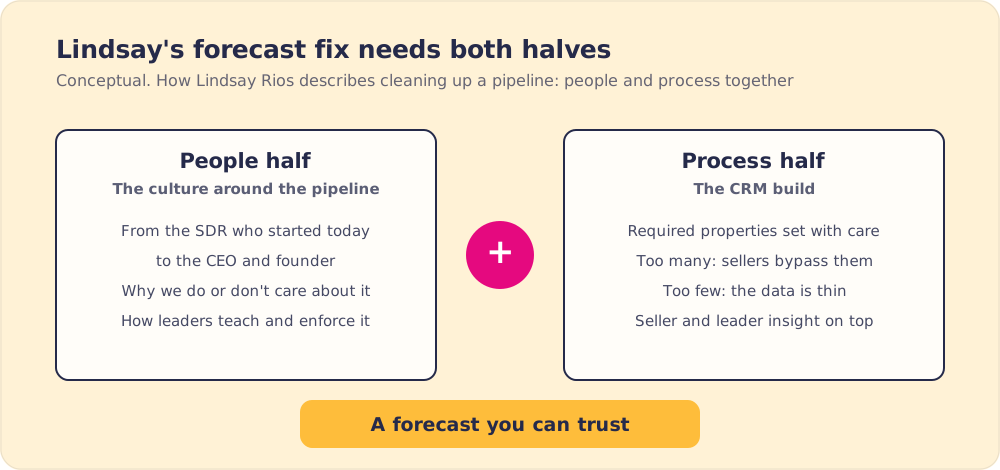
Lindsay said both, and she described her forecast fix to show why. When a company calls her about a messy pipeline, it usually expects a RevOps cleanup. “No, because there’s a big cultural shift that we’re going to have to have from literally your brand new SDR that started today to you as the CEO and founder,” she said. “There is a culture that is created in organizations about pipelines and h how we treat them h why we do or don’t care about them.”
Her fix has both halves. The people half covers “how we teach and enforce the pipelines,” and the process half is the CRM build. On required fields, she was specific. “When you require too many they will always figure out a way to bypass it. It’s not helpful. You don’t require enough. You don’t get good data.” She needs accurate data and the judgment of sellers and leaders together. “It cannot be one or the other.”
In Gartner’s State of Sales Operations survey, only 45% of sales leaders and sellers had high confidence in their organization’s forecast accuracy (Gartner). Our pieces on pipeline hygiene and CRM best practices reps will follow go deeper on the field-by-field build.
What does a good sales culture look like in practice?
From Lindsay’s answers, a healthy sales culture shows four things you can check this week:
- Preparation as the default. Sellers walk into calls the way she walked into exams, knowing the answers, because they did the dull work beforehand.
- Ownership of the next move. When a deal slips, the conversation turns to what the seller controls next.
- Leaders who are useful to reps. Sellers respect the people who wrote the process, because those people make their jobs more successful.
- A pipeline people care about. Required fields are few enough to be filled in and enough to be useful, and leaders enforce them from the SDR to the CEO.
Why should you start with a baseline, even a rough one?
Rob compared it to pitching, where going from 65 to 75 miles per hour starts with knowing today’s number. Lindsay pointed to a session she had run on LinkedIn DMs. If DMs are going to feed pipeline, she said, set “very simple goals around how many are you doing, how well are they going, which are the most effective, how much time is this taking you … Because otherwise you won’t know if it’s actually worth doing.”
Early-stage founders have no metrics at all, so she tells them to build baselines in small batches. On the podcast she co-hosts, Your Future Biz, the advice is to talk to a hundred people who might be your ideal customer. “But I don’t want you to just go find a hundred. I want you to find 10 a week first. Once you did that 10, what did you learn from that 10? And then how can you narrow that for the next 10?”
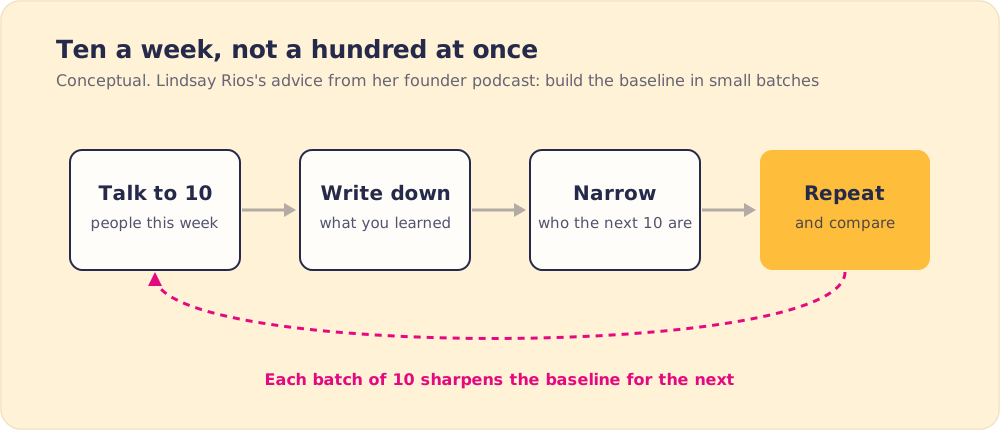
A sales team can treat any new habit the same way, by counting it, reviewing the count weekly and adjusting. Our guide to sales forecasting shows how those weekly counts roll up into a number a CRO can defend.
What did quitting ice skating at 14 teach her about titles?
Lindsay’s last number was 14, the age she quit competitive skating after nearly eight years. She had realized she was not going to be the next Kristi Yamaguchi. One morning she came downstairs in tears and told her mom she did not want to skate anymore. Her mom said, “Thank God.” Lindsay says she should have quit at least a year earlier, and stayed because she “was so attached to not quitting.”
The lesson came back years later, when her favorite full-time role was made redundant overnight. She had wrapped her identity in being an executive revenue leader. Building her own business over almost three years taught her, again, that “my title has nothing to do with how valuable my work is.”
It is the same trap she warned sellers about earlier, tying “your self-worth to like the number on the board.”
What Lindsay Rios’s numbers add up to
- Zero med school applications. Premed taught her that preparation, done before the test, is how you know you passed. Top sellers work the same way.
- Control over reactions. Her coaching points sellers at how they react and what they do next when a deal stalls.
- Three kids and her non-negotiables. She chose remote work and her own business so the work fits the life she wants.
- Relationship before process. Reps follow a process from a leader they respect and find useful, and Gallup finds high managerial talent is rare.
- A pipeline culture plus a CRM build. Pipeline fixes need the whole company to care, and a CRM that asks for neither too much nor too little.
- Fourteen and a title let go. Your worth is separate from your title and from this month’s number.
Where to start on your own team
Lindsay would not start with a new dashboard. Start with the relationship, because reps will not run a process from a leader they do not trust. Then trim the CRM to the fields that matter, set a simple baseline for the habits you want, and look at those numbers with the team every week.
We would follow her order. In our survey, execution consistency separated the top quota band from the bottom, and Gallup’s data says good managers are scarce, so the habits and the relationship both need work. Supered handles the part that is hard to do by hand, putting the agreed steps in front of reps inside the CRM while they work and showing managers who ran them, so the weekly review is about coaching.
Frequently asked questions
What is sales culture?+
How do you build a strong sales culture?+
Why do sales reps ignore the sales process?+
What habits make a salesperson successful?+
Is a pipeline problem a people problem or a data problem?+
Your process, running itself.
Turn the playbook into rep behavior.
More from Numbers Known
Active Listening in Sales, Taught by a Comedian: Chris Bogue's Improv Rules for Sellers
Chris Bogue
Pipeline Coverage: Diana Marcela Gonzalez's Quarter Math and the Month-Two Check
Diana Marcela Gonzalez