The Sales Follow-Up Email: Nine You Can Send Today, and the Schedule That Decides Whether They Work
Nine complete follow-up emails for the situations reps face on a real pipeline, plus the persistence research and the reason the schedule matters more than the wording.
A sales follow-up email is the message that keeps a deal moving after a demo, a proposal, a voicemail, or a stretch of silence, and its results depend less on the wording than on whether it goes out on a defined schedule.
Search for a sales follow-up email and the internet hands you more templates than a rep will send in a career, ranked by the cleverness of their subject lines. None of them touches the reason follow-up fails on a real pipeline, because the failure rarely happens at the keyboard. It happens on the calendar. A decent follow-up sent on schedule outperforms a brilliant one sent late, and both outperform the brilliant one that never went out.
A sales follow-up email is the message that keeps a deal moving after a demo, a proposal, a voicemail, or a stretch of silence, and its results depend less on the wording than on whether it goes out on a defined schedule. The nine emails below cover the situations a pipeline serves up. The schedule underneath them decides whether any of them get sent.
Why do buyers go quiet after a good meeting?
The meeting went well. The buyer asked sharp questions, agreed the problem was real, and ended with send that over and let’s find time. Then nothing. Three weeks later the rep is composing messages to a silence.
Reps read that silence as rejection. The research reads it as something else. Matthew Dixon and Ted McKenna analyzed 2.5 million recorded sales conversations for The Jolt Effect and found that 40 to 60 percent of deals end in no decision. No competitor won and no one said no; the buyer stalled. Of the deals lost that way, 56 percent were lost to indecision, the fear of getting the purchase wrong, rather than to comfort with the status quo. A silent buyer is usually a stuck one.
So follow-up built on hope fails predictably. Hope became the plan the moment the meeting ended without a scheduled next step. A dental office runs the identical problem differently. The receptionist books your next visit before you reach the door: a date, an owner, a card in your hand. It never sends a message that says thinking of you, any interest in plaque? A sales meeting that ends with “I’ll send some info over” leaves with intent instead, and intent has no calendar entry.
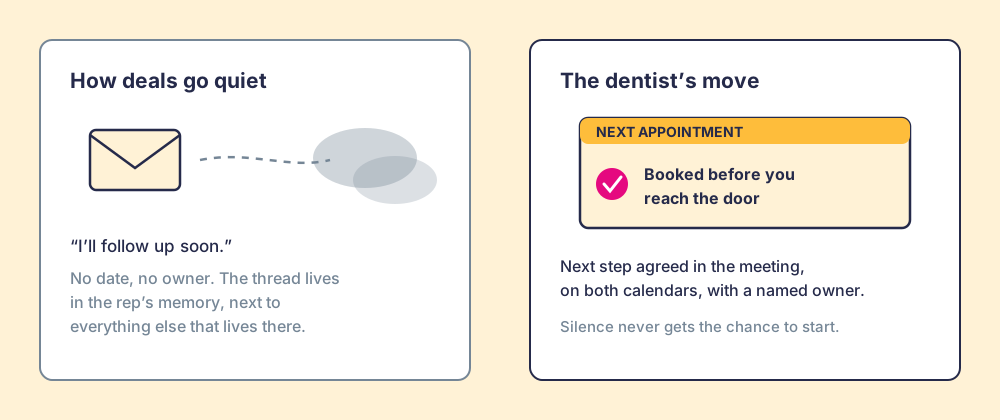
The upstream fix is to contract the step in the room: what happens next, who owns it, by when, agreed out loud and placed on both calendars. A mutual action plan formalizes that for larger deals. When a buyer goes dark anyway, the Jolt data sets the follow-up’s job: give a stuck buyer a small, safe next move. A share of those silences are an objection the buyer never voiced; common sales objections covers how to surface one.
How many follow-up emails does it take to get a reply?
The Brevet Group’s synthesis of sales research puts two numbers side by side. 80 percent of sales require five follow-ups after the meeting. 44 percent of salespeople stop after one. The work needs five. Nearly half the profession quits at one.
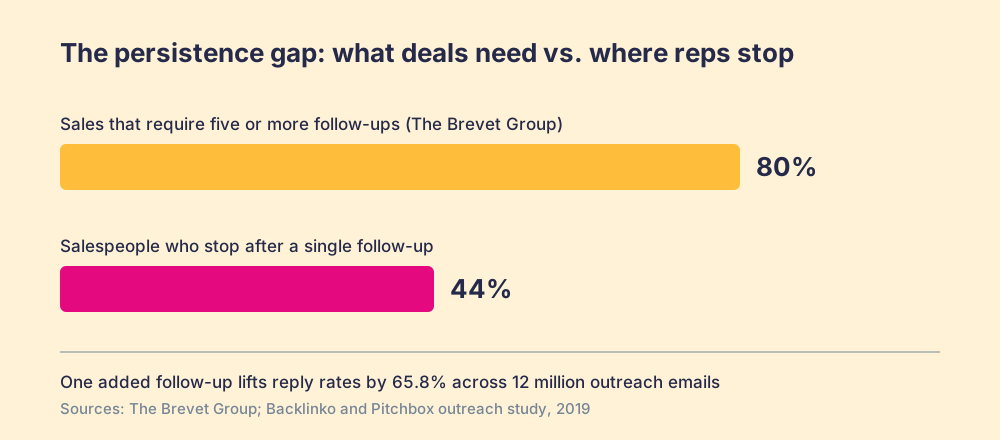
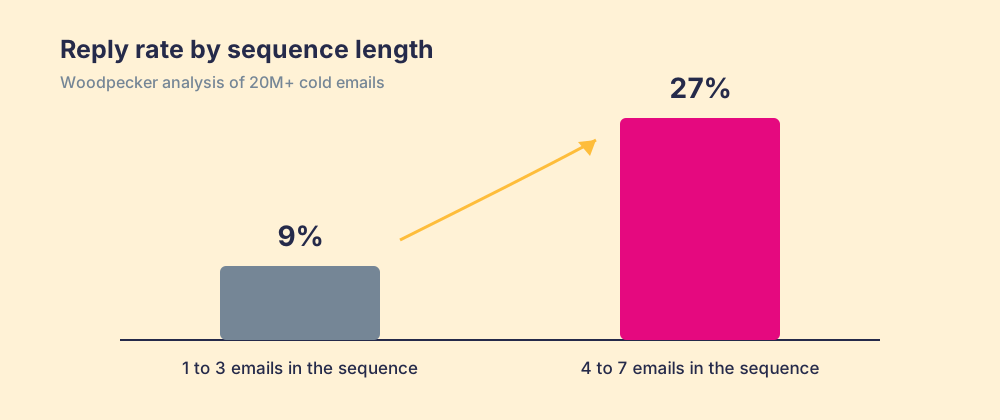
Email-only data at scale tells the same story. Across 12 million outreach emails analyzed by Backlinko and Pitchbox in 2019, only 8.5 percent got any response, and a single added follow-up lifted replies by 65.8 percent. Across more than 20 million cold emails at Woodpecker, sequences of four to seven emails replied at 27 percent against 9 percent for sequences of one to three. A 3x difference, purchased by showing up more times.
Persistence has a ceiling, and past it extra touches erode trust and deliverability; touch counts, channel mix, and the stopping rule belong to the sales cadence. The replies live on touches three, four, and five, the same touches memory drops. A first silence carries almost no information. A second one feels like a verdict, attention drifts to warmer names, and the touch that would have landed dies unsent. The template was never the missing part.
Nine sales follow-up email examples you can copy
The buyer in all nine is Dana. Swap in yours and your specifics; the structure does the work: each email adds a new reason to reply, shrinks the ask, and points at a concrete next step. None of them apologizes for existing.
1. After the demo, same day
Send within hours; it converts a good conversation into commitments with owners and a booked next step, so silence never gets its chance.
Subject: Recap, your multi-currency question, and the next step
Hi Dana,
Thanks for the time today. Three things, so none of this has to live in anyone’s memory:
- You asked whether reporting handles multi-currency. It does; the short doc is attached.
- Pricing for the 20-seat tier comes from our side by end of week.
- The next step we agreed on: a 30-minute technical review with Priya next week. Invite is in your inbox; grab a different slot if needed.
Anything I missed from your side?
Alex
2. After no response, first touch
Send two to three business days after a message goes unanswered; it carries new material, a number the buyer can react to, instead of a request to react to nothing.
Subject: The math on your day-a-week problem
Hi Dana,
When we spoke, you said the team loses about a day a week to manual updates. I put rough numbers on that: across 12 reps, that is roughly 600 hours a quarter. Would you sanity-check my math?
If the timing has shifted, say so and I will recalibrate. Otherwise, does a short call this week work?
Alex
3. After no response, second touch
Send four to five business days later; it shrinks the ask to something a busy person can answer from a phone and offers a graceful exit.
Subject: One-question version
Dana, compressing my last note to a single question: is the reporting project still slated for this quarter?
A one-word reply is plenty. If it slipped, tell me and I will stop nudging and come back when the timing is real.
Alex
4. After a proposal
Send three to four days after the proposal lands; it names the sections that draw scrutiny before the buyer has to admit confusion, and invites a hard answer over a slow death.
Subject: The two sections worth pressure-testing
Hi Dana,
You have had the proposal a few days, which is usually when the questions show up. The two sections that draw the most of them are the implementation timeline (page 3) and the seat-count assumptions (page 5). Want 20 minutes to pressure-test both before it goes to anyone else internally?
And if something in there reads wrong, say so plainly. I would rather rework a section than have it die politely in a drawer.
Alex
5. After a voicemail
Send within minutes of hanging up; it turns an anonymous missed call into a named, specific message and hands the buyer a choice instead of a chore.
Subject: The voicemail, in writing
Hi Dana,
I left you a voicemail a minute ago so the missed call would not be a mystery. Short version: the security review your team asked for is done, and it cleared. I can send the summary or walk through it live.
Which is easier for you?
Alex
6. Re-engaging a gone-dark deal
Send when a deal has been silent 30 to 90 days; it reopens the thread with the buyer’s own blocker and news that shrinks it. If nothing has changed, this email has no engine.
Subject: Closing the loop on the migration blocker
Hi Dana,
When we last spoke, the blocker was the data migration workload on your team. Two things have changed since: we shipped a migration tool that removes most of that manual work, and a team about your size went live with it in under three weeks.
Worth reopening the conversation, or is this settled on your end for the year?
Alex
7. After a trade-show introduction
Send within two days of the show, before the badge-scan pile buries you; it proves you listened and asks for one small slot instead of a relationship.
Subject: Your forecasting question, from the expo floor
Hi Dana,
We talked for five minutes at the booth about your forecast reviews running on stale numbers. You asked whether the sync works with HubSpot; it does, natively.
Show follow-ups arrive in a pile, so mine has exactly one ask: 15 minutes next week to show you the piece you asked about.
Alex
8. The breakup email
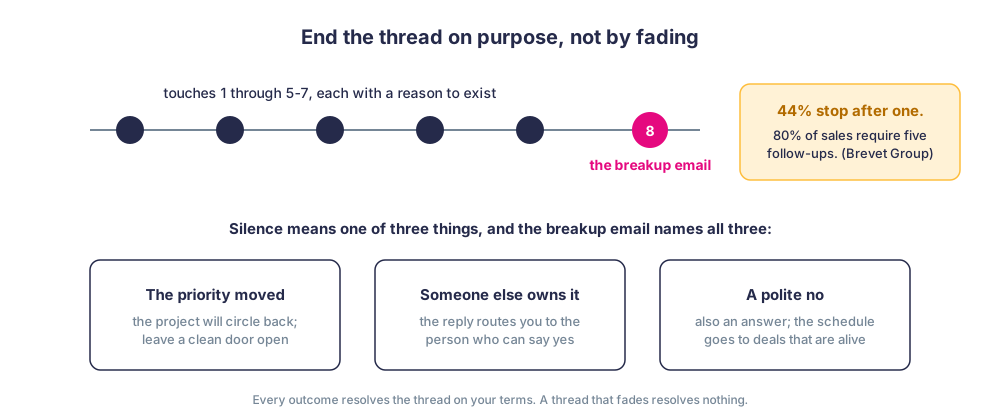
Send after five to seven unanswered touches, as the deliberate end of the sequence; it names the silence without blame and leaves a clean door open.
Subject: Closing your file
Hi Dana,
I have sent a few notes without a reply, which in my experience means one of three things: the priority moved, someone else owns this now, or the answer is no and being polite about it. All three are useful to know.
I will stop here either way. If the project comes back, the work we scoped is saved and takes one email to restart.
Alex
9. The buyer-driven check-in
Send when a shared deadline approaches; the urgency belongs to Dana, so the email reads as protecting her plan rather than advancing yours.
Subject: Working back from your go-live date
Hi Dana,
You set a go-live target eight weeks out. Working backward from it, the security review needs to start within two weeks to hold that date. Priya owns the questionnaire on our side and turns it around within 48 hours.
Should I connect her with your IT contact now, or has the target moved?
Alex
Why does a scheduled follow-up outperform a better-written one?
Because the follow-up problem is a process problem wearing an email costume. The costume gets all the attention: subject lines, opening hooks, sign-off temperature. Underneath sits a plainer question that decides the outcome: whether, for this deal, a message went out when the process said one should. The nine emails above are the costume. Whether email 2 fires two days after the silence starts, for the deal a rep is not thinking about, is the process.
Cities faced a version of this and solved it. Streetlight did not become dependable because towns hired more conscientious lamplighters. As long as a man had to walk to each lamp and remember it, some lamps stayed dark, and which ones depended on the route and the man. The light became dependable when the lamps went on a circuit and the cue stopped living in anyone’s memory. Follow-up is a lamp. On a pipeline of forty open threads, the deals that get theirs are the ones the rep happens to walk past.
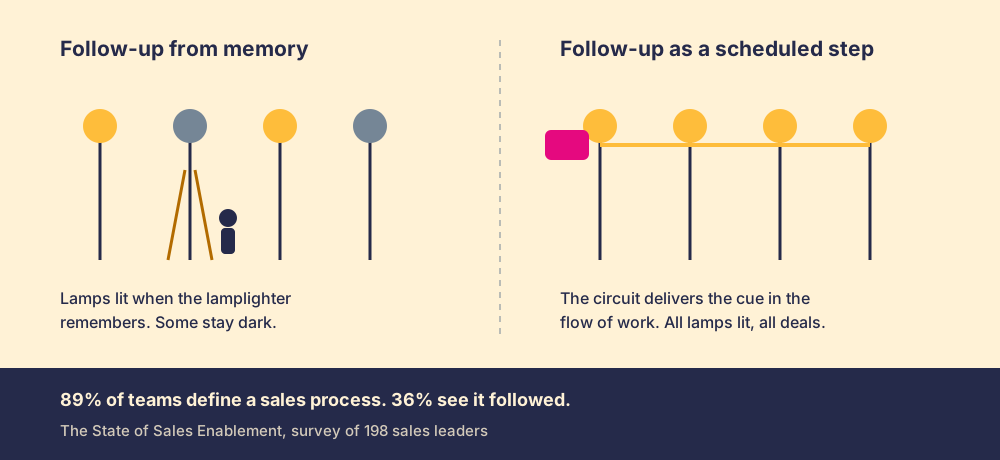
The gap between the two panels of that picture is measurable. In our survey of 198 sales leaders for The State of Sales Enablement, 89 percent of teams had a defined sales process and 36 percent saw it followed. Follow-up lives inside that gap, between the playbook’s schedule and the pipeline’s reality. The same survey found guidance delivered in the flow of work split quota attainment from 15 percent to 49 percent, which is what you would expect if the constraint were delivery rather than knowledge. Reps do not lack follow-up templates. They lack the cue, at the moment the follow-up is due, for the deal that needs it.
When a follow-up dies unsent, the tempting explanation is discipline, and it is the wrong one. The cue lived in a rep’s memory, competing with three proposals and a renewal, and memory lost, the way it loses for lamplighters. Sequence tools handle the outbound slice: HubSpot sequences fire a timed series at a contact and pause on reply, which suits cold outreach, where messages can be written in advance. Post-meeting follow-up resists blind automation, because the right message depends on what happened in the room. A business logic layer handles that case. The follow-up exists as a scheduled step of the sales process, surfaced to the rep in the flow of work when it comes due, and measured afterward, so a manager can see which deals got their follow-up and which are still waiting. Supered is built as that layer.
A quick recap
- The real failure point. Follow-up fails on the calendar before it fails at the keyboard: 80 percent of sales need five follow-ups and 44 percent of salespeople stop after one.
- The silent buyer. Silence usually signals a stuck buyer: 40 to 60 percent of deals end in no decision, and 56 percent of those are lost to fear of a wrong purchase.
- The contracted next step. A next step agreed inside the meeting, with an owner and a date, removes the guesswork templates paper over.
- The persistence math. One added follow-up lifts replies by 65.8 percent, and sequences of four to seven emails reply at 27 percent against 9 percent for one to three.
- The schedule. A follow-up that lives as a process step fires for every deal. One that lives in memory fires for the deals the rep happens to walk past.
What we recommend
Three ways to attack a weak follow-up motion, and they are not equal.
- Better templates. Real but small. Wording moves reply rates at the margin; the Backlinko data puts the big lever in whether a second and third message exist at all.
- More discipline. The pep-talk fix. It fails on mechanism, because memory rather than motivation drops the thread, and it sours a team by blaming people for a cue the system never delivered.
- A scheduled step. Define which situation gets which email and when, put the cue in the flow of work, and measure whether it fired. The only option aimed at the constraint.
We recommend the scheduled step. An 80 percent requirement met by a profession where 44 percent quit at touch one is a scheduling failure, and a schedule is something you can build. Copy the nine emails. Then give them a circuit to run on. The design of that circuit, touch counts, spacing, channels, and the stopping rule, is the subject of our guide to the sales cadence. To see follow-up delivered as a process step in the flow of work, book a demo and bring a deal that went silent.
Frequently asked questions
How long should you wait before sending a sales follow-up email?+
How many follow-up emails should you send before giving up?+
What should a follow-up email say after no response?+
Why do prospects stop responding after a good meeting?+
Do breakup emails work?+
Your process, running itself.