What Is Revenue Operations? The Team That Makes the Agreed Process Happen
Revenue operations is usually defined as aligning people, process, data and tools.
The job is making the agreed process happen, deal by deal. What RevOps owns, how the team is shaped by company size, and the metrics that show whether the process ran.
Revenue operations (RevOps) is the function that designs and runs one shared revenue process across marketing, sales and customer success: it owns the systems, the data and the rules, and its real job is making sure the process the team agreed on happens, deal by deal.
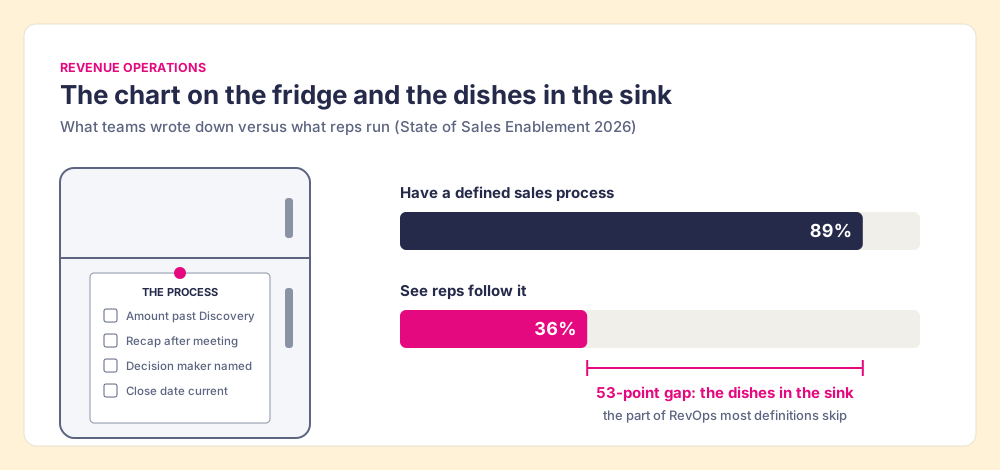
A family chore chart on the fridge is a lovely document. The whole family agreed to it, the kids signed it, and it has neat columns for dishes, bins and the dog. Then a week goes by, and the dishes are in the sink, and the chart is still on the fridge, exactly as accurate as the day it went up. The chart describes the household’s process. It does not run it.
Revenue operations (RevOps) is the function that designs and runs one shared revenue process across marketing, sales and customer success: it owns the systems, the data and the rules, and its real job is making sure the process the team agreed on happens, deal by deal. Most definitions of revenue operations stop at the first half, aligning people, process, data and tools. That half is the chore chart. In The State of Sales Enablement 2026, 89% of sales teams had a defined process and 36% saw reps follow it. The 53 points between those numbers are the dishes in the sink, and they are the part of the job this guide is about.
What is revenue operations?
Start with the definitions a buyer will already have read, because they are mostly right. Salesforce calls revenue operations “a strategic framework that brings together all revenue-related activities in an organization” (Salesforce). Highspot, part of Seismic since their merger closed in August 2026, calls it “the business unit that connects process, data, and technology for sales, marketing, enablement, and customer success” (Highspot, updated September 2026). The RevOps Co-op community collected definitions from practitioners, and the one it leads with comes from Natalie Furness: “the business function dedicated to aligning people, processes, and data systems across go-to-market teams to maximize revenue generation while minimizing costs effectively” (RevOps Co-op, May 2025).
Gartner gave the reason for the whole movement in 2021. Doug Bushée, a senior director analyst in its sales practice, said that “functional silos handing off clients from one function to the other, and using different technologies, people and processes, are a barrier to revenue growth,” and Gartner predicted that 75% of the highest-growth companies would deploy a RevOps model by 2025 (Gartner, May 2021).
The history is short. Sales had its operations team, marketing had its own, customer success had a spreadsheet, and each one kept its own version of the customer. Stephen Diorio wrote in Forbes that revenue operations consolidates “historically separate functions” including sales operations, sales enablement, marketing operations and customer analytics (Forbes, March 2023). The labor market followed: LinkedIn’s 2023 Jobs on the Rise list put Head of Revenue Operations at number one in the US, with a median of five to six years of prior experience, and the top roles people moved from were Sales Operations Manager, Marketing Operations Manager and Business Operations Manager (LinkedIn, January 2023).
So, what is RevOps? I agree with all of the above, and I would add one sentence. Jeff Ignacio, quoted in the same RevOps Co-op piece, describes RevOps as “bringing go-to-market strategy and execution to life.” Execution is the word to hold onto. Alignment is a meeting. Execution happens in the minute after a call ends, when a rep with six open deals and a buyer waiting on another line decides whether to send the recap. RevOps is the team that decides whether anyone finds out.
What does revenue operations own?
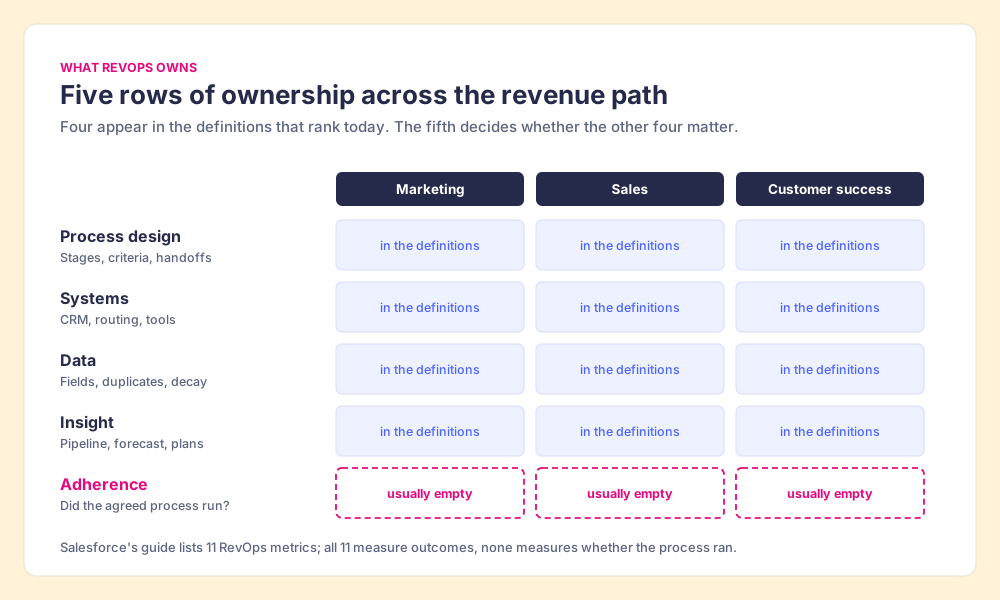
The consensus list is sound, and it is worth laying out in full because each item is a real job with a real failure mode:
- The revenue process. Lifecycle stages, deal stages, entry and exit criteria, and the handoffs from marketing to sales to customer success.
- The systems. The CRM and everything connected to it: routing, enrichment, sequencing, quoting, billing sync. Our post on RevOps software walks through how operators pick that stack, and the RevOps tools post shows one real stack piece by piece.
- The data. Field definitions, required properties, duplicates and decay. Validity’s 2025 survey of 602 CRM users found 76% said less than half of their CRM data was accurate and complete (Validity via PR Newswire, July 2025).
- The insight. Pipeline reports, the forecast, win-loss, and the territory and quota math that goes to finance.
- The enablement handoff. RevOps decides what changes; enablement teaches it. Our comparison of sales enablement vs sales operations covers where that line usually sits.
- The adherence. Whether the process above is what reps do, deal by deal, checked often enough to matter.
The last line is the one the popular definitions leave out. Salesforce’s guide lists eleven revenue operations metrics, from cost per acquisition to customer adoption rate, and all eleven measure outcomes; none of them measures whether the process ran. RevOps Co-op’s four responsibilities (insights, enablement, systems and process optimization) treat the process as something to design and improve. Nothing on either list says who checks that the designed process happened yesterday.
Why does the agreed process break down after RevOps designs it?
Suppose a RevOps lead does everything on the first five rows well. The stages have exit criteria. The CRM requires an amount past Discovery. The recap template is in the sequence tool. Then the team grows.
The State of Sales Enablement 2026 shows what happens next. Process adherence was 47% on teams with one to five reps per manager and 23% on teams with six to eight. Asked why reps skip the process, the most common answer (29%) was that managers do not enforce it, and capacity came up more often than indifference. Managers run out of hours before they run out of good intentions. Forrester found the same strain from the RevOps side: in its 2024 Revenue Operations survey, as cited by Highspot, 46% of RevOps directors said their processes are “overly manual.”
None of this is the reps’ fault. A rep who skips a step is responding to the system around them: the step lives in a doc, the first check comes at the pipeline review, and the deal in front of them has a buyer waiting. Fix the system and the behavior follows. The research on formal process agrees on both halves. Jordan and Kelly’s survey of 62 B2B companies for Vantage Point Performance and the Sales Management Association, reported in Harvard Business Review, found “an 18% difference in revenue growth between companies that defined a formal sales process and companies that didn’t,” and companies that spent at least three hours a month managing each rep’s pipeline saw 11% greater revenue growth than those that spent less (HBR, January 2015). Defining the process pays. Spending time checking it pays again. The second payment is the one a growing team stops making.
What can a hospital checklist teach a revenue operations team?
In 2001, Peter Pronovost, a critical-care specialist at Johns Hopkins, wrote a five-step checklist on a sheet of plain paper for putting a central line into an ICU patient: wash hands with soap, clean the skin with chlorhexidine, drape the whole patient, wear a sterile mask, hat, gown and gloves, and put a sterile dressing over the site. Atul Gawande, telling the story in The New Yorker, noted that the steps were “no-brainers; they have been known and taught for years.” Pronovost asked nurses to watch doctors for a month anyway. “In more than a third of patients, they skipped at least one.”
The next part is the part RevOps should study. Pronovost did not write a better checklist or run a training. He and his team “persuaded the hospital administration to authorize nurses to stop doctors if they saw them skipping a step on the checklist.” A year later, “the ten-day line-infection rate went from eleven per cent to zero” (Gawande, The New Yorker, December 2007). When the program spread to 103 Michigan ICUs, the median rate of catheter-related bloodstream infection fell from 2.7 per 1,000 catheter-days to 0 within three months, a reduction of up to 66% that held for the full 18 months of the study (Pronovost et al., New England Journal of Medicine, 2006).
The doctors knew the steps. The checklist existed. What changed was that someone in the room had the job, and the authority, of checking that the steps happened while the work was going on.
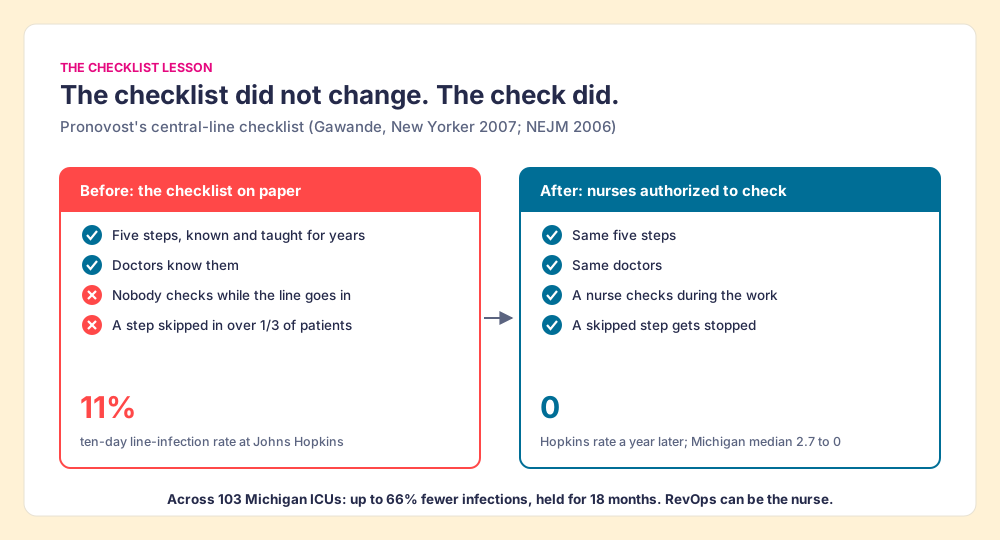
A sales team is the ICU before the nurses were authorized. The playbook is the checklist, the steps are well known, and a busy, capable professional skips one in the moment because nothing in the room catches it. RevOps can be the nurse. The comparison stops somewhere, of course: a rep should never be blocked from selling, and a missed recap is not a bloodstream infection. What carries over is narrower. The check runs during the work, against steps the team already agreed to, by someone whose job it is, without waiting for the senior person to remember.
In our survey, teams that inspect deals against a defined process at the highest frequency hit quota at 6.3x the rate of the lowest band. Inspection is the lever. The question for RevOps is who pulls it when the managers are out of hours.
How is revenue operations structured at different company sizes?
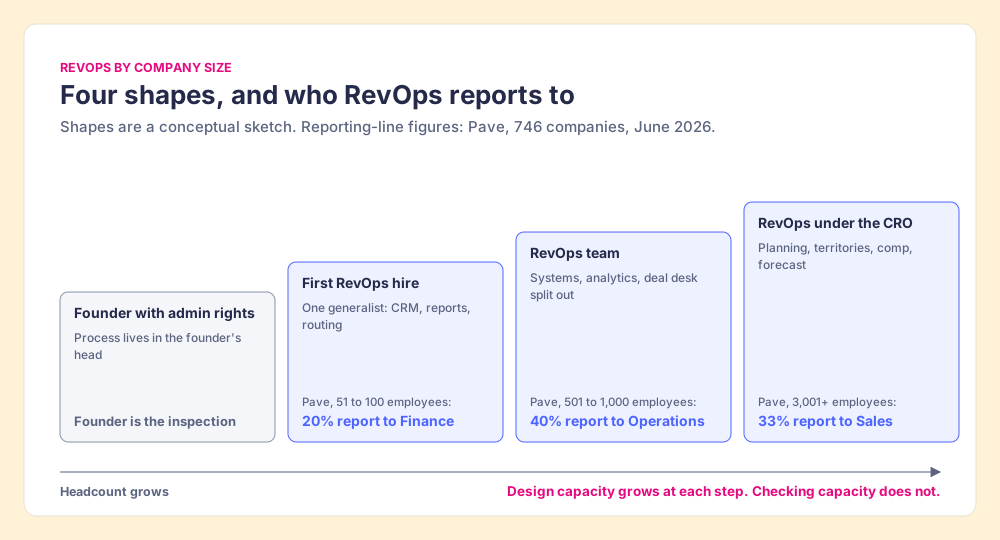
The shape of RevOps changes with headcount, and the reporting line changes with it. Pave analyzed 746 companies with RevOps employees and published where the function reports (Pave, June 2026):
| Company size | What Pave found |
|---|---|
| 51 to 100 employees | Finance at its peak: 20% of RevOps teams report to Finance |
| About 200 employees | Finance levels off at around 9% |
| 501 to 1,000 employees | Operations at its peak: 40% report into Operations |
| 3,001+ employees | Sales becomes the most common line at 33%, mostly under a CRO; Operations drops to 22% |
The shapes behind those numbers, sketched as four stages (a conceptual map, not Pave’s categories):
- The founder with admin rights. Under the first sales manager, RevOps is whoever set up the CRM. The process lives in the founder’s head and the founder is the inspection.
- The first RevOps hire. One generalist owns the CRM, the reports, the routing and the stage definitions. Finance often owns the line at this stage, because the first question is “can I trust the pipeline number.”
- The RevOps team. Systems, analytics, deal desk and sometimes enablement split into specialists, usually reporting into an Operations leader. Process design gets real attention here; adherence often gets a monthly dashboard.
- RevOps under the CRO. At scale the function sits beside sales, marketing and customer success leadership and owns planning, territories, compensation and the forecast. The process now covers more deals than any manager can inspect by hand.
The pattern across all four: each step up adds people who can design the process, and none of them adds hours to check it. Adherence drops as span grows, from 47% to 23% in our data, at the same moment the RevOps team gets big enough to have a process worth following. Our guide to sales operations covers the sales-only version of this role and when a company needs both.
What revenue operations metrics should you track?
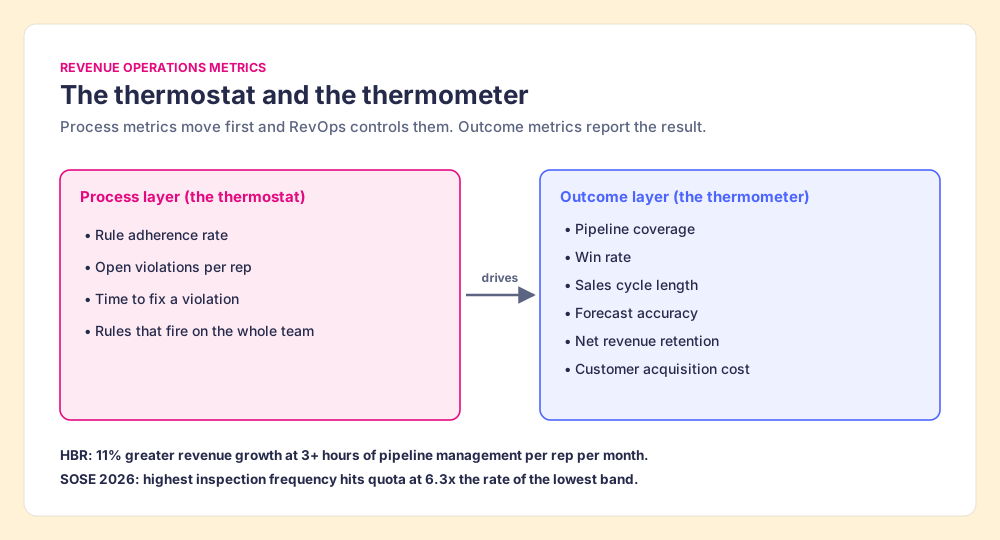
Revenue operations metrics come in two layers, and the eleven metrics in Salesforce’s guide all sit in the top one.
The outcome layer tells you what happened:
- Pipeline coverage. Open pipeline against the remaining target for the period.
- Win rate. Closed-won deals as a share of deals that reached a decision.
- Sales cycle length. Days from opportunity creation to close.
- Forecast accuracy. The committed number against the booked number.
- Net revenue retention. Revenue kept and expanded from existing customers, after churn.
- Customer acquisition cost. What it costs to win a customer, ideally with its payback period.
The process layer tells you why, and it moves first:
- Rule adherence rate. The share of open deals that meet every agreed rule today: amount past Discovery, a decision maker named, a recap after every meeting.
- Open violations per rep. A count a rep can drive to zero by morning, which makes it coachable in a way a win rate never is.
- Time to fix. How long a violation stays open. A day means the rep still remembers the call. A month means someone is reconstructing it.
- Rules that fire on the whole team. When one rule fails for most of the reps on a team, the step is broken, and the fix belongs to the process design.
The outcome numbers are a thermometer. The process numbers are the thermostat setting. You can stare at a cold thermometer all winter; the house warms when someone changes the setting and something checks that the furnace came on. HBR’s data and ours point the same way: time spent checking the pipeline (11% greater revenue growth at three or more hours per rep per month) and inspection frequency (6.3x) are inputs RevOps controls, and the outcome metrics follow them.
How does AI change the revenue operations job?
AI has already moved into RevOps work. In The State of Sales Enablement 2026, 46% of teams use AI for CRM admin and cleanup, against 26% for deal strategy and forecasting. The tools can update fields, draft recaps and summarize calls faster than any admin.
What they cannot know is your process. A model asked to “clean up the CRM” will clean toward its own guess. Teams with strong process adherence rated AI’s impact high 40% of the time; teams with weak adherence, 21%. AI amplifies the process you already run, which makes the written rules more valuable, because they are the instructions the model follows and the test its work has to pass.
My own board is a small example. It is called the Zero Board, it runs 22 Process Rules against my open deals, and one night it showed 11 violations: close dates in the past, no amount past Discovery, a missing recap, no decision maker. With Supered, HubSpot and Gmail connected to Claude, one prompt cleared it: Claude read the rules, updated the fields from my notes and calendar, and saved the recap and pre-call emails as Gmail drafts for me to send. About 45 minutes by hand, about 10 that way. Those times come from one night on my own deals, and yours will differ. The rules lived outside the model, so the next nightly check graded Claude’s work the same way it grades mine. Our post on AI for RevOps covers how operators are building the rest of that stack.
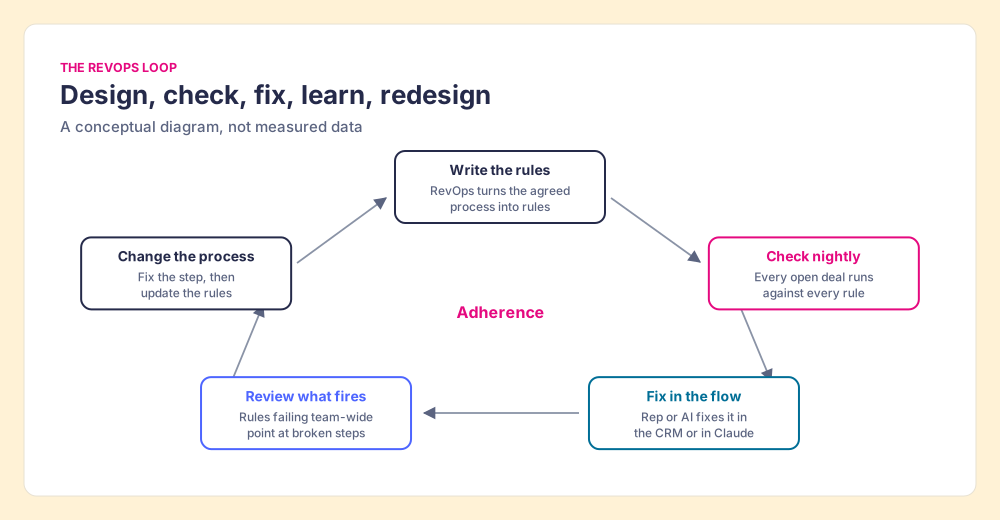
In Supered, the nurse has software help. RevOps writes the agreed process as Process Rules inside a Process Ruleset; a Process Board checks every open deal against them every night; the rep sees what failed inside HubSpot, Salesforce or Pipedrive, or fixes it from Claude; and the manager sees who followed the process without reading records. Supered started inside RevPartners, the HubSpot partner I founded to do RevOps as a service, which sold roughly 2x more Sales Hub than any other partner and reached Elite tier in 13 months. The sales expectations use case shows the full setup, and pricing shows the Process Compliance plan that includes it.
What we recommend
Make RevOps the owner of the process that runs: the rules written down, checked every night by software, fixed in the flow of work, and reviewed for which ones fire most. Systems and numbers still matter, and here is how the alternatives compare:
- RevOps as the systems team. It keeps the CRM running and the integrations connected. Useful, and the first hire usually starts here, but the process stays wherever the managers keep it.
- RevOps as the numbers team. It owns the forecast, the dashboards and the planning math. Better, because leadership trusts the pipeline, but the dashboards report the outcome layer after it is too late to change.
- RevOps as the owner of the process that runs. It does both of the above and owns adherence.
The evidence for owning adherence:
- A known gap. 89% of teams have a defined process and 36% see it followed. Design is done at nine teams in ten; running it is where the points are.
- A lever with a measured effect. Inspection frequency carries a 6.3x quota multiple in our data, and HBR’s survey found 11% greater revenue growth when managers spent three or more hours a month per rep on the pipeline.
- A cost that grows with headcount. Adherence halves from 47% to 23% as span grows, and the top reason reps skip the process is that managers do not enforce it (29%). Software reads every deal every night; a manager cannot.
- A precedent outside sales. The ICU steps were known for years and still skipped in more than a third of cases, until someone in the room was authorized to check them. Infection rates fell to zero.
- AI that needs a rulebook. Teams with strong adherence rate AI’s impact high nearly twice as often (40% vs 21%). Written rules are what let AI do RevOps work you can trust.
If you are still choosing tools, read RevOps software for how operators pick a stack, then sales process adoption for what it takes to get the process followed once it is designed. If your CRM data is the first fire to put out, CRM hygiene shows the six nightly rules I run on my own deals. Or book a demo and we will put your agreed process into rules and run them against your open pipeline.
Frequently asked questions
What is revenue operations in simple terms?+
What does a revenue operations team do day to day?+
What is the difference between revenue operations and sales operations?+
Who does revenue operations report to?+
What metrics should revenue operations track?+
When should a company hire its first revenue operations person?+
Your process, running itself.