CRM Hygiene Is a Nightly Check: The Six Rules I Run on My Own Deals
CRM hygiene gets sold as a cleanup project. The word means a daily habit. Why CRM data goes stale when nobody did anything wrong, the six rules I check every night, and who should fix what they find.
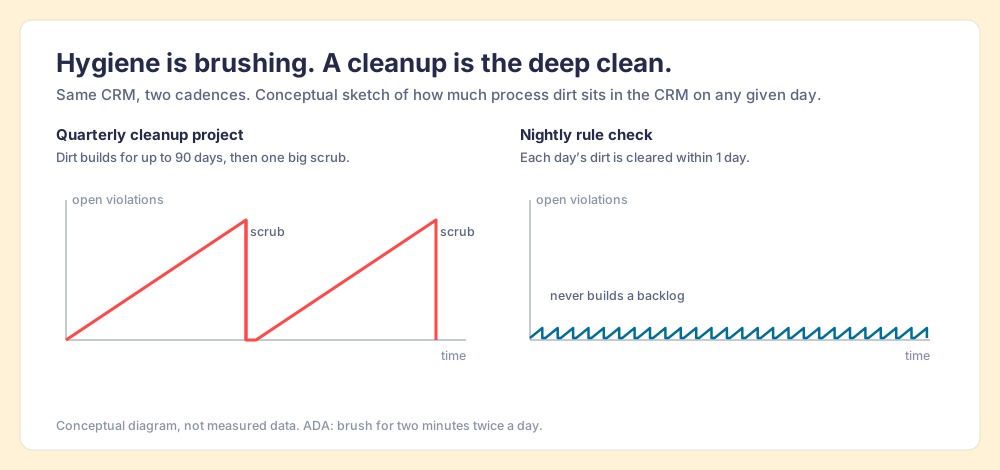
CRM hygiene is the habit of checking your CRM records against a short, written set of rules every night, so a stale close date or a missing recap gets fixed within a day instead of piling up until the next cleanup project.
The word already tells you the answer. Hygiene is what you do every day so you never need the drastic version. The American Dental Association says to brush “for two minutes twice a day” (ADA), and no dentist has ever proposed skipping that in favor of one heroic scrub at the end of March. Yet most of what gets written about CRM hygiene describes the heroic scrub: an audit, a purge, a cleanup sprint, then a promise to stay disciplined.
CRM hygiene is the habit of checking your CRM records against a short, written set of rules every night, so a stale close date or a missing recap gets fixed within a day instead of piling up until the next cleanup project. That definition carries the whole argument of this post. CRM data does not get dirty because reps are careless. It gets dirty because time passes, meetings end and deals move forward, which means it gets dirty at the speed of selling. A cleanup project is a photograph of a moving thing. A nightly check is the only cadence that keeps up.
What is CRM hygiene, and how is it different from a cleanup?
A CRM data cleanup is a project. It has a start date, an owner, a spreadsheet of bad records and an end. CRM data hygiene is a routine. It has rules, a cadence and no one who has to remember to run it.
Both are useful, in that order. You do one cleanup to clear the backlog, the way a dentist scrapes off years of tartar once. Then you brush. The trouble starts when a team treats the deep clean as the routine, because the gap between cleanups is where the forecast goes wrong and the buyer gets a recap three days late or never.
The numbers say the deep-clean approach is losing. Validity surveyed 602 CRM users and administrators for its 2025 State of CRM Data Management report: 76% said less than half of their organization’s CRM data is accurate and complete, and 57% said their company relies on manual data cleaning efforts while cutting investment in dedicated data quality staff (Validity via PR Newswire, July 2025). Manual scrubs, fewer people to run them, and three quarters of teams still looking at mostly wrong data.
Why does CRM data get dirty even when reps do their jobs?
Late one night I opened my own board. It is called the Zero Board, it runs 22 Process Rules against my open deals under a ruleset called Sales Expectations, and it showed 11 violations across six types:
- Close date in the past. The deal says it closes on a date that has already gone by.
- No amount past Discovery. The deal has moved beyond Discovery with the amount still blank.
- Overdue tasks. A task tied to the deal is past its due date.
- No pre-call email within 24 hours. A meeting is coming up and the buyer has not heard from me.
- No recap sent. A meeting happened and the follow-up never went out.
- No decision maker. The deal has advanced with no contact marked as the person who signs.
Sort them by what made each one true. Three were made true by the calendar alone: a date went by, a task came due, a meeting moved inside its 24-hour window. One was made true by a meeting ending. Two were made true by the deal moving forward, which is the outcome I wanted. Zero of the six fired because I did something wrong. The violations on that board were the exhaust of selling.
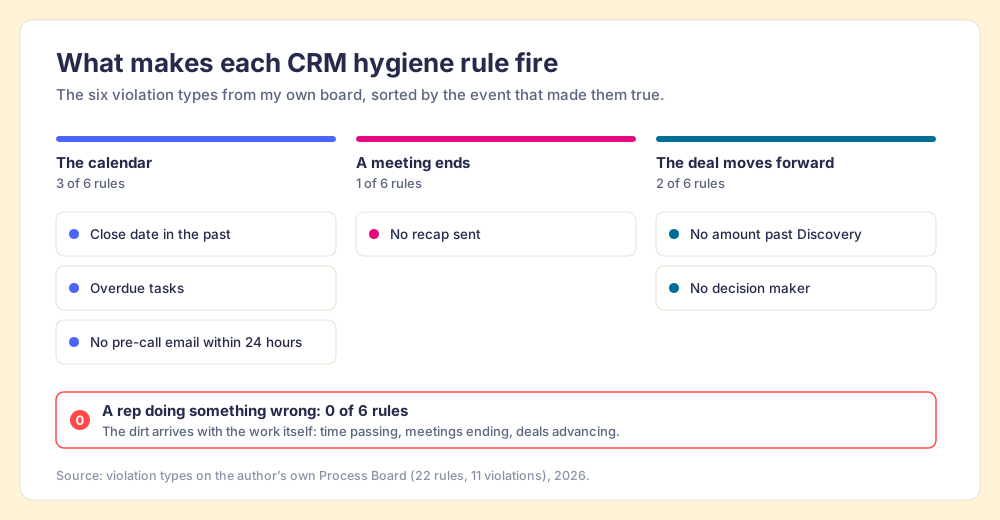
This changes how you think about a dirty CRM. A sink full of dishes is evidence that people ate, and a lecture on discipline will not empty it. Contact data decays the same way. The median US wage and salary worker had been with their current employer for 4.1 years in January 2026 (Bureau of Labor Statistics, September 2026), so half of them had been in their job for less time than that, and the person in your CRM record changes jobs whether or not anyone touches the record. The CRM stays still while the world moves, and the distance between them is the dirt.
It also explains why the cleanup never holds. The morning after the sprint ends, the calendar starts firing again.
What does a CRM hygiene rule look like?
A rule is a sentence a computer can check: a condition, the records it applies to, and what fixes it. The six from my board, written out the way I would hand them to a new sales leader:
| Rule | What makes it fire | Who it protects | The fix |
|---|---|---|---|
| Close date in the past | The calendar | The forecast | Move the date to the next real buyer event |
| No amount past Discovery | The deal advancing | The forecast | Enter the number the buyer gave in discovery |
| Overdue task | The calendar | The buyer | Do it, re-date it with a reason, or close it |
| No pre-call email within 24 hours | The calendar | The buyer | Send an agenda and the question you need answered |
| No recap sent | A meeting ending | The buyer | Send what was agreed and the next step |
| No decision maker | The deal advancing | The forecast and the buyer | Name the person who signs, or ask who that is |
Two kinds of protection run through that table. Three rules keep the forecast true, which is the job CRM hygiene advice usually talks about. Four protect the buyer, with the decision-maker rule doing both, and the buyer rules matter more than they look. A buyer who gets an agenda the day before and a recap the afternoon after is having a better experience than one who gets neither, and a nightly rule can tell you which one they had.
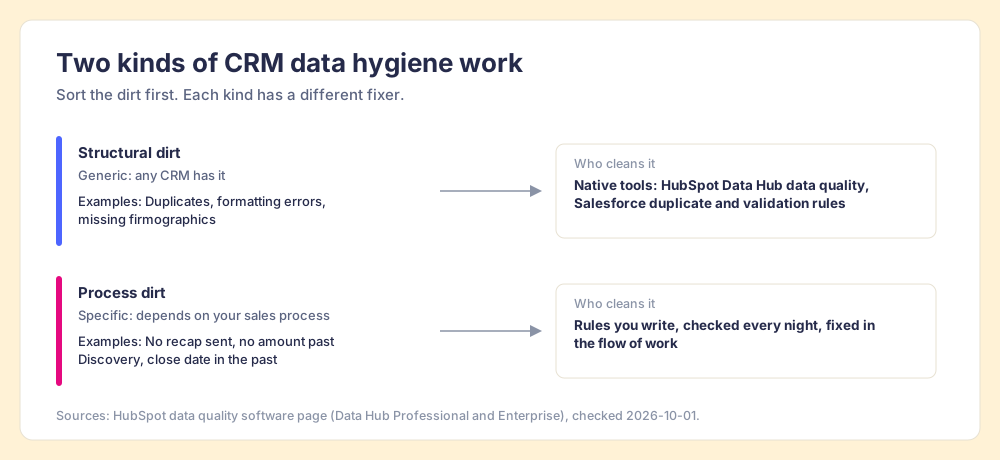
CRM data hygiene splits in two here. Some dirt is structural: duplicates, bad formatting, missing firmographics. Software that knows nothing about your sales process can fix it. HubSpot data quality tools in Data Hub Professional and Enterprise merge duplicates, fix formatting errors and enrich missing fields, with AI scanning the database for issues (HubSpot), and Salesforce has duplicate and validation rules for the same job. Use them. Our post on HubSpot data cleanup walks through the biggest structural source in HubSpot, form sprawl, and Salesforce data quality covers why reps under-capture in the first place.
The other dirt is process dirt, and no vendor can ship rules for it, because the rules are yours. HubSpot cannot know that your team sends a recap after every meeting, or that an amount is required past Discovery and not before. You have to write those down.
Why does a nightly check work better than a quarterly CRM data cleanup?
One of the most visible guides on this topic is ZoomInfo’s five-step CRM hygiene framework, and it deserves a fair hearing (ZoomInfo, updated July 2026). It defines governance rules first, which is right. It even sets a cadence by layer: “Log all interactions to the CRM immediately” daily, a duplicate review weekly, a stale-record audit monthly, and “a full deduplication pass across the database” quarterly. For contact and account data, that schedule is sensible.
Where I part ways is on who runs the daily layer. In that framework, the daily work is a request to the rep, and the checking happens later, in audits a person runs. The rule is enforced by memory and the inspection is periodic. For deal data that changes at the speed of the calendar, the check has to run as often as the dirt arrives, and it has to run without anyone deciding to run it.
The research on monitoring is unusually clear here. Benjamin Harkin and colleagues pooled 138 studies with 19,951 participants in Psychological Bulletin and found that monitoring progress toward a goal raised the odds of reaching it; in the words of the press summary of the study, “the more frequent the monitoring, the greater the chance of success,” and the effect grew when progress was “physically recorded or publicly reported” (Harkin et al., 2016; EurekAlert summary). A nightly rule check is all three at once: frequent, written down, and visible to the team.
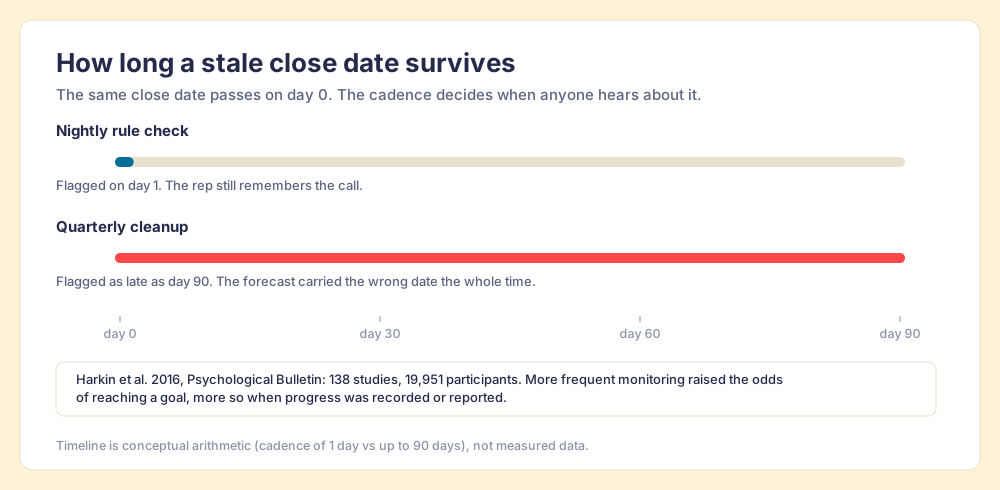
The delay matters for a reason that goes beyond the forecast. The day after a call, the rep remembers what the buyer said about budget, so the fix is quick and the number is right. Ninety days later the rep is reconstructing a conversation, and Validity found that 37% of staff regularly fabricate data to tell leaders what they want to hear. A scrub before a pipeline review invites exactly that: fill the field, pass the check, move on.
Our own survey says the same from the manager’s side. In The State of Sales Enablement 2026, 89% of teams had a defined sales process and 36% saw reps run it. Adherence fell from 47% on teams with one to five reps per manager to 23% on teams with six to eight, and the most-cited reason reps skip the process was that managers do not enforce it (29%). Managers run out of hours before they run out of good intentions. Inspection is mandatory, and the only way to inspect every deal every night is to take the reading off the manager’s desk and give the manager back the coaching time.
Should the rep or the AI fix the violations?
The fixing is where AI pays its way, and teams already know it: in The State of Sales Enablement 2026, 46% of teams use AI for CRM admin and cleanup, against 26% for deal strategy and forecasting.
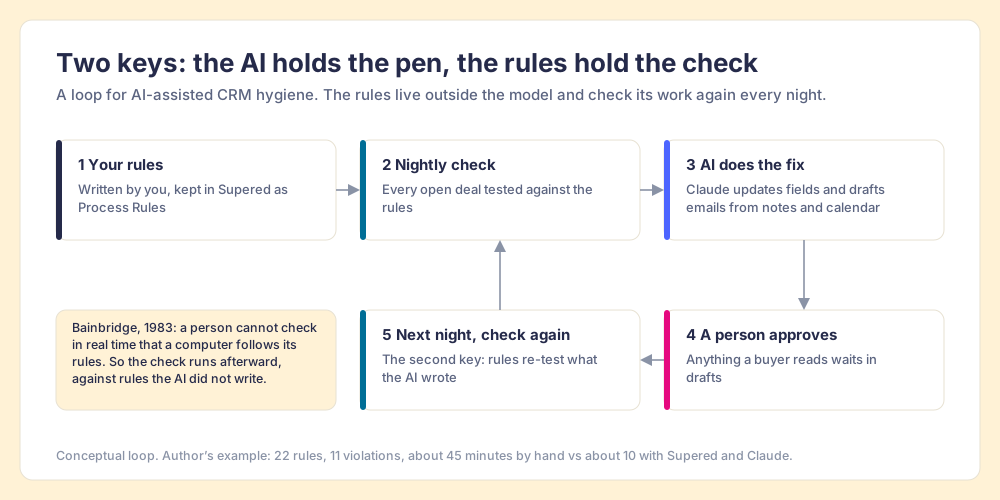
On my board it went like this. With Supered, HubSpot and Gmail connected to Claude, I typed one prompt: look at my Zero Board, fix all my violations, and draft anything that needs an email. Claude loaded my rules, found the 11 violations, filled the missing amount from my discovery notes, moved close dates to match the next meetings on my calendar, and saved recap and pre-call emails with a recommended next step to my Gmail drafts. By hand the same pass takes me about 45 minutes. This one took about 10. Those times come from my own deals, one night, and yours will differ.
Lisanne Bainbridge wrote the warning for this setup in 1983, about industrial control rooms. In “Ironies of Automation” she pointed out that when a computer follows fully specified rules faster than a person can, “there is no way in which the human operator can check in real-time that the computer is following its rules correctly” (Bainbridge, Automatica, 1983). She also noted that a person cannot keep effective watch over a source “on which very little happens, for more than about half an hour.” Asking a sales manager to watch an AI edit the CRM all day would fail on both counts.
Banks settled this long ago with two keys: the vault opens only when two people turn them, so no single hand both moves the money and vouches for it. The AI holds the pen. The rules hold the check. The rules live outside the model, written by you, and the next night they run again against whatever the AI wrote. If Claude moved a close date to a meeting that got cancelled, the rule fires again and the board shows it. A person still approves anything a buyer reads, which is why my emails landed in drafts instead of going out. If you are wiring this up yourself, our post on the HubSpot MCP server covers what the connection can see and what it cannot know about your rules.
The sequence matters too. In our survey, teams with strong process adherence rated AI’s impact high 40% of the time, against 21% for teams with weak adherence. AI amplifies the process you already run. Hand it your rules first and the cleanup becomes the process; hand it a vague request to “tidy the CRM” and it will tidy toward its own guess. Bainbridge has a line for the rule count, too: “a proliferation of flashing red lights will confuse rather than help.” Six rules a rep can name from memory will do more than sixty that pile up unread.
How do you set up CRM hygiene rules this week?
Start small and let the board teach you what to add.
- One cleanup, once. Clear the backlog of stale deals and blank fields so the first night’s board shows today’s dirt alone.
- Six rules to start. Use the six above, or swap in your own, and write each one as a condition, a scope and a fix.
- A nightly check that runs itself. The rules evaluate every open deal while the team sleeps, and the result is waiting in the morning.
- The violation in front of the rep, where they work. In our survey, quota attainment was 49% when guidance was embedded in the workflow, 24% when it lived in CRM fields or stages, and 15% when it lived in docs or wikis. A morning list in the CRM or in Slack works; a report someone has to go and open does not.
- A fixer with guardrails. Let the rep fix it by hand or let Claude do the pass, with buyer-facing emails left as drafts until a person sends them.
- A weekly look at which rules fire most. A rule that fires on the whole team points at a broken step in the process, and the fix belongs to the step.
In Supered, the rules live as Process Rules inside a Process Ruleset, and a Process Board tracks every open deal against them. You can describe a rule in English and Supered’s MCP creates the Process Rule directly. The same rules show up inside HubSpot or Salesforce for the rep who works there, and in Claude for the rep who would rather type one prompt. The sales expectations use case shows the whole setup, including the morning summary.
What we recommend
Run CRM hygiene as a short set of your own rules, checked every night, with the fixes landing in the flow of work, and keep the vendor’s data quality tools switched on underneath for duplicates and formatting. Do one cleanup at the start to clear the backlog, then never schedule another.
The reasons come straight from the evidence above:
- Cadence matched to decay. Three of my six rules fire on the calendar alone, so a check that runs less often than the calendar turns will always be behind.
- Monitoring that works. Harkin’s 138 studies reward progress checks that are frequent and recorded, and a nightly board is both.
- Inspection without the manager’s hours. Adherence halves from 47% to 23% as span grows, and the top reason reps skip the process is that managers do not enforce it (29%). Software can read every deal every night; a manager cannot.
- AI with a second key. Let Claude write the fixes, keep the rules outside the model, and let the next night’s check confirm the work.
The quarterly cleanup project still has fans, and for a backlog it is the right tool. As a routine it lets process dirt build for up to 90 days, leans on the manual cleaning that 57% of companies run while cutting the staff to do it, and invites filled-in guesses before the review. Brush every night; see the dentist once.
If you want to see the AI half of this in detail, our hub on Claude for sales covers how the same rules reach any screen, and the HubSpot Claude connector guide walks through the one-prompt fix step by step. If you are shopping for a new system to get this, read AI CRM first: you likely do not need one. For why a board can pass every rule and still misread the buyer, read pipeline hygiene next. Or book a demo and we will run your first six rules against your own deals.
Frequently asked questions
What is CRM hygiene?+
What is the difference between CRM data hygiene and CRM data cleanup?+
How often should you clean CRM data?+
What are the most important CRM hygiene rules for sales?+
Can AI fix CRM hygiene problems?+
Does HubSpot have a data quality tool?+
Your process, running itself.