Sales Operations: What Sales Ops Owns, and the Job It Forgot
Sales operations writes the rules a sales team sells by.
What sales ops owns, how it differs from RevOps and enablement, the work week, the metrics, the tools, and the one job it hands to managers who have no time for it.
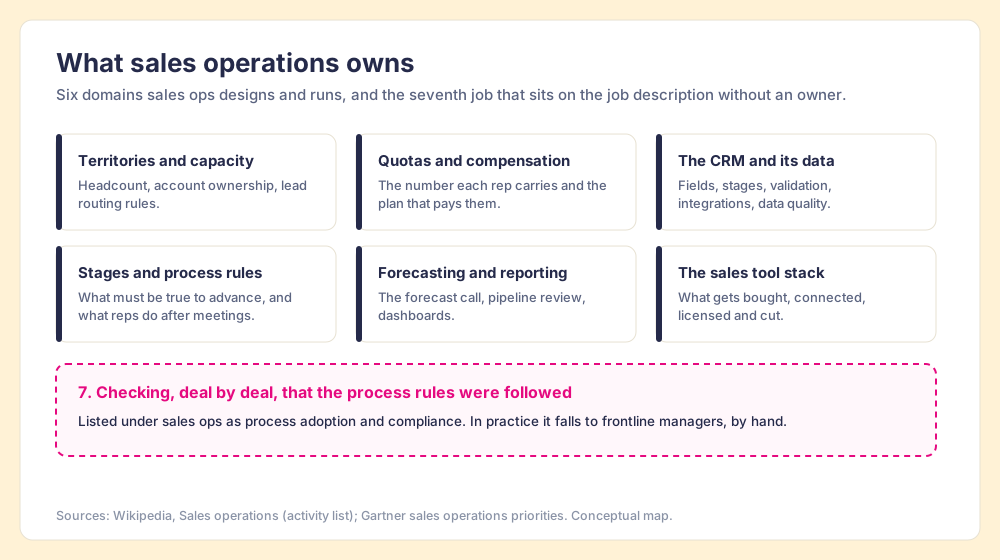
Sales operations (sales ops) is the team that designs and runs the system a sales team sells inside: territories, quotas and compensation, the CRM and its data, the stages and rules of the sales process, the forecast, and the tools reps use every day.
Sales operations began at Xerox in the 1970s, and the man who ran one of the first groups described its job better than any modern definition. J. Patrick Kelly called it “all the nasty number things that you don’t want to do, but need to do to make a great sales force” (Zoltners, Sinha and Lorimer, HBR, 2014). Planning, territories, comp, the forecast. Fifty years on, the list has grown a CRM, a tool stack and an AI budget, and the spirit has not changed.
Sales operations (sales ops) is the team that designs and runs the system a sales team sells inside: territories, quotas and compensation, the CRM and its data, the stages and rules of the sales process, the forecast, and the tools reps use every day. Google’s first page gives you some version of that definition. This one adds the part those guides leave out. Sales ops writes the rules of the sales process. Few companies give sales ops the job of checking, deal by deal, whether the rules were followed. That job falls to the frontline manager, who is also supposed to coach, and who runs out of hours long before the deals run out.
I spent years on the operations side of selling. At RevPartners, the HubSpot partner I founded, we ran RevOps as a service for sales teams, acting as the operations function they had not hired yet. Writing the rules was the easy half.
What is sales operations, and where did it come from?
Sales ops exists because selling at scale produces arithmetic that reps and their managers do not want to do. How many reps do we need to hit the number? Which accounts go to whom? What does a rep earn for a renewal versus a new logo? When will the money land? Each answer is a model, and each model needs an owner who is not also carrying a bag.
Wikipedia’s list of sales ops activities is a fair map of what the job became: sales process development and “adoption/compliance,” sales metrics and forecasting, territory analysis, goal setting and capacity, vendor selection, and change management (Wikipedia, Sales operations). Read that second item again. Compliance with the sales process sits on the official job description. It is the item that rarely shows up in a sales ops team’s weekly calendar.
Gartner’s sales operations guidance names process optimization, technology stack planning and operational risk among the function’s priorities, and Senior Director Analyst Wendy Butler-Mafuz warns that “to maintain relevance and prevent technology from outpacing workforce skills, sales operations must adapt how it supports the enterprise” (Gartner, Sales operations). Tools are arriving faster than the habits that make them pay.
What does sales operations own?
The scope varies with company size, but the core of sales ops is six domains.
- Territories and capacity. How many reps you need, which accounts each one owns, and the rules for who gets a new inbound lead.
- Quotas and compensation. The number each rep carries, the plan that pays them, and the disputes when a deal crosses two territories.
- The CRM and its data. Fields, stages, required properties, validation rules, integrations, and the data quality that every report depends on.
- Stages and process rules. What has to be true for a deal to move from Discovery to Proposal, what a rep must do after a meeting, and what “qualified” means here.
- Forecasting and reporting. The weekly call, the pipeline review, the board deck, and the dashboards leaders open on their phones.
- The sales tool stack. Which tools get bought, how they connect to the CRM, who has a license, and which ones get cut at renewal.
Look at the fourth bullet. Sales ops writes the stage definitions and the process rules. Writing a rule is a design job, and sales ops is good at design. Making sure the rule holds on deal 214 is an inspection job, and it needs hours that design jobs do not.
Sales ops vs RevOps vs sales enablement: what is the difference?
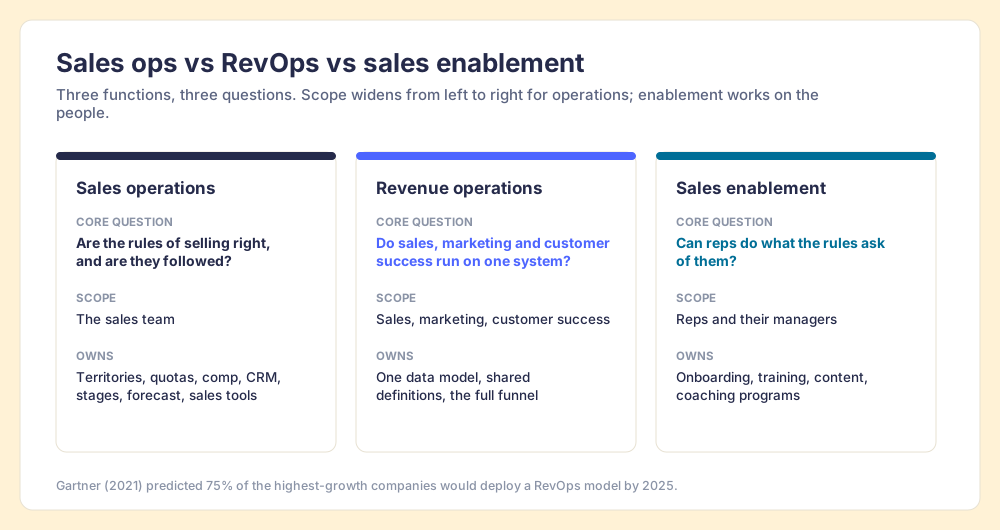
These three functions get blurred in job titles, so here they are side by side. For the full head-to-head between the first and third, read our post on sales enablement vs sales operations. For the wider operations model that now absorbs sales ops at many companies, read what revenue operations is.
| Sales operations | Revenue operations (RevOps) | Sales enablement | |
|---|---|---|---|
| Core question | Are the rules of selling right, and are they followed? | Do sales, marketing and customer success run on one system? | Can reps do what the rules ask of them? |
| Scope | The sales team | Sales, marketing, customer success | Sales reps and their managers |
| Owns | Territories, quotas, comp, CRM, stages, forecast, sales tools | One data model, shared definitions, the full funnel, cross-team tooling | Onboarding, training, content, coaching programs |
| Typical metrics | Forecast accuracy, pipeline coverage, win rate, data completeness | Funnel conversion end to end, net revenue retention, CAC payback | Ramp time, certification, content usage, skill scores |
| Reports to | CRO or VP Sales | CRO, COO or CFO | VP Sales, CRO or sales ops |
| Fails when | Rules exist on paper and go unchecked | The model is shared and the teams are not | Training lands and behavior does not change |
The direction of travel is toward RevOps. In 2021 Gartner predicted that 75% of the highest-growth companies would deploy a RevOps model by 2025 (Gartner on X, May 2021). In practice that has meant renaming the org and keeping the sales ops job inside it. Someone still owns territories and the forecast; their title now says revenue.
Smaller teams often run sales operations and enablement under one leader, and it can work well, because the person who writes the stage rules also builds the training for them. The risk is that one person does the design and the teaching, and the checking falls through the gap between them.
What does a sales ops team do in a typical week?
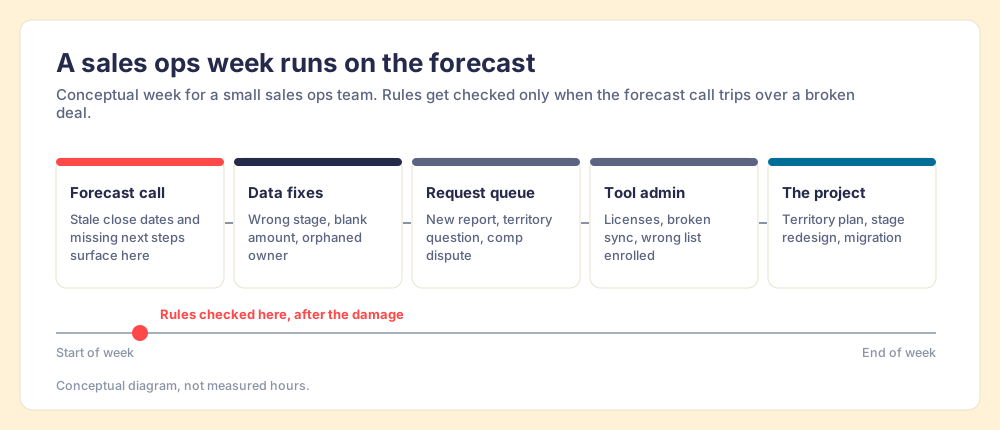
The rhythm of a sales ops week follows the forecast. A two- or three-person sales ops team supporting 20 to 50 reps runs a week shaped like this.
- The forecast call. Early in the week, pipeline numbers get pulled, close dates get questioned, and someone notices that half the commit sits in deals with no next meeting booked.
- The data fixes. After the call come the corrections: wrong stage, missing amount, duplicate company, a deal owned by a rep who left.
- The request queue. A new report for the VP, a territory question, a comp dispute, a field somebody wants added “just for my team.”
- The tool admin. License changes, an integration that stopped syncing, a sequence that enrolled the wrong list.
- The project, if time allows. Next year’s territory plan, a new stage definition, a CRM migration, a pricing change in the quote tool.
Look at where the hours go. Almost all of them are reactive, and almost all of them happen after something already went wrong. The forecast call finds the stale close date. The data fix corrects it. Nothing in the week checks the rules before the forecast call does. Salesforce’s 2026 State of Sales report, from 4,050 sales professionals, found that 74% are focused on data cleansing efforts, and that high performers prioritize data hygiene 79% of the time against 54% for underperformers (Salesforce, State of Sales 2026). The cleanup is a shared chore with no system behind it.
Which sales operations metrics matter most?
Sales ops is measured by whether the system it built produces a number leaders can trust. The usual set:
| Metric | What it tells you | Owner of the fix |
|---|---|---|
| Forecast accuracy | How close the committed number lands to the result | Sales ops with frontline managers |
| Pipeline coverage | Open pipeline divided by the remaining target | Sales ops, marketing, SDR leaders |
| Win rate | Share of qualified deals that close won | Sales leaders and enablement |
| Sales cycle length | Days from creation to close, by segment | Sales ops |
| Quota attainment | Share of reps at or above quota | Sales leaders, comp design by sales ops |
| CRM data completeness | Share of records with the fields the forecast needs | Sales ops |
| Process adherence | Share of open deals meeting your own written rules today | Usually unassigned |
The last row is the one I would add to any sales ops dashboard first, because it explains the others. A forecast misses because close dates were stale. Pipeline coverage looks fine and is not, because half the deals have no next step. Win rate sags in one segment because reps there skip the discovery step. Each of those is a rule that existed and was not followed.
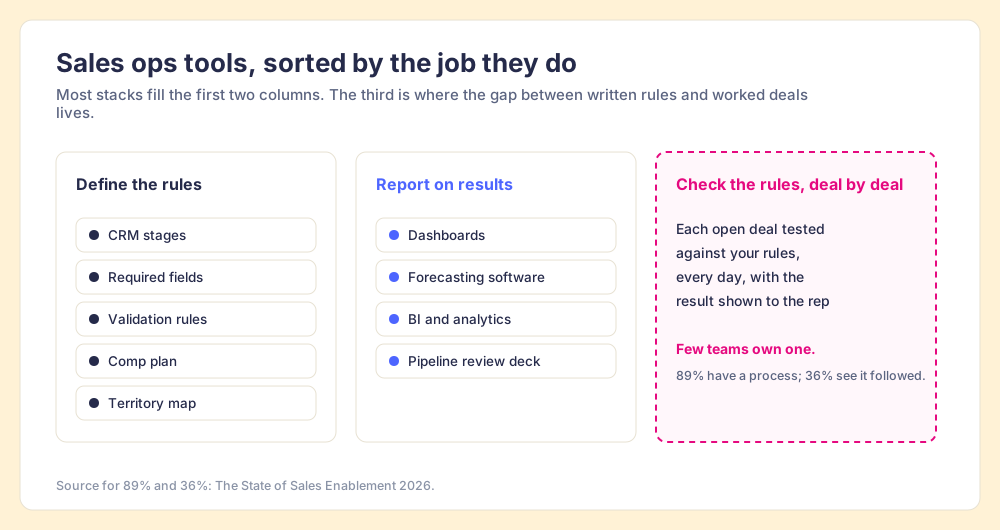
The gap is large. In The State of Sales Enablement 2026, our survey of 198 sales leaders, 89% of teams had a defined sales process and 36% said their reps follow it (The State of Sales Enablement). A 53-point gap between the rules sales ops wrote and the deals reps worked. For a deeper look at how the gap shows up in data, our post on CRM hygiene breaks down the six rules I run on my own deals.
What tools does sales operations run?
The CRM sits in the middle: HubSpot, Salesforce or Pipedrive for most mid-market teams. Around it, sales ops typically runs forecasting, compensation, CPQ and quoting, data enrichment, reporting, and a growing layer of AI. In Salesforce’s 2026 report, 54% of sales professionals already use AI agents and nearly 9 in 10 plan to by 2027.
Sort those tools by the job they do and a pattern appears. They fall into three groups.
- Tools that define the rules. The CRM’s stages, required fields and validation rules; the comp plan; the territory map. They say what should be true.
- Tools that report on results. Dashboards, forecasting software, BI. They say what happened, after it happened.
- Tools that check the rules, deal by deal, while the work is in motion. Very few teams own one.
A required field is the classic sales ops attempt to fill the third group with the first. It works for one moment, the save, and all it guarantees is that a value exists. Whether the value is true is another matter. A close date can be required and still be three weeks in the past. A next step can be required and say “TBD.” The field held. The rule did not.
Who enforces the sales process: sales ops or managers?
Football has a useful arrangement. A competition committee writes the rulebook in the off-season. On game day, referees enforce it, play by play, and the coach never has to blow a whistle on his own players. No league asks the head coach to also referee the game, because a coach watching for holding penalties is not watching his quarterback, and the team would get worse at both.
Sales teams ask for exactly that. Sales ops is the competition committee: it writes the rules and goes back to its desk. The frontline manager is the coach. And because no one else on the team has the job, the manager is also the referee, reading records in the CRM to see who skipped the recap, who left a close date in the past, who moved a deal to Proposal with no decision maker named.
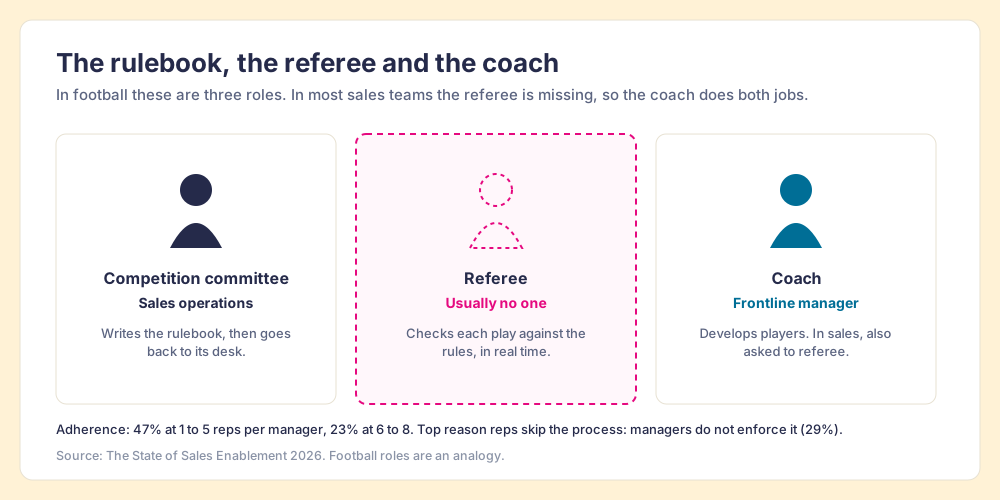
Our survey shows what happens next. Process adherence was 47% on teams with one to five reps per manager and 23% on teams with six to eight. The number one reason reps gave for skipping the process was that managers do not enforce it (29%), and capacity came up more often than indifference. The managers in that data were short on hours, the way a coach asked to referee would be by halftime.
The checking matters because it is the strongest lever in the data. In the same survey, teams that inspect deals against a defined process at the highest frequency hit quota at 6.3x the rate of the lowest band. Inspection is how a rule written by sales ops becomes a behavior on a deal. It is also tenet-level for us: you can only expect what you inspect, and the win is taking the burden of inspection off the manager so the manager’s hours go to coaching.
Where the check shows up matters too. Quota attainment was 49% when guidance was embedded in the rep’s workflow, 24% when it lived in CRM fields or stages, and 15% when it lived in docs or wikis. A rule written in a sales ops wiki page is a rule in the lowest band.
So the referee has to be a system. The rules sales ops already writes get checked against every open deal, every night, and the results reach the rep in the place they work, the next morning, before the forecast call has to find them.
Supered does this. The rules live in Supered as Process Rules inside a Process Ruleset, and a Process Board checks every open deal against them nightly in HubSpot, Salesforce or Pipedrive. Reps see what to fix inside the CRM, and the same rules work in Claude or any LLM connected to the CRM. On my own board, 22 rules once flagged 11 violations across my deals late at night; one prompt in Claude with Supered, HubSpot and Gmail connected cleared them in about 10 minutes instead of about 45 by hand. It is my own example, not an average. Process Compliance is $40 per user per month paid yearly, with a 5-user minimum (pricing), and the sales expectations use case shows the board end to end.
How should you set up sales ops if you are starting from zero?
Teams often hire sales ops after something breaks, usually the forecast. A calmer order works better.
- The CRM and stage definitions first. Write down what must be true at each stage, in sentences a rep could repeat. Five or six rules per stage is plenty.
- A nightly check second. Before a single dashboard, set up something that tests open deals against those rules every day and shows the rep the result.
- The forecast third. A forecast built on deals that pass your rules is a forecast you can defend. Built on deals that fail them, it is a guess with decimals.
- Territories and comp fourth. These matter more as headcount grows. At 8 reps a spreadsheet and a clear rule for inbound leads will hold.
- Enablement alongside, from the first hire. If the rules change, the training has to change with them, and a rule reps were never shown is a rule they cannot follow.
What we recommend
Keep the definition of sales operations exactly as the field has it: the team that designs and runs the system a sales team sells inside. Then add one sentence to its charter. Sales ops owns the rules and the automated check that they were followed; managers own the coaching that follows the check.
The reasons are on the page:
- A job already on the list. Wikipedia and Gartner both put process compliance inside sales ops. Teams tend to staff the design half and leave the checking to whoever has time.
- A gap that size. 89% of teams have a defined process and 36% see it followed, a 53-point gap that no dashboard closes, because dashboards report after the fact.
- Managers out of hours. Adherence halves from 47% to 23% as span grows, and the top reason reps skip the process is that managers do not enforce it.
- The strongest lever in the data. Teams that inspect most often hit quota at 6.3x the rate of the lowest band.
No league would play a game without a referee and then blame the players for the penalties. A sales team without an automated check is playing that game, and the forecast call is where the penalties finally get noticed.
If you are weighing where sales ops ends and the people side begins, read sales enablement vs sales operations next. If your org is folding sales ops into a wider model, what revenue operations is covers the shift. And if you want to see your own rules checked against your own deals, book a demo and we will run them live.
Frequently asked questions
What is sales operations?+
What is the difference between sales ops and RevOps?+
What is the difference between sales operations and sales enablement?+
What metrics does sales operations track?+
Who should enforce the sales process, sales ops or managers?+
What tools does a sales operations team use?+
Your process, running itself.