Value Selling: Why a Big ROI Number Still Ends in No Decision
Value selling teaches reps to sell the buyer's outcome in the buyer's numbers.
The method is right. It fails in two places the guides skip: the formula multiplies, so one weak element sinks the deal, and a bigger ROI number does nothing for a buyer who is afraid of being wrong.
Value selling is a sales methodology in which the rep wins the deal by helping the buyer quantify, in the buyer's own numbers, what solving a business problem is worth, then confirming who can approve the purchase and how it will happen, instead of selling on features or price.
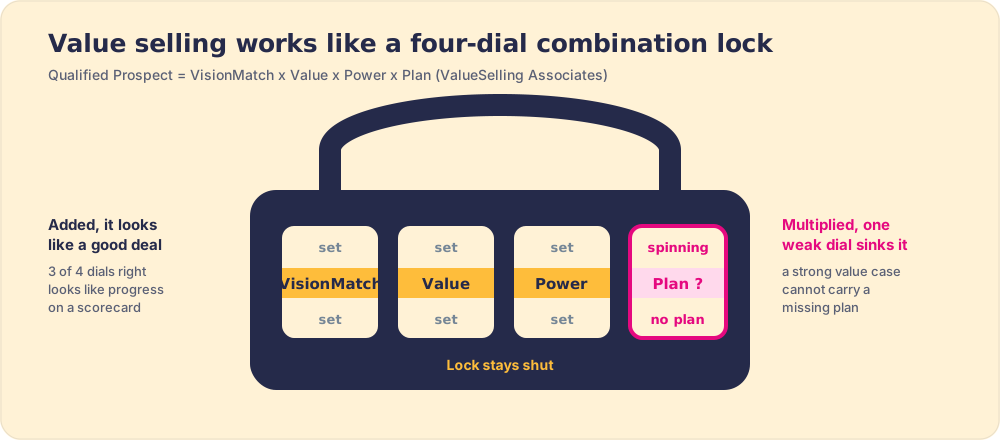
A combination lock with four dials does not open when three of them are right. You can set three numbers perfectly and spin the fourth to anything at all, and the shackle stays shut. Nothing about the lock rewards being mostly correct. It checks all four dials at once, and one wrong dial keeps it shut.
Value selling works the same way, and the guides that rank for it mostly teach it as a sum. Value selling is a sales methodology in which the rep wins the deal by helping the buyer quantify, in the buyer’s own numbers, what solving a business problem is worth, then confirming who can approve the purchase and how it will happen, instead of selling on features or price. Its best-known formal version, the ValueSelling Framework, writes its qualification test as multiplication: VisionMatch x Value x Power x Plan. A dazzling ROI case with no access to the person who signs is three dials set and one spinning. And the research on lost deals adds a second problem the formula’s fans skip: most deals that die in “no decision” die of the buyer’s fear of being wrong, and a bigger number does nothing for fear.
What is value selling?
Value selling is the discipline of selling the result instead of the product. The rep’s job is to help the buyer name a business issue that matters, trace the problems causing it, agree on what a fix would be worth in the buyer’s own numbers, and then confirm the two things that turn a good conversation into a purchase: who can approve the spend, and the steps both sides will take to get there.
The term has a generic meaning and a branded one. Gong’s widely read guide uses the generic sense, describing value selling as an approach centered on the buyer’s needs, where “solution sellers champion their products and value sellers champion their buyers” (Gong). Its seven steps (research the buyer, know your differentiators, ask and listen, teach, be candid about fit, personalize, keep adding value after the close) are good conversational habits, and a rep who runs them will be better company than one who leads with a demo.
The branded meaning belongs to ValueSelling Associates, the sales training firm whose ValueSelling Framework has been in use since 1991 and which is led by President and CEO Julie Thomas (ValueSelling). It remains independent; its notable deal was buying Value Prime Solutions, one of its own certified training partners, in 2018 (Training Industry). The branded version adds what the generic one lacks: a qualification test with teeth.
That difference is where the method succeeds or fails. A conversational posture produces buyers who like the rep. A qualification test tells the rep, and the rep’s manager, whether the deal will close.
What is the ValueSelling Framework?
The framework has two working parts: a conversation guide and a formula.
The conversation guide, which ValueSelling calls the ValuePrompter, walks the rep through six elements in order: the buyer’s business issue, the problems behind it, the solution the buyer envisions, the value of solving it, the power to approve, and the plan to buy (ValueSelling webinar deck, 2019). The first three combine into what the framework calls a differentiated VisionMatch: the buyer’s picture of a solution, shaped so that it matches what you uniquely do.
The formula compresses those six elements into the test. ValueSelling writes it as Qualified Prospect = VisionMatch (differentiated) x Value x Power x Plan, and defines each term plainly (ValueSelling):
- VisionMatch. Whether the buyer agrees your solution addresses a meaningful business issue, framed in a way only you match.
- Value. Whether the solution is worth the investment, proven through “a time-bound, measurable business case.”
- Power. Whether you have confirmed access to the person with the authority to approve the decision.
- Plan. “A mutual plan outlining the issue, solution, quantified value, buying steps, and realization plan.”
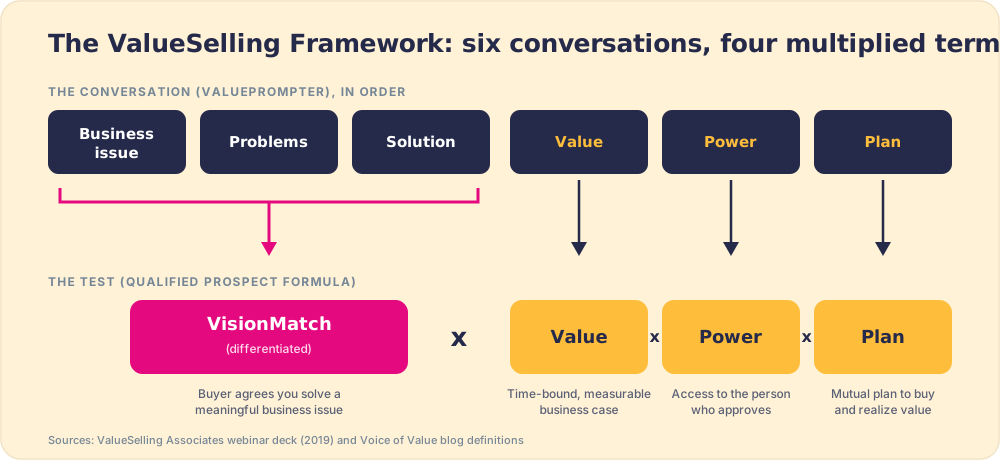
ValueSelling’s own guidance on the formula is blunt about partial credit. “Each element must be present and developed,” it says, and “if any element scores low, the deal is at risk and should not be counted at full value in the forecast.” The multiplication sign is the design. A sum would let a spectacular value case paper over a missing signer. A product will not.
Why does the value selling formula multiply instead of add?
Because purchases fail at their weakest link, and an additive score hides the weak link inside a healthy-looking total.
Run the arithmetic on two deals scored one to five on each element. Deal A scores 5, 5, 5, and 1: the buyer loves the vision, the business case is excellent, the economic buyer is engaged, and there is no plan. Add the scores and Deal A totals 16 of 20, an 80 percent deal. Multiply them and it scores 125 of a possible 625, or 20 percent. Deal B scores 3 on all four: decent everywhere, excellent nowhere. Added, it totals 12 of 20, worse than Deal A. Multiplied, it scores 81 of 625, about 13 percent, which ranks it below Deal A but by far less than the sum implied, and with no single failure point.
The scores are our illustration; ValueSelling does not publish a numeric scale. The behavior it predicts is the familiar one. The 80 percent deal with no plan is the deal that sits in commit for three cycles while the champion “works on getting it scheduled.” The sum told the forecast what the rep hoped. The product told it what was missing.
The deeper reason sits in how buying decisions get made. A purchase is a chain of separate yeses: the person with the problem agrees it is worth solving, someone with budget agrees the math works, someone with authority signs, and procurement, legal, and IT each let it through. A chain breaks at the weakest link no matter how thick the others are, and the formula is a chain written as algebra.
How do you run value selling on a real deal?
You build each term with the buyer, in the buyer’s numbers, and you re-score it as the deal moves. A worked example makes the mechanics concrete. The figures below are illustrative.
A rep is selling scheduling software to a 25-technician field service company. Discovery surfaces the business issue (the operations director’s margin is slipping) and the problem behind it: technicians lose about 50 minutes a day to rescheduled jobs and backtracking. The rep does not supply those numbers. The operations director pulls them from last month’s dispatch log, which is the step that separates a value case from a pitch.
Then the math, done together on the call:
| Input | Figure | Where it came from |
|---|---|---|
| Technicians | 25 | Buyer’s headcount |
| Time lost per technician per day | 50 minutes | Buyer’s dispatch log |
| Working days per year | 220 | Buyer’s calendar |
| Loaded cost per technician hour | $65 | Buyer’s finance team |
| Annual cost of the problem | about $298,000 | 25 x 50 min x 220 days = about 4,580 hours, x $65 |
| Share the buyer believes is recoverable | 30% | Buyer’s own estimate, deliberately conservative |
| Annual value of solving it | about $89,000 | $298,000 x 30% |
| Annual price | $36,000 | Vendor quote |
| Payback | under 5 months | $36,000 / $89,000 x 12 months |
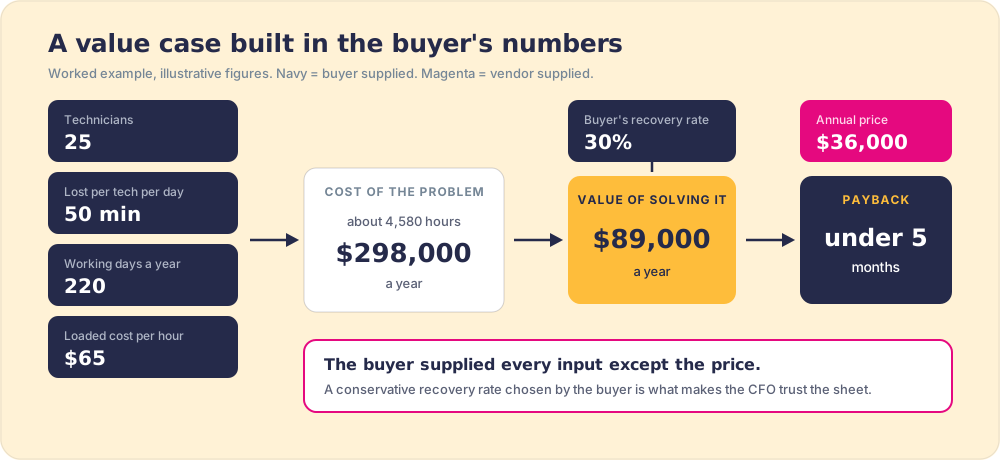
The conservative 30 percent matters more than it looks. A CFO who sees a recovery assumption of 80 percent stops trusting the whole sheet. One who sees 30 percent, chosen by their own operations director, starts checking whether it could be higher. The value case gets stronger by claiming less.
Value alone still leaves two dials. Power: the operations director can recommend but not sign above $25,000, so the rep asks to bring the COO into a 20-minute review of the math the director built. Plan: the two sides write down the remaining steps and dates (a 30-day pilot with five technicians, the metric that decides it, the security review, the contract, the rollout). That plan is the same document a mutual action plan formalizes, and value selling counts it as a qualification element in its own right, scored before the close.
The questions that build each term, phrased the way a rep would ask them:
- VisionMatch questions. “What happens to the margin target if nothing changes this year?” “If this worked, what would your dispatchers do differently on Monday morning?”
- Value questions. “Where would we find the real number for time lost, and who owns that report?” “What recovery rate would you defend in front of your CFO?”
- Power questions. “Who signs a purchase this size, and what would they need to see?” “Who would lose something if this went ahead?”
- Plan questions. “What has to be true by the end of the pilot for you to recommend it?” “What has stalled a purchase like this here before?”
The last question opens the most important conversation in the deal, because it surfaces the fear.
Why do strong business cases still end in no decision?
Because the business case answers a question the buyer was not stuck on.
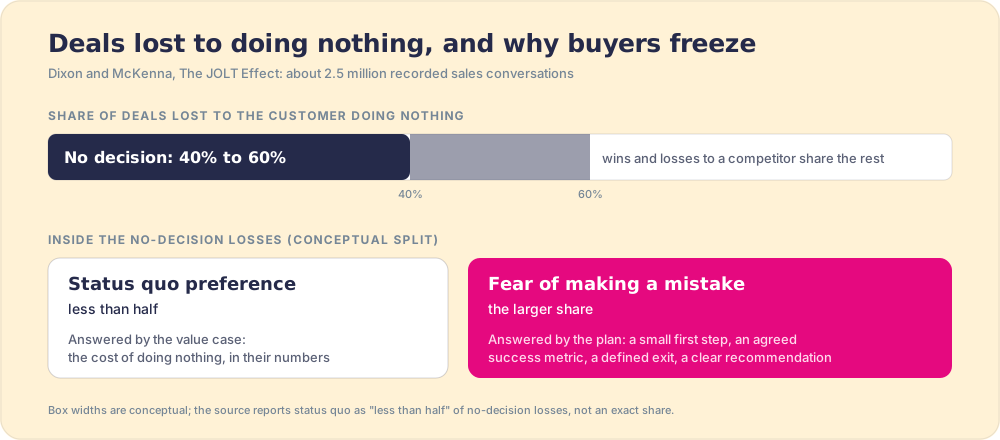
A study of 2.5 million sales conversations points here. Matt Dixon and Ted McKenna analyzed about 2.5 million recorded sales conversations for The JOLT Effect and found that “anywhere between 40 and 60% of all deals are actually lost to the customer doing nothing” (CustomerThink interview with Matt Dixon). ValueSelling reaches a similar figure from its own field experience: its Voice of Value blog says wins, losses, and no-decisions split “fairly evenly” (ValueSelling). A behavioral research team and a methodology vendor, with different data and different incentives, land close together: somewhere between a third and more than half of qualified pipeline ends with the buyer doing nothing.
Dixon’s second finding is the one that matters for value selling. Preference for the status quo accounts for “less than half of all the losses to no decision.” The larger share comes from buyers afraid of “making a big mistake.” The classic value-selling move, quantify the cost of inaction until the status quo looks unaffordable, attacks the smaller cause. A buyer who already agrees the problem is expensive is not waiting for a larger number. They are waiting to feel safe.
There is a mechanism under the fear, and it is old and well measured. Amos Tversky and Daniel Kahneman’s work on prospect theory estimated that losses weigh about 2.25 times as heavily as equivalent gains in people’s choices (Tversky and Kahneman, 1992). For the buyer, the $89,000 of recovered time is a gain to the company. A failed rollout is a loss to them personally, in front of the COO who approved it. The ROI sheet raises the gain. Nothing on it shrinks the personal loss.
A diver on a ten-meter platform knows the pool is deep. Telling them it is five meters deep, then six, then that it was certified last week, does not move their feet, because what holds them on the platform is the height. What gets a nervous diver into the water is a lower board: the three-meter platform first, then the five, with the ladder down always available. The value case measures the depth of the pool. The plan builds the lower boards.
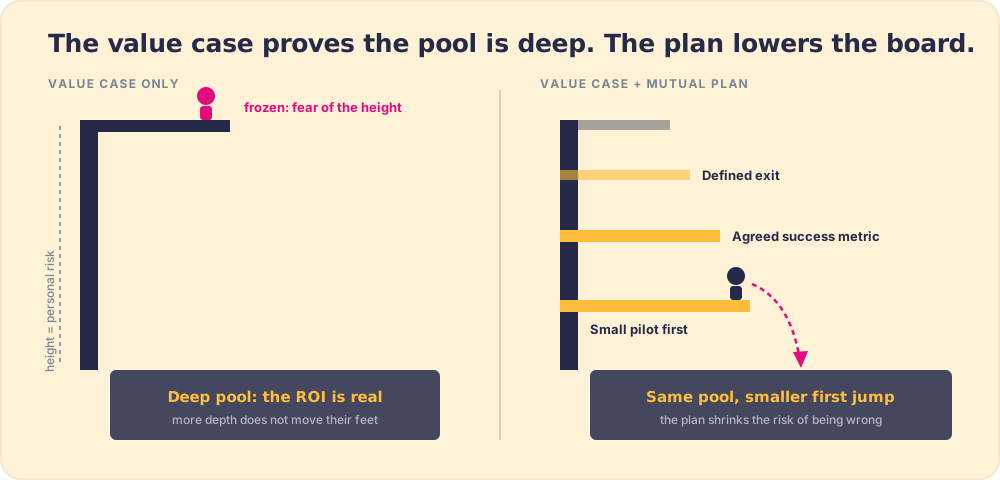
Dixon and McKenna’s prescription fits the Plan element closely. Their four moves (judge the buyer’s level of indecision, offer a clear recommendation, limit the exploration, take risk off the table) all shrink the jump rather than deepen the pool. In value-selling terms, the plan carries the risk reduction:
- A small first step. A pilot with five technicians costs the buyer little to undo and gives them a result to show before they bet the whole team.
- A success metric agreed in advance. The buyer knows, before starting, what “it worked” will mean, which turns a judgment call into a measurement.
- A defined exit. If the pilot misses the metric, both sides know what happens next, so the buyer is not choosing between success and public failure.
- A recommendation, stated plainly. Dixon’s data shows buyers stall when handed a menu. The rep’s job is to say which option they would pick and why.
How is value selling different from MEDDPICC, Command of the Message, and Challenger?
The methodologies overlap more than their marketing suggests, and the useful question is which job each one does best. We map the wider family in our guide to sales methodologies.
| Methodology | Main job | What it checks or produces | Where value selling overlaps |
|---|---|---|---|
| Value selling (ValueSelling Framework) | Build the business case with the buyer and qualify the deal | VisionMatch, Value, Power, Plan | Itself |
| MEDDPICC | Verify the facts of a complex deal | Metrics, economic buyer, decision criteria and process, paper process, pain, champion, competition | Metrics maps to Value; economic buyer to Power; decision and paper process to Plan |
| Command of the Message | Make every rep articulate value the same way | A shared value framework: current state, outcomes, required capabilities, metrics, proof | The value framework supplies the language a VisionMatch is built from |
| The Challenger Sale | Reframe how the buyer sees their problem | A commercial insight that teaches the buyer something new | A strong reframe creates the VisionMatch; value selling then prices it |
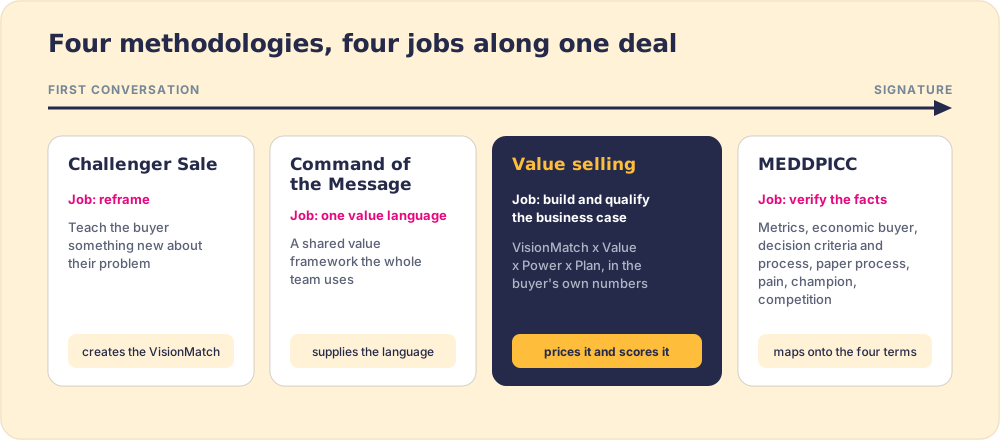
Teams often pair a messaging framework with a qualification checklist; Force Management sells Command of the Message and MEDDICC together. The value selling methodology is unusual in that it tries to be both, which is its strength for mid-market teams that cannot staff two training programs and its risk for teams that treat it as a vocabulary and skip the scoring.
Why doesn’t training the value selling framework make reps run it?
Because a framework in a rep’s memory competes with everything else in the rep’s day, and the deal does not wait for the rep to remember.
The evidence that methodology works is strong, and it carries a condition. Korn Ferry found that organizations with a dynamic, consistently applied sales methodology see win rates 27 percent higher and quota attainment 21 percent higher than those with a random or informal one (Korn Ferry). Academic work on value-based selling found the same condition: a study of 816 salespeople and directors in 30 sales organizations found that sales strategy reaches performance through what salespeople do, their customer orientation and value-based selling behavior (Terho, Eggert, Haas, and Ulaga, 2015). The strategy on paper does not produce the result. What the seller does in the conversation does.
Our own research measured how often the behavior shows up. In The State of Sales Enablement, 89 percent of revenue teams said they had a defined sales process and 36 percent said their reps consistently ran it. The teams that inspected deals against their process most often hit quota at 6.3 times the rate of the teams that inspected least.
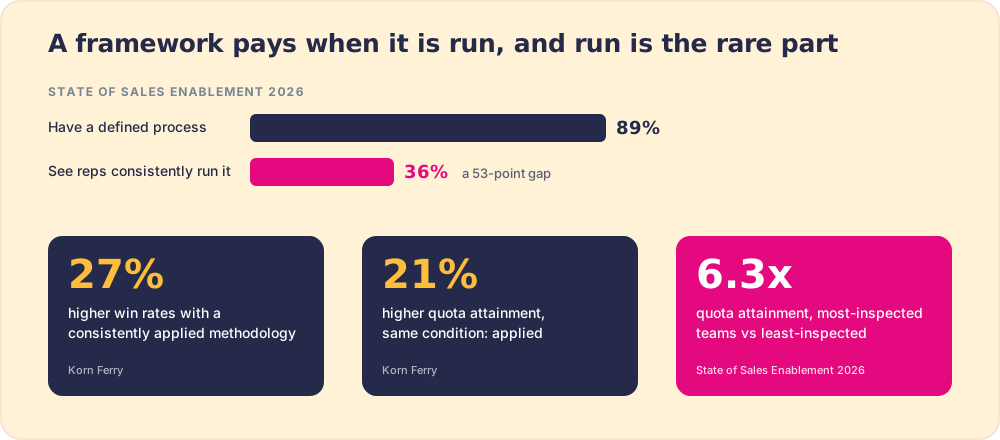
For value selling, the gap has a specific shape. A rep who attended the workshop can recite the formula. With the buyer waiting on a call, the rep forgets to ask who signs, scores Power from optimism, and the manager finds out at forecast review. The cause sits in the system. The formula lived in a slide deck and the deal lived in the CRM, and the step that would have caught the gap was a manager’s memory. ValueSelling itself frames qualification as continuous (“High performing reps consistently qualify the opportunities in the pipeline”), and continuous qualification needs the four terms in front of the rep at each stage and visible to the manager on each deal. Our guide to process adherence covers how to measure whether a defined step happened on real work.
Supered is built for that last part. It is the business logic for your deals: your definition of a good deal at each stage, with the VisionMatch, Value, Power, and Plan checks written into it. Reps follow it in HubSpot or Salesforce, or while working in Claude or ChatGPT, AI agents follow the same logic, and every deal is checked against it, so a deal with a strong value case and no plan surfaces while it can still be saved.
What we recommend
Adopt value selling as a qualification discipline, with the conversation habits on top, and build the Plan element as seriously as the business case.
Three findings support that order. The formula multiplies, and ValueSelling’s own guidance says a deal weak on any element should not be counted at full value, so the scoring is the part that protects the forecast. Dixon and McKenna’s 2.5 million conversations show that fear of a mistake, more than love of the status quo, drives the 40 to 60 percent of deals lost to no decision, so a plan that shrinks the first step does work a bigger ROI number cannot. And Korn Ferry’s 27 percent win-rate lift belongs to methodology consistently applied, while 36 percent of teams see their defined process consistently run, so the framework only pays when it reaches the rep at the stage where it applies and someone checks it, deal by deal.
In practice, that means four changes to the usual rollout:
- Buyer-sourced inputs. The rep asks for the buyer’s numbers and lets the buyer pick the conservative assumption.
- Scores by element. Each deal carries four scores, and the weakest one drives the forecast category.
- The plan as a qualification step. A mutual plan with a pilot, a success metric, and an exit is required before commit.
- Inspection at the stage. The four elements are checked where the deal advances, so the manager’s time goes to coaching the missing dial instead of finding it.
If your team already runs MEDDPICC, map its letters onto the four terms rather than adding a second checklist; the MEDDPICC field guide shows the fields. If the value case itself is the weak spot, start with value proposition examples and the SPIN Selling questions that surface implications in the buyer’s own words. And for the methodology that first mapped who holds Power in a complex deal, read Miller Heiman’s Strategic Selling next.
Frequently asked questions
What is value selling?+
What is the ValueSelling Framework?+
What is the value selling formula?+
What is the difference between value selling and value-based selling?+
How is value selling different from MEDDPICC and Command of the Message?+
Why do deals with a strong business case still end in no decision?+
Your process, running itself.