Process Adherence: Why Teams Skip the Steps They Agreed To
Process adherence is usually treated as a documentation problem: write a clearer SOP, train harder, appoint a champion.
The steps get skipped anyway. Adherence is a behavior at the moment of work, and it only moves when the step reaches that moment and someone checks it.
Process adherence is the degree to which people follow a defined process on real work, measured as the share of cases where every required step happened; it is a behavior you observe on the work itself, not an understanding you confirm in training.
Operations leaders keep running into the same small mystery. The team helped design the process. They nodded through the training. The document is clear, short, and pinned in the channel. And a month later, a third of the work goes out with a step missing, the same step, again, as if the meeting never happened.
The usual reading is that people need more of what they already got: a clearer SOP, another session, a process champion. That reading is wrong, and it is wrong in a way that wastes most of what teams spend on the problem. Process adherence is the degree to which people follow a defined process on real work, measured as the share of cases where every required step happened; it is a behavior you observe on the work itself, not an understanding you confirm in training. Treat it as a knowledge problem and you will keep fixing knowledge, which was never what was missing.
This post covers what process adherence means and how it differs from compliance and conformance, why teams skip steps they agreed to, how to measure process adherence without a team of auditors, and the four levers that raise it. Sales is the running example because the data is best there, but the mechanics hold for any team that runs a defined process: client onboarding, support, finance close, implementation.
What does process adherence mean?
Ask what is process adherence in plain terms, and the process adherence meaning reduces to one test: did the process happen on the work, beyond existing on the page? It is measured case by case: this deal, this ticket, this client kickoff either had every required step or it did not. Averaged across cases, that becomes a rate you can track by person, by stage, and over time.
Three neighboring terms get used interchangeably, and separating them clears up most of the confusion in the pages that rank for this topic:
| Term | Whose rules | When it is checked | Cost of a miss |
|---|---|---|---|
| Process compliance | External: a regulation, an auditor, a legal control | Usually at audit time | A penalty or a finding |
| Process conformance | The process model in a mining tool | After the fact, from event logs | A deviation report |
| Process adherence | The team’s own definition of how the work should go | Case by case, ideally while the work is in motion | A worse result on that case |
Celonis, the process-mining company, frames adherence as a superset of the other two. An October 2024 post on its blog describes it as bringing “the elements of process mining, process modeling, process compliance and conformance together” (Celonis). A mining platform can see all of that. The description leaves out the part that decides the number: whether the person doing the work ran the step while it still mattered.
Scribe, the documentation tool, takes the opposite starting point. Its guide defines process adherence as “when a person or team clearly understands an assigned process’s goals, purpose and scope, how to follow the process and obtain expected results,” and most of its eight tactics are about writing, training, and access to documents (Scribe). Understanding is a real precondition. It is not adherence. A team can understand a process perfectly and run it on a minority of cases, which is exactly the pattern the data shows.
Why do teams skip steps they agreed to?
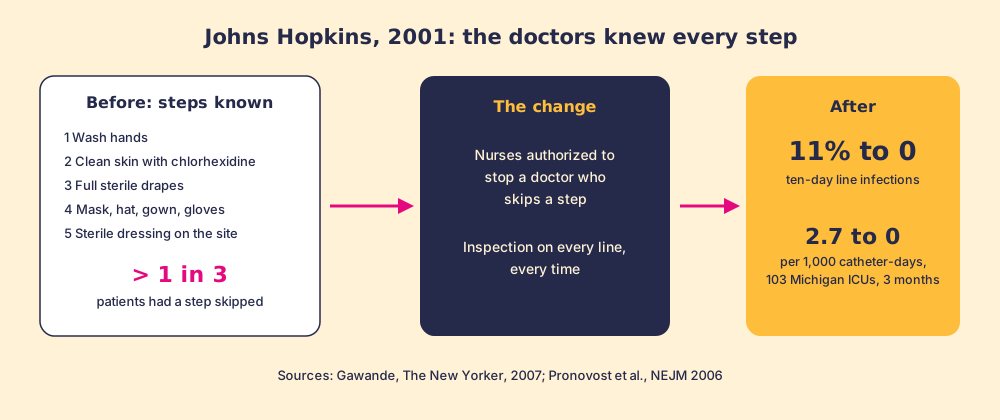
For system reasons, almost every time. The most famous adherence study in modern medicine makes the point better than any sales example. In 2001 at Johns Hopkins, Peter Pronovost wrote down five steps for putting in a central line, steps Atul Gawande later described as “no-brainers; they have been known and taught for years.” Nurses observed doctors for a month. “In more than a third of patients, they skipped at least one” (Gawande, The New Yorker, 2007). These were trained specialists who knew every step. Knowledge was not the gap.
What closed it was a change to the system, not to the doctors. The hospital authorized nurses to stop a doctor who skipped a step, and the ten-day line-infection rate went from eleven percent to zero. When the same approach ran across 103 Michigan ICUs, the median infection rate fell from 2.7 per 1,000 catheter-days to zero within three months (Pronovost et al., NEJM 2006).
Three causes account for most skipped steps, in medicine and in a CRM alike:
- Decay of the instruction. Ebbinghaus’s forgetting curve has people losing around 70 percent of new information within a day without reinforcement. A process taught once at kickoff is mostly gone by the first busy week.
- Distance from the work. The step lives in a document, a wiki, or an LMS, and the work lives in the CRM, the ticket, or the client portal. Every tab between the two is friction, and friction wins under pressure.
- No inspection. A step that no one inspects is optional in practice, whatever the document says. In the State of Sales Enablement 2026, the top reason reps gave for skipping the process was that managers do not enforce it, at 29 percent.
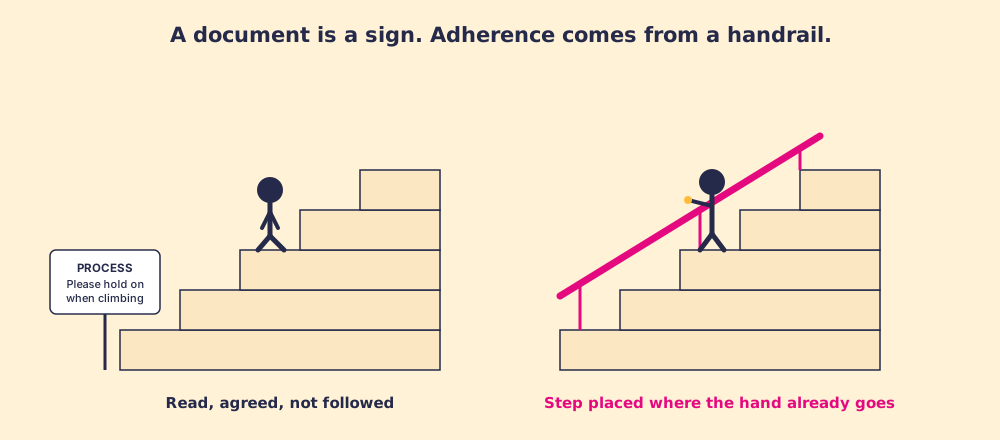
Think of a staircase. You can post a sign at the bottom explaining that people should hold on when they climb, and a good share of people will read it, agree, and climb with their hands in their pockets. Or you can install a handrail, and nearly every climber holds it, without being persuaded of anything, because the rail is where the hand already goes. A process document is the sign. Process adherence comes from rails: the step placed exactly where the hand already is, at the moment it is needed.
None of the three causes is a character flaw, which is why exhortation does so little. A rep who skips discovery questions on a deal with the quarter closing is not lazy. The step arrived at the wrong moment, in the wrong place, and no check was coming. Fix those three and the same people adhere.
Isn’t process adherence a documentation problem?
Partly, and the documentation camp deserves its due. An unwritten process cannot be adhered to, and plenty of teams run on expectations that live only in a manager’s head. Writing the process down, with the people who do the work, is the first step. Scribe’s advice to involve teams in process design is sound, and so is its advice to keep documents current.
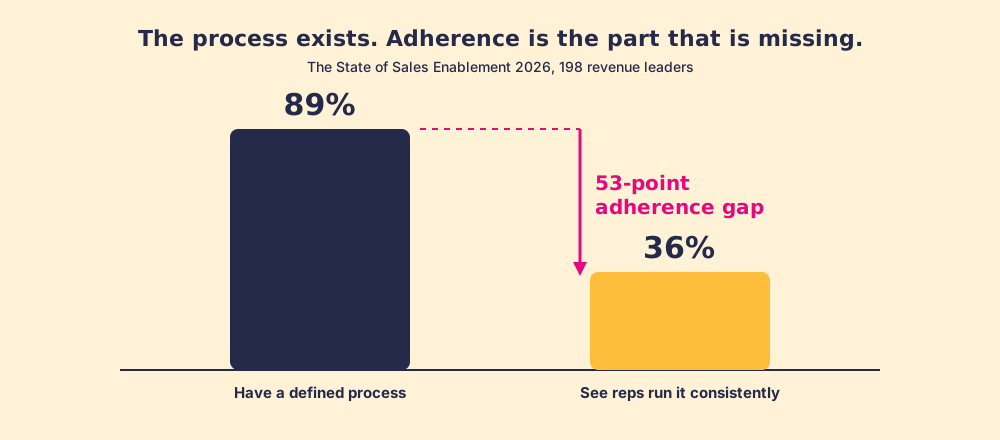
The trouble is what happens after the writing. The State of Sales Enablement 2026 surveyed 198 revenue leaders: 89 percent said they have a defined sales process, and 36 percent said their reps consistently run it. That 53-point gap is the documentation strategy’s ceiling. The process exists. It is understood. It is not run. Another revision of the document attacks the 89, which was already high, and does nothing for the 36.
The same survey shows where the 36 moves. Teams whose process guidance is embedded inside the CRM attain quota at 49 percent, compared with 15 percent for teams whose process lives in docs or wikis (State of Sales Enablement 2026). Same process, same people, different location, more than three times the result. The document was never the bottleneck.
Documentation answers whether people could follow the process. Adherence asks whether they did, and it is decided at the point of work. For the wider version of this argument, see the knowing-doing gap.
How do you measure process adherence?
Start with a definition you can check. For each stage of the work, list the required steps as yes-or-no facts on the record: the economic buyer is named, the kickoff agenda went to the client, the refund reason code is set. Then process adherence for a stage is the cases that met every required step, divided by all cases in that stage. Track it per person and per stage. A single team-wide number hides the one step the whole team skips.
There are three ways to collect the data, and they differ mostly in timing:
| Method | How it works | Strength | Limit |
|---|---|---|---|
| Sampled review | A reviewer pulls a sample of cases each month and scores them against the steps, as in the KCS Process Adherence Review used in support teams | Rich judgment on quality as well as presence | Sees a sample, weeks after the work |
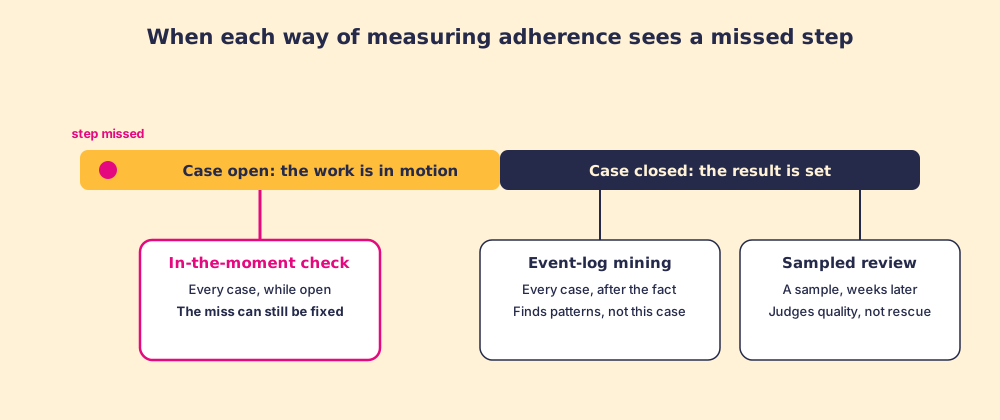
| Event-log mining | A mining tool compares system logs against the process model | Covers every case, finds undocumented variants | After the fact; needs clean logs and an analyst |
| In-the-moment checks | Each open case is checked against the rules continuously, and misses surface to the person doing the work | Catches the miss while the case can still be saved | Only checks what can be expressed as a rule |
The Consortium for Service Innovation’s KCS methodology builds the sampled review into its practices guide as a named technique, the Process Adherence Review (KCS v6 Practices Guide). It is the right tool for judging quality. Mining is the right tool for discovering the process you really run. In-the-moment checking is the only one of the three that changes the outcome of the case being measured, which is why it carries the most weight on the number.
The inspection evidence lines up with that timing. In the State of Sales Enablement 2026, teams that inspect deals against a defined process at the highest frequency hit quota at 6.3x the rate of the lowest band, the largest effect in the study. The formulas, data sources, and review cadence for an adherence dashboard are laid out in sales enablement KPIs, which treats process adherence as the keystone leading metric.
How do you improve process adherence?
Four levers, pulled in order. Each one has evidence behind it, and each one is a change to the system rather than a speech to the team.
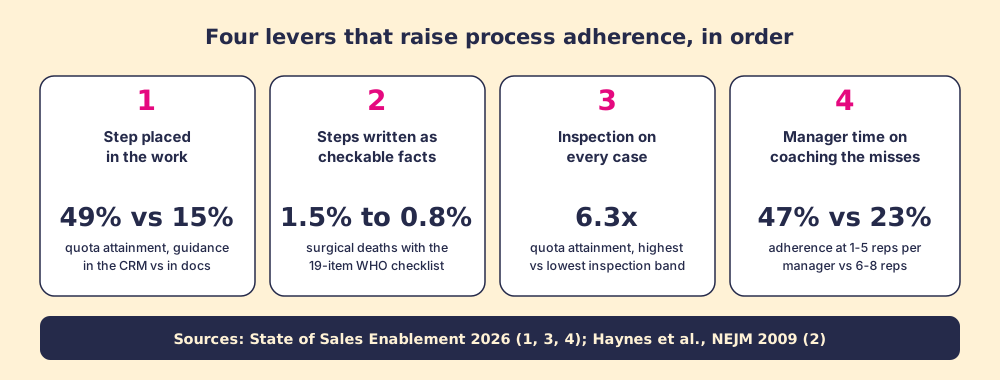
- The step, placed in the work. Put the required step where the work already happens: in the CRM record, the ticket view, the onboarding plan. This placement is the 49-against-15 lever. It also borrows a mechanism from psychology. Peter Gollwitzer’s implementation intentions, plans in the form “when situation x arises, I will do y,” had a medium-to-large effect on goal attainment (d = .65) across 94 independent tests in his 2006 meta-analysis with Paschal Sheeran. A step that appears in the situation is that plan, built into the screen.
- Steps written as checkable facts. “Qualify the buyer” cannot be checked. “Economic buyer named before Proposal” can. The WHO Surgical Safety Checklist worked this way: 19 items, each a yes or no, and across eight hospitals and 7,688 patients inpatient deaths fell from 1.5 percent to 0.8 percent and major complications from 11.0 to 7.0 percent (Haynes et al., NEJM 2009).
- Inspection on every case, done by the system. Sampling tells you the rate; checking every case fixes cases. Pronovost’s nurses inspected every line, every time. In software, that inspection should run automatically, so a miss is visible the day it happens rather than at quarter end.
- Manager time spent on coaching the misses. Inspection by hand does not scale. The State of Sales Enablement 2026 found adherence of 47 percent on teams with one to five reps per manager, falling to 23 percent at six to eight. Span is a capacity limit, not a motivation problem. Automate the checking and the manager’s hours go to the conversations that change the next case.
Training still matters. It belongs before the levers, not instead of them. A team should understand why each step exists, and new hires need to learn the process before they can run it. What training cannot do is be present on the four-hundredth case in a busy week. The levers can.
What does process adherence look like on a real team?
Take a services firm onboarding a large new client, the kind of process where a first impression and a renewal both ride on consistency. The firm’s process has six required steps before kickoff: signed scope, named client owner, data access granted, kickoff agenda sent, internal handoff from sales completed, and success criteria written down. The project leads helped design it.
Under the documentation approach, the steps live in a template in the shared drive. A project lead running three kickoffs at once skips the written success criteria on one of them, and the gap surfaces four months later as a renewal argument about what success meant. Under the adherence approach, the six steps sit in the onboarding plan inside the tool the lead already works in, each one a checkbox tied to the account record, and an account that reaches kickoff with a step open is flagged to the lead and their manager the same day. The client never sees the miss, because it never ships. The longer playbook for this process is in client onboarding.
Sales process adherence works the same way, and sales is where most of our data comes from. Each deal stage has its exit facts, each deal is checked against them continuously, and a rep sees the missing fact while working the deal, not in a dashboard reviewed at the end of the month.
Does AI change process adherence?
It raises the stakes. AI agents now draft follow-ups, update records, and advance work on their own, and an agent adheres to a process only if that process is written down as rules it can read. An unwritten process was always a risk with people. With agents it becomes a risk that runs at machine speed, across every open case at once.
The fix mirrors the one that works for people: one written definition of what good looks like at each stage, followed wherever the work happens, and checked on every case. Supered is built for this. It is the business logic for your deals, a single definition of what a good deal looks like stage by stage. Reps follow it in HubSpot or Salesforce, or while working in Claude or ChatGPT, AI agents follow the same rules, and every deal is checked against it, so adherence is measured case by case without a manager auditing by hand. For how that plays out across a revenue team, see sales process adoption.
What we recommend
Treat process adherence as a behavior to design and inspect, not a document to improve. Write the process down with the people who do the work, phrase every required step as a fact you can check on the record, put each step where the work already happens, and check every case automatically, so manager time goes to coaching the misses.
The evidence for that order is consistent across fields. Pronovost’s surgeons knew every step and skipped at least one on more than a third of patients until a nurse was authorized to stop them. The WHO checklist cut surgical deaths nearly in half with nineteen yes-or-no items. In sales, 89 percent of teams have a defined process and 36 percent see it run, guidance inside the CRM lines up with 49 percent quota attainment against 15 percent in docs, and the highest-inspection teams hit quota at 6.3x the rate of the lowest. Every one of those results came from changing where the step lives and whether it gets checked, not from explaining the step again.
If your process is still unwritten, start with SOP software and the habits that keep documents current. If it is written but not run, the sales execution gap explains why the distance between the two persists. And when you are ready to put a number on it, sales enablement KPIs shows how to calculate adherence every week.
Frequently asked questions
What is process adherence?+
What is the difference between process adherence and process compliance?+
How do you measure process adherence?+
Why don't employees follow processes?+
How do you improve process adherence?+
Your process, running itself.