Value Proposition Examples: Copy the Formula, Never the Slogan
Value proposition examples are useful for the formula they reveal and useless when copied. A value prop is not a slogan you lift; it is the one or two points of difference that matter most to your specific buyer.
Value proposition examples are sample value propositions useful for the formula they reveal, not for copying, because a value proposition is the one or two points of difference that matter most to a specific buyer versus their alternative, not a slogan you can lift.
Search “value proposition examples” and you will find lists of polished one-liners, and the temptation is to pick the one you like and make it yours. It will not work, for the same reason copying a sales playbook does not work: a value proposition is not a slogan, it is a positioning claim built from a specific buyer’s priorities and your specific edge against their alternative. The example shows you the output of that formula, a finished line, but the line is bound to the company that wrote it, their buyer, their differentiation, their competitive context. Lift the words and you inherit none of what made them true. Examples are worth studying, but for the formula they reveal, not the copy you can paste, and the formula is the part that travels.
Value proposition examples are sample value propositions useful for the formula they reveal, not for copying, because a value proposition is the one or two points of difference that matter most to a specific buyer versus their alternative, not a slogan you can lift. Learn the formula, and the examples earn their keep.
Why does an all-benefits value proposition fail?
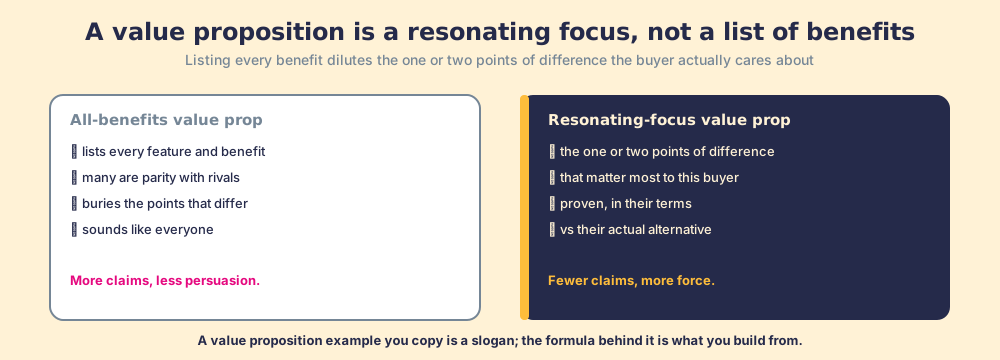
Because listing everything you do buries the few things that differ, and only the differences persuade. The marketing researchers James Anderson, James Narus, and Wouter van Rossum studied how companies frame value and found that the strongest approach is not listing all benefits but what they called a “resonating focus”: leading with the one or two points of difference that matter most to the customer, because most of what any product offers is parity with competitors and only the genuine differences move a decision (Anderson, Narus and van Rossum, in Harvard Business Review). An all-benefits value proposition violates this. It catalogs every feature, most of which competitors also have, and in doing so drowns the one or two points of real difference in a list of claims the buyer has heard from everyone. The buyer cannot find the reason to choose you, because you buried it in reasons that apply to the whole field.
This is why more is less in a value proposition. Each additional generic benefit you add does not strengthen the case; it dilutes it, lowering the salience of the points that truly differentiate you. The resonating-focus value proposition does the opposite: by saying less, leading with only the differentiated points the buyer cares about, it makes those points land with full force. Fewer claims, more persuasion, which is the counterintuitive heart of a strong value proposition.
There is a cognitive reason the long list backfires, not just a stylistic one. Anderson and Narus draw a careful distinction between points of parity (where you match the alternative) and points of difference (where you beat it), and their research found that what they called the “all benefits” pitch is the most common and the weakest, because sellers who assert every favorable point usually have only a surface knowledge of what the customer truly values and end up claiming advantages for features that are, on inspection, mere parity (Anderson, Narus and van Rossum). The buyer, who has sat through the same catalog from three other vendors, discounts the entire pitch. A second mechanism compounds it. Decades of work on choice overload, from Sheena Iyengar and Mark Lepper’s jam-tasting study onward, show that piling on options and reasons tends to reduce action rather than increase it, because each added claim raises the buyer’s cognitive load and lowers their confidence that they have understood the real trade-off (Iyengar & Lepper, 2000). A focused value proposition is partly an act of mercy: you have done the buyer’s sorting for them and handed back the two reasons that decide it.
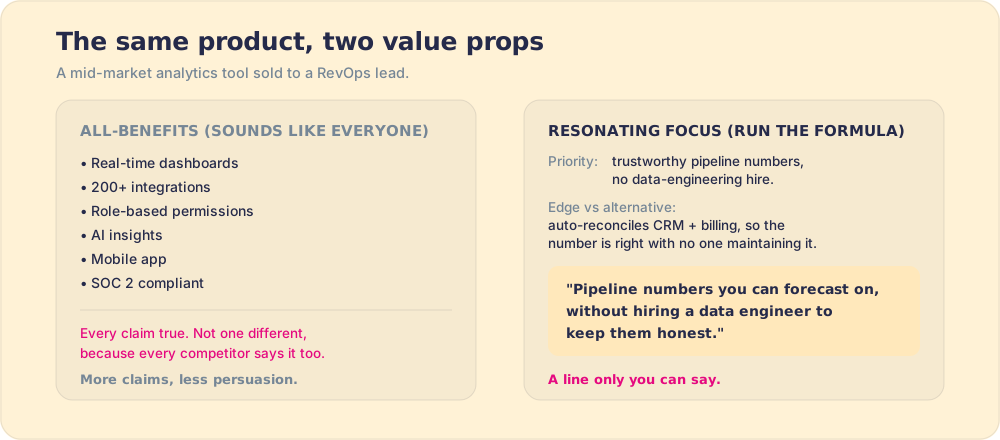
A worked example makes the formula concrete, because value proposition examples b2b lists rarely show the reasoning underneath the line. Suppose you sell a mid-market analytics tool, and your buyer is a RevOps lead whose top priority is getting accurate pipeline numbers without a data-engineering hire. The all-benefits version reads: “Real-time dashboards, 200+ integrations, role-based permissions, AI insights, mobile app, SOC 2 compliant.” Every word true; not one of them different, because every competitor says the same six things. Now run the formula. Their priority: trustworthy pipeline numbers, no new headcount. Your real edge against their actual alternative (a junior analyst wiring spreadsheets together): your tool reconciles CRM and billing data automatically, so the number is right without a person maintaining it. The value proposition becomes: “Pipeline numbers you can forecast on, without hiring a data engineer to keep them honest.” Shorter, sharper, and impossible for a competitor without that reconciliation to copy. The example is useless to anyone else, because their buyer and edge differ. The formula that produced it travels anywhere.
How do you use value proposition examples to build your own?
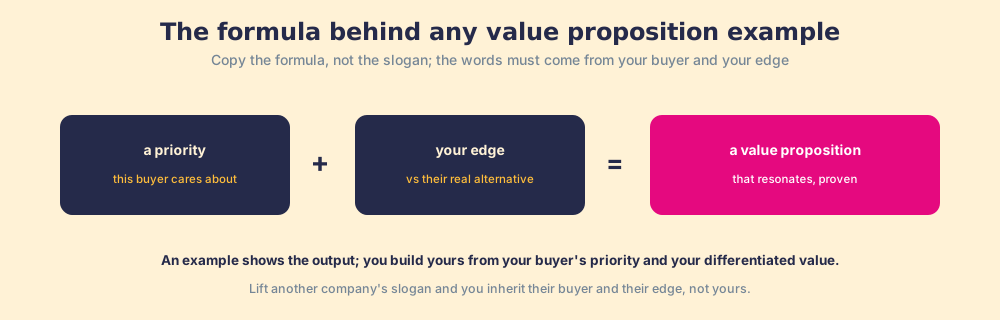
Extract the formula, then build from your buyer and your edge, because the words in any example belong to someone else’s context. A strong value proposition has the same structure underneath the slogan: a priority the buyer cares about, plus your genuine edge against their real alternative, equals a claim that resonates. That formula travels between companies; the specific words do not, because they encode one company’s buyer and one company’s differentiation. So use examples to internalize the formula, what a focused, proven, buyer-framed value proposition looks like, and then build yours from your own inputs: your buyer’s top priorities and the points where you genuinely beat their actual alternative. This is the same build-from-your-context logic as win themes, of which the value proposition is the distilled, repeatable core.
- Their priority. Start from what this buyer cares about, not your feature list. The value prop begins with the buyer.
- Your edge vs the alternative. Where you genuinely beat what they would otherwise do. Parity features do not belong here.
- The overlap, stated in their terms. Lead with the one or two points where priority and edge meet, with proof. That is the value proposition.
- Cut the rest. The parity features and generic claims dilute the case. Saying less makes the difference land.
Notice what the second bullet assumes: that you know the buyer’s real alternative, and most teams get this wrong. The alternative is rarely the named competitor in the deal. More often it is “do nothing,” “build it ourselves,” or “keep using the spreadsheet,” and the points of difference that matter are the ones that beat that real alternative, not the ones that beat a rival the buyer was never seriously going to pick. A value prop examples search returns lines written as if every deal were a head-to-head bake-off, when the largest competitor in B2B is inertia. Diagnose the actual alternative first, then find your edge against it. An edge against the wrong alternative persuades no one, because it answers a question the buyer was not asking.
How do you make a value proposition land in deals?
Build it from the formula, make it focused, and weave it consistently through every rep’s deals rather than leaving it to instinct. A value proposition only works if it is genuinely differentiated and genuinely used. The differentiation comes from the formula, building from your buyer’s priorities and your edge rather than copying a slogan or listing every benefit. The usage comes from consistency: the value proposition has to show up the same way across discovery, the demo, the proposal, and the sales one-pager, so the buyer hears the same focused reason by decision time. Most teams write a value proposition once, file it, and let reps improvise, which is how a focused value prop degrades back into a generic feature pitch. Making the value proposition a required, coached element of the sales playbook, surfaced in the flow of work, is the sales process adoption move that keeps it focused and used. A value proposition that lives in a slide and never reaches the deal persuades no one.
What we recommend
Treat value proposition examples as lessons in the formula, never as copy to paste, because a value proposition is bound to a specific buyer and a specific competitive context that you do not inherit when you lift the words. The formula is what transfers: a priority your buyer cares about, plus your genuine edge against their real alternative, distilled to the one or two points of difference that matter most, stated in their terms and backed by proof. Resist the instinct to list every benefit, because the parity features bury the differences and make you sound like the field; the resonating focus persuades precisely by saying less. Build your value proposition from your own buyer and edge, keep it focused, and weave it consistently through every touchpoint so it lands by decision time. Examples show you what a strong value proposition looks like. Your buyer and your edge are the only things that make one true.
From here: the deal-level version in win themes, the proof in the pitch in sales pitch examples, the document that carries it in the sales one-pager, and the adoption underneath in sales process adoption.
Frequently asked questions
What is a value proposition?+
How do you use value proposition examples?+
Why do all-benefits value propositions fail?+
How do you write a value proposition?+
Your process, running itself.