SPICED Sales Methodology: The Diagnosis, Not the Script
The SPICED sales methodology from Winning by Design is a diagnosis sequence, not a checklist.
Why the Critical Event creates real urgency, and how to keep the framework from decaying back into a pitch.
The SPICED sales methodology is a B2B discovery framework from Winning by Design (Situation, Pain, Impact, Critical Event, Decision) that runs as an ordered diagnosis sequence, anchoring urgency to a real buyer-side deadline before any solution is pitched.
A good doctor does not write the prescription on the way into the room. She asks where it hurts, then asks how long, then presses on the spot and watches your face, and only after she has a picture of what is wrong does she reach for the pad. The order is what separates medicine from guessing. A prescription written before the diagnosis is a lucky guess at best and malpractice at worst, and the patient can usually tell which one they are getting.
The SPICED sales methodology is the closest thing selling has to that discipline. Built by Winning by Design for recurring-revenue businesses, it stands for Situation, Pain, Impact, Critical Event, and Decision, and its claim lies less in the five words than in the order they come in. SPICED is a diagnosis sequence. Each step earns the right to the next, the solution is discussed last rather than first, and one of those steps, the Critical Event, does something the older frameworks never made a required step: it ties urgency to a real date in the buyer’s world instead of a discount that expires on Friday. That single move is why the Winning by Design SPICED framework is worth more than its acronym, and it is also where teams lose the plot, because a spiced methodology taught once and never inspected does not stay a sequence for long.
What is the SPICED sales methodology?
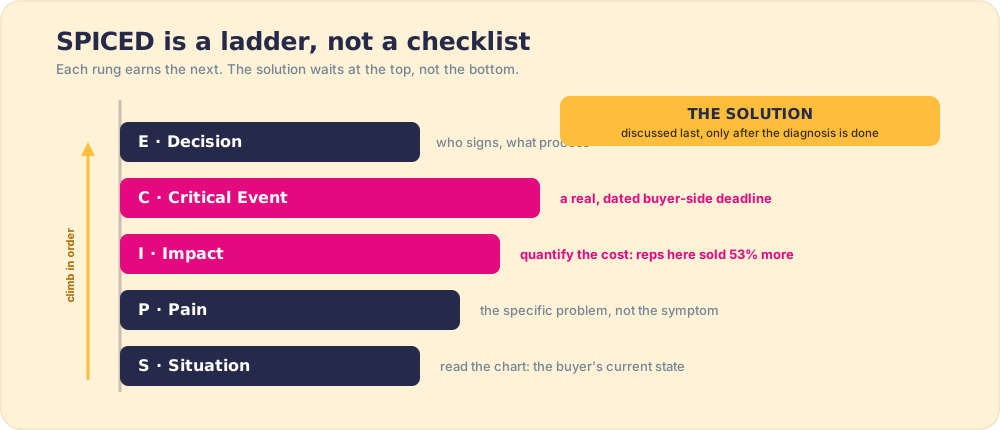
The SPICED sales methodology is a B2B discovery framework from Winning by Design, designed for subscription and recurring-revenue selling, in which the rep works through five ordered steps, Situation, Pain, Impact, Critical Event, and Decision, as a causal chain that ends at the solution rather than starting with it. Good reps already know the buyer’s pain matters. What the SPICED framework adds is an order, and the spiced sales framework insists on it because each step is the foundation for the next. You cannot quantify Impact until you have surfaced Pain, and you cannot surface real Pain until you understand the Situation. Skip a rung and every step above it rests on a guess.
Each step has a job, and a reason for its place in the line.
- Situation. The buyer’s current state: their context, their stack, their team, the way the work runs today. It is the chart the doctor reads before touching anything. Rush it and you are treating a patient you have not examined.
- Pain. The specific problems living inside that situation. The specific one, so “new reps take five months to ramp and a third leave before they get there” rather than “onboarding is hard.”
- Impact. The commercial cost of that pain, in the buyer’s own numbers. It drives the framework, and it is the easiest step to skip, because naming a pain already feels like progress. Winning by Design’s SPICED blueprint puts it at the center for that reason: Impact is where a named problem becomes a business case the buyer can take to a CFO, and without it the Critical Event has nothing to make urgent.
- Critical Event. A real, dated deadline on the buyer’s side that forces a decision: a contract expiry, a compliance cutoff, a board-committed number, a launch. The innovation of the framework lives here.
- Decision. How the choice will be made: who signs, who can veto, what criteria, what process. The last step, because mapping the decision before you have earned urgency is only organizing a “no.”
The shortest answer to what is SPICED selling: the refusal to prescribe before you have diagnosed, with a dated reason to act built into the diagnosis itself.
Why is the Critical Event the part that matters most?
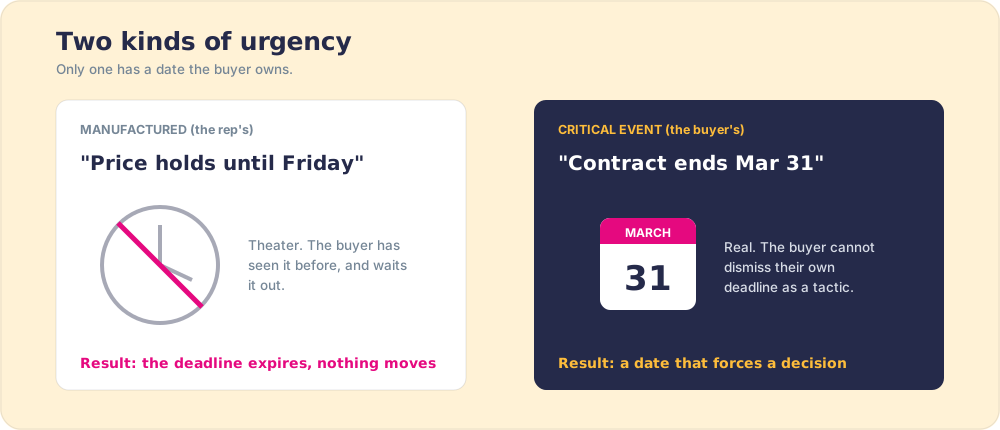
Because it is the only step that manufactures nothing. The frameworks before SPICED knew that deals need urgency, and many of them taught reps to create it: the limited-time discount, the end-of-quarter push, the “I can only hold this price until Friday.” That urgency belongs to the rep, and buyers have learned to wait it out, because they can feel the difference between a deadline that is true and one the rep invented to force a close.
The Critical Event flips the source. Instead of the rep inventing a reason to hurry, the rep finds a reason that already exists in the buyer’s world and names it: the current contract ends March 31, the compliance rule takes effect at fiscal year-end, the board promised a number that this problem is now blocking. A deadline the buyer owns is one they cannot dismiss as a sales tactic, because it is theirs. And a deal with no genuine Critical Event is not a deal that needs a harder close; it is a deal with no reason to happen now, and the right move is to say so rather than forecast it anyway.
Together, the Impact and Critical Event steps carry most of the framework’s lift, and the behavioral science explains why. Daniel Kahneman and Amos Tversky showed that people feel a loss about twice as intensely as an equivalent gain (Kahneman & Tversky, prospect theory), and the economists William Samuelson and Richard Zeckhauser named the status-quo bias in 1988: the strong human preference to leave things alone unless the cost of staying becomes undeniable. A future-state benefit (“you could grow faster”) is a gain, and gains are weak motivators. A quantified Impact (“this is costing you two ramped reps a quarter”) is a loss. A dated Critical Event turns that loss from a someday into a deadline. Put them together and you have the only thing that reliably beats a buyer’s strongest competitor, which is doing nothing.
What happens when a deal has no real Critical Event?
It dies in indecision, and it usually dies looking healthy. In The Jolt Effect, Matt Dixon and Ted McKenna analyzed more than 2.5 million recorded sales conversations and found that 40 to 60 percent of qualified deals end in no decision at all, lost to the buyer’s own paralysis rather than to a competitor (The Jolt Effect). Read through a SPICED lens, a large share of those were deals where the rep built a pleasant future and never quantified the present, or quantified the present and never found a date that forced the buyer’s hand. The Impact was soft, or the Critical Event was missing, and the status-quo bias won by default.
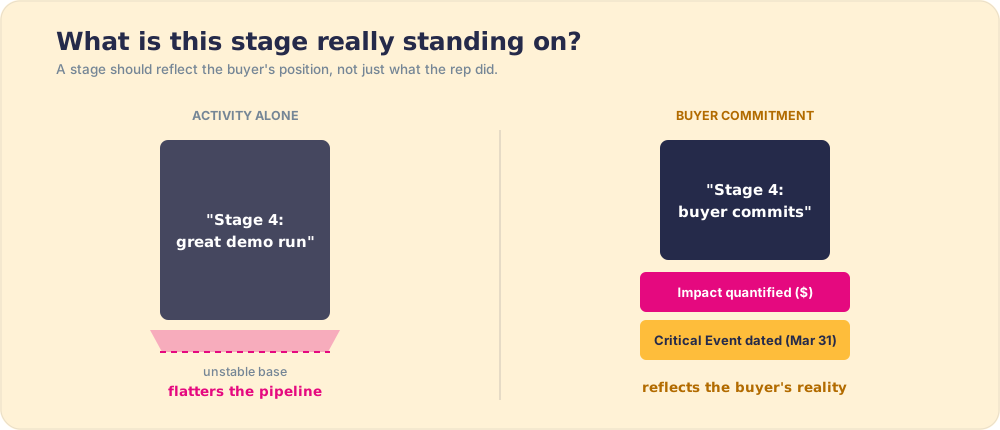
SPICED also connects to a belief we hold firmly about pipeline. A deal stage should reflect the buyer’s real position, not merely a box the rep checked. It is good and necessary to track what the rep did (you cannot inspect a process you do not capture), but a deal does not get to advance on seller activity alone. The Critical Event is the cleanest test of buyer position there is: either a true, dated event is pulling this deal forward, or none is. A pipeline built on “the rep ran a great demo” flatters you; a pipeline built on “this deal has a named Critical Event on March 31, confirmed by the buyer” tells you the truth. Run with discipline, the framework is a buyer-commitment filter wearing a discovery costume.
How is SPICED different from MEDDIC and BANT?
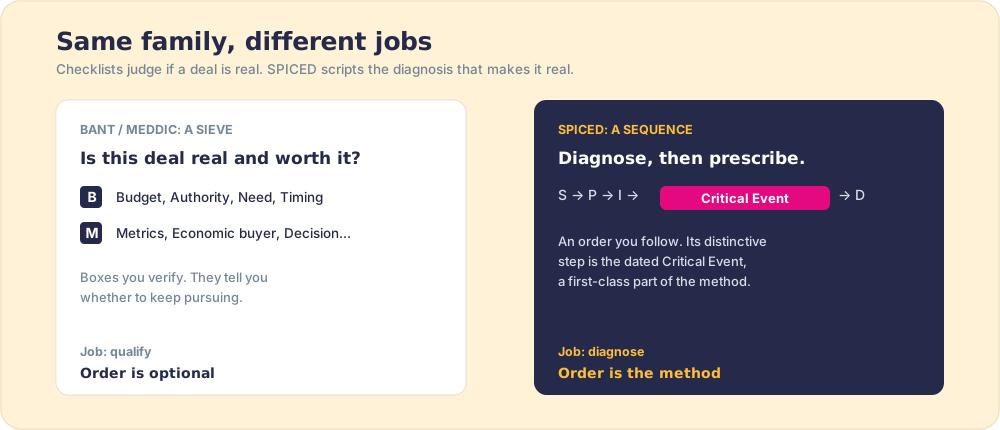
They overlap more than their advocates admit. The difference lies in the job each one does. BANT and the older qualification checklists exist to answer one question: is this deal real and worth my time? They are a sieve. MEDDIC and MEDDPICC go deeper into the same job, adding the Champion, the Decision Process, and the Economic Buyer, and they remain at heart a qualification discipline you verify against.
SPICED is built for a different motion. It is a discovery and diagnosis sequence for recurring-revenue selling, where the conversation itself is the product and where keeping the customer matters as much as winning them. Its steps are an order to follow, the shape of the call itself, where a checklist’s boxes can be ticked in any order. You can see the family resemblance: SPICED’s Impact is MEDDIC’s quantified Metrics and pain, and SPICED’s Decision is MEDDIC’s Decision Process by another name. What SPICED adds, and what the qualification frameworks leave implicit, is the Critical Event as a first-class, dated step. MEDDIC coaches will tell you to find the compelling event; SPICED makes it one of five things you are not allowed to skip. If you are mapping the broader terrain, our field guide to the major sales methodologies places SPICED next to its cousins and shows which job each one does best.
How do you run SPICED without slipping back into a pitch?
You make the sequence a defined, inspected step in your process, because a methodology that lives only in a training deck gets nodded at and abandoned. The team buys the Winning by Design course, the reps learn the acronym, the whole floor can recite Situation-Pain-Impact-Critical-Event-Decision by Friday, and within a month the quota pressure hits and the old habit reasserts itself: hear a hint of a problem, reach for the demo, skip the Impact, invent the urgency. Knowing the sequence and running it are different acts, and the distance between them is where the value leaks out.
More training will not fix it, because knowledge was never the problem. Knowledge is solved; any rep can pull up the SPICED blueprint in ten seconds. What reps do under pressure is the unsolved problem, and the only thing that changes behavior is an expectation that is set, surfaced, and inspected. The State of Sales Enablement 2026 found that teams who consistently inspect their deals against a defined process hit quota at 6.3 times the rate of teams that rarely do, the single largest lever in the study. For SPICED that means three things: the quantified Impact and the named Critical Event have to be required on a deal before it advances, the prompts have to reach the rep in the moment they are working the deal rather than in a half-remembered class, and a manager has to be able to see, deal by deal, whether the diagnosis happened. When reps drop the sequence under pressure, the system failed to make the right step easy and visible, and no lecture on discipline will repair that.
What we recommend
There are two ways to bring a framework like SPICED into a team, and only one of them changes the number. You can teach it: run the workshop, hand out the one-pager, and trust that reps will carry the sequence into their calls. Or you can install it: turn the steps into expectations that show up where the work happens, require the Impact and the Critical Event before a deal can move, and inspect the motion so coaching has something true to work from.
We recommend installing it, and the evidence points one way. Winning by Design’s own framework puts Impact at the center of the sequence, and a step only pays when it is run, so the value sits in doing it. The Jolt Effect’s 2.5 million conversations put 40 to 60 percent of deals in no decision, which is exactly what a missing Critical Event produces. And our own field data says a process changes outcomes only when it is inspected, by a factor of 6.3. So adopt the SPICED sequence, but adopt the discipline more than the acronym: anchor every deal to a quantified Impact and a dated, buyer-owned Critical Event, make those a visible part of the process rather than a private good intention, and let the inspection happen automatically so your managers spend their time coaching the diagnosis instead of chasing whether it happened.
Run the exam before you write the prescription. If you want the wider map, read our guide to the major sales methodologies; for the qualification that follows a quantified Impact, the MEDDIC field guide; for the discovery questions that surface Situation and Pain, discovery call questions; for the classic that maps the whole buying committee, Miller Heiman; and for why a documented method so often goes unrun, sales process adoption and the sales playbook guide that ties it all into one runnable system.
Frequently asked questions
What is the SPICED sales methodology?+
What does SPICED stand for?+
What is the Critical Event in SPICED?+
How is SPICED different from MEDDIC or BANT?+
How do you make the SPICED methodology stick across a team?+
Your process, running itself.