Miller Heiman: The Original Deal-Inspection Artifact
Miller Heiman invented the Blue Sheet: a structured map of every buying influence on a complex deal.
How to fill one out, the four response modes, the sales funnel stages, what Korn Ferry sells now, and why the sheet only works when it is re-walked.
Miller Heiman is the complex-deal sales methodology, formally Strategic Selling and now owned by Korn Ferry, that maps every buying influence (Economic, User, Technical, Coach) onto one planning page, the Blue Sheet, because a complex deal is decided by a committee.
A harbor pilot does not memorize one channel and call the job done. With each ship that comes in, the depth has shifted, a buoy has moved, a sandbar that was not there last month now sits under the hull. So the pilot re-reads the chart, takes fresh soundings, and walks the same water again, because the water is never the same water twice. The chart is not the harbor. The chart is only worth anything to the degree someone keeps re-walking it against what is actually there.
Miller Heiman built the first real chart for a complex sale. Strategic Selling, the methodology Robert Miller and Stephen Heiman published in 1985, gave reps the Blue Sheet: a structured map of every buying influence on a deal, the original deal-inspection artifact. Its enduring insight is that a complex B2B deal is won by managing multiple buyers, not by charming one champion. But the Blue Sheet carries the same fatal flaw as every documented process. A Blue Sheet left unrevised is fiction. The value was never the sheet. It was the inspected motion of re-walking the deal, every deal, the way the pilot re-reads the harbor. You can only expect what you inspect, and a map drawn once and filed is not inspection.
What is Miller Heiman strategic selling?
Miller Heiman is the name sellers use for Strategic Selling, the complex-deal framework created by Robert Miller and Stephen Heiman in the 1980s that maps every buying influence on an opportunity onto a single planning artifact, the Blue Sheet. Strip it down and it makes one claim that was genuinely new for its time: a large, considered purchase is never decided by a single person, so a rep who builds the whole deal around one friendly contact is building on sand. The job is to identify every influence, read where each one stands, and manage the account as a system rather than a relationship.
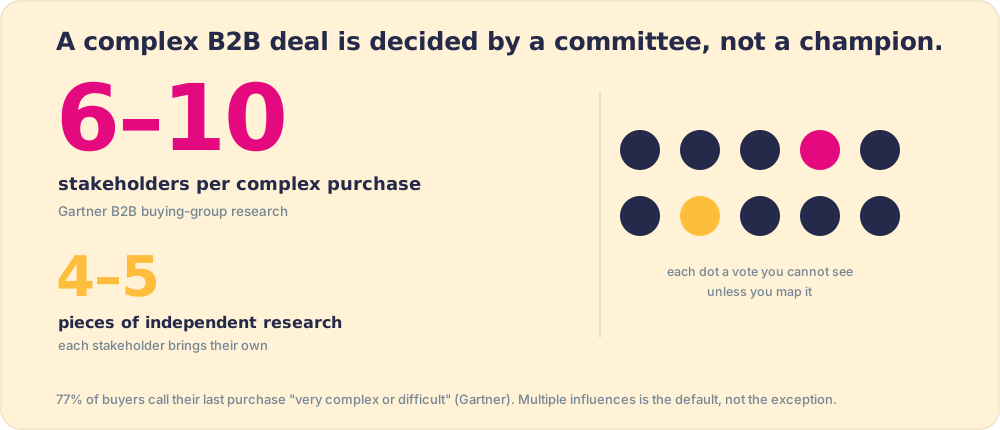
That claim has aged extraordinarily well. Gartner’s research on modern B2B buying finds that a typical complex purchase now involves 6 to 10 decision-makers, each arriving with 4 to 5 pieces of independent research, and that 77% of buyers describe their most recent purchase as very complex or difficult (Gartner, B2B buying journey). Strategic Selling saw the committee coming forty years early. The miller heiman strategic selling system was the first to treat the buying group, not the buyer, as the unit of the sale.
What are the four buying influences?
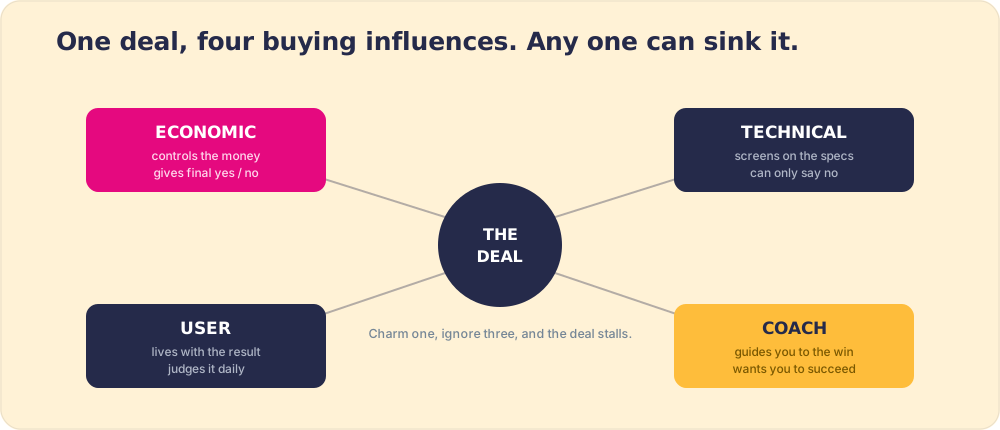
Strategic Selling names four roles on any complex deal, and the discipline is to find a real, named human in each one. They are not job titles. A single person can hold two; a single role can be split across three people. What matters is the function each performs on the decision, and the rule that any one of them can stop the deal cold.
- Economic buyer. The one who controls the money and gives the final yes or no. There is exactly one, often invisible until late, and a deal without an identified economic buyer is a deal you do not have.
- User buyer. The person who lives with the result day to day and judges, with their hands, whether it works. Users do not approve budgets, but a User who hates the rollout can starve a signed deal from the inside.
- Technical buyer. The gatekeeper who screens against requirements (security, legal, procurement, IT). The defining feature: a Technical buyer can only say no, never yes. Their job is to disqualify.
- Coach. The one person inside the account who wants you to win and will guide you to the other three. The Coach is not your User or your friend by default; a real Coach has credibility with the economic buyer and a stake in your success.
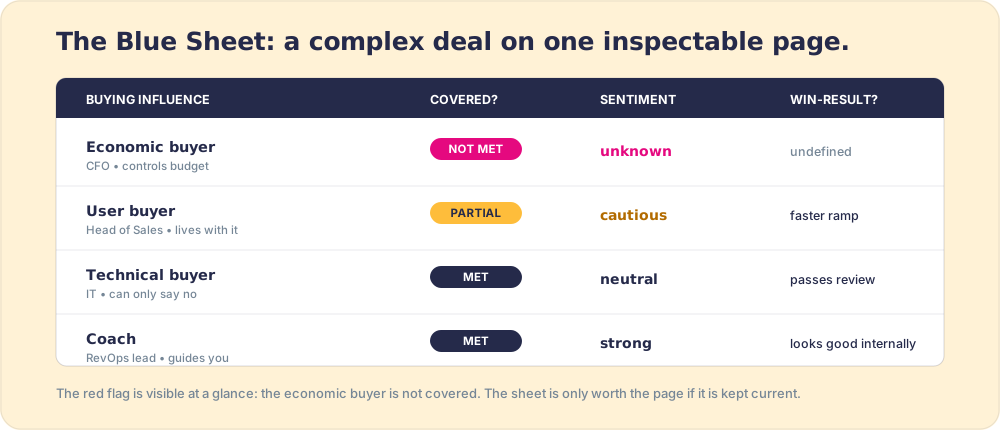
The point of the map is not to collect names. It is to expose the gaps before they become surprises. The methodology calls these red flags: an influence you have not met, a sentiment you cannot read, a role you cannot fill with a person. A red flag is not a problem to hide; it is the single most valuable thing on the sheet, because it tells you exactly where the deal is blind. The reps who lose complex deals rarely lose them to a competitor’s feature. They lose them to a buying influence they never mapped, the Technical buyer in procurement who killed it in a meeting the rep was not in.
What is the Miller Heiman Blue Sheet?
The miller heiman blue sheet is the planning worksheet that holds all of this on one page. For a single opportunity it lists every buying influence, the rep’s read on each one’s coverage and sentiment, the red flags, and the win-result each buyer is personally after, the individual outcome that makes this purchase a win for them as a person, on top of any win for the company. It is the original deal-inspection artifact: a structured forcing function that makes a rep account for the whole committee instead of the one contact who answers their emails.
The win-result idea is the part most people forget, and it is the sharpest thing in the whole framework. Miller and Heiman drew a hard line between a result (an organizational outcome, “we cut ramp time”) and a win (a personal one, “I look like the person who fixed onboarding”). A buyer commits when the deal delivers both. Ignore the personal win and you get a maddening pattern in complex deals: a buyer who agrees with every business case you make and still will not move, because nothing in it is a win for them. This is the same self-interest engine that consultative selling taps when it gets the buyer to articulate their own stakes out loud.
How do you fill out a Miller Heiman Blue Sheet?
A blue sheet in sales is Miller Heiman’s one-page plan for a single complex opportunity, and you fill it in top to bottom, in order, because each box leans on the one above it. The fields below follow The New Strategic Selling and the Blue Sheet as Korn Ferry now embeds it in its CRM software (Korn Ferry Sell). This is the Miller Heiman sales process at the scale of one deal, and it is what people usually mean when they ask what the Miller Heiman technique is.
- Single sales objective. One specific thing you intend to sell to one account, with a revenue figure and a close date. “Grow the account” is a wish; “200 seats, signed by June 30” is an objective. It is single because a sheet that covers three opportunities plans none of them.
- Current position. The rep’s own read on how secure the deal is, written down before the analysis so the analysis can prove it wrong.
- Buying influences. A named person in each of the four roles, with their degree of influence, their response mode (below), and how well you have covered them.
- Win-results. For each influence, the business result they need and the personal win it delivers to them.
- Red flags and strengths. Each gap, uncertainty, new player, or unmet influence goes down as a red flag; each real advantage goes down as a strength to lean on.
- Possible actions, then the best action. List the moves that would remove a red flag or use a strength, then pick the few worth doing now. The SellingSherpa summary of the book caps the action plan at “4 or 5 items.”
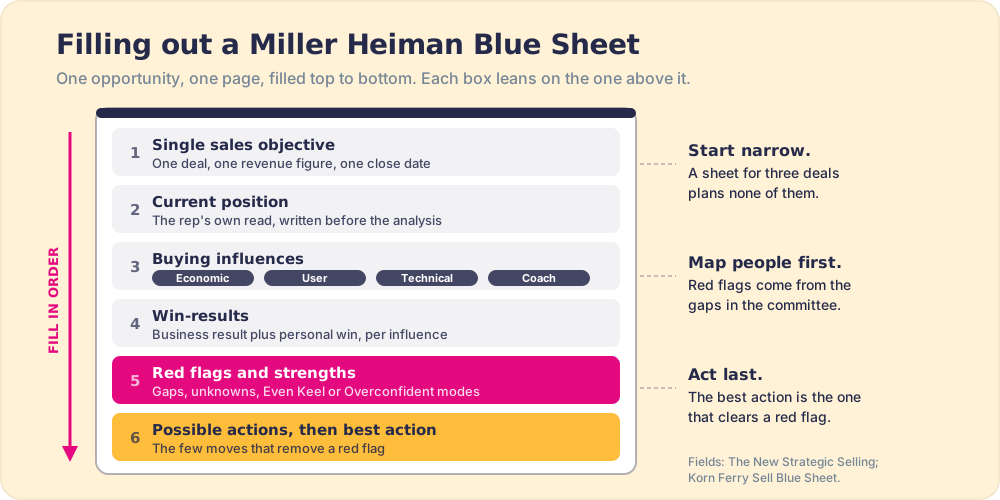
The order is the lesson. A rep who jumps straight to possible actions writes a to-do list for the deal they wish they had. A rep who works down the page writes one for the deal they have, because by the time they reach the bottom, the red flags have picked the targets.
A blank field is a finding.
What are the four response modes?
Response modes are the least-quoted part of Strategic Selling and one of the most useful. For each buying influence, Miller Heiman asks how that person sees the distance between their current reality and the results they want, and the answer predicts whether they will buy at all.
- Growth. Things are fine and could be better, and the buyer wants the better. Likely to buy.
- Trouble. Reality has fallen below where it needs to be, and the buyer wants to get back. Likely to buy, and fast.
- Even keel. The buyer sees no gap: reality matches the goal. No gap, no reason to change, however good the product.
- Overconfident. The buyer believes reality already beats the goal. The book’s advice is to wait them out.
Picture a thermostat in each office on the buying committee. The office in Trouble is cold, and the heat comes on without argument. The office on Even Keel sits at exactly the temperature on the dial, and the finest furnace ever built will not fire, because nothing is asking it to. The overconfident office thinks it is too warm already. The rep’s job is to read each thermometer before selling heat, and an influence reading Even Keel or Overconfident goes on the sheet as a red flag.
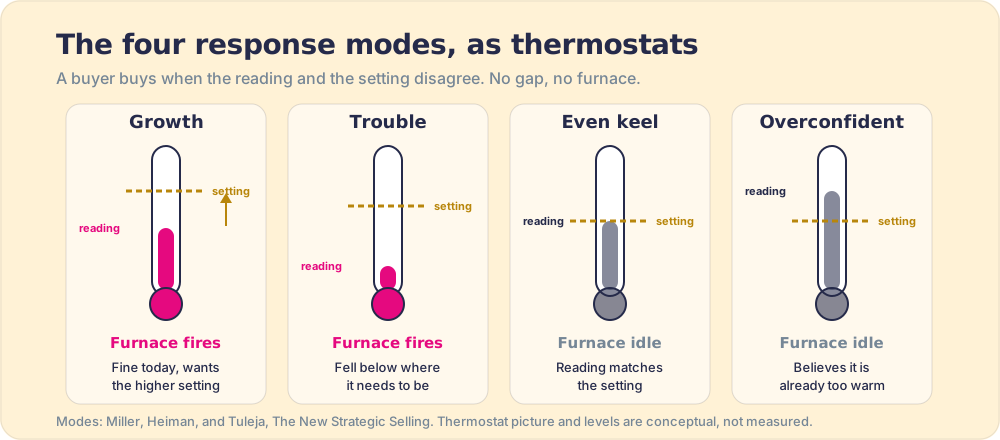
The thermostat stops being a good picture at one point. A rep cannot turn a buyer’s dial by force; pushing an Even Keel buyer to feel a gap they do not feel is how pressure selling earns its reputation. What the rep can do is ask questions that let the buyer notice a gap that exists. That discrepancy engine is the same one that runs gap selling and the Sandler pain funnel: no felt gap, no deal.
What are the Miller Heiman sales funnel stages, and why work them backwards?
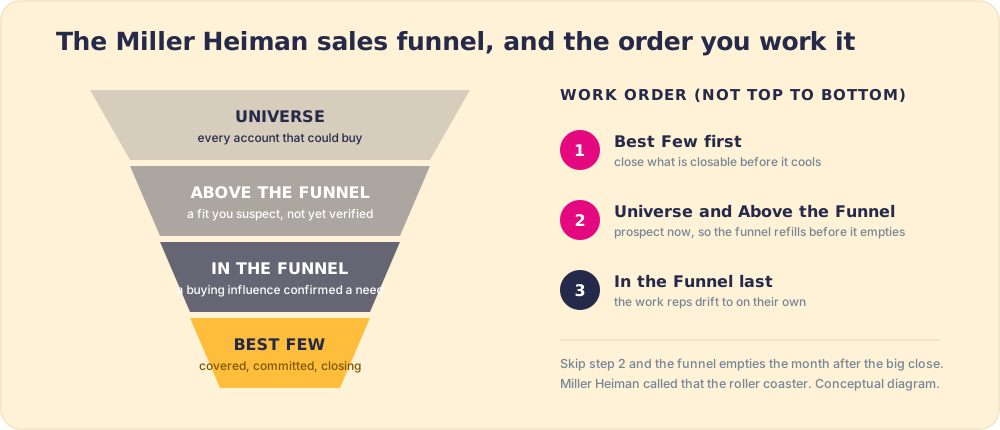
The Blue Sheet maps one deal. The miller heiman sales funnel is the second half of Strategic Selling, and it maps the rep’s whole book, because a seller who wins one complex deal beautifully and has nothing behind it is a seller about to miss two quarters in a row. Miller and Heiman sorted every opportunity into four levels, each defined by what has been verified, not by how the rep feels about it (Miller, Heiman, and Tuleja, The New Strategic Selling).
- Universe. Every account that fits your ideal profile and could, in principle, buy. No contact yet, no data beyond fit.
- Above the funnel. Accounts where the data suggests a real need, but no buying influence has confirmed it. A suspicion, not a deal.
- In the funnel. At least one buying influence has verified a discrepancy between where they are and where they want to be, and you have started covering the committee. This is where the Blue Sheet lives.
- Best few. Every influence is covered, the red flags are cleared, and the buyer has taken a concrete step toward closing. In the original model, the rep should expect to win roughly nine of ten of these.
- Order. Where the funnel empties: the signed deal, and the moment a new Best Few slot opens.
| Funnel stage | What has to be true | When to work it |
|---|---|---|
| Universe | The account fits your ideal customer profile | Second: prospect it |
| Above the funnel | Data suggests a possible need; no buying influence has confirmed it | Third: qualify it |
| In the funnel | A buying influence has verified the need; the Blue Sheet is open | Fourth: work it |
| Best few | Influences covered, red flags cleared, luck and uncertainty removed | First: close it |
The levels are ordinary. The rule about how to work them runs against instinct. The obvious way to spend a week is top to bottom, or wherever the most email is coming from, which in practice means the middle: the in-the-funnel deals that send emails, ask for demos, and feel like progress. Miller and Heiman said no. Work the best few first, so nothing that is closable cools while you are busy elsewhere. Then, before touching the middle, go prospect the universe and qualify what sits above the funnel. Only then work the deals in the middle. One summary of the book lists the order verbatim: “Do closing work on your Best Few objectives. Prospect by narrowing the Universe. Qualify your Above the Funnel objectives. Work the objectives In the Funnel” (SellingSherpa, The New Strategic Selling summary). The reasoning is mechanical. Prospecting is the one activity with no buyer pulling on the rep’s sleeve, so it is the activity that gets skipped whenever the middle is busy, and a funnel that is not refilled while it is being worked runs dry the month after the big close. Miller and Heiman called the resulting pattern the roller coaster: a fat quarter of closing, an empty quarter of scrambling, repeat. The work order is a forcing function against a predictable human default, the same job the Blue Sheet does for committee coverage. Both exist because the rep, left to instinct, drifts to the comfortable work.
Strategic Selling was also never the whole Miller Heiman catalogue, which is why the name gets attached to three different colored sheets. Conceptual Selling (1987) is the call-planning method: it plans a single meeting around the buyer’s own concept of the problem, on a Green Sheet, and its core move is to get the buyer talking before the seller presents anything. Large Account Management Process, LAMP (1991), plans a whole strategic account over years on a Gold Sheet. Blue for the deal, green for the call, gold for the account. The three share one spine: write the current state down, then re-walk it on a cadence. A rep who runs the funnel rule and keeps the sheets current is running an inspected sales process; a rep who fills them in once has a filing cabinet.
Why does a documented process decay into fiction?
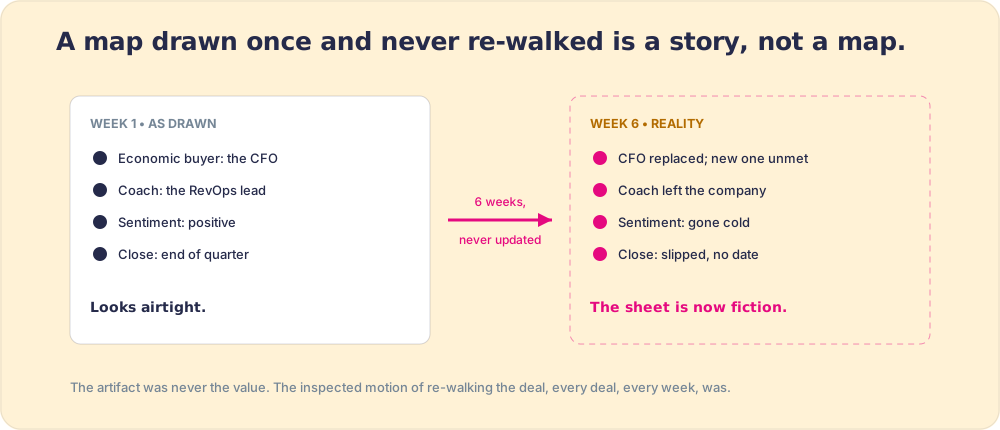
Because documentation is not inspection, and the Blue Sheet, for all its brilliance, is documentation. Here is the failure mode every Miller Heiman shop eventually hits. The rep fills the sheet out beautifully at deal kickoff. Then the deal moves, as deals do. The CFO who was the economic buyer gets replaced. The Coach takes a job elsewhere. Sentiment that read “positive” in week one goes cold by week six. And the sheet, sitting in a folder, still says everything is fine. The map now describes a harbor that no longer exists.
This is not a Miller Heiman problem. It is the universal flaw of every documented process, the gap between a process that exists on paper and a process that is run. A process exists only to the degree that adherence to it is inspected. A Blue Sheet that is reviewed once and filed has all the predictive value of last year’s tide chart. The State of Sales Enablement 2026 found that teams who consistently inspect their deals against a defined process hit quota at 6.3 times the rate of teams that rarely do, the single largest lever in the study. The sheet was never the asset. The inspected motion of re-walking it, every deal, every week, was.
And re-walking it surfaces the thing a static artifact hides: the buyer’s real position, the sentiment behind the checked box. A Blue Sheet that says “economic buyer: met” is worthless if “met” happened in March and the relationship has gone dark since. What you want on the page is the buyer’s current sentiment as of this week, not a checkmark from March, which is exactly the discipline of tracking both the seller’s activity and the buyer’s real position rather than letting a deal advance on activity alone.
How does Miller Heiman relate to MEDDIC?
MEDDIC is Miller Heiman’s most successful descendant, and the lineage is direct enough to be obvious once you see it. MEDDIC, built by Dick Dunkel and Jack Napoli at PTC in the early 1990s, took the Strategic Selling insight that you must map multiple influences and compressed it into a qualification checklist: Metrics, Economic Buyer, Decision Criteria, Decision Process, Identify Pain, Champion. Two of those six letters are lifted almost whole from Miller Heiman. The Economic Buyer is the Economic buyer. The Champion is the Coach, renamed.
The difference is emphasis, and it matters. Strategic Selling is a planning and account-mapping system: it spreads the whole deal across a page so you can see it. MEDDIC, and its stricter cousin MEDDPICC, is a qualification and inspection discipline you run on every deal to decide whether it is real. Where Miller Heiman asks “have I mapped the whole committee?”, MEDDIC asks “have I verified the things that predict a win?” The modern best practice is to run both impulses at once, which is where the serious sales methodologies converge: map the committee like Miller Heiman, then qualify it like MEDDIC, then inspect both on a cadence so neither goes stale. The mapping without the inspection is the stale Blue Sheet all over again.
Who owns Miller Heiman now, and what are Korn Ferry blue sheets?
Korn Ferry does. The methodology outlived its company’s independence: Korn Ferry completed its acquisition of Miller Heiman Group, along with AchieveForum and Strategy Execution, on November 1, 2019 for approximately 110 million dollars (Korn Ferry press release). The brand changed hands; the ideas did not. Three names now circulate, and searchers meet all of them.
- Strategic Selling with Perspective. The current name of the Strategic Selling program, which Korn Ferry sells as onsite instructor-led training or digital e-learning (Korn Ferry, Strategic Selling with Perspective). This is what blue sheet sales training means in 2026: the Blue Sheet method, taught as a course.
- Korn Ferry Sell. The software, which Korn Ferry describes as “native to Salesforce and Microsoft Dynamics” and which “embeds the Blue Sheet,” alongside the Gold Sheet for account plans and the Green Sheet for call plans (Korn Ferry Sell). Korn Ferry blue sheets are this: the Blue Sheet as a panel on the opportunity record.
- Miller Heiman. The name of a firm that no longer operates independently, and still the word sellers use for the method.
Moving the sheet out of the binder and onto the opportunity record is the method’s owner conceding the argument of this article: a plan kept away from the work drifts away from the work. That fixes where the sheet lives. It does not, by itself, fix when anyone looks at it. A Blue Sheet panel in Salesforce goes stale as fast as one in a folder if no step in the process asks the rep to re-walk it and no one checks that they did.
Storage and inspection are two problems. Korn Ferry has solved the first.
What we recommend
Two instincts sit underneath this whole tradition, and only one of them wins complex deals reliably. You can run the deal off your best relationship: find the buyer who likes you, build the case with them, and trust that their enthusiasm carries it. Or you can run the deal off the map: identify every buying influence, read each one’s real position this week, name the red flags, and treat the whole committee as the unit you are selling to.
We recommend running it off the map, and the evidence is not subtle. Gartner says a complex purchase now spreads across 6 to 10 stakeholders, so the single-champion deal is structurally fragile. Miller Heiman saw that forty years ago and built the Blue Sheet to handle it. But the Blue Sheet only pays off under one condition, and it is the condition the original method left to discipline and hope: the deal map has to be inspected, re-walked every deal the way a harbor pilot re-reads the channel, or it decays into a confident-looking fiction. So build the map, by all means. Then make re-walking it a required, inspected step rather than a private habit, because the inspected motion was always the asset and the sheet was only ever its shadow.
If you want the qualification discipline that grew out of this tradition, read the MEDDIC field guide; for the way buyers talk themselves into the gap, consultative selling; for the wider map of how the methodologies fit together, sales methodologies; for the modern, buyer-owned take on deal urgency, the SPICED methodology; and for how a deal map becomes a step a team runs instead of a sheet it abandons, sales process adoption.
Frequently asked questions
What is Miller Heiman?+
What are the four buying influences in Miller Heiman strategic selling?+
What is a blue sheet in sales?+
What are the four response modes in Miller Heiman?+
What are the Miller Heiman sales funnel stages?+
Is Miller Heiman still used, and who owns it now?+
How is Miller Heiman different from MEDDIC?+
Your process, running itself.