Social Selling Tips From Jen Allen-Knuth: Four Dogs, 18 Years of Quota and the Buyer's Status Quo
Jen Allen-Knuth carried quota for 18 years at CEB, Gartner and Challenger, then built DemandJen and a LinkedIn audience of more than 100,000. Her social selling tips start with the problem you solve and a Saturday post about shelter dogs.
Social selling tips are practical habits for earning a buyer's trust on LinkedIn and other networks before the first meeting, such as posting about the specific problem you solve, showing what you stand for, and writing so a buyer recognizes their own situation in your content.
Jen Allen-Knuth carried a quota for 18 years before she went out on her own. She started at CEB, stayed through its sale to Gartner, and kept selling when Gartner sold the Challenger division to private equity. Today she runs DemandJen, a sales training company that counts GE, IBM, Autodesk and Bloomberg as clients. When her LinkedIn audience passed 100,000 followers, she asked herself a plain question. “What am I doing this for?”
The answer she gave Rob Jones on Numbers Known holds most of her social selling tips, and it starts with her dogs. On the show each guest brings three numbers and Rob tries to guess what they mean. Jen’s were four, 18 and 41. Rob brought his own for her, including 53, one and 25%.
Why do Jen Allen-Knuth’s four dogs show up on her sales calls?
Four is the number of dogs in Jen’s house. Jen started posting on LinkedIn as an account executive who wanted more meetings, and a stint at Lavender, a company with a big social following, showed her how much a feed could do. Then the follower count crossed six figures. “I realized that like there’s a lot that you can do when you have a voice and sometimes we like tend to use that selfishly,” she said.
So she started a Saturday post that anyone can sponsor. The sponsor donates to a dog shelter, and Jen features their business next to a dog her husband has photographed. She did not build the posts to sell anything, and still, “a lot of the sales calls that I have, they start off with like, oh, I love the dog from a couple weeks ago or we are big rescue fans too.”
Rob pushed back. Does this only work with 100,000 followers? Jen said no and told him about Marissa, a recruiter with a modest following who posts a feel-good dog story every Monday. Jen has no need for a recruiter, but “if there was ever a need for someone to have that, I would I would think of Marissa first because she’s the one that stands out to me as someone who stands for something that I care about.”
LinkedIn reports that social selling leaders create 45% more opportunities than peers with lower Social Selling Index scores and are 51% more likely to hit quota (LinkedIn Sales Solutions). LinkedIn is measuring its own product, so take that as a direction. Jen had also weighed brand deals, and asked herself whether she would “make all this money, or could I do something different that wouldn’t make me feel so gross at night?”
How does Jen Allen-Knuth pick her content pillars?
Rob asked what she posts about. Jen credited Devin Reed, who once asked a room she was in “what are the three or four words that you want to be known for?”
The words she landed on name a problem. “I tried to make status quo, like buyer status quo my lane,” she said. Calling herself the best sales trainer would mean nothing, because “best is so subjective.” The buyer who agrees your product is better and still does nothing, since “good is good enough,” is the problem her clients hire her to fight. Three pillars sit under it, each a place where the status quo wins a deal:
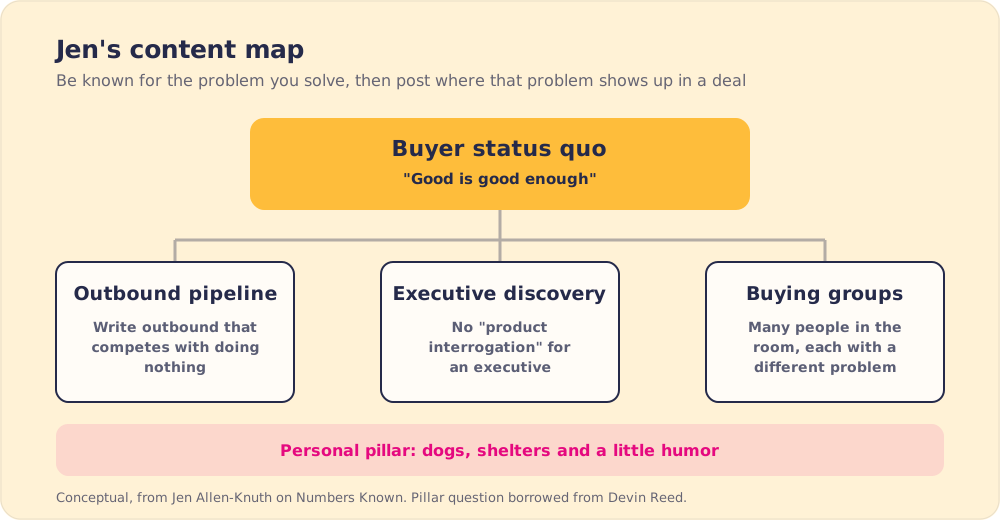
- Outbound pipeline. “When status quo is your enemy, how do you write outbound that competes against it?”
- Executive discovery. An executive is “not going to sit through your product interrogation.”
- Buying groups. “When you got 10 different people in the room with 10 different opinions on what problem is important, that’s a whole different ballgame.”
Rob compared it to search, where a small firm picks a narrower term than “best HubSpot provider.” Jen agreed. Taking on a big methodology company or a trainer with 40 years behind them “would just be a stupid decision for me,” and in a crowded field “it’s easier to be known for the specific problem you solve.”
In Challenger’s decade of buyer research, 38% of purchases that buyers started ended in “no deal” (Challenger). Jen writes for the seller who reads a post and thinks, “Oh my gosh, I just lost a deal to the same thing.”
What does the 53% figure say about the sales experience?
Rob’s first number for Jen was 53, and she named the research before he finished. Rob put the sales experience at 53% of what drives B2B customer loyalty, and Challenger’s own summary says it “drives more customer engagement and loyalty than brand, reputation, service, quality, and price combined” (Challenger). Jen said the work began in 2008, and in later waves the sales experience “never dropped below any of the other ones.”
Buyers now arrive after hours in ChatGPT or Claude. Jen has heard that buyers would rather skip reps, and disagrees. “I don’t think that anyone prefers a rep-free experience. I think people prefer talking to someone who has more to offer than just like, ‘Let me show you the bells and whistles.’”
Rob noted that the Challenger Sale method, teach, tailor and take control, resembles how people use AI now. Jen agreed, with one change to tailoring. When Challenger taught it, she said, tailoring was mostly about the persona, other CIOs like you. With an AI bot, “You’re asking me, right?” Buyers now bring that expectation to reps. “The expectation is I want a conversation about me, not others like me,” she said.
Why is sales becoming marketing?
Rob has what he calls an “insane theory,” that the sellers who win will become part marketer. Jen agreed and explained her company’s name.
“I don’t point to marketing and say your job is to to generate demand and my job is to close it. I think those years are totally freaking gone like I have to play a heavier hand in generating my own demand if I want to be effective.”
“I’m a firm believer that our profession is not going to go away,” she said. The credit-card, inbound, product-led sale is where teams will shrink. A complex purchase is “still such an emotional decision to make a change. You’re going to want to talk to somebody. They just have to not be like order takers.” Her husband researched his new car with AI, walked onto the lot sure of his choice, and changed his mind after a salesman raised a couple of points.
For a sales leader, that means a rep’s posts, outbound emails and discovery calls should make the same argument. Our guide to sales and marketing alignment covers the handoffs that break when they do not.
Why did Jen Allen-Knuth carry a quota for 18 years?
Her second number was 18, the years she carried a quota at CEB, Gartner and Challenger. She never wanted to manage. When she covered for a manager on leave, she lost sleep over a rep who might miss plan. “What if I have to put him on a PIP?” An early manager gave her a test she still uses. Audit a week, and note what you looked forward to and what you dreaded. That audit moved her from account management to new-logo sales, and roughly every two years she changed customers or roles.
Rob turned his own number, one, on her. She teaches the cost of inaction and spent her whole career in one company family. Wasn’t that inaction? She called it a question she had never been asked. She could have left and “probably made 20K more than I was making,” but the people, the product and the brand she had built outweighed it. The extra pay was real. “It just wasn’t enough.”
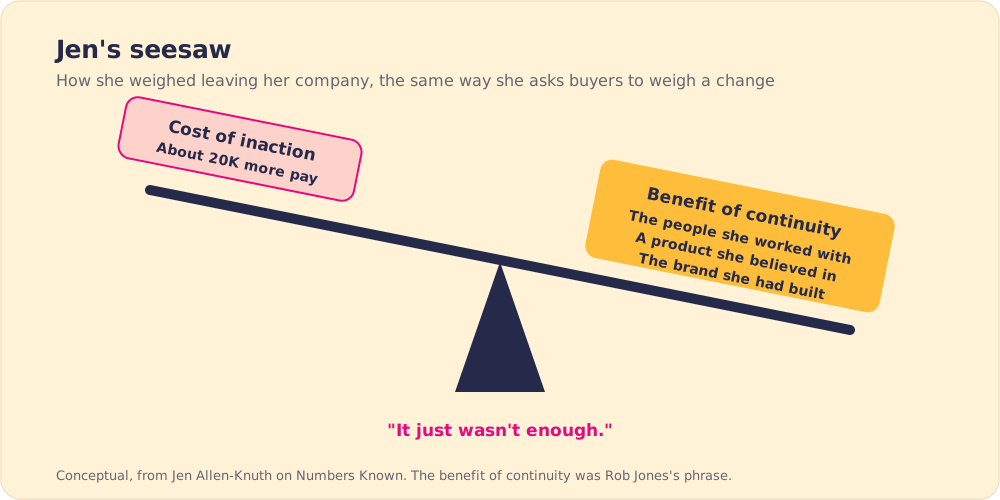
The idea underneath is prospect theory, she said, where “we as human beings are more likely to act to avoid a risk than we are to realize benefit.” Kahneman and Tversky published it in 1979 (Econometrica), and our guide to sales psychology shows how loss aversion plays out in a deal. She doesn’t use it to push anyone. “I’ve never in my entire history of selling convinced anyone to do anything. It’s their own personal choice to change.”
Her third number, 41, was the age she married, chosen for women in sales who feel they must pick career or family on a schedule. “I don’t think we should put as much pressure as we do on ourselves for the timeline.”
Social selling tips from Jen’s feed
Pulled from the episode, Jen’s social selling tips come to five:
- One buyer problem at the top. Name what your buyers lose deals to, in their words.
- Pillars where that problem shows up. Outbound, discovery and buying groups, in Jen’s case.
- A cause on a set day. Her Saturday dogs and Marissa’s Monday dogs both work, at follower counts far apart.
- Happy dogs, no guilt. Rob’s last number was 25%, which he cited as the estimated share of US dogs adopted from shelters (he did not name the study). Jen never leads with a stat like that. Sad shelter ads make people “change the channel,” so she shows happy, well-adjusted dogs.
- Care for the customer. Asked what rescue has that sales needs, she said “a deep care for the customers.”

What Jen Allen-Knuth runs on
- Four dogs. A Saturday post that funds shelters, features a sponsor, and opens many of her sales calls.
- One overarching problem. Buyer status quo, because “best sales trainer” means nothing to a buyer.
- A 53% sales experience. Challenger’s loyalty research, with a higher bar now that buyers expect a rep to talk about their own business.
- Eighteen years of quota. A career decision weighed like a buyer’s, cost of inaction against the benefit of continuity.
- Her own demand. “I have to play a heavier hand in generating my own demand if I want to be effective.”
What should a sales leader take from Jen?
Start where Jen started. Before anyone posts, help each rep name the buyer problem they want to be known for, in your buyers’ words, and check that their posts, outbound and discovery questions all argue it. Then give them room to post about what they care about on a regular day. Challenger’s 53% says the experience earns loyalty, and a buyer who has read a rep’s thinking for six months has had part of that experience before the first call.
The call still has to live up to the post. Supered carries the team’s discovery and deal guidance into the rep’s workflow while the conversation is live, so a buyer who came in through a post hears the same thinking on the call. Start with the three or four words, the way Jen did, and then post about what you care about.
Frequently asked questions
What are the best social selling tips for B2B salespeople?+
Do you need a big LinkedIn following for social selling to work?+
What should a salesperson post about on LinkedIn?+
How do you choose content pillars for social selling?+
Does social selling help salespeople hit quota?+
Your process, running itself.
Turn the playbook into rep behavior.
More from Numbers Known

Active Listening in Sales, Taught by a Comedian: Chris Bogue's Improv Rules for Sellers
Chris Bogue
Pipeline Coverage: Diana Marcela Gonzalez's Quarter Math and the Month-Two Check
Diana Marcela Gonzalez