Sales Psychology: The Mechanisms, Not the Tricks
Sales psychology is not a bag of tricks. The durable principles, reactance, loss aversion, commitment, self-persuasion, and indecision, are behaviors a rep has to run the same way on every deal, not gimmicks to deploy once. Here is the science, named and sourced.
Sales psychology is the study of the cognitive and emotional mechanisms behind why buyers decide, including reactance, loss aversion, commitment, and indecision, and the discipline of running those principles as consistent rep behaviors rather than one-off persuasion tricks.
Walk into any bookshop and the sales-psychology shelf will sell you a magic trick. Mirror the buyer’s posture, drop a scarcity line, anchor high, and the deal falls into your lap. It reads like stage hypnosis with a CRM, a set of moves you perform on a buyer who never notices. The trouble is that the buyer always notices, and the durable findings of behavioral science say almost the opposite of the trick. The principles that genuinely move a decision, reactance, loss aversion, commitment, self-persuasion, and the plain indecision that kills most deals, are not levers you pull once. Each is a behavior, an unglamorous thing a rep has to run the same way on every single deal, or it does nothing at all. Naming the mechanism is the easy half. Running it on the forty-first deal of the quarter the way you ran it on the first is the half that changes the number.
That is the argument of this post, and it cuts against most of what gets written under the heading. The psychology is real. The science is sound. What almost nobody says is that the science only pays when it stops being knowledge and becomes a habit you inspect.
What is sales psychology, really?
Sales psychology is the study of the cognitive and emotional mechanisms behind why buyers decide, and the discipline of working with those mechanisms instead of against them. It draws on the same behavioral science that explains every other human choice: Robert Cialdini’s principles of influence, the prospect theory of Daniel Kahneman and Amos Tversky, the decision research behind why people freeze rather than choose. The psychology of sales is not a separate magic; it is general human psychology, observed at the moment a person decides whether to spend money to change something.
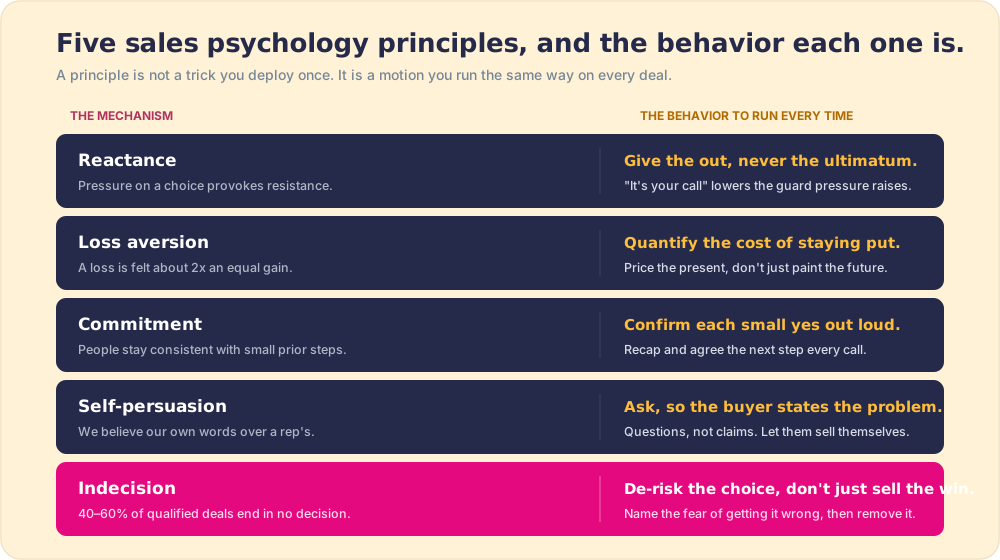
The popular treatment of buyer psychology stops at the list of principles, as if knowing the names were the skill. It is not. A principle you can recite and cannot run is worth nothing on a live call. So the useful definition has two halves: the mechanism, and the behavior that delivers it. Five principles carry most of the weight, and each one is paired below with the behavior a rep has to run, every time, to get the effect.
- Reactance. Pressure on a buyer’s freedom to choose provokes resistance, so manufactured urgency and “act now” tactics make a wary buyer dig in.
- Loss aversion. A loss is felt about twice as intensely as an equal gain, so the cost of staying put moves a buyer more than the promise of growth.
- Status-quo bias. Doing nothing feels safer than choosing wrong, which is why 40 to 60 percent of qualified deals die to no decision rather than to a rival.
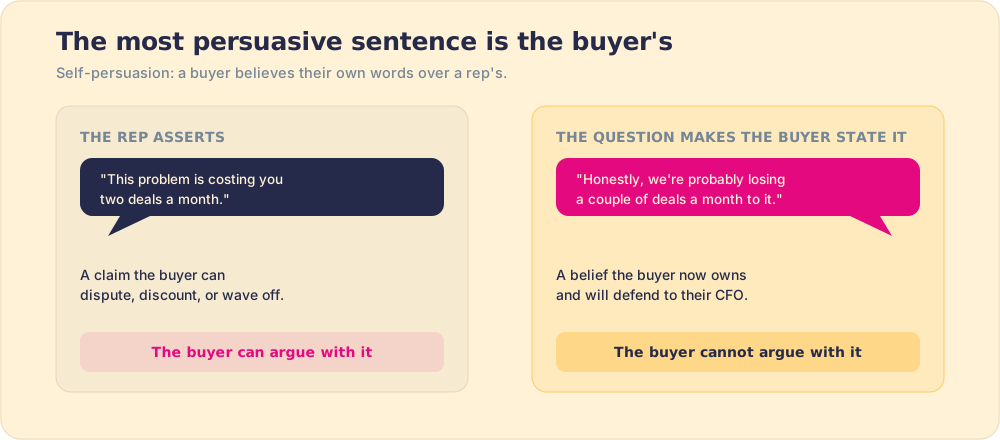
- Self-persuasion. A buyer believes their own words over a rep’s, so the question that makes them state the problem beats any claim the rep could assert.
- Commitment and consistency. A small earlier yes pulls the next one along, because abandoning it would contradict the buyer’s own prior choice.
Why does pushing harder make a buyer pull away?
Because of reactance, the most ignored finding in all of sales. In 1966 the psychologist Jack Brehm described what happens when a person’s freedom to choose is threatened: they do not comply, they resist, often by doing the very thing the pressure was meant to prevent (Brehm, A Theory of Psychological Reactance). Tell someone they must decide today and you have not added urgency; you have added a threat, and the wary part of them digs in to protect its own freedom, even against its own interest.
This is why the single most common piece of sales-psychology advice, “always create urgency,” is usually wrong. A manufactured deadline reads as exactly what it is, and a buyer who feels herded stops listening to the merits and starts defending her autonomy. The harder you push a door that only opens by pulling, the more firmly it stays shut.
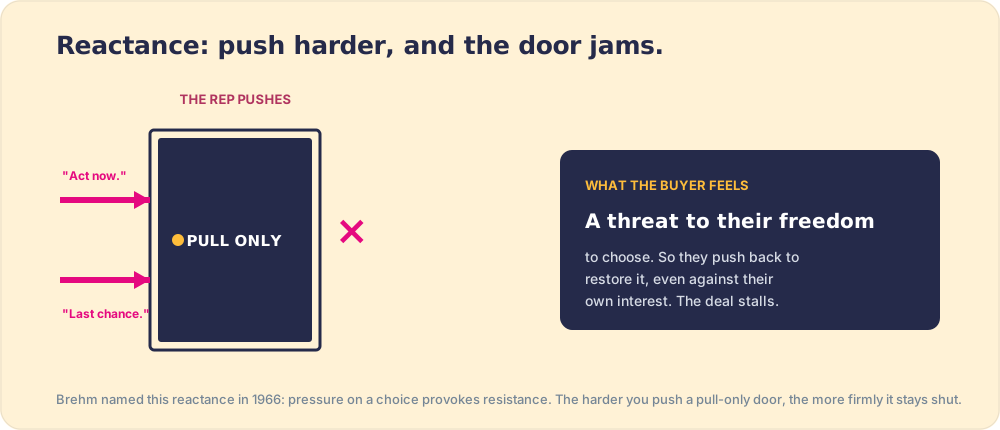
The behavior that works with reactance instead of against it is small and counterintuitive: hand the buyer back the choice out loud. “It’s genuinely your call, and there are good reasons to wait” lowers the guard that pressure raises, and a buyer who feels free to say no listens far more honestly to why they might say yes. Real urgency is not manufactured. It comes from the buyer’s own cost of staying put, which is the next mechanism, and the honest one.
Why does the cost of staying put beat the promise of growth?
Because losses weigh more than gains, and not by a little. Kahneman and Tversky’s prospect theory, the work that won a Nobel Prize, established that people feel a loss about twice as intensely as an equivalent gain (Kahneman & Tversky, prospect theory). A future benefit (“you could grow faster”) is a gain, and gains are weak fuel. The cost of the present (“you are losing two deals a month to slow ramp”) is a loss, and losses move people. Same deal, two framings, and the second one is roughly twice as motivating as the first.
This is the honest engine of urgency, and it is why so much enthusiastic future-state selling lands soft. The rep paints a bright tomorrow, the buyer nods, and nothing happens, because a gain the buyer does not yet have is easy to defer. Quantify what the current situation is costing them right now, in their own numbers, and you have engaged the part of the mind that hates to lose. Persuasion in sales is less about making the future shine and more about making the present expensive.
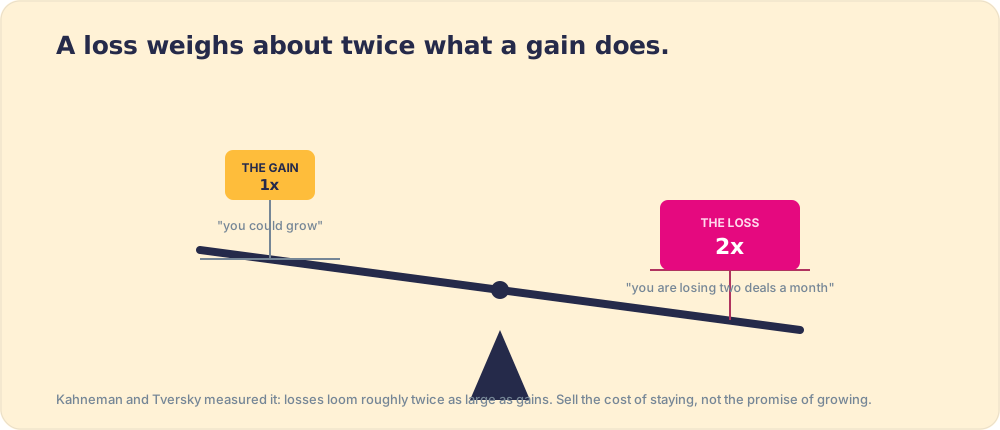
The behavior here is a discipline, not an instinct: get a real number on the cost of the status quo before you talk about the solution. That is the same diagnostic move at the heart of gap selling, where the size of the quantified gap, not the product’s features, is what creates the reason to act. The mechanism is loss aversion; the behavior is making the buyer say the cost out loud, on every deal, instead of only on the ones where it comes up easily.
Why is the buyer’s strongest competitor an empty chair?
Because the deal you are most likely to lose is not lost to a rival; it is lost to nothing at all. In The Jolt Effect, Matt Dixon and Ted McKenna analyzed more than 2.5 million recorded sales conversations and found that 40 to 60 percent of qualified, interested buyers end up making no decision whatsoever (The Jolt Effect). They wanted to buy. They believed the pitch. And then they did nothing, because doing nothing felt safer than the risk of choosing wrong.
This is status-quo bias, the close cousin of loss aversion, and it reframes the whole job. You are not mostly competing against the other vendor on the shortlist. You are competing against the buyer’s fear of making a mistake, a fear so strong it routinely beats a product the buyer already prefers. Dixon and McKenna’s counterintuitive finding is that for these wary buyers, more enthusiasm makes it worse: a rep who piles on benefits raises the stakes of the decision and deepens the freeze.
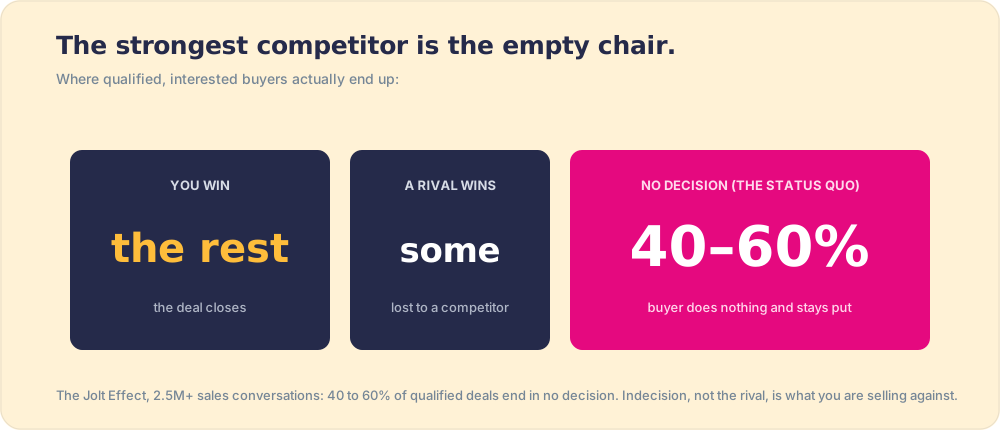
The behavior that beats indecision is to de-risk the choice rather than sell the win harder. Name the buyer’s fear of getting it wrong, then remove it: a smaller first step, a clear recommendation, a guarantee, proof that people like them made the same call and were fine. The same honest mechanics show up when you handle a sales objection well: most objections are the fear of choosing wrong wearing a logical costume, and the win is addressing the fear, not winning the debate.
How do commitment and self-persuasion actually move a deal?
These two do most of the work, and they are the clearest case of a principle that is useless until it becomes a behavior. Cialdini’s commitment-and-consistency principle holds that once people take a small step, they stay consistent with it; a buyer who agreed to a short pilot is far more likely to agree to the rollout, because abandoning it would contradict their own earlier choice (Cialdini, Influence). And self-persuasion, the older insight behind Neil Rackham’s SPIN research, holds that a buyer believes their own words over a rep’s. Rackham’s team studied roughly 35,000 sales calls and found the top performers did something specific: they asked far more questions, and questions that led the buyer to state the problem and its implications in their own voice (Rackham, SPIN Selling).
Put plainly: the most persuasive sentence in a sales call is one the buyer says, not one the rep says. A rep who asserts the cost of a problem is making a claim the buyer can dispute. A rep who asks the question that makes the buyer articulate that cost has produced a belief the buyer now owns and will defend. This is the deep mechanism under consultative selling and SPIN selling alike, and it is why good discovery is mostly asking, not telling. The strongest discovery call questions are the ones that let the buyer sell themselves.
But here is where the topic turns, and where most sales-psychology content stops. Knowing that questions beat claims does not make a rep ask them. Under quota pressure, the instinct is always to talk, to pitch, to fill the silence with features. The principle is sound and the rep still reverts, because a principle in your head is not a behavior in your hands.
Why do these principles fail in practice, and what fixes it?
Because naming a mechanism is not running it, and almost everything ever written about sales psychology stops at the naming. This is the same problem behavioral science has wrestled with for decades under a different label: the intention-action gap, the well-documented distance between what people intend to do and what they actually do. The psychologist Peter Gollwitzer showed that intentions alone are weak predictors of behavior, and that what closes the gap is not more motivation but a concrete plan tied to the moment of action (Gollwitzer, implementation intentions). A rep who “intends to ask better questions” behaves no differently from one who never read the book. A rep prompted with the exact question, at the exact moment the deal needs it, behaves differently because the cue is there when the choice is.
That is the bridge from psychology to results, and it is the part the trick-merchants skip. The mechanisms are real, but they only change the number when they become inspected, in-the-moment behaviors the whole team runs the same way. The State of Sales Enablement 2026 found that teams who consistently inspect deals against a defined process hit quota at 6.3 times the rate of teams that rarely do, the largest single lever we measured. Read that through a psychology lens and it is the intention-action gap restated for sales: the knowledge of what to do is everywhere, and the doing of it, consistently, is the whole difference. Consistency beats brilliance here, the same as everywhere else: a sound principle run on every deal beats a brilliant one run on half.
What we recommend
Two ways to read sales psychology sit underneath this whole discussion, and only one of them changes a number. You can treat it as a kit of tricks: learn the scarcity line, the mirroring tactic, the anchoring move, and reach for one when a deal feels stuck. Or you can treat it as a small set of true mechanisms, reactance, loss aversion, status-quo bias, commitment, self-persuasion, and build the behavior that delivers each one into a process every rep runs the same way.
We recommend the second, and the evidence is not subtle. Reactance says pressure backfires, so manufactured urgency loses; the fix is a behavior, hand back the choice. Prospect theory says losses move people about twice as much as gains, so the future-state pitch loses to the quantified cost of staying put; the fix is a behavior, get the number every time. The Jolt data says indecision beats the rival, so selling harder loses to de-risking the choice; again, a behavior. And Gollwitzer’s research, with our own, says none of it survives contact with a busy week unless the right move is cued at the moment of the work and inspected after. The principles are not the moat. Running them consistently is.
So pick the mechanisms that are real, and then do the unglamorous thing the tricks let you avoid: make each one a step the rep runs on every deal, prompted in the moment and inspected so it sticks. For the discovery discipline that puts the buyer’s own words to work, read consultative selling and SPIN selling; for the loss-aversion engine in full, gap selling; for the indecision fight at the point of friction, how to handle a sales objection; for the question sequence that runs on self-persuasion, the Sandler pain funnel; and for how a method stops being a book and becomes a habit, sales process adoption.
Frequently asked questions
What is sales psychology?+
What are the main sales psychology principles?+
Does creating urgency actually work in sales?+
How is buyer psychology different from old-school persuasion tricks?+
Why do most psychology-based sales tactics fail in practice?+
Your process, running itself.