Skrapp Pricing in 2026: A Family Plan Sold by the Line
Skrapp pricing checked October 2, 2026: eight paid sizes from $29 to $1,124 a month on yearly billing, priced by seats more than credits. Skrapp's own data shows the 5K plan costs more per credit than the 2K. Credits, search caps, and the cost with phones.
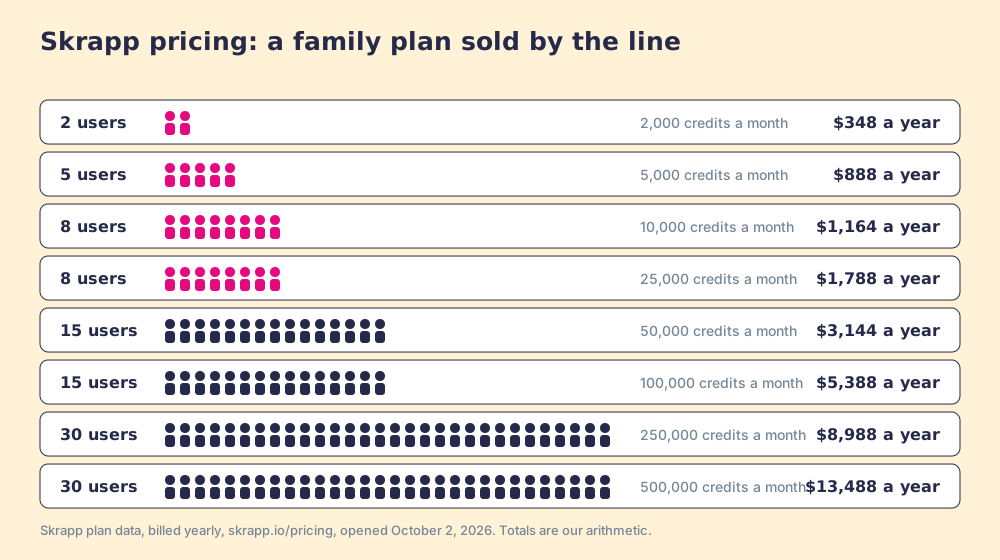
Skrapp pricing in 2026 is a free plan with 50 credits, Professional from $29 to $149 a month billed yearly for 2,000 to 25,000 credits and 2 to 8 users, and Enterprise from $262 to $1,124 a month for 50,000 to 500,000 credits and 15 to 30 users.
A family phone plan is sold by the line. The carrier prices two lines, then four, then six, and the data comes in the box, more of it with every package. A parent shopping for one counts the people at the dinner table before the gigabytes, and they buy the smallest package with enough chairs.
Skrapp pricing in 2026 is a free plan with 50 credits, Professional from $29 to $149 a month billed yearly for 2,000 to 25,000 credits and 2 to 8 users, and Enterprise from $262 to $1,124 a month for 50,000 to 500,000 credits and 15 to 30 users (skrapp.io/pricing, opened October 2, 2026). The plan card leads with credits. The price follows the users, and Skrapp’s own plan data proves it: the 5,000-credit plan costs more per credit than the 2,000-credit plan.
The quick answer, three ways:
- Skrapp, sized by headcount. A team of up to eight reps that emails and never dials: Professional 2K at $348 a year for 2 users, 5K at $888 for 5, 10K at $1,164 for 8.
- Skrapp plus a phone source. A team that dials. Skrapp sells no phone numbers, so add one, such as Findymail Starter at $996 a year for 5,000 credits, 500 phones at most.
- Supered Prospector, $45 per rep per month billed annually. A team that already pays for Clay. Clay’s waterfall across 200+ vendors finds emails and phones from LinkedIn, the company site and the CRM record, and Skrapp is not one of Clay’s data providers.
Skrapp pricing in 2026: what does each plan cost?
The pricing page puts a slider on each card and a toggle that saves 25% on yearly billing. The table below comes from the plan data the page loads, read October 2, 2026, including the users per size and Skrapp’s own cost-per-credit field.
| Skrapp plan | Yearly, per month | Yearly, per year | Monthly | Credits a month | Users | Skrapp’s cost per credit, yearly |
|---|---|---|---|---|---|---|
| Free | $0 | $0 | $0 | 50 | 1 | n/a |
| Professional 2K | $29 | $348 | $39 | 2,000 | 2 | 1.45 cents |
| Professional 5K | $74 | $888 | $99 | 5,000 | 5 | 1.48 cents |
| Professional 10K | $97 | $1,164 | $129 | 10,000 | 8 | 0.97 cents |
| Professional 25K | $149 | $1,788 | $199 | 25,000 | 8 | 0.60 cents |
| Enterprise 50K | $262 | $3,144 | $349 | 50,000 | 15 | 0.52 cents |
| Enterprise 100K | $449 | $5,388 | $599 | 100,000 | 15 | 0.45 cents |
| Enterprise 250K | $749 | $8,988 | $999 | 250,000 | 30 | 0.30 cents |
| Enterprise 500K | $1,124 | $13,488 | $1,499 | 500,000 | 30 | 0.23 cents |
Yearly totals are our arithmetic. Professional adds Multi-Page Enrichment for LinkedIn, Auto-Connect with LinkedIn Profiles, the Sales Navigator List Saver, list exports, CRM list sync and AI enrichment. Enterprise adds the API, SSO, accelerated support and a dedicated account manager. The Free plan covers the email finder, the verifier and the extension on LinkedIn, Sales Navigator, Recruiter and company websites. Skrapp’s help center calls the free allowance “50 credits once when you create your account” (Skrapp help, verification statuses), so treat Free as a trial.
Why does Skrapp’s 5K plan cost more per credit than the 2K?
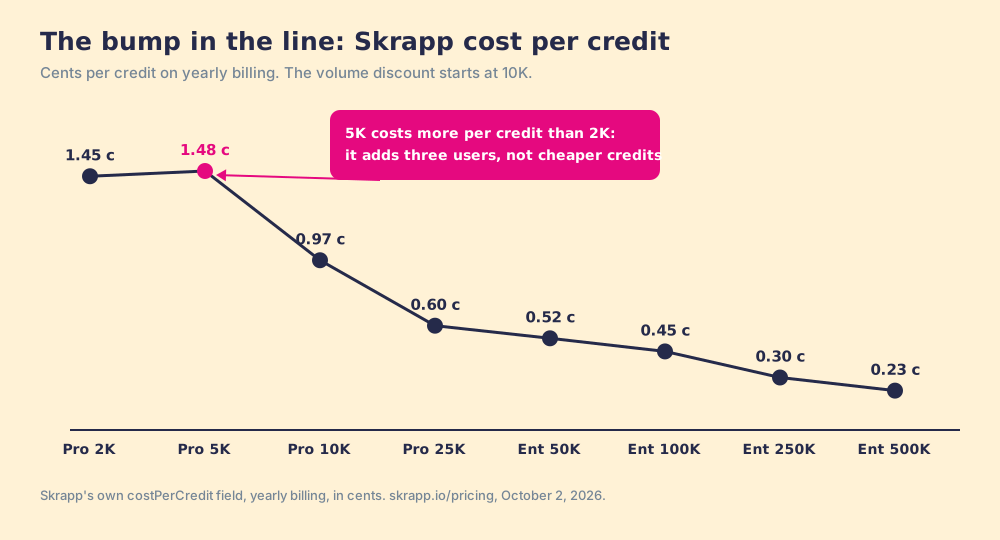
Skrapp publishes a cost per credit for each plan in the page data, and it does not fall in a straight line. On yearly billing, 2K costs 1.45 cents a credit and 5K costs 1.48. Monthly, 2K is 1.95 cents and 5K is 1.98. A buyer who moves up from 2K to 5K pays a little more for each email, the opposite of how a volume discount behaves.
The family plan explains it. The 5K plan is the five-line package. It adds three users and 3,000 credits for $45 a month more on yearly billing, and the users are what you are paying for; the credits come along at a slightly worse rate. The per-credit price only starts to fall at 10K, where 8 users and 10,000 credits cost $97 a month, 0.97 cents a credit. Above that, credits get cheap fast: 25K is 0.60 cents and 500K is 0.23.
So choose among the skrapp plans the way you buy a family plan, by the chairs at the table:
- One rep. Free for a trial, then Professional 2K at $348 a year; the second seat comes free in the box.
- Two reps. Professional 2K, $348 a year, 1,000 credits each a month.
- Three to five reps. Professional 5K, $888 a year.
- Six to eight reps. Professional 10K, $1,164 a year. Professional 25K seats the same eight for $1,788, so buy it only for the extra 15,000 credits a month.
- Nine to fifteen reps. Enterprise 50K, $3,144 a year, or ask sales@skrapp.io for a custom seat count.
- Sixteen to thirty reps. Enterprise 250K, $8,988 a year.
The ninth rep is the expensive one: $1,980 a year more than the eighth, for five times the credits. The Skrapp alternatives page calls it the ninth chair and grades the tools that sell seats differently.
What do Skrapp credits buy?
The rules for skrapp credits sit in the pricing FAQ, verbatim:
- The find. “Each email credit allows you to find one professional email address, marked as either ‘Valid’ or ‘Catch-all’. Or verify a single email address.”
- The free miss. “Your account is not charged for email credits labeled as ‘Invalid’ or ‘Unknown’.” The FAQ adds: “We only charge for deliverable emails marked as ‘Valid’ or ‘Catch-all.’”
- The rollover. “Any unused credits will roll over to the next month,” and “you can keep your credits even if you cancel your subscription.”
- The shared pool. “Team members share access to a common pool of credits.”
- The repeat check. Skrapp’s help center says “verifying the same email address multiple times will only consume a single credit.”
Rollover plus keep-on-cancel is generous. Prospeo’s credits “do not roll over” (Prospeo pricing), and Wiza’s monthly credits reset on the billing date (Wiza pricing). Skrapp’s are yours until you spend them.
The Catch-all rule cuts the other way. Skrapp’s own help center, updated July 13, 2026, defines the label: “The email address is potentially risky, often because it is part of a catch-all email server. However, sending emails to this address is still possible.” A catch-all server says yes to any name at the domain, so the check cannot tell you whether the person exists. Skrapp charges a credit for that answer, alongside a Valid one. Findymail sells the opposite policy, verifying catch-alls itself and charging “only” for “verified results,” with a refund if bounces pass 5% (Findymail pricing).
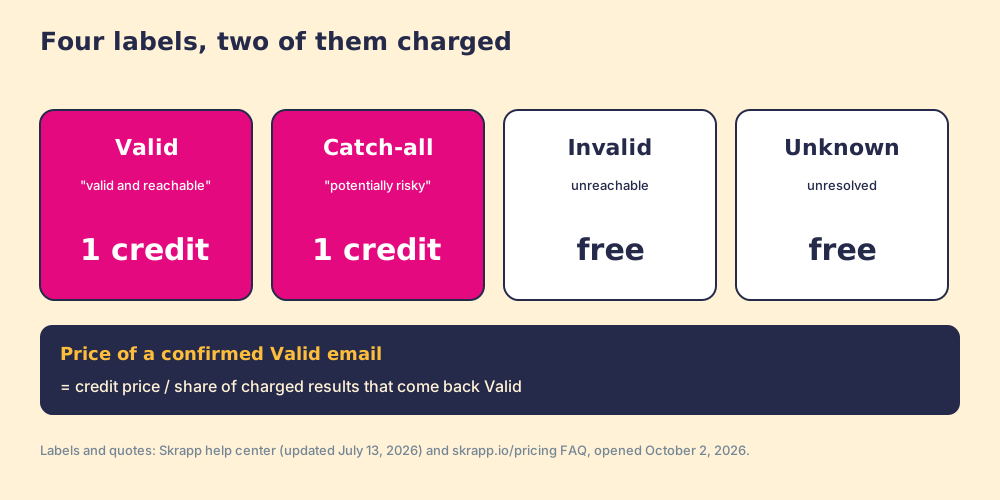
That makes the sticker per credit a floor. If a fifth of the results you pay for on a list come back Catch-all, a confirmed Valid email costs a quarter more than the credit price. The share depends on your list; check it on a sample of 100 before you budget, and count Catch-alls separately in your sequencer so you can see what they deliver. Skrapp claims a “92% average email search success rate and 97% verification accuracy” on its homepage; its Capterra listing quotes “85%” and “99%,” so treat both as marketing.
What are Skrapp’s daily search limits?
Credits are not the only meter. Skrapp’s Lead Finder, its search of people and companies, runs on daily caps printed in the plan comparison, separate from credits.
| Lead search capacity | Free | Professional | Enterprise |
|---|---|---|---|
| People searches a day | 10 | 20 | 150 |
| Company searches a day | 5 | 10 | 150 |
| People results per search | 10 | 100 | 400 |
| Company results per search | 10 | 50 | 300 |
| AI-powered searches a day | 3 | 5 | 30 |
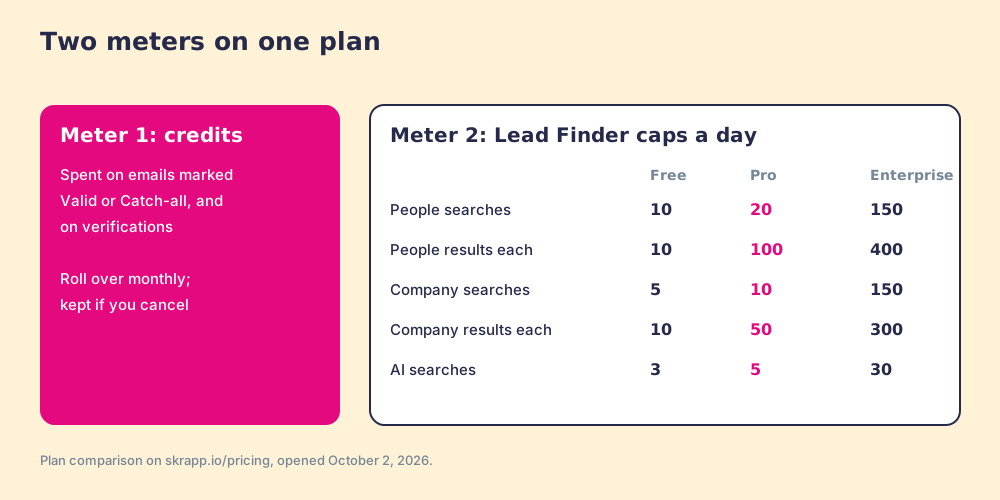
For a rep who builds lists from LinkedIn and Sales Navigator, the caps rarely matter; those lists come from LinkedIn and spend only credits. For a team that wants Skrapp’s own database to be the list source, Professional’s 20 searches a day at up to 100 results each is the ceiling, and it is a reason to price Enterprise even before the ninth seat.
Should you pay Skrapp monthly or yearly?
Yearly billing saves 25% on every size:
| Plan | 12 x monthly | Yearly | You save |
|---|---|---|---|
| Professional 2K | $468 | $348 | $120 |
| Professional 5K | $1,188 | $888 | $300 |
| Professional 10K | $1,548 | $1,164 | $384 |
| Professional 25K | $2,388 | $1,788 | $600 |
| Enterprise 50K | $4,188 | $3,144 | $1,044 |
Our arithmetic from the page’s prices. With credits that roll over and stay after cancellation, prepaying risks little: the usual danger of a yearly plan, credits you paid for and lost, does not apply. Skrapp’s FAQ adds that “We do not offer refunds for partial months” and that upgrades and downgrades are prorated. Start monthly only if you have not yet counted the reps who will use it.
What does Skrapp cost once you add phones?
Skrapp’s own comparison page answers the phone question: “Skrapp.io focuses on verified business emails. If your outreach relies on calling, Cognism might be a better fit” (skrapp.io, Cognism comparison). The Bridge Group’s 2025 SDR report, 351 companies, puts the median SDR at 112 activities a day, 44 of them phone and 41 email (Bridge Group, 2025). For a team that dials, Skrapp covers the smaller half of the day.
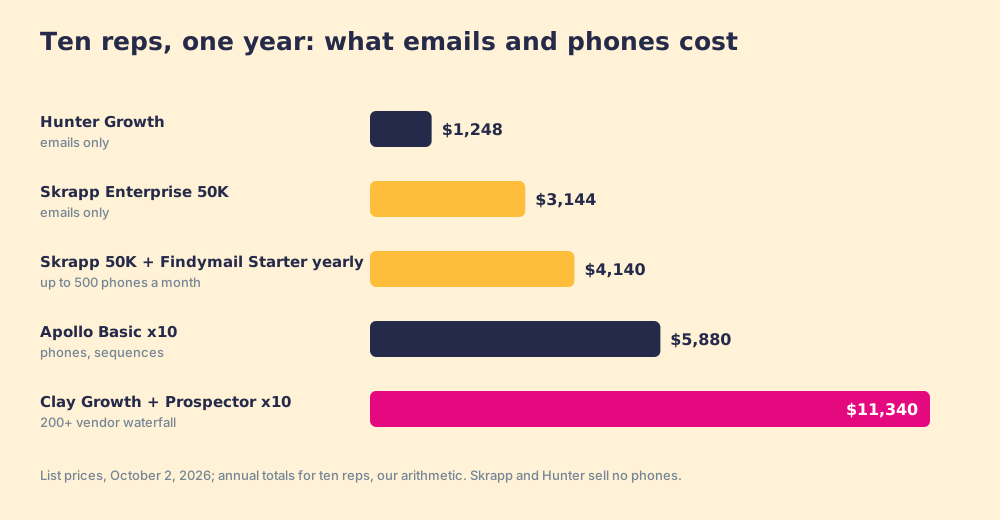
So the fair comparison for a dialing team is Skrapp plus a phone source. Ten reps, one year, list price on October 2, 2026:
- Skrapp Enterprise 50K alone. $3,144, emails only.
- Skrapp Enterprise 50K plus Findymail Starter yearly. $4,140. Findymail’s 5,000 credits buy 500 phones a month at 10 credits each, for non-EU contacts, and Clay’s test had it finding 45.84% of North American mobiles.
- Apollo Basic, ten seats. $5,880 at $49 a seat a month billed annually, a phone at 8 credits, with sequences.
- Clay Growth plus Supered Prospector. $11,340: Clay Growth at $5,940 and Prospector at $540 a rep.
- Hunter Growth, for comparison. $1,248 for unlimited users, emails only.
Why trust this breakdown?
We sell no contact data. Prospector runs on Clay, the only data provider we use, and we have no stake in which single database you buy. I founded RevPartners, a HubSpot partner that did only sales implementations, sold roughly twice as much Sales Hub as any other partner, and reached Elite tier in 13 months. Supered grew out of that work and holds 4.9 out of 5 from 81 reviews on G2 and 5.0 from 122 on the HubSpot App Marketplace (checked October 1, 2026). Skrapp holds 4.5 from 356 reviews on G2 and 4.8 from 549 ratings with 200,000 users on the Chrome Web Store (October 2, 2026). A news search on October 2, 2026 found no acquisition, funding round or rebrand for Skrapp.
Which Skrapp plan, or which alternative, fits your team?
The grades use the five weights on the Skrapp alternatives page: coverage (x3), rep-side delivery (x2), price structure (x2), what the leader sees (x2), bundled outreach (x1), out of 50, for a team of ten to fifty reps who email and dial. For two reps who only email, Skrapp’s $348 a year wins.
| Rank | Option | Grade | Best fit | CRM integration | Setup effort | Pricing (plan with the feature) | Reason to choose |
|---|---|---|---|---|---|---|---|
| 1 | Supered Prospector | A (44) | Teams already paying for Clay | Native: HubSpot, Salesforce, Pipedrive | Live in under a week on your Clay account | $45 a rep a month, billed annually, plus your Clay plan | Emails and phones from Clay’s waterfall, from the rep’s screen |
| 2 | Apollo | A- (36) | Data, phones and sequences in one seat | Native: HubSpot, Salesforce | A day | $49 a seat a month, annual | Phones and a sequencer in the plan |
| 3 | Findymail | B+ (29) | A finder that adds phones | Native: HubSpot, Salesforce, Pipedrive, Clay | Minutes | $99 a month, $83 yearly, for the team | Phones at 10 credits, pay only for verified |
| 4 | Hunter | B+ (28) | Email-only teams past eight reps | Native: HubSpot, Salesforce, Pipedrive, Zoho | Minutes | Growth $1,248 a year, unlimited users | No seat ladder |
| 5 | Skrapp | B- (23) | Up to eight reps who only email | List sync on Professional | Minutes | $348 to $1,788 a year for 2 to 8 users | The reference: cheap, rollover, keep-on-cancel |
Skrapp’s 23 is coverage 2 (no phones), rep-side delivery 4 (LinkedIn, Sales Navigator, Recruiter and company websites), price structure 3, what the leader sees 1, outreach 1. Prospector’s coverage score is Clay’s waterfall, credited to Clay, and its outreach score is the lowest on the card by design.
Where does Supered Prospector fit?
Back to the family plan. A family plan covers your household on one carrier’s network, and where that carrier has no signal, the whole family loses it. Skrapp’s network has no phone numbers at all. Clay is the roaming agreement: “One contract to buy data from 200+ data and AI vendors” (clay.com), and when one network has nothing, the waterfall hops to the next. Clay charges nothing for the hop that finds no signal: “If an enrichment returns no result, you’re not charged Data Credits or Actions” (clay.com/pricing). Skrapp is not one of the networks; Clay’s directory has no Skrapp page on October 2, 2026.
Prospector does not bring its own database. It brings Clay’s waterfall, which is every database, routed, to the rep’s screen. Clay plus Supered is the best way for a sales team to prospect: GTM engineers build in Clay, reps never open Clay. Prospector runs inside the Supered Chrome extension, on your own Clay account.
- The rep’s button. On a LinkedIn profile, a company website or the HubSpot, Salesforce or Pipedrive record, the rep picks a flow from a Push menu and the table runs. Sales Navigator leads go onto a prospect list that pushes to a Clay table.
- The owner check. Before a push, the rep sees the matching CRM record, its owner, and whether the person was already prospected, so no two reps work the same lead.
- The leader’s view. Found, Worked, Closed: which lists reps found, who is working theirs, and how each lead ended the way your process says, Qualified, Recycled or Disqualified.
On LinkedIn, Prospector works within LinkedIn’s terms and does not copy search results in bulk; the contact data comes from Clay’s waterfall on the customer’s Clay account. At $45 per rep per month billed annually (Prospector), ten reps cost $5,400 on a Clay account you already pay for. Against Skrapp plus a phone source at $4,140, the difference buys every provider in Clay’s waterfall behind each lookup, phones included, and a list the leader can follow to closed.
Choose something else if you do not have Clay; Prospector runs on the customer’s Clay account and does nothing without one. Choose Skrapp itself if your team is eight reps or fewer and only sends email, because $1,164 a year for eight users is a fair price for that job.
What we recommend
- A small team that only emails. Buy Skrapp by headcount, yearly: 2K for two reps, 5K for five, 10K for eight. Skip 25K unless you need the credits.
- A team about to hire its ninth rep. Price Hunter before Enterprise 50K. Unlimited users on a shared pool beats a $1,980 jump for one login.
- A team that dials. Add a phone source or move to one that has phones; Findymail is the closest swap.
- A team on Clay. Retire the single network and give reps the roaming agreement from the page they already work on, with Supered Prospector. The sourcing use case shows the rep’s side.
The plan card shows credits, and the bill follows the chairs. Count the chairs, count the phones you need, then pick. The email finder tools guide sorts the rest of the category by job.
Frequently asked questions
How much does Skrapp cost in 2026?+
How do Skrapp credits work?+
How many users does each Skrapp plan include?+
Does Skrapp sell phone numbers?+
Is Skrapp's yearly plan worth it?+
Is there a cheaper way to get emails and phones if my team already has Clay?+
Everything we have written on Skrapp
More on Skrapp
Looking past Skrapp? See Supered Prospector on your own Clay accountYour Clay waterfall, where reps already work.