SOP Software: The Tools Worth Buying, Sorted by the Job
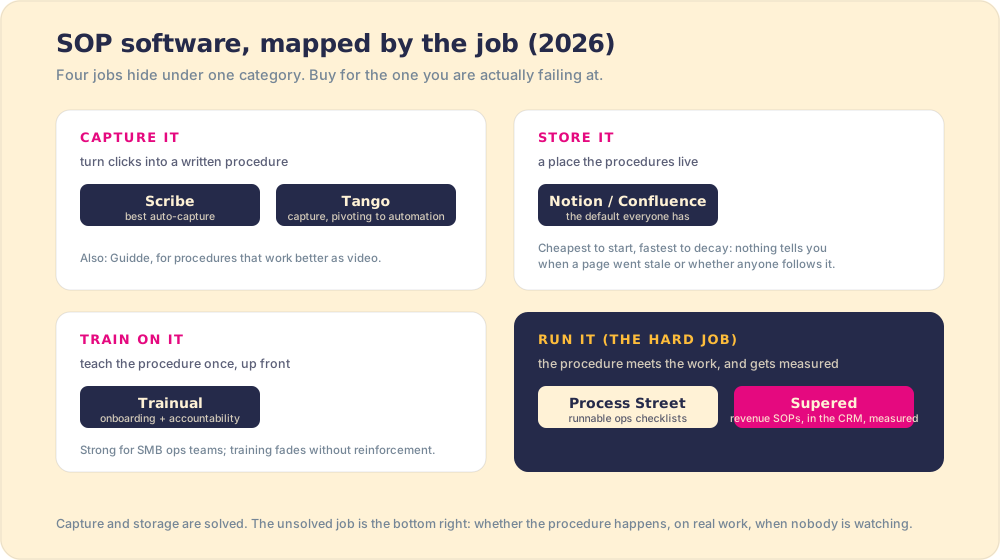
Most SOP software lists rank capture tools. Capture is the solved job. This is the field sorted by what you are failing at: writing procedures, storing them, training on them, or getting them followed.
SOP software is the category of tools for creating, storing, and operationalizing standard operating procedures, and the right pick depends on which job you are failing at: capturing procedures, storing them, training people on them, or getting them followed in real work.
A standard operating procedure is a promise the company makes to itself: the next time this task happens, it will happen this way. SOP software is the industry that grew up around keeping that promise, and somewhere along the way it split into four different products that all share one shelf label. Some tools write the procedure for you. Some store it. Some teach it. (The same job split shapes the wider field, which is why it pays to see how the knowledge base tools compare by job before you buy.) A few, the rare ones, concern themselves with whether it happens.
Here is the case this page makes: the first three jobs are largely solved, the prices prove it, and almost every “best SOP software” list you will find ranks tools by how well they do the solved jobs. The lists are mostly written by the capture vendors themselves (Scribe, Tango, and Process Street each publish one, with their own product at the top, which is fair enough but worth knowing). For the capture leader in particular, our Scribe alternatives sorted by job do the ranking those vendor lists skip. What none of them rank is the job that decides whether your SOP program works: does the procedure get followed when nobody is watching? That is the job this list is sorted around. (The category also answers to standard operating procedure software; same shelf, same four jobs.)
Why does the followed procedure matter more than the written one?
Medicine ran this experiment for us, with stakes that make a missed CRM field look quaint. In 2006, Peter Pronovost and his colleagues published the Keystone ICU study in the New England Journal of Medicine: 103 intensive care units in Michigan adopted a five-step checklist for placing central lines. The steps were not new knowledge. Wash hands, full barrier precautions, chlorhexidine, avoid the femoral site, remove unnecessary lines: any ICU physician could recite them. What changed was that the checklist entered the workflow, with a nurse empowered to stop the procedure if a step was skipped. Median bloodstream infections fell from 2.7 per 1,000 catheter-days to zero within three months, and the infection rate was down 66 percent at 18 months (Pronovost et al., NEJM 2006).
Read that again with SOP software in mind. The knowledge already existed. The document already existed. Outcomes moved when the procedure reached the moment of the work and someone could see whether it was followed. Atul Gawande built The Checklist Manifesto on this insight, and the WHO surgical checklist he helped design showed the same shape: when it entered the operating room itself, complications fell from 11 percent to 7 percent across eight hospitals (Haynes et al., NEJM 2009).
Sales is not surgery, but the mechanics of the failure are identical, and we have the field data. In our survey of 198 sales leaders for The State of Sales Enablement, 89 percent had a defined, documented process. Thirty-six percent saw it followed as designed. The documents were fine. The delivery was the gap.
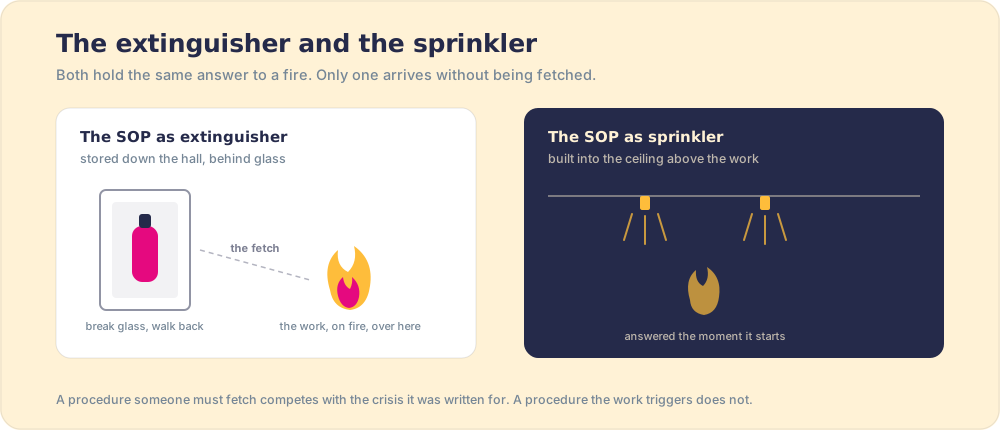
That picture is the buying criterion hiding under this whole category. An SOP stored in a wiki is a fire extinguisher behind glass: present, correct, and useless unless someone under pressure remembers to stop, walk down the hall, and fetch it. An SOP that surfaces inside the task, at the step where it applies, is a sprinkler system. Nobody fetches a sprinkler. The fire finds it. (The picture has its limit, and it is worth marking: a sprinkler cannot tell you anything afterward, and the best SOP tooling can. The measurement is where the analogy stops and the software starts earning its price.)
The tools, by the job you are failing at
An honest list, sorted by job, with the current corporate facts on each vendor as of June 2026. Seven entries, because seven earn a place.
- Scribe, for capture. The strongest pure capture tool in the field. You perform the task once; Scribe’s extension watches the clicks and writes the step-by-step guide, screenshots included. The market agrees: a $75M Series C at a $1.3 billion valuation in November 2025, with over 5 million users and a claimed 10 million workflows documented (TechCrunch, Nov 2025). If your bottleneck is writing procedures, buy Scribe and stop reading vendor lists. Its limit is the one this page exists to name: the output is still a document that lives in Scribe, waiting to be visited.
- Tango, for capture with a caveat. Tango’s capture experience is genuinely slick, and its in-page guidance moved closer to the work than a static doc. The caveat is strategic: in April 2025 Tango (now at tango.ai) launched AI browser automation it calls Hybrid Automation, repositioning from documenting workflows to executing them. With roughly 69 employees and $23.7M raised, a company that size follows its pivot. If you buy Tango for documentation today, you are buying yesterday’s roadmap, which may be fine, and you should do it knowingly. The full job-by-job read, scored, is in Tango alternatives.
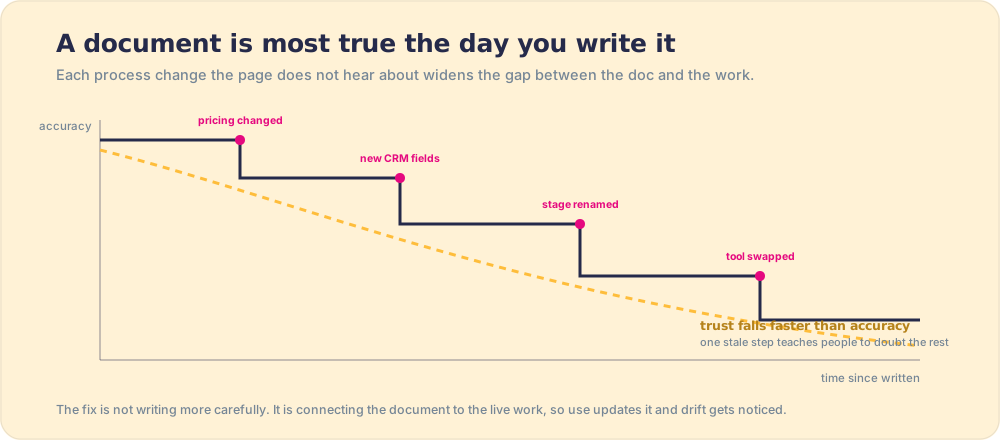
- Notion or Confluence, for storage you already own. The default answer, and for a five-person team an honest one: your SOPs have to live somewhere, and the wiki you already pay for is somewhere. The cost shows up later, and the decay curve below is its picture. A wiki gives you no signal: no flag when a page goes stale, no record of whether anyone followed it, no connection to the work itself. The page is most true the day it is written, and every process change it does not hear about widens the gap.
- Trainual, for training-first rollouts. Trainual treats SOPs as a curriculum: write the procedure, assign it, test on it, track completion. For SMB operations teams, franchises, and anyone whose real problem is onboarding, it is the right shape. Its boundary is the one the behavioral research draws: training is an input, and inputs fade. Knowing the procedure on day 10 says little about running it on day 100 unless something in the work keeps it present.
- Guidde, for procedures that want to be video. Some procedures read better as a 90-second annotated video than twelve screenshots. Guidde generates those quickly. A complement to a written system, not a replacement for one; video is even harder to keep current than text.
- Process Street, for SOPs that run in operations. The most interesting incumbent on this list, because it crossed the line the others stop at: a Process Street SOP is not a page, it is a runnable checklist instance with assignees, conditional logic, and a record of what was checked and when. For recurring operational processes (client onboarding, employee offboarding, audits), this is the strongest answer in the field. Its blind spot is the revenue team: the work it runs lives in Process Street, which means a salesperson must go to the checklist rather than the checklist coming to the deal.
- Supered, for revenue SOPs that run where reps work. One entry on this list is ours, so weigh it knowing that. Supered takes the position this whole page argues: for sales and RevOps teams, the SOP only matters if it reaches the rep in the moment of the work, inside HubSpot, Salesforce, Gong, Gmail, wherever the deal is being worked, and if adherence is measured in the flow of work so drift gets coached the week it starts. It is the Behavior Layer rather than a documentation library, which also means it is the wrong pick for general company SOPs (use Scribe or Process Street for those) and the right one when the procedures that pay your bills are the ones your sales team runs. The mechanics are at how it works.
How should you choose SOP software?
Run the decision in this order, and notice it is a sequence, not a scorecard:
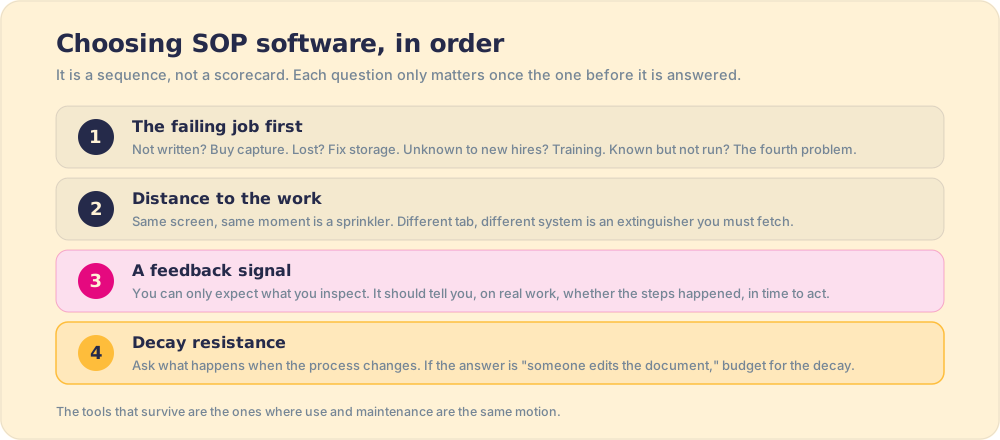
- The failing job first. If procedures are not getting written, buy capture (Scribe). If they exist and nobody can find them, fix storage and ownership before buying anything. If new people do not know them, training (Trainual). If people know them and do not run them, you have the fourth problem, and no capture tool will touch it.
- Distance to the work. Ask where the procedure appears relative to where the task happens. Same screen, same moment: sprinkler. Different tab, different system: extinguisher. The Pronovost result was a delivery result, and yours will be too.
- A feedback signal. A procedure you cannot inspect is a procedure you are hoping about. You can only expect what you inspect, so whatever you buy should tell you, on real work, whether the steps happened, while there is still time to do something about it.
- Decay resistance. Ask the vendor what happens when your process changes. If the honest answer is “someone edits the document,” budget for the decay curve above. The tools that survive are the ones where use and maintenance are the same motion.
What about AI writing the SOPs?
It already does: AI is the headline feature of most SOP creation software now, and Scribe’s version of it is good. This solves the writing problem so thoroughly that it sharpens the real one. When any procedure can be generated in minutes, the differentiator cannot be having procedures. McKinsey’s Social Economy research found interaction workers already spend 19 percent of their time, roughly a day a week, searching for and gathering information (McKinsey Global Institute, 2012), and AI has only raised the volume of documents to search. Knowledge is solved. The procedure that gets followed, on real work, under time pressure, is the remaining scarce thing, and it is a delivery-and-measurement problem, not a writing problem. Sequence AI behind an adopted process and it compounds; in front of one, it generates beautifully formatted shelf-ware faster.
The verdict
- Scribe itself. The pick when the bottleneck is creating documentation, full stop. The sharpest capture on the market, priced and funded like the category winner it is.
- Process Street itself. The pick for recurring operational processes that should run as accountable checklists, outside the CRM.
- Trainual itself. The pick when the underlying problem is onboarding and baseline training in an SMB.
- Supered itself. The pick when the procedures that matter are your sales process, and the test you care about is whether reps run it in the flow of work in the CRM, measured, with drift coached the week it appears.
- The wiki you have. The pick only when the team is small enough that the author, the maintainer, and the follower are the same three people. Past that, the decay curve is not an if.
We would tell a revenue team to skip the capture-tool beauty contest entirely: their procedures are already short, the problem was never writing them, and the dollars should go to the delivery and measurement side where the execution gap lives. How to write the procedure itself is its own craft, covered in how to write an SOP, and the wider category sits in the process documentation guide. If the SOPs you care about are sales process, start with where your sales process should live, because the location decides the outcome before the writing quality gets a vote.
Frequently asked questions
What is SOP software?+
What is the best SOP software?+
What is the difference between SOP software and a knowledge base?+
Why do SOPs fail even with good software?+
How much does SOP software cost?+
Your process, running itself.