Notion Alternatives, Picked by the Job Your Team Needs Done
Notion is healthy and well loved.
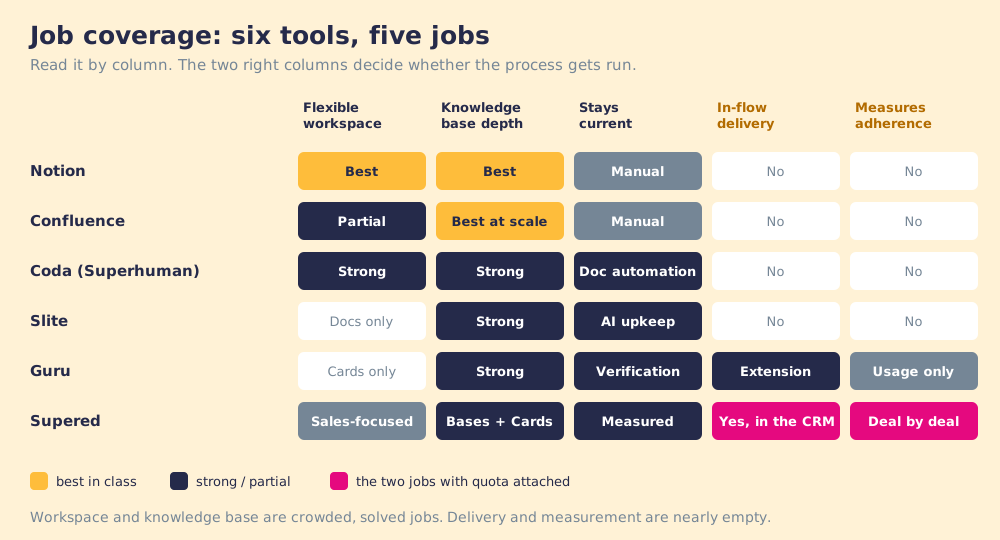
Teams shopping for alternatives are usually solving one of six jobs, and only one of them is a sales process that has to reach reps inside the CRM. The pick for each job follows, with prices checked October 1, 2026.
Notion alternatives are the tools teams weigh against Notion's all-purpose workspace, and the right one depends on the job: a governed wiki, documents that behave like apps, pages that stay current, or a sales process reps follow inside the CRM.
Notion alternatives are the tools teams weigh against Notion’s all-purpose workspace, and the right one depends on the job: a governed wiki, documents that behave like apps, pages that stay current, or a sales process reps follow inside the CRM. The short answer, by who it fits:
- Supered. Revenue teams on HubSpot or Salesforce whose sales process lives in Notion pages reps never open mid-deal. From $13.50 per user per month paid yearly.
- Confluence. Companies already on Jira that want a governed wiki at scale. Free up to 10 users, Standard $5.42 per user per month.
- Superhuman Docs (formerly Coda). Teams that want documents to behave like small apps, with tables, buttons, and automations.
And if the job is a flexible workspace for the whole company, stay on Notion. Nothing on this list does that job better.
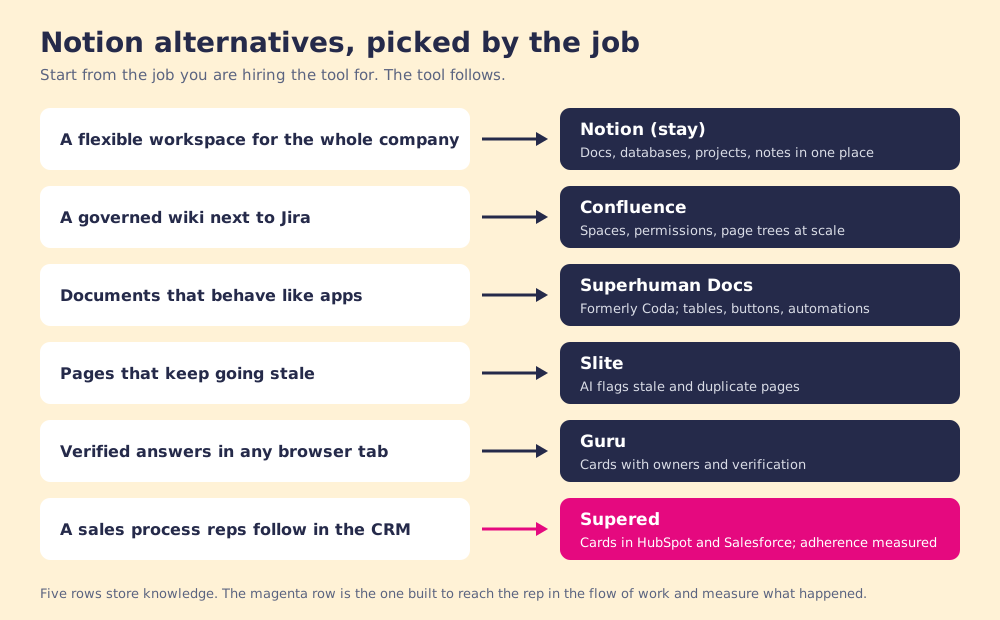
How do the Notion alternatives compare at a glance?
Prices are the plan that covers the job, opened on each vendor’s pricing page on October 1, 2026. Grades come from the two-lens scoring further down: the revenue-team lens decides the rank, and the company-wide grade sits beside it so you can see where each tool wins its own lane.
| Rank | Tool | Grade (revenue team / company-wide) | Best fit | CRM integration | Setup effort | Price (plan with the feature) | Reason to switch |
|---|---|---|---|---|---|---|---|
| 1 | Supered | A- / B- | Sales process and playbooks for HubSpot or Salesforce teams | Native in HubSpot and Salesforce; Sidekick extension in Gmail, LinkedIn, Gong, any URL | Admin builds Bases and rules; free trial, no card | Digital Adoption $13.50/user/mo paid yearly; Process Compliance $40/user/mo paid yearly, 5-user minimum | The process reaches reps inside the CRM, and adherence is measured by rep and rule |
| 2 | Guru | B- / C+ | Verified answers across departments | Browser extension over any web app | Sales-led package with solution engineering | Quote only; pricing page lists no prices | Cards carry an owner and a verification date |
| 3 | Notion | C / B+ | Flexible workspace for the whole company | API; no native CRM surface | Self-serve, minutes | Plus $10, Business $20 per member/mo billed yearly | Stay if the job is the company workspace |
| 4 | Superhuman Docs | C / B | Documents that behave like apps | API and Packs | Self-serve; G2 reviewers cite a steep learning curve | Billed per Doc Maker on Superhuman’s plans page | Automations inside the document |
| 5 | Confluence | C / B- | Governed wiki at Atlassian scale | Marketplace apps and API | Self-serve; space design takes planning | Free to 10 users; Standard $5.42, Premium $10.44 per user/mo | Permissions and Jira links that hold at thousands of users |
| 5 | Slite | C / C+ | Small teams fighting stale pages | Slack and app integrations; no CRM surface | Self-serve | Basic $10, Pro $20 per member/mo billed yearly | AI flags stale and duplicate pages |
Why trust this comparison?
I started RevPartners, a HubSpot partner that did only sales implementations and reached Elite tier in 13 months, and Supered grew out of that work. I have watched a lot of sales playbooks get written in Notion and then sit unopened while the deals ran in HubSpot. The disclosure follows from that: we make Supered, and it ranks first on the revenue-team lens. Supered holds 5.0 out of 5 from 122 reviews on the HubSpot App Marketplace and 4.9 out of 5 from 81 reviews on G2 (both checked October 1, 2026). The scoring below shows both lenses, and on the company-wide lens Notion wins and we finish fourth.
Why do teams look for a Notion alternative?
Start with a fair word about Notion, because a list that opens by knocking the leader is a sales pitch. Notion is rated 4.6 out of 5 from 13,862 reviews on G2 (October 1, 2026). It ran a $270 million employee tender offer at an $11 billion valuation in January 2026 and passed $500 million in annual revenue in September 2025. The one retreat this year was Notion Mail, which shuts down on September 22, 2026; Notion’s stated reason was that more than half its users managed email without ever opening the inbox (AI Weekly, June 25, 2026). The workspace itself is in good health.
Teams weighing alternatives to Notion are leaving a healthy product, so the reasons matter more than the logo. G2’s review summary for Notion names the complaints that recur, and they sort into four reasons:
- Learning curve. G2 tags 1,895 reviews for a steep learning curve and 941 for navigation that gets harder as the workspace grows. The flexibility that makes Notion pleasant to build in makes it hard to find things in.
- Depth. 1,027 reviews call the features limited for their use, usually a team that needs governed permissions (Confluence’s lane) or real automation (Superhuman Docs’ lane).
- Speed at scale. Reviewers report slower search and page loads on large workspaces, which is a cost paid every time someone goes looking.
- No line of sight to behavior. This one comes from operators we work with, and G2 does not tag it. The sales process is documented in Notion, and the operating question has no answer: is anyone following it? Page views say a doc was opened and stop there.
The first three have wiki-shaped answers, and the market has built good ones. The fourth is a different job, and the clearest way to see why is a factory.
A factory can have a superb reference library across the courtyard, indexed and climate controlled. It can also have a laminated checklist bolted to the side of the press, at eye level, where the operator’s hands already are. The library holds more knowledge by any measure. The checklist is the one that prevents the injury, because it arrives in the moment the hands are on the machine. Notion, and every wiki on this page, is the library. A revenue team outgrowing Notion is usually discovering it needed the checklist.
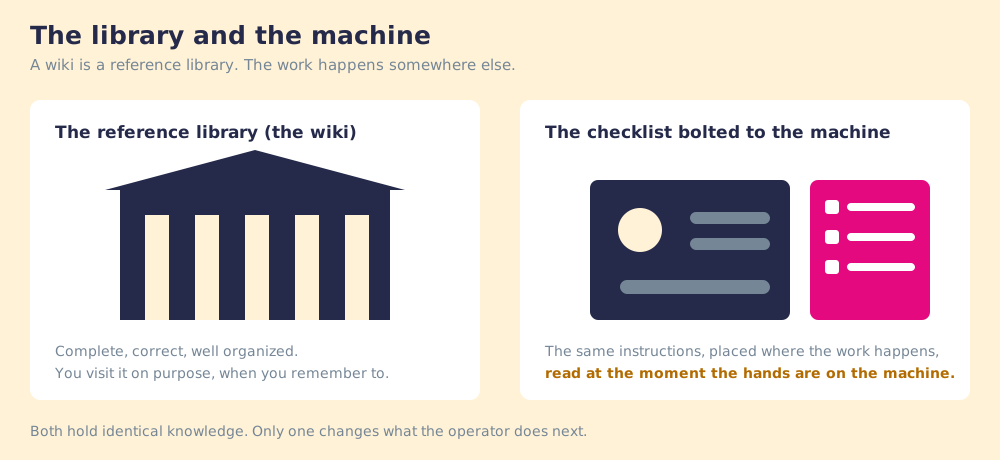
What job does every wiki leave open?
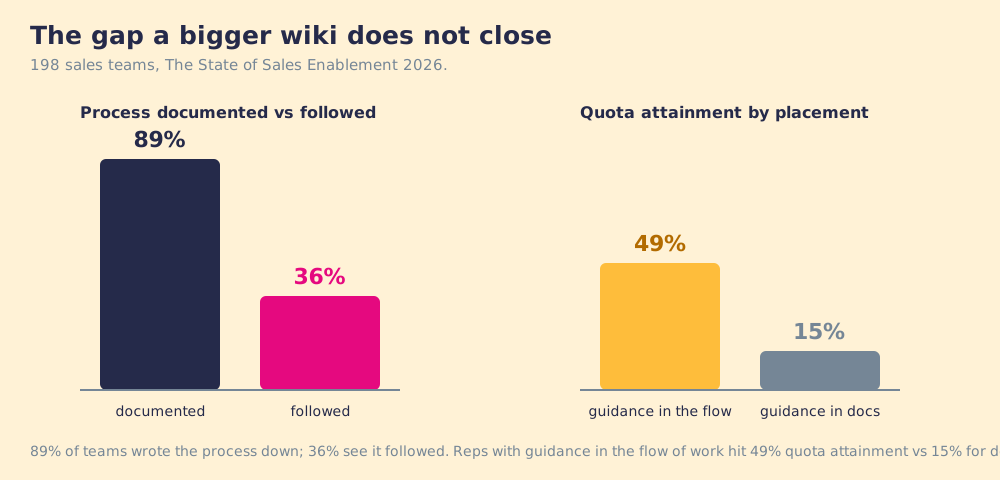
Across 198 sales teams in The State of Sales Enablement, 89 percent had a defined, documented sales process and 36 percent saw it followed as designed. The documentation job was done. The behavior job stayed open no matter how good the wiki was, because no wiki was wired to see it.
The mechanism has been on the record for a long time. Hermann Ebbinghaus charted the forgetting curve in 1885, and a 2015 replication found that relearning a list six days later saved only 17 percent of the original effort (Murre and Dros, PLOS ONE, 2015). A rep who read the discovery checklist in onboarding is not carrying it into month four from memory. Retrieval has a price too: McKinsey Global Institute found knowledge workers spend about 19 percent of the week searching for and gathering information. When the answer costs a tab switch, a search, and a scan through page sprawl, a rep with a buyer waiting makes a sensible call and guesses.
The miss belongs to the system, and the fix belongs there too. The same survey puts a number on placement: teams whose process guidance was embedded in the workflow hit quota at 49 percent, against 15 percent when guidance lived in docs or wikis. Storage got solved, thoroughly, by Notion and its rivals. Placement, and the measurement of what happened after, is the open job.
Which Notion alternative fits a revenue team?
Supered, when the team runs on HubSpot or Salesforce. A wiki is a thermometer for process: it records the standard the way a thermometer records the room. Hang the finest thermometer in a cold house and the house stays cold. What a cold house needs is a thermostat, an instrument wired to act on its own reading, one that notices the gap between the room and the setting and closes it.
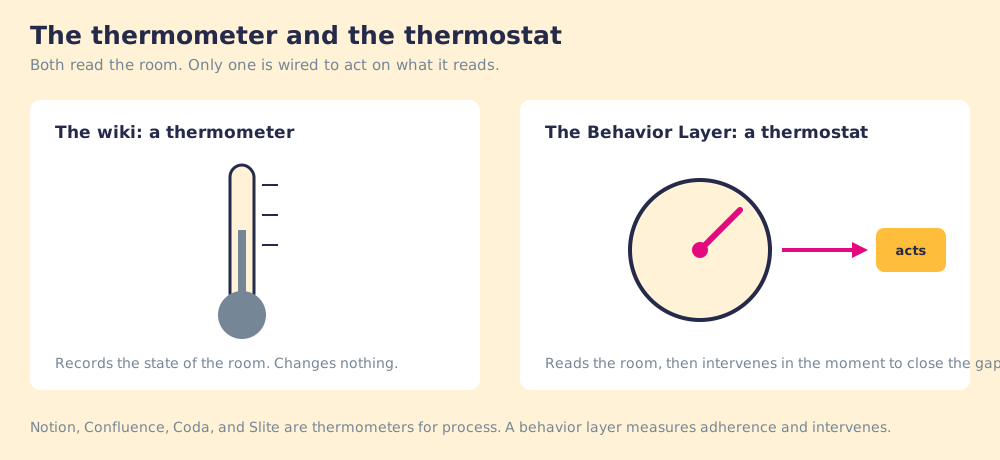
Supered is that thermostat for a sales process, and it starts with a full knowledge base:
- Bases, Cards, and Guides. The playbook moves out of Notion into Bases. A Card is an article with instructions, links, and embedded media; a Guide is a screen-recorded, step-by-step walkthrough. This covers the slice of Notion a revenue team uses.
- Page Triggers and the Sidekick extension. A Page Trigger watches the page a rep is working in and surfaces the right Card when its context appears: a deal stage in HubSpot, an opportunity in Salesforce, a thread in Gmail, a profile on LinkedIn, a call in Gong. No tab to switch and no search to run.
- Process Rules and Process Boards. On the Process Compliance plan, each expectation becomes a rule that reads the CRM: no amount past Discovery, a close date in the past, no recap sent after the meeting. The Process Board shows compliance by rep, by stage, and by rule, so a manager coaches the gap the week it opens instead of auditing deals by hand (how Supered works).
- The same rules in Claude. The rules live in Supered, and Claude or another assistant connected over MCP reads them and does the cleanup, as our sales expectations page shows with a real board going to zero.
Pricing is published on the Supered pricing page: Digital Adoption, the knowledge-in-flow plan, is $13.50 per user per month paid yearly ($15 paid monthly). Process Compliance adds the rules and boards for $40 per user per month paid yearly ($45 monthly), with a 5-user minimum. Both are 12-month commitments, and a free trial needs no card.
Choose something else if:
- Company-wide wiki. Engineering specs, marketing calendars, and meeting notes do not belong in Supered. Keep Notion or Confluence for them.
- No HubSpot or Salesforce. Process Rules and Process Boards read those two CRMs. A team elsewhere gets Cards and Guides through the extension but not the rule engine.
- Field or phone-first teams. Supered fits teams of 10 or more who work at a computer. There is no mobile app.
- Personal notes. A solo note-taking setup is a different product category from everything on this page.
What are the other Notion alternatives worth considering?
These Notion competitors each win a lane, and each is the right call for a team whose job is that lane. Corporate status was checked on October 1, 2026, because an alternatives page that misses a rename is wrong on arrival.
- Confluence. Atlassian’s wiki stays the default wherever Jira runs, with page trees, permissions, and governance that hold up at thousands of users. It is rated 4.1 out of 5 from 4,369 G2 reviews (October 1, 2026), where the top complaint is search surfacing outdated drafts and duplicate pages first. Atlassian is independent and public; it completed its $1 billion purchase of DX in January 2026 and bought The Browser Company in September 2025 (Wikipedia). Free up to 10 users, Standard $5.42 and Premium $10.44 per user per month (Atlassian pricing).
- Superhuman Docs, formerly Coda. Grammarly bought Coda in December 2024, the parent renamed itself Superhuman in October 2025, and on July 8, 2026 Coda became Superhuman Docs. The product is the same: documents with tables, buttons, and automations, billed per Doc Maker, and Superhuman says existing pricing did not change with the rename. It holds 4.6 out of 5 from 493 G2 reviews (October 1, 2026), with a steep learning curve as the recurring complaint. The tradeoff: the roadmap now serves an AI productivity suite.
- Slite. Slite has staked its product on the upkeep problem, with AI that flags stale and duplicate pages. Rated 4.6 out of 5 from 275 G2 reviews (October 1, 2026). Basic is $10 and Pro $20 per member per month billed yearly (Slite pricing). If decay is your complaint, Slite is aimed straight at it; the fresh page still waits to be visited.
- Guru. The closest of the wikis to the delivery job: a browser extension surfaces Cards beside the work, and verification puts a named owner and a freshness date on each one. It holds 4.7 out of 5 from 2,323 G2 reviews (October 1, 2026) and announced a Boomi partnership in May 2026. As of October 1, 2026 its pricing page lists no prices and routes buyers to sales. Guru verifies the knowledge and counts usage; whether the process on the Card was then followed, it does not see. The longer version is in our Guru alternatives breakdown.
- Notion itself. Plus is $10 and Business $20 per member per month billed yearly (Notion pricing), with Notion Agent and enterprise search on Business. For a flexible company workspace at that price, it remains the pick.
For a 20-person team, the published prices work out like this. Confluence lists its rate without a billing term on the page, so we used it as listed.
| Option | Basis | Annual cost, 20 users |
|---|---|---|
| Confluence Standard | 20 x $5.42 x 12 | $1,300.80 |
| Supered Digital Adoption | 20 x $13.50 x 12 | $3,240 |
| Notion Business | 20 x $20 x 12 | $4,800 |
| Slite Pro | 20 x $20 x 12 | $4,800 |
| Supered Process Compliance | 20 x $40 x 12 | $9,600 |
The common pattern uses two lines of that table together: Notion or Confluence for the company, and Supered for the revenue team’s slice.
How we graded the Notion alternatives
Five jobs, each tool scored 1 to 5 per job. The weights depend on who is buying, so we show two lenses and let you pick yours.
| Job | Revenue-team lens | Company-wide lens | What it rewards |
|---|---|---|---|
| Workspace | x1 | x3 | Docs, databases, projects, notes for anyone in the company |
| Knowledge base | x1 | x2 | Structure, permissions, search |
| Stays current | x1 | x1 | Verification, AI upkeep, ownership |
| Delivery in the flow of work | x2 | x1 | The answer reaches the person inside the tool they are working in |
| Adherence measured | x2 | x1 | Someone can see whether the documented process ran |
| Tool | Workspace | Knowledge base | Stays current | Delivery | Measured | Revenue lens (of 35) | Company lens (of 40) |
|---|---|---|---|---|---|---|---|
| Supered | 1 | 3 | 3 | 5 | 5 | 27 | 22 |
| Guru | 1 | 4 | 4 | 3 | 2 | 19 | 20 |
| Notion | 5 | 4 | 2 | 1 | 1 | 15 | 27 |
| Superhuman Docs | 4 | 4 | 3 | 1 | 1 | 15 | 25 |
| Confluence | 3 | 5 | 2 | 1 | 1 | 14 | 23 |
| Slite | 2 | 4 | 4 | 1 | 1 | 14 | 20 |
Grades are the share of the maximum: 75 percent or more is an A-, 65 to 74 a B+, 58 to 64 a B, 52 to 57 a B-, 45 to 51 a C+, and below 45 a C. On the revenue-team lens Supered scores 27 (A-), Guru 19 (B-), and the four wikis 14 to 15 (C). On the company-wide lens Notion leads at 27 (B+), Superhuman Docs follows at 25 (B), Confluence 23 (B-), Supered 22 (B-), Guru and Slite 20 (C+).
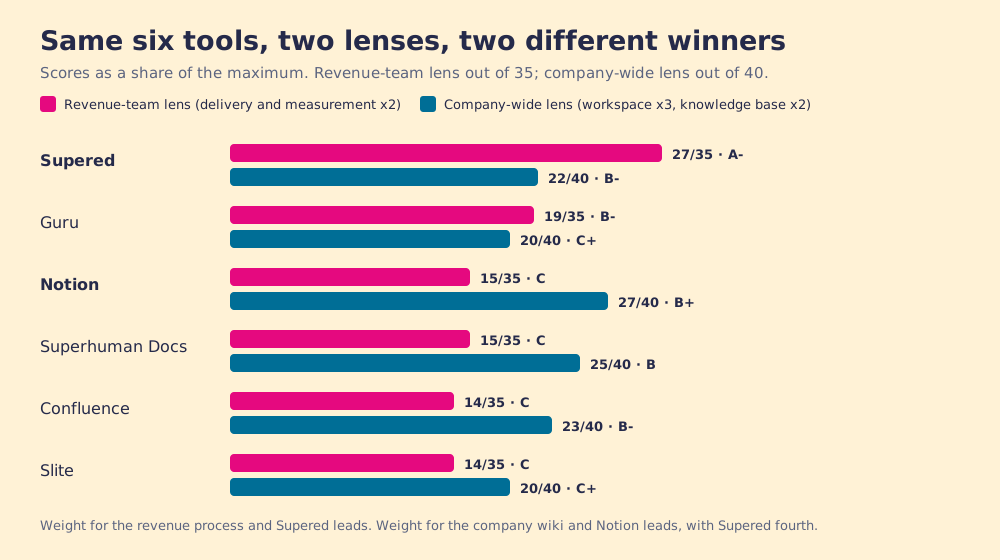
Two admissions keep the table straight. Supered’s 1 on workspace is earned: it is built for revenue process, and an engineering team’s design docs have no business in it. And our earlier version of this page claimed that flipping to even weights would put Notion first; run the math and it does not, which is why the company-wide lens now weights the workspace job the way a company-wide buyer would. What no weighting changes is how empty the delivery and measurement columns are outside two rows.
Can Supered replace Notion as a knowledge base?
For the revenue team’s slice, yes, and the slice has clean edges. The sales process, playbooks, objection library, onboarding walkthroughs, and how-we-run-this-motion pages move into Bases as Cards and Guides. They gain delivery inside the CRM and, on Process Compliance, adherence measured by rep and by rule. What a strong internal library looks like in the first place is in our internal knowledge base guide, and the architecture question is in the process documentation pillar.
For the rest of the company, no. Product specs, engineering docs, the marketing calendar, and meeting notes are general-workspace territory, and Notion or Confluence should keep them. The same split applies to operational procedures, covered in SOP software.
The verdict
- Notion, still. The pick for a flexible, affordable workspace for the whole company. It leads the company-wide lens, and an $11 billion valuation says the platform risk is low.
- Confluence. The pick for structured documentation at scale inside an Atlassian shop, where permissions outrank flexibility, from free to $5.42 a user.
- Superhuman Docs. The pick when documents need to behave like software and you are comfortable with a roadmap set by an AI productivity suite.
- Slite. The pick when decay is the wound and the team is small enough that a self-maintaining wiki covers it.
- Guru. The pick for verified answers across every department, when usage analytics are measurement enough and a sales-led contract is fine.
- Supered. The pick when the job is a sales process that gets run: the playbook in Bases, the right Card surfaced inside HubSpot or Salesforce while the rep works, and compliance by rep and by rule so coaching starts the week drift does.
Our recommendation follows the numbers already on the page. If 89 percent documented against 36 percent followed describes your team, the wiki was never the bottleneck, and a better wiki will not move it; the 49 against 15 percent quota gap tracks where guidance lives. Keep the general workspace for the company, move the revenue process to the tool built to deliver it and measure it, and see it inside your own CRM.
From here: the process side in sales process adoption, the closest wiki rival in Guru alternatives, the enablement view in Spekit alternatives, and the CRM-native setup on Supered for HubSpot and Supered for Salesforce.
Frequently asked questions
What is the best Notion alternative for a sales team?+
What does each Notion alternative cost in 2026?+
Is Notion still a good choice in 2026?+
What happened to Coda?+
Which Notion alternative works inside HubSpot or Salesforce?+
When should a team stay on Notion instead of switching?+
Your process, running itself.