Tango vs Scribe: Two Tools, One Category, and the Job They Both Leave Open
Tango and Scribe both capture workflows and turn them into guides. The tools diverged sharply in 2025: Tango pivoted to AI browser automation, Scribe doubled down on documentation. Here is a fair head-to-head, a verdict, and the harder job neither captures.
Tango vs Scribe compares two workflow documentation tools that diverged in 2025: Tango pivoted toward AI browser automation while Scribe doubled down on capture and reached 6 million users at a $1.3 billion valuation.
Two tools walk into a comparison. Both were built for the same job: sit behind a person doing a software task, watch every click, and turn the observation into a clean step-by-step guide without anyone having to write a word. For a few years they were the two obvious names in the same conversation. Then in April 2025, one of them changed its mind about what it wanted to be when it grew up.
Tango vs Scribe is now a genuinely interesting comparison because it is not a feature comparison anymore. It is a question about where each company has placed its bet, and whether the bet you want to back aligns with the problem you came in to solve.
Here is a fair accounting of both tools, what each does well with evidence, where they diverged, and the verdict that sorts them cleanly. There is also a harder question at the end: the job neither captures, which happens to be the one the business runs on, getting a team to follow the process the same way every time.
What do Tango and Scribe share?
Before the divergence, understand the shared foundation, because the overlap is real and it matters for the comparison. Both tools work through a browser extension that observes a user performing a task and generates an annotated, screenshot-based guide automatically. The process that used to take a technical writer an afternoon collapses to a few minutes of performed work. That is a genuine category win, and both tools deliver it.
The shared job is tacit knowledge capture, a concept the organizational learning scholar Ikujiro Nonaka named in his 1995 work with Hirotaka Takeuchi in The Knowledge-Creating Company. Tacit knowledge is the kind that lives in the expert’s hands and eyes, the way an experienced rep navigates a CRM, the specific click path a compliance officer runs before approving a contract. It resists codification because the person doing it has automated it past the level of conscious thought. Workflow capture tools like Tango and Scribe are, at bottom, tacit-to-explicit knowledge converters: they surface the pattern the expert stopped noticing so someone else can learn it. That is the real innovation, and both tools do it.
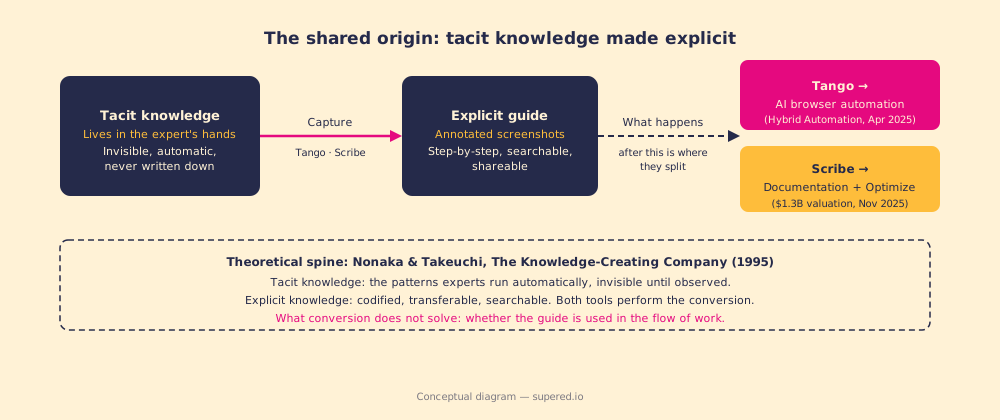
How did Tango and Scribe diverge after 2024?
The split is real, and a buyer in 2026 should understand it before choosing.
Tango’s direction. In April 2025, Tango relaunched at tango.ai and announced Hybrid Automation: an AI browser agent that performs roughly 90% of a workflow’s clicks autonomously, pausing only on consequential decisions that require human judgment. The company, backed by $23.7M from investors including HubSpot Ventures and Salesforce Ventures, had roughly 69 employees as of 2026, per Latka. Its public positioning moved from “we document your workflows” to “we run them.” The capture product did not disappear, but the roadmap signal is clear: Tango has placed its engineering bet on automation, not documentation. A company that size follows its bet.
Scribe’s direction. Scribe raised a $75M Series C at a $1.3 billion valuation in November 2025, led by StepStone, with Tiger Global and Redpoint participating, growing its user base to over 6 million by May 2026, per TechCrunch. It also launched Scribe Optimize, a workflow intelligence layer that analyzes activity patterns across teams to surface time waste and automation opportunities. Scribe went deeper into the documentation-and-intelligence job. At roughly $100M ARR across 80,000 customers and 94% of the Fortune 500 using the product (45% as paying customers, per Sacra), this is a company whose entire business model still depends on being the best documentation tool on the market.
The divergence matters because roadmaps are where your next two years of value come from, not the feature sheet as it stands today.
Which is better for pure documentation capture?
If documentation is the job, this comparison sorts reasonably cleanly.
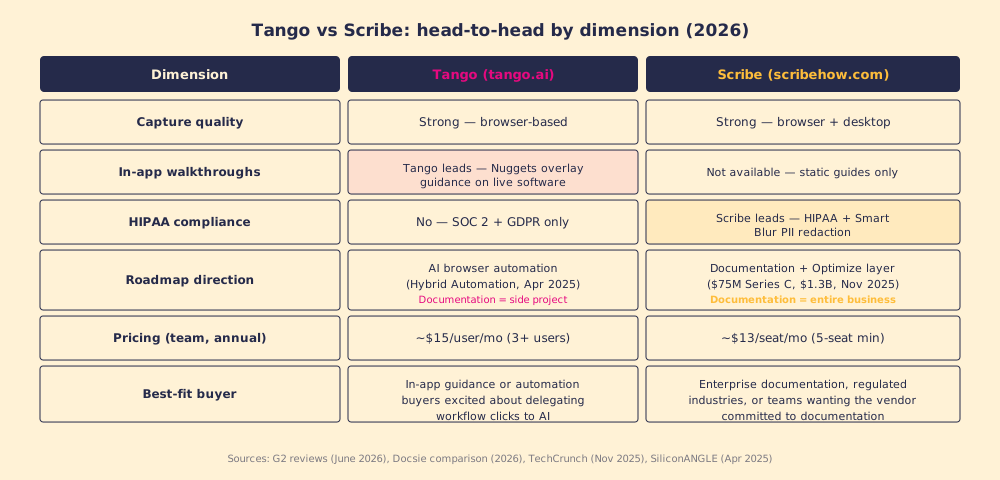
- Scribe on features and compliance. Scribe leads on HIPAA compliance, Smart Blur PII redaction, and approval workflows for documentation governance. For regulated industries, financial services, healthcare, pharma, this is not a minor difference. Tango is SOC 2 and GDPR compliant but not HIPAA, which closes a door for a meaningful portion of enterprise buyers.
- Tango on in-app walkthroughs. Tango’s Nuggets feature overlays guided walkthroughs directly on live software, stepping a user through a process in context rather than presenting a static guide to consult. For software onboarding and change management, this is the more invasive and often more effective format, because the guide is there when the person is doing the thing, not filed somewhere nearby.
- Capture quality. Both are strong. External comparisons in 2026, including Docsie, note that Scribe is more focused on centralized knowledge management and static SOPs while Tango started with an emphasis on real-time on-screen guidance. For raw screenshot-based step capture, neither has a clear technical advantage in 2026 that a free trial would not reveal.
- Pricing. Close at team scale: Scribe Pro Team at approximately $13 per seat per month on annual billing, Tango Pro at approximately $15 per user per month on annual billing. Neither is free at team scale, and enterprise pricing is custom on both sides.
Is Tango’s automation bet worth following?
This is the genuinely interesting question in the comparison, and it deserves a straight answer rather than a diplomatic hedge.
Hybrid Automation is a coherent product thesis. The same browser-level instrumentation that once recorded your clicks now executes them. If screen work is going to be automated, a tool that already understood your workflows is a sensible place to build that from. HubSpot Ventures and Salesforce Ventures backing the bet suggests investors who see a lot of workflow automation deals thought it was worth their capital.
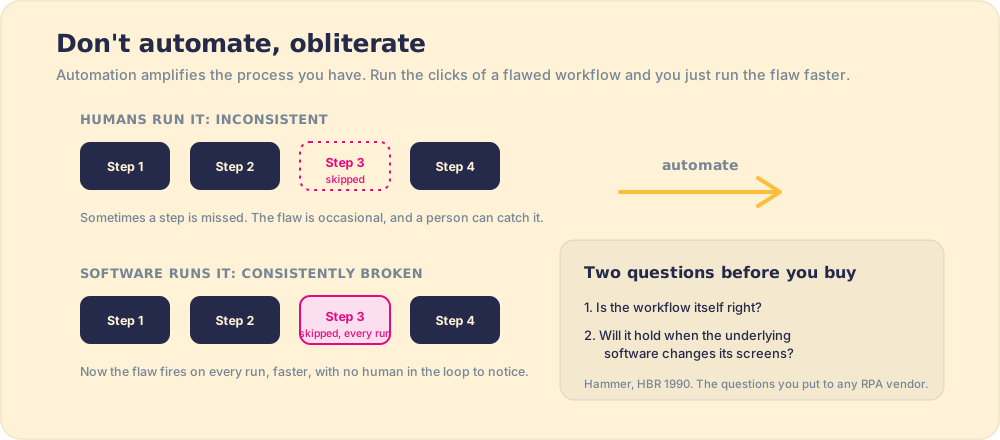
The honest caution is one the enterprise has learned before. In 1990, Michael Hammer published “Reengineering Work: Don’t Automate, Obliterate” in the Harvard Business Review, and his warning has aged well: automating a broken process does not fix the process, it entombs the flaw and runs it faster. Automation amplifies the process you have. A workflow that was inconsistent when humans ran it does not become consistent because software runs the clicks. So the automation question is two questions: is the workflow itself right, and if it is, will the automation hold when the underlying software changes its screens? Those are the questions you put to any RPA vendor, and Tango should answer them before a purchase.
If automation is what excites you, evaluate Tango as an automation bet, not a documentation one. The documentation it does alongside the automation is now the side project.
What do G2 users say about each?
Both tools have strong G2 profiles, and checking peer reviews is the right step before a software decision. Tango holds a 4.7 out of 5 on G2 across approximately 900 reviews (Tango on G2); Scribe holds a 4.8 out of 5 on G2 across approximately 450 reviews (Scribe on G2). The review bases reflect the different scale of the two companies, and individual ratings within a point of each other on a five-star scale are not a useful tiebreaker. Read the specific reviews for your use case: the automation features draw different commentary than the documentation features.
What do both Tango and Scribe leave open?
There is a job the documentation-capture category has never been built for, and understanding it is what keeps a buyer from solving the wrong problem.
Think of Ebbinghaus’s forgetting curve, which the German psychologist Hermann Ebbinghaus first charted in 1885. Without reinforcement, people forget approximately 70% of what they learn within 24 hours and roughly 90% within a week. A guide that a team consults once during training and then files away has done almost nothing to change what the team does when the real work is moving, say a services firm onboarding a big client, where the kickoff, requirements, and handoff steps have to run the same way on every account. The guide sits on a shelf. The shelf does not follow the team to the client.
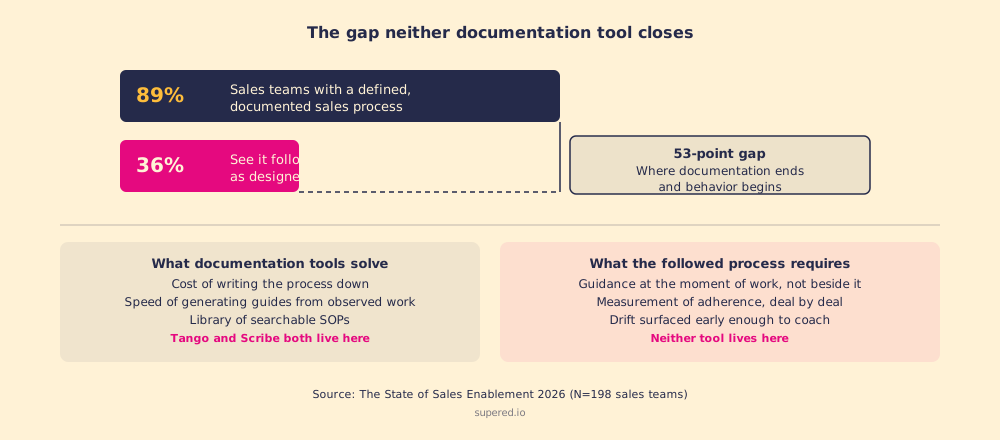
The documentation tools in this category, Tango and Scribe alike, solve the cost of writing process knowledge down. They do not solve whether the process is followed in the flow of work. Those are different jobs. The evidence is hard to wave away: across 198 teams in The State of Sales Enablement, 89% had a defined, documented process. 36% saw it followed as designed. The documentation was there. The following was not.
McKinsey’s research found that knowledge workers spend roughly 19% of the week searching for and gathering information (McKinsey Global Institute, 2012). A faster, better-organized library reduces that cost. It does not change what a team does while the work is in motion, because the library and the work are in different places.
The job that addresses the second number is different from documentation. It is process guidance delivered in the flow of work, inside the tools where the work lives, with adherence measured so drift is caught the week it starts, not discovered at a quarterly review. For general SOP capture, Scribe is the right tool alongside it. For the process-specifically-followed-and-measured job, a services firm onboarding a big client being the sharpest case, that is what Supered does: the how it works page shows the mechanics, and the reasoning for why documentation is never the finishing line sits in the process documentation guide.
What we recommend
Stop treating Tango vs Scribe as a horse race over features, because the features that matter most are the ones on the roadmap, and those now point in different directions.
- Scribe. The cleaner choice when documentation is the job, when HIPAA compliance or enterprise governance is required, and when you want the vendor whose entire business is the documentation problem. At $1.3 billion valuation and 6 million users, this is a company betting everything on the category you are buying. That is usually a good sign.
- Tango. The more interesting bet when in-app walkthroughs are the use case, or when the automation direction is genuinely what you came for. Evaluate the Hybrid Automation product as an automation purchase with all the questions that follow: exception handling, screen-change resilience, audit trail. Do not evaluate it as a documentation purchase.
- Both for what they are. For most teams, the documentation job and the process-adherence job are both real and both go unsolved. Scribe handles the first at lower cost than any alternative. Neither handles the second. The tools that do live in the CRM, not beside it.
From here: the full Scribe list in Scribe alternatives (also the place to look if you are searching scribehow alternatives specifically), the full Tango list in Tango alternatives, the broader workflow documentation question in workflow documentation, and the behavior problem underneath both in process documentation software.
Frequently asked questions
What is the difference between Tango and Scribe?+
Which is better, Tango or Scribe?+
Is Tango still good for documentation in 2026?+
How do Tango and Scribe compare on price?+
Your process, running itself.