Scribe Alternatives: Keep the Capture, Question the Shelf
Scribe won the documentation-capture race, and most teams shopping for alternatives are not unhappy with the capture. They are unhappy with what the documents do afterward. The honest list, sorted by job.
Scribe alternatives are the tools teams weigh against Scribe's automatic documentation capture, and the right pick depends on the job: producing guides faster, training on them, running them as checklists, or getting a sales process followed and measured in the CRM.
An alternatives page owes you the truth even when it complicates the pitch, so here it is up front: if your complaint with Scribe is the capture, the speed or quality of turning work into documentation, there is no alternative to recommend. Scribe is the best documentation factory on the market, and the funding says the market agrees ($75M Series C at a $1.3 billion valuation in November 2025, over 6 million users as of May 2026, 94% of the Fortune 500 using the product, per TechCrunch). Switching capture tools will buy you a quarter of migration pain for a sideways move.
But almost nobody typing scribe competitors or scribehow alternatives into a search bar is unhappy with the capture. Read the actual complaint underneath the search: we have hundreds of beautiful guides now, and the work has not changed. The factory runs; the warehouse fills; the floor does what it always did. That is not a Scribe defect, it is a category boundary, and the useful alternatives list is sorted by which side of that boundary your problem lives on.
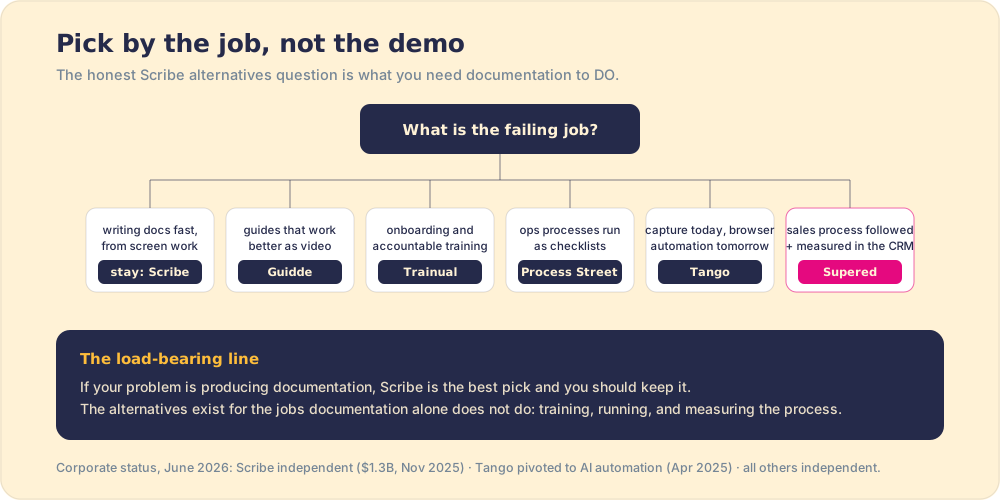
What is Scribe genuinely best at, and where is the boundary?
Scribe collapsed the cost of writing process documentation to nearly zero: perform the task once, get a clean, screenshotted, step-by-step guide. For teams drowning in “can you show me how” requests, that is a real bill paid.
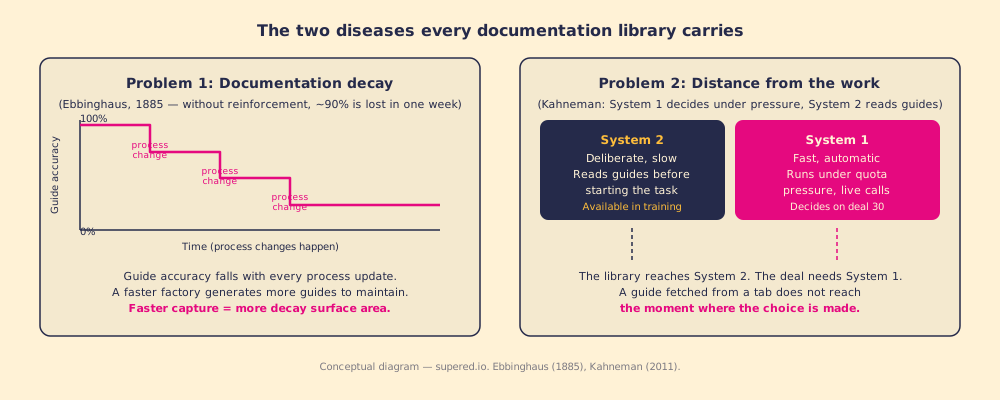
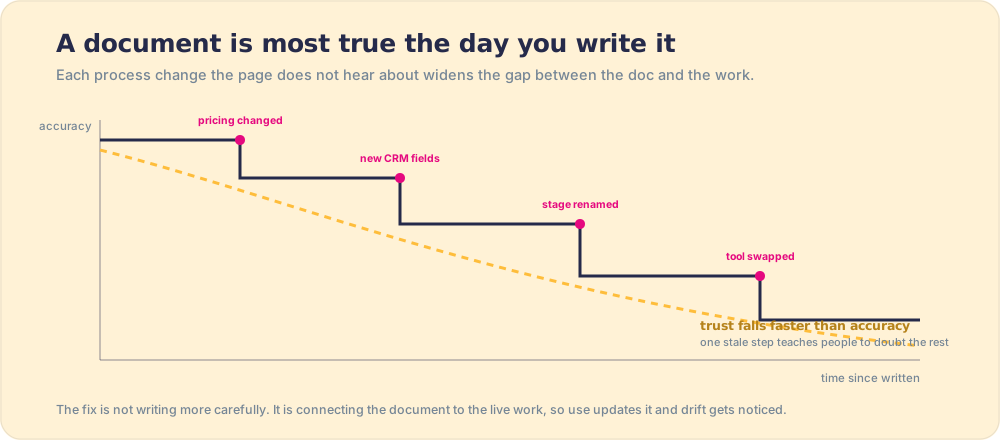
Fairness also requires the full picture of what you produce with it: a library. The guides live in Scribe (or export to your wiki), which means they inherit the two diseases every library carries. First, they decay. A guide is most accurate the day it is generated, and your processes keep moving. Second, they sit at a distance from the work. The behavioral economist Daniel Kahneman’s dual-process model helps here: System 2 thinking is deliberate, careful, consultative. It reads a guide before starting a task. System 1 is the fast, automatic mode that runs under pressure, when a rep has a prospect live on a call or a deal stage decision to make in the CRM. Guidance that requires System 2 effort to retrieve from a separate destination does not reach the moment where System 1 is deciding. McKinsey’s research clocked interaction workers spending 19 percent of the week, close to a day, searching for and gathering information (McKinsey Global Institute, 2012). A faster pen does not move the shelf.
The forgetting curve makes this concrete. Hermann Ebbinghaus, in his 1885 research, showed that without reinforcement, people lose roughly 70% of newly learned material within 24 hours and around 90% within a week. A guide a new hire reads during onboarding has done almost nothing to change what they do on their twentieth deal. The knowledge transfer happened; the behavior transfer did not. These are different facts, and only the second one pays.
What are the best Scribe alternatives for each job?
- Tango, for capture you want to ride somewhere new. The closest like-for-like on capture quality, with in-page guidance overlaid directly on live software, a capability Scribe lacks. The strategic fact a 2026 buyer needs: Tango (now at tango.ai) launched AI browser automation in April 2025 and is repositioning from documenting workflows to executing them, a 69-person company following its pivot (SiliconANGLE, April 2025). Tango is backed by HubSpot Ventures and Salesforce Ventures and has raised $23.7M total. If that direction excites you, Tango is the interesting pick; if you want a documentation roadmap, you are buying their side project. The full breakdown is in Tango alternatives.
- Guidde, for guides that should be video. Some procedures read worse than they watch. Guidde generates narrated video walkthroughs fast, and as a complement to written SOPs it earns a slot; as the system of record it inherits video’s curse, being the hardest format to keep current when the underlying process changes.
- Trainual, for documentation that must train and certify. If the real job is onboarding, Trainual treats procedures as a curriculum with assignments and tests. The boundary is the one all training shares: knowing the procedure in week one and running it in week twenty are different facts, and only the second one pays.
- Process Street, for procedures that should run. The strongest answer outside the CRM to the behavior boundary, and the far edge of process documentation software: SOPs become checklist instances with owners, logic, and a record of what was checked when. For recurring operations (onboarding a client, closing the books) it converts documentation into events you can inspect. Its gravity is its own app: the work must come to the checklist.
- Supered, for the sales process specifically. Ours, so judge accordingly. Supered starts where the factory stops: the documented process surfaces inside HubSpot or Salesforce at the stage where it applies, in the moment of the deal, and adherence is measured on live opportunities so drift is coached the week it starts, not discovered at the quarterly review. It is not a general documentation tool, and for company-wide SOP capture Scribe remains the right buy alongside it. The mechanics are at how it works, and the wider reasoning sits in the process documentation guide.
Scribe alternatives at a glance: which tool fits which job?
The job-first list in one view. Read down the middle column to the job you are failing, then take the tool on that row. A feature table sorted by capture quality would put the wrong tool first, because capture is the one job the whole market already does well.
| Scribe alternative | Best when the failing job is | Where it stops |
|---|---|---|
| Scribe | Producing documentation fast | The guide waits on a shelf to be consulted |
| Guidde | A procedure that plays better than it reads | Video is the hardest format to keep current |
| Trainual | Onboarding and certifying on the procedure | Knowing it in week one is not running it in week twenty |
| Process Street | Operational procedures that should run as checklists | The work must come to the checklist’s own app |
| Tango | Capture from a vendor racing toward browser automation | Documentation is now the side bet, not the roadmap |
| Supered | A sales process followed and measured inside the CRM | Not a general SOP tool; pair it with Scribe for company-wide capture |
Is the scribehow.com platform itself worth understanding?
A note worth knowing before a purchase. Scribe’s product is built around scribehow.com, and the platform has two surfaces. The product itself, where your team creates and manages guides internally, is the well-regarded, well-funded tool this page describes. The public-facing side of the platform, where guides can be published at scribehow.com/page/ URLs, hosts a large volume of user-generated content that ranges well beyond the product’s core use case. This is a common outcome when a productivity platform opens its sharing layer without content governance, a dynamic Google’s 2024 algorithm updates were designed to address. It says nothing meaningful about capture quality and something about where to look when evaluating how publicly shared Scribe guides appear alongside your brand. If your guides will be shared only internally or via PDF export, it is not a relevant consideration. If they will be published at public Scribe URLs, check the neighborhood first.
What should decide it for you?
- The unhappy moment. If it is “writing takes too long,” stay with Scribe. If it is “nobody reads them,” your problem is placement, not authorship. If it is “people read them and still do not do it,” your problem is the behavior boundary, and only the runnable layers (Process Street for ops, Supered for revenue) live on that side.
- The decay bill. Whatever you pick, ask what happens when the process changes. A hundred guides at five minutes of upkeep each, every quarter, is a real salary. Tools where use and maintenance are the same motion age better than any library.
- The inspection question. You can only expect what you inspect. Ask each vendor what they can tell you about whether the documented process happened on real work last week. Page views are not an answer. This single question sorts the entire category in about thirty seconds.
The evidence for caring about that last question is the gap our research keeps finding: 89 percent of 198 sales teams had a defined, documented process, and 36 percent saw it followed as designed, with placement in the flow of work separating the 49-percent-of-quota teams from the 15s (The State of Sales Enablement). Documentation was the precondition. It was never the lever. A more productive documentation factory does not change this ratio, because the ratio was never a documentation problem.
The verdict
- Scribe itself. The pick when the bottleneck is producing documentation. It is the best at this job, and this alternatives page says so without a wink.
- Guidde. The pick when your guides should be watched rather than read, alongside a written system of record.
- Trainual. The pick when the underlying job is onboarding and certified training in an SMB.
- Process Street. The pick when operational procedures should run as accountable, inspectable checklists.
- Tango. The pick when you want capture from a company whose roadmap is racing toward browser automation, eyes open, and you find the automation direction interesting rather than alarming.
- Supered. The pick when the documents that matter are your sales process, and the test you answer to is whether reps run it in the flow of work inside the CRM, with adherence visible continuously. Knowledge is solved; the followed process is the part still deciding quarters, and it is the part we built for. Start with how to write an SOP if the library itself still needs its cards written, and the comparison between the two main capture tools in Tango vs Scribe.
Frequently asked questions
What are the best Scribe alternatives?+
What does Scribe do well?+
What is the difference between Scribe and Supered?+
Is Scribe worth it?+
Why do teams switch away from Scribe?+
Your process, running itself.