LinkedIn Personal Branding: Tom Boston on Three Pillars, One Lane, and Why Real Beats Funny
Tom Boston went from a DIY store to My Sales Coach and more than 50 million views as the creator behind Larry and Barry. Here are the numbers he runs his LinkedIn personal brand on, in his words.
LinkedIn personal branding is how a person becomes known for something specific on LinkedIn, and Tom Boston of My Sales Coach builds it on three pillars: an optimized profile, a content strategy and an engagement strategy.
Tom Boston arrived in London for a job interview in 2019 in a suit, a tie and shoes he had worn once before, on his wedding day. The man interviewing him was in a hoodie, and one of his first questions was “Do you do you normally dress like this?” Tom burst out laughing. “No, not not at all,” he said. “You’re getting a a kind of a fancy version of me.”
Laughing at himself helped him relax and connect, he told Rob Jones on Numbers Known. Rob had picked the number two for Tom, the times he has worn those shoes. Tom now teaches LinkedIn personal branding for a living, and most of his advice comes back to showing up as himself.
Today Tom is the face of My Sales Coach and the creator behind two fictional co-workers, Larry and Barry, with more than 50 million views by Rob’s count. He brought three numbers of his own: 3, 10 and 1.
How did Tom Boston get into B2B sales?
His number 10 is the years he will have been married to his wife Katie next year. She is, in his words, the person “who pushed me into B2B sales kicking and screaming.”
Before Katie, Tom was, by his own account, lost. He took a drama degree “because I like telling stories,” watched a podcast with a friend flop, and ended up in a DIY store and then an Apple store, telling jokes on the shop floor and living with his parents in his mid-twenties. Customers told him he was wasted there. “Even though it was a joke, that was like a dagger,” he said.
Katie “just kind of held a mirror up to my life.” With a wedding to pay for, she found him an outbound sales job selling gas and electricity to local businesses. “I did not want to take that job,” Tom said. It led to Hootsuite, then a move to London, then Salesloft, then My Sales Coach.
Rob said his own wife plays the same part for him, and pointed to why it matters for anyone who posts in public. “Putting a video out to the public that doesn’t do well is like a whole other kind of rejection,” he said.
What are the three pillars of LinkedIn personal branding?
Tom’s number 3 is the framework he has coached sales reps on for years: “a three pillar approach to building their brand that involves an optimized profile a content strategy and an engagement strategy.”
The weak spot is the third pillar. “They’re quite good at posting and they’ll maybe make their profile look quite nice,” Tom said, “but actually the engagement tends to kind of drop off.” His check-in with a rep is which pillar needs the most help.
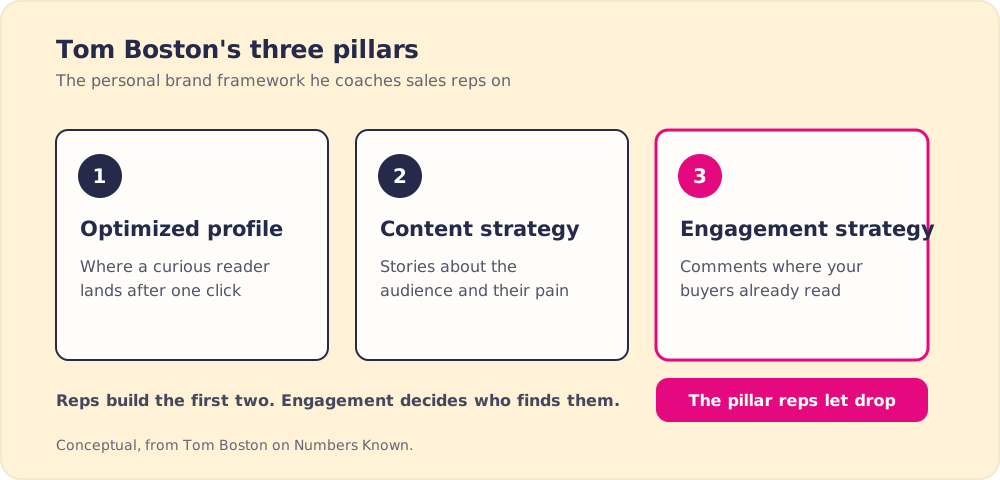
Each pillar asks something different of a rep:
- An optimized profile. The easy part, in Rob’s words, and the page a curious reader lands on.
- A content strategy. Posts about the audience’s problems and their week.
- An engagement strategy. Daily comments on posts your buyers already read.
Is commenting on bigger creators’ posts a tactic or a relationship?
Rob pushed on this directly. Showing up in comments to build trust “seems very odd to me that that would have to be tacticalized,” he said. When he comments on a friend’s post, it is because he enjoys it or learns from it.
Tom answered with where he started. “I’m an SDR that nobody has heard of. And I mean, nobody, right?” So he made a choice. “In the early days I stole a lot of my audience from the big players, right, by turning up in their comment section.” He dropped his videos into big sales creators’ comments, showed up every day, and invited people to his profile. “They’ve already built the audience. So, why not go and take a slice of the pie?”
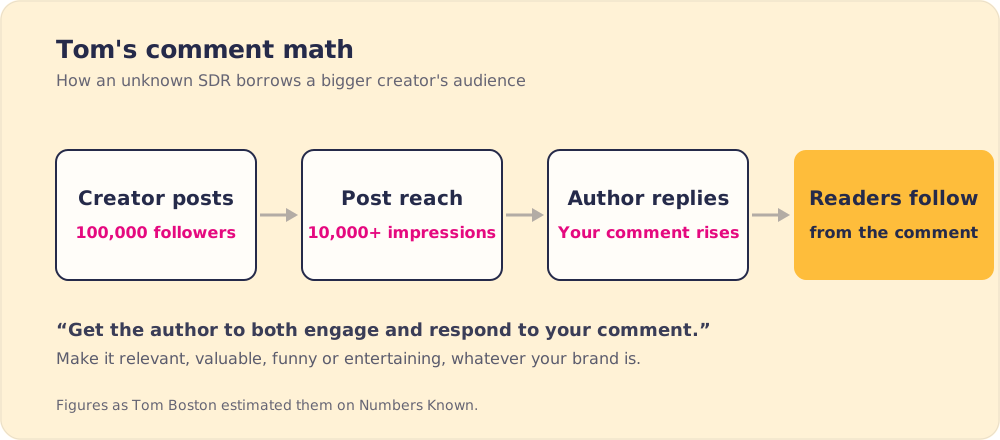
LinkedIn no longer lets authors pin a comment, so likes and author replies decide the order. “The best thing you can do in the comment section is get the author to both engage and respond to your comment,” Tom said. Then he did the math out loud. “If that person has got 100,000 followers, right? You’re probably guaranteed that that post has got at least 10,000 impressions, that’s eyes on your comment.” He also pointed to LinkedIn’s new follow button inside comments.
Rob recognized the idea as barnacle SEO, a term Will Scott coined in 2008 for attaching your content to pages that already rank.
The two met in the middle. Tom’s rule is that a comment should be “relevant, valuable, like you said, funny, entertaining, whatever your brand is.” Rob’s reason for commenting, that he enjoys a post or learns from it, fits inside that rule.
Why does Tom tell reps that nobody cares about them?
“What I always say, Rob, is like I say this to everyone I work with, nobody cares about you,” Tom said. Rob laughed that it was early in his day for that.
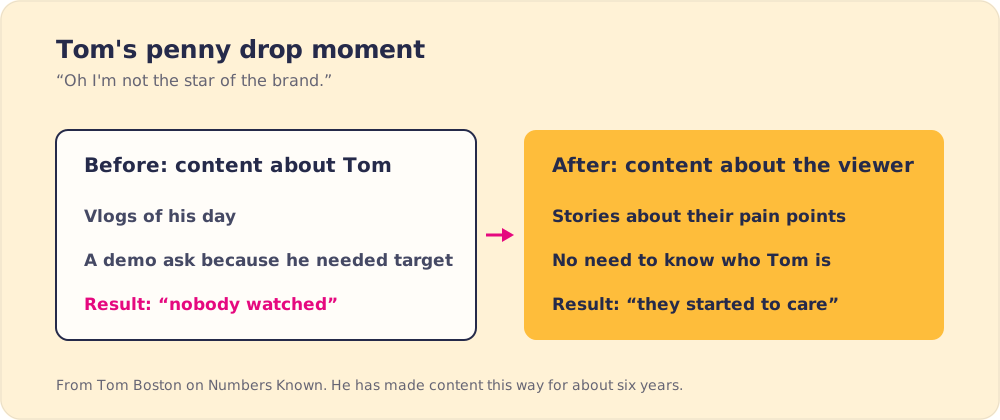
“The mistake I made for for months is I made all my content about me.” His early vlogs ended with a request for a demo because he needed to hit target. “Nobody watched that because nobody cares.”
The change came when he started telling stories about the viewer’s pain. “It was this like penny drop moment,” he said. “Oh I’m not the star of the brand.” He has judged his content by one line since. “You don’t need to know who Tom Boston is to enjoy this content.” He has worked that way for about six years.
Jonah Berger and Katherine Milkman studied three months of New York Times articles and found that emotional stories got shared more, especially ones that stirred high-arousal feelings such as awe, anger or anxiety (Berger and Milkman, Journal of Marketing Research, 2012). Tom’s own list says a good post “either makes them laugh, makes them cry, makes them think.”
How does LinkedIn content turn into inbound leads without a pitch?
Rob described the mechanism from the viewer’s side. You watch a Barry video about cold calling, then another, and eventually ask who this person is and who he works for. “There comes a moment of familiarity where where familiarity turns to curiosity,” he said. On LinkedIn, finding out takes one click.
My Sales Coach’s inbound form asks “Where did you hear about us?” The answers often name Tom or a colleague on LinkedIn. The company rarely posts about its roster of coaches. “We just talk about things that resonate to the sales world,” he said.
Most of the people watching aren’t buying yet. The 2024 Edelman-LinkedIn B2B Thought Leadership Impact Report, a survey of nearly 3,500 managers and executives, found 95% of business clients are not in market at any given moment (Edelman, 2024).
A rep whose name a buyer recognizes starts the sales prospecting process warmer, and the first call is easier too, as our cold calling tips cover.
What should you do when a post flops?
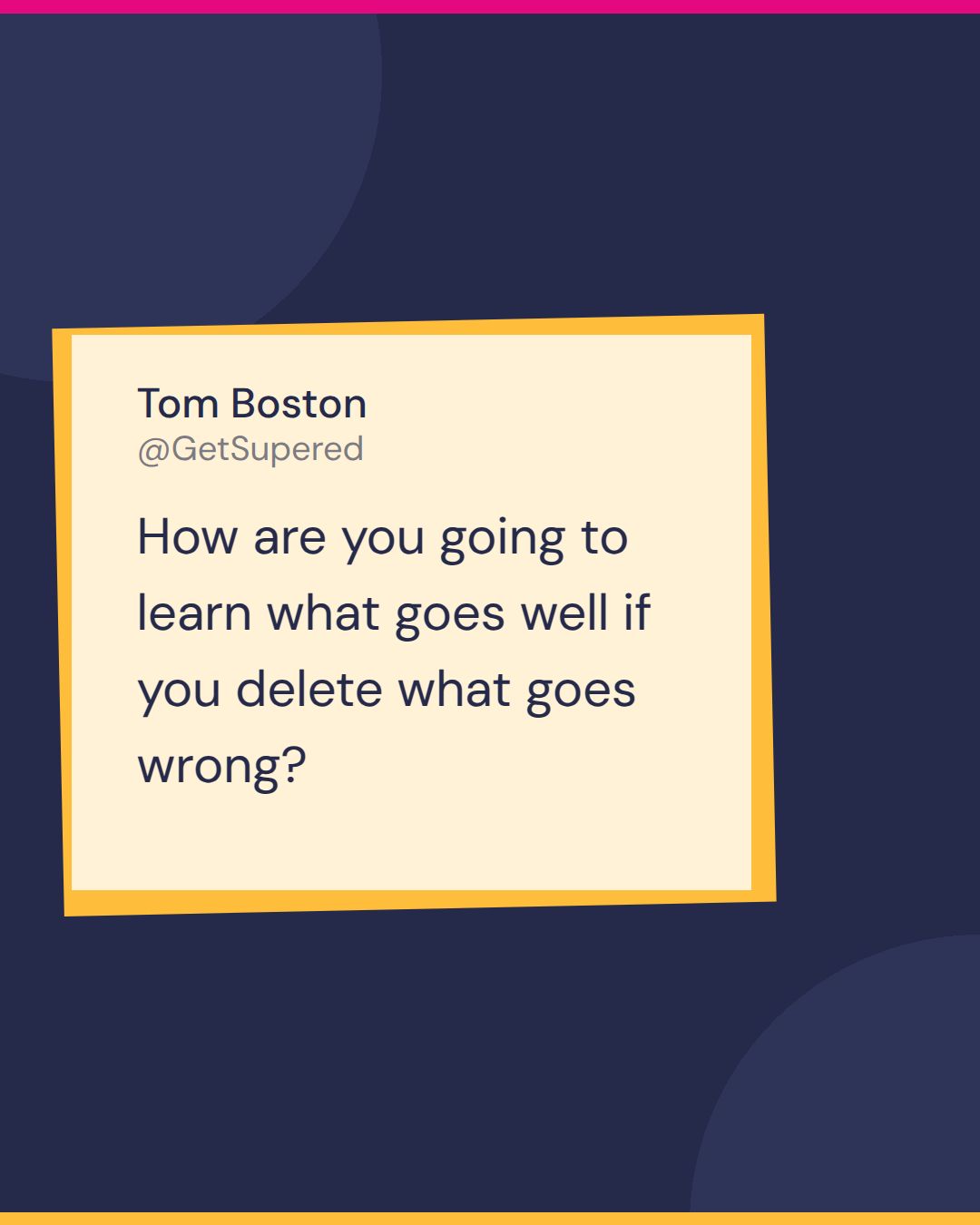
Clients ask Tom whether to delete a video that did not land. He says no. “How are you going to learn what goes well if you delete what goes wrong, right?” He treats content as an experiment. “In the same way that I turn the volume up on things that land, I turn the volume down on things that don’t.” Rob compared it to A/B testing and named the obstacle as fear. A lot of people “feel like they can’t have even one failure,” he said.
Should you be known for one thing on LinkedIn?
Tom’s last number was 1. “You have to pick a lane,” he said. Years ago he decided “I’m going to be the funny sales guy. That’s going to be my thing. I nailed it to the wall.” People scrolling LinkedIn will not stop to decode what you do, so he tells reps to “choose your lane, tell your story really simply,” and adds a release valve: “You can always change, you can pivot, you can switch lanes, but when you’re in that lane, mean it.” He credits the idea to a line from Dolly Parton: “figure out who you are and do it on purpose.”
Rob’s final number was about Tom’s life beyond the lane: Tom also posts about his two boys, who are autistic. “I strongly disagree with this and I also can’t deny that it’s exactly right,” Rob said of the one-lane rule.
Tom laughed. “I wouldn’t be a sales influencer if I didn’t contradict myself every five minutes, right?” A feed of nothing but comedy videos would be too much, he said. “Let’s have a little bit of light and shade.” He never planned to write about disability. “But I will talk about autism on LinkedIn until they tell me to stop.”
Why does real beat funny?
Near the end, Rob told Tom he is good at capturing the context of a sales situation. “Well, I’ve lived it right,” Tom said. “The reason that the videos work is because people go, ‘Oh my god, that is so real.’ They don’t tend to go, ‘That is so funny.’”
His advice to reps who want comedy in their content is “don’t try to be funny.” Skip the wigs and silly voices. Post the moment someone else has lived, the one that makes them say “Oh my god, I got to share that with Sarah.” In Tom’s view, “the algorithm will reward you for that share.”
Our guide to sales skills covers the discovery habits that give a rep those stories in the first place.
What Tom Boston’s numbers add up to
- Three pillars. Profile, content and engagement. Reps let engagement drop, and it is how strangers find the rest.
- Comments on bigger posts. Daily, useful comments let an unknown SDR reach a large creator’s audience.
- Content about the audience. Tom’s early vlogs about himself failed. Stories about the viewer’s pain worked.
- Experiments that stay up. A flop teaches, so Tom leaves it up and turns up what lands.
- One lane. Be known for one thing and mean it, while still posting about the people you love.
- Moments people share. Viewers pass on what feels real to them.
Where should a rep start?
If I were a rep starting today, I would take Tom’s order as written, since the pillar reps skip is the one that built his audience. Fix the profile in an afternoon. Pick the one thing you want a buyer to remember you for. Then spend most of your LinkedIn time in the comments of people your buyers already read, and save your own posts for stories about the buyer’s day.
When a buyer starts replying, our sales prospecting guide picks up the follow-up that turns attention into a meeting. Supered handles the stretch after that, keeping the rep’s next step in front of them inside the CRM once a conversation turns into a deal.
Frequently asked questions
What are the three pillars of LinkedIn personal branding?+
Does commenting on other people's LinkedIn posts help build a personal brand?+
Should you be known for one thing on LinkedIn?+
Do you need to be funny to build a personal brand on LinkedIn?+
How long does LinkedIn personal branding take to produce inbound leads?+
Your process, running itself.
Turn the playbook into rep behavior.
More from Numbers Known

Software Demo Best Practices: Jeff Hatten's 2% Factor for Winning When Features Match
Jeff Hatten
SDR to AE in 11 Months: Dom Odoguardi's Numbers, From Quota to Do Content
Dom Odoguardi