Sales Skills: Why Training Doesn't Build Them
Every team has a list of the sales skills that matter and a training program meant to install them. The program teaches the rep what to do and still does not make them able to do it. Here is the mechanism nobody names, and the fix.
Sales skills are procedural abilities, the things a rep can do on a live call, not the things a rep can name, which is why they are built by repeated practice in the flow of real deals rather than by a training course that teaches the rep what they ought to do.
Ask a sales leader to name the skills that make a great rep and the list comes fast: discovery, qualification, objection handling, closing, the discipline to run the process when the quarter is on fire. Ask the same leader why their training program, the one that teaches all of those, has not produced a team of great reps, and the answer comes slower. The list is right. The training is sincere. And the reps still cannot reliably do the things on the list. That gap between a correct list and a capable team is the most expensive misunderstanding in sales, and it comes from treating a skill as a thing you can hand to someone.
Sales skills are procedural abilities, the things a rep can do on a live call, not the things a rep can name, which is why they are built by repeated practice in the flow of real deals rather than by a training course that teaches the rep what they ought to do. Get the kind of knowledge right, and how you build skill changes completely.
So what is a sales skill?
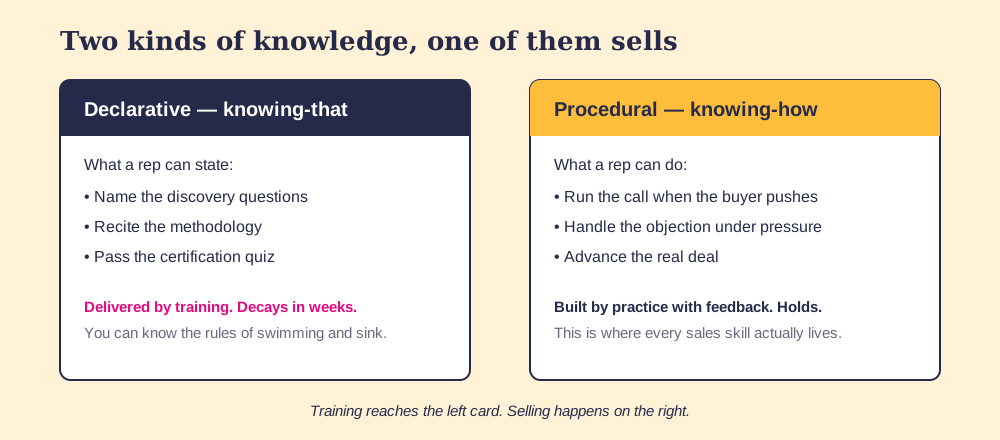
Cognitive psychology has a clean distinction that sales has mostly ignored. There is declarative knowledge, knowing-that, the facts and rules you can state. And there is procedural knowledge, knowing-how, the skill you can perform. They are learned differently, stored differently, and one does not produce the other. You can know every rule of swimming and sink. You can ride a bicycle and be useless at explaining how you stay up. The bicycle is in your legs, not your notes.
A sales skill lives in the legs. The rep who handles an objection well is not retrieving a script; they are doing something they have done a hundred times, the way a pianist does not read the notes for a piece they know. So when we say a rep “has discovery as a skill,” we mean they can run a real discovery call with a real buyer pushing back, not that they can list the seven questions. Almost every sales skills list you will find online blurs the two: it names the behaviors (good) and implies that learning the names is learning the skills (wrong). The names are declarative. The selling is procedural. The whole problem is that we test and train the first and need the second.
Why doesn’t sales training build sales skills?
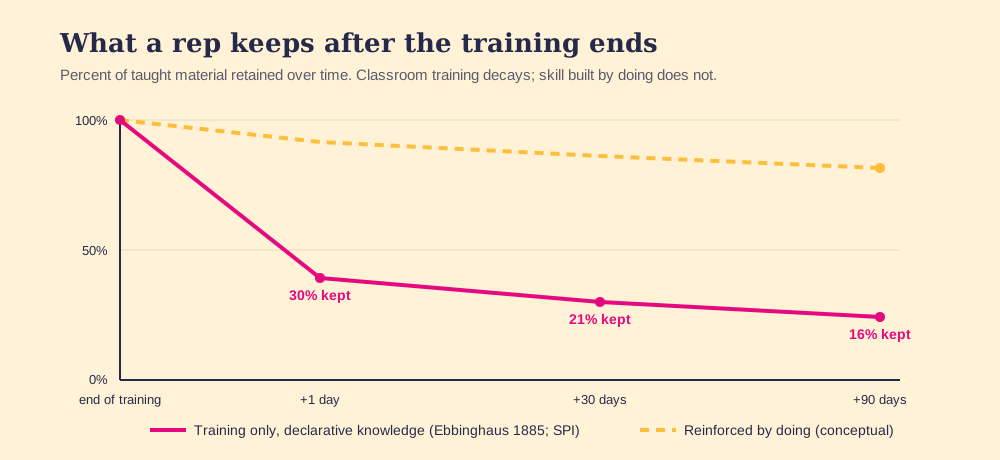
Because training is a delivery system for declarative knowledge, and declarative knowledge evaporates. This is not a slur on training; it is the structure of memory. Hermann Ebbinghaus mapped the forgetting curve in 1885, and the numbers in a sales context are brutal: a rep loses about 70 percent of what they were taught within 24 hours, 79 percent within 30 days, and 84 percent within 90 days. Sales Performance International, studying sales programs specifically, found the same shape: most reps forget at least half of what they learned within about five weeks, and 84 percent of it is gone after 90 days. The workshop you ran in January is, by April, a folder nobody opens and a feeling that the company tried.
Frank Cespedes of Harvard Business School, who has written more sense about sales training than almost anyone, put the indictment plainly in HBR: most sales training is an event, disconnected from the actual selling context and rarely reinforced, so it fails on its own terms (Cespedes, “Your Sales Training Is Probably Lackluster,” HBR, 2017). He is right, and we would go one step further than the diagnosis usually does. The disconnection is real, but it is the smaller half of the problem. The deeper half is that an event, by its nature, can only deliver the declarative side. Even a perfectly designed, perfectly reinforced lecture would still be teaching knowing-that, when the thing that closes deals is knowing-how. You cannot lecture someone into a skill any more than you can read a book at a person until they can swim.
The forgetting curve and the procedural gap stack into one conclusion: an information-first program is the weak lever for changing what a rep does. That is why we train on output, not input, and why the knowing-doing gap is the real subject hiding behind most “skills” conversations. A certified rep is not a ready rep, because the certificate measured the knowledge and readiness is the skill.
Which sales skills move deals?
If skills are procedural, the useful question is not “what should reps know” but “what should reps reliably do.” The research and our own field data converge on a short list, and it is worth saying which ones matter and which ones the market has overrated.
- Diagnostic discovery. The ability to ask the question that surfaces the buyer’s real problem, not the surface request. This is the single behavior most correlated with deals that close, and the one most often skipped under pressure.
- Qualification under pressure. The skill of walking away from a bad-fit deal when the pipeline looks thin. Easy to state, hard to do, and the difference between an honest forecast and a hopeful one.
- Objection handling that addresses the fear. Not reciting a rebuttal, but hearing the worry under the words and answering that. The Jolt Effect research on indecision shows that most lost deals die of buyer fear, not preference, so this skill decides a large share of the number.
- Process discipline. Running the same motion on every deal, the tough ones as much as the easy ones. A mediocre process run consistently beats a brilliant one run half the time, because consistency is what makes coaching and forecasting possible at all.
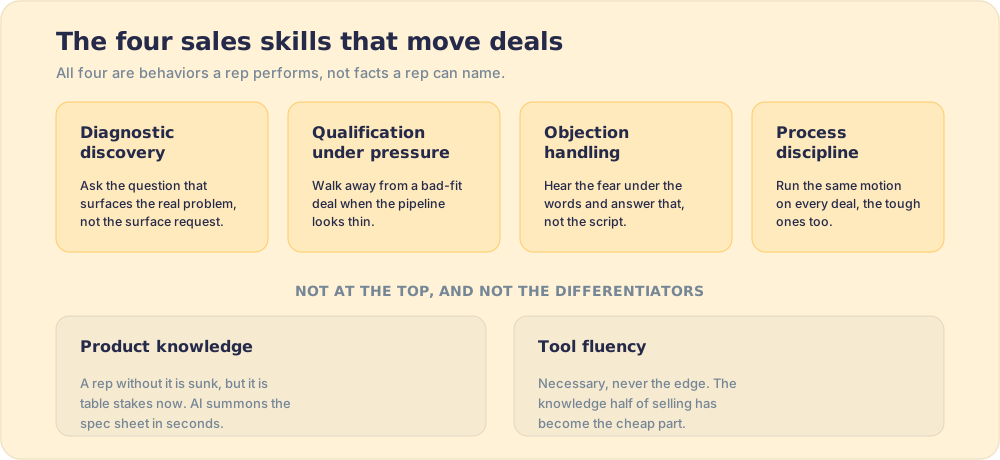
Notice what is not at the top: product knowledge and tool fluency. They matter, and a rep without them is sunk, but they are table stakes, because they are the parts AI has already made nearly free. Any rep can now summon the spec sheet, the competitor comparison, the tailored email in seconds. Knowledge has become the cheap part of selling. The expensive, durable, unautomatable part is the behavior: whether the rep runs the diagnostic discovery when the buyer is impatient and the clock is short. That is where the moat is now, and any most important sales skills list written for 2026 that still leads with “knows the product” is describing the world of fifteen years ago.
How do you build sales skills that hold?
Here is the honest part, and the part that should change a training budget. The real question of how to improve sales skills has one uncomfortable answer: if skills are procedural, they are built the way every procedural skill is built, by doing the thing, repeatedly, with feedback, under conditions close to the real ones. This is not a sales idea; it is the most replicated finding in the science of expertise. Anders Ericsson’s 1993 study of violinists in Berlin established that expert performance tracks accumulated deliberate practice, focused repetition with immediate feedback on a specific weakness, not hours in a lecture hall (Ericsson, Krampe & Tesch-Römer, Psychological Review, 1993). The mechanism behind every real skill, from the violin to the discovery call, is the same: practice, feedback, repeat. A workshop has almost none of those ingredients. A rep’s actual week has all of them, and we waste it.
So the move to improve sales skills is not more sales skills training in the classroom sense. It is to turn the work itself into the practice field. That means three things, and they are the opposite of an annual event.
- Definition. Name the specific behaviors a strong rep performs, in plain language, deal stage by deal stage. You cannot reinforce what you have not made explicit, and most teams never write the standard down.
- Reinforcement in the flow of work. Deliver the right prompt the instant the rep needs it, while they are in the deal, not in a quarterly session they will have forgotten by spring. A cue at the moment of action is worth a hundred slides in a folder, because it lands where the skill is used.
- Inspection that feeds coaching. Check whether the behavior happens on real deals, so a manager can coach the specific gap instead of guessing. Inspection is not surveillance; it is the feedback half of deliberate practice, the thing that turns a thousand reps into a thousand reps who are getting better.
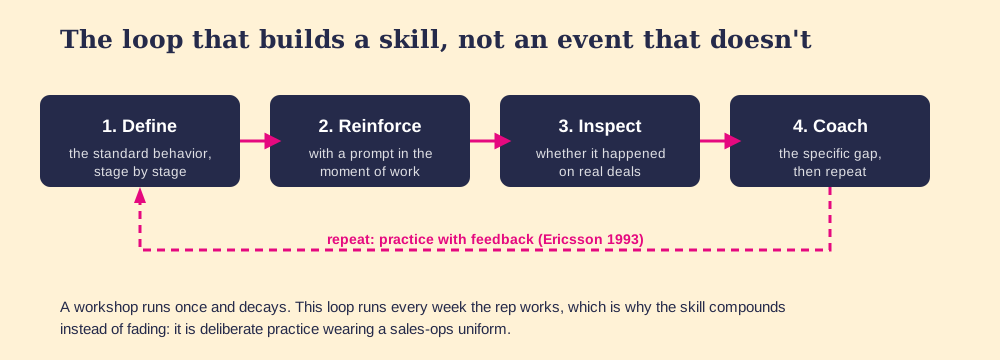
This is the work sales coaching is supposed to do, and the reason coaching beats training on every study that compares them: coaching is practice with feedback, and training is information transfer. When non-adherence shows up, it is almost never that the rep is lazy. It is that the right action was not easy, not visible, and not reinforced in the moment. That is a system to fix, not a person to blame.
One honest edge on the picture. Reinforcement is not magic, and the gold line on the chart above is a target, not a guarantee; a rep with no aptitude will not become a closer because you cued them well. Talent is real. But talent is the part you cannot manufacture, and behavior is the part you can, so the entire return on a skills budget sits in the half you can move.
What to do with your skills budget
There are three ways a leader can spend to raise the team’s skills, and only one of them pays back. You can buy more sales skills training, the workshops and courses, and watch 84 percent of it leave the building by the second month. You can hire for talent and hope, which works for the top of the team and abandons the middle where most of your number lives. Or you can build the system that turns the rep’s own week into deliberate practice: a written standard, the right prompt delivered in the moment of work, and inspection that frees a manager to coach the gap.
We recommend the third, without hedging, because it is the only one the mechanism supports. Training fights the forgetting curve and loses. Hiring ignores the middle of the team. Reinforcement in the flow of work is the one lever that matches how procedural skill is built, and it is the job the sales training software category is finally being judged on: not whether it can deliver a course, but whether it can change what a rep does on the next call. Supered exists to be that layer, the prompt and the standard reaching the rep the instant the question arises, so the practice happens where the work does. Buy the course if you want the team to know the play. Build the reinforcement if you want them to run it.
The skills on your list are the right skills. The list was never the problem. The problem is that we keep trying to install procedural ability with a declarative tool, and then wondering why the rep who aced the workshop froze on the call. Stop teaching the names. Build the doing.
Frequently asked questions
What are sales skills?+
What are the most important sales skills?+
Can sales skills be taught?+
How do you improve sales skills?+
Your process, running itself.