Lead Generation Tools in 2026, Sorted by Team Size: What Changes When the Second Rep Arrives
Lead generation tools change with team size.
A founder needs a form and a free CRM; a ten-rep team needs data; past ten, the cost is reps colliding on the same accounts. Nine tools graded and priced October 2, 2026.
Lead generation tools are the software a business uses to get the names of people who might buy, by capturing the ones who raise a hand (forms, chat, site visits) or finding the ones you choose (contact data, prospecting extensions), and getting each name to a seller.
Lead generation tools are sorted on most lists by feature, and they should be sorted by headcount. The short answer, graded in full below:
- Supered Prospector. For a sales team of ten to fifty that already has Clay: the team’s Clay tables become a button reps press in Sales Navigator, on a company website or in the CRM record, with the record’s owner shown before anyone pushes a duplicate. $45 per rep per month, billed annually.
- HubSpot. For a small business with one or two sellers: free forms, live chat, landing pages and a CRM that never expires, so the people who raise a hand land somewhere.
- Apollo. For a sales team of three to ten without Clay: contact data, sequences and a dialer in one plan, free to start and $49 a seat per month on annual billing.
Lead generation tools are the software a business uses to get the names of people who might buy, by capturing the ones who raise a hand (forms, chat, site visits) or finding the ones you choose (contact data, prospecting extensions), and getting each name to a seller. That last clause is the one the top-ranking lists skip, and it is the one that changes as a team grows.
A man fishing alone off a dock needs a rod and some bait. He can watch his own line, and when it twitches he knows it is his fish. Put ten people on a charter boat, all casting off the same side, and the problem stops being bait. The lines cross, two anglers fight the same fish, and a good catch goes back in the water while the crew untangles. The skipper on a busy boat spends more time managing lines than finding fish. Lead generation works the same way, and the tools that help the man on the dock are not the tools that help the skipper.
What do the top lists of lead generation tools have in common?
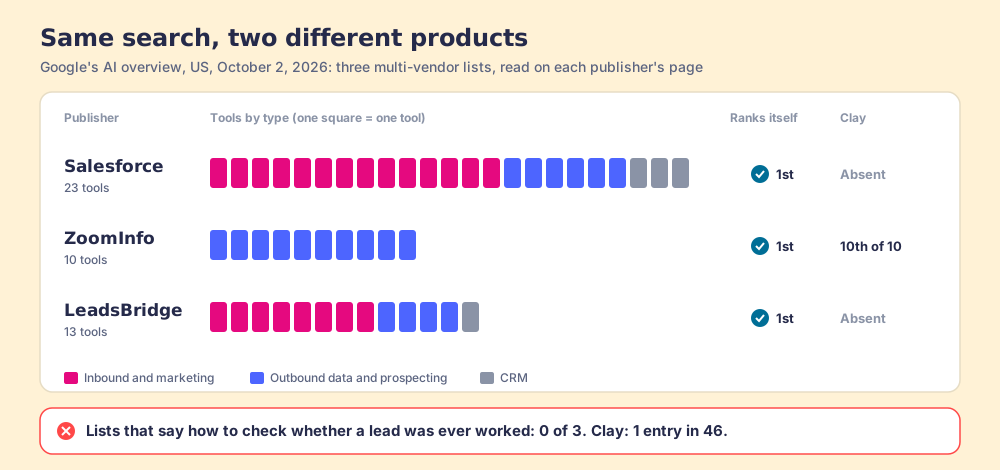
Google’s AI overview for “lead generation tools” in the US cited five pages on October 2, 2026 (Ahrefs SERP overview). Two are a vendor’s product page (Apollo) and a vendor’s blog (Overloop). The other three are multi-vendor lists, and I read each on the publisher’s own page the same day:
| Publisher | Tools listed | Publisher’s own rank | Inbound and marketing tools | Outbound data and prospecting | CRM | Clay | How to tell whether a lead was worked |
|---|---|---|---|---|---|---|---|
| Salesforce (modified August 28, 2026) | 23 | 1st (Marketing Cloud) | 14 | 6 | 3 | Absent | Absent |
| ZoomInfo (September 28, 2026) | 10 | 1st | 0 | 10 | 0 | 10th of 10 | Absent |
| LeadsBridge (updated August 13, 2026) | 13 | 1st | 8 | 4 | 1 (HubSpot) | Absent | Absent |
Three publishers, three self-appointed winners, which is their right on their own blogs. The finding is in the middle columns. Two buyers typing the same three words get two different products: Salesforce’s list is mostly the marketer’s toolkit of forms, pop-ups, webinars, referral programs and email, and ZoomInfo’s is entirely the seller’s toolkit of contact databases. ZoomInfo’s page explains the split in a sentence (“Inbound tools capture interest from prospects already coming to you through content, forms, and chat. Outbound tools find and engage prospects who haven’t raised their hand yet.”) and then lists only one side of it. Across 46 entries, Clay appears once, last. And none of the three lists tells you how to find out whether anyone worked the leads the tools produced.
Two smaller details show how lightly these pages get maintained. Salesforce lists Leadfeeder at number 2 and Dealfront at number 16 as separate tools, five months after “Dealfront became Leadfeeder, unifying the entire platform under one brand” on March 24, 2026 (Leadfeeder). It also recommends Zendesk Sell, which Zendesk announced on September 9, 2025 it will retire on August 31, 2027 (Zendesk). Neither is a scandal. Both are a reason to check the date on any list you buy from, this one included.
What is a lead, and which kind of lead generation software do you need?
The word “lead” carries two meanings, and the lists split along them.
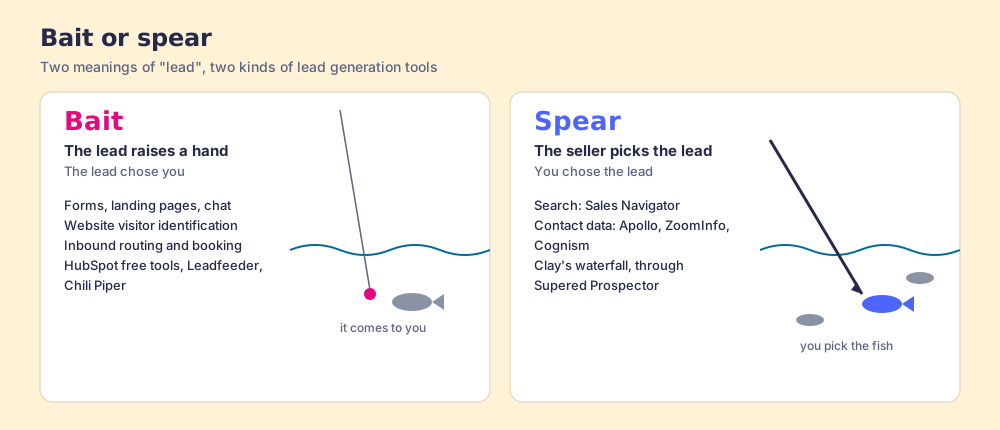
- The hand-raiser. Someone filled in your form, opened your chat, booked from your page or visited your pricing page. Marketing tools capture this lead: forms, landing pages, chat, website visitor identification. The lead chose you.
- The chosen name. A seller decided this person fits the customer profile and went to get an email and a phone. Sales lead generation tools produce this lead: contact databases, Sales Navigator, enrichment. You chose the lead.
Back on the dock, the first kind is bait: you put something in the water and wait for a bite. The second is a spear: you see the fish you want and go after that one. A good fisherman owns both, and which one he reaches for depends on the water. A founder with a website and no sales team mostly fishes with bait, because the founder’s hours are the scarcest thing in the company. A sales team with a quota mostly fishes with a spear, because a quota does not wait for bites.
Why do lead generation tools change with team size?
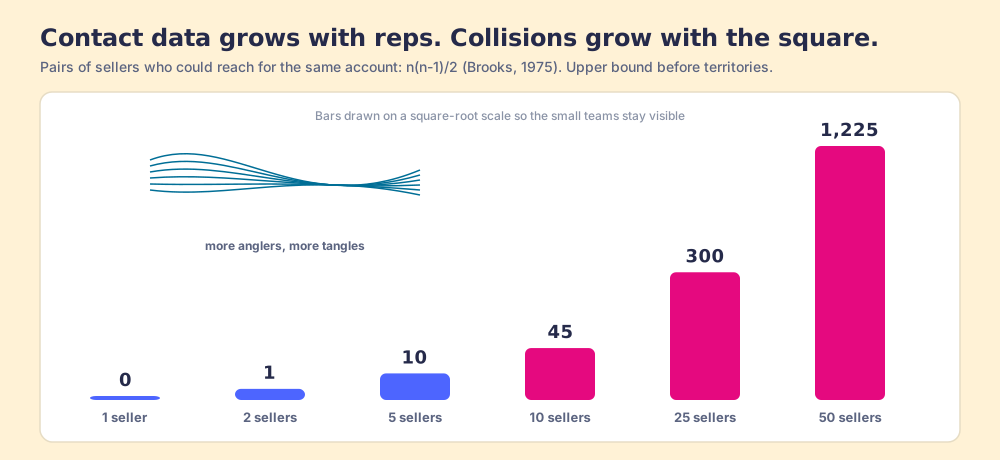
Fred Brooks worked this out for software teams in 1975, and the arithmetic carries over to sales floors. “If each part of the task must be separately coordinated with each other part, the effort increases as n(n-1)/2. Three workers require three times as much pairwise intercommunication as two; four require six times as much as two” (The Mythical Man-Month, chapter 2).
Count the pairs of reps who could reach for the same account:
| Sellers | Pairs who could collide on one account | What the bottleneck is |
|---|---|---|
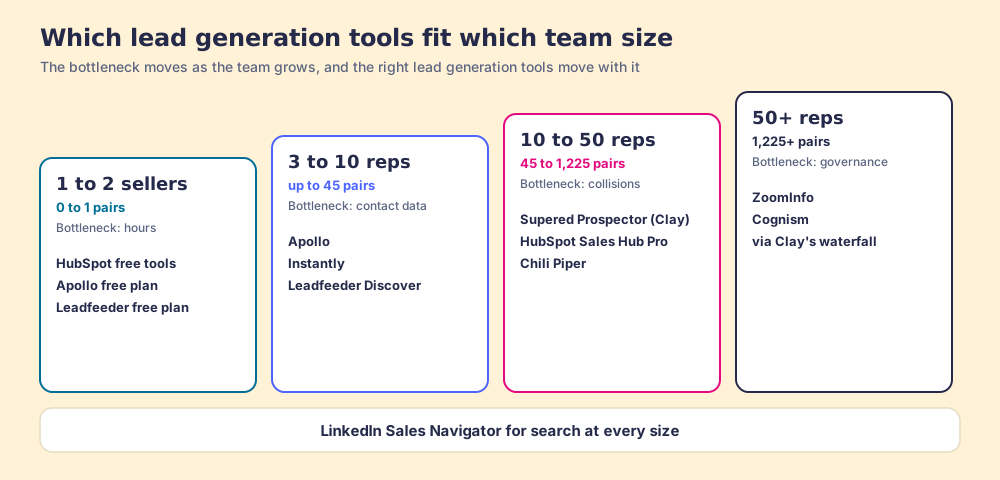
| 1 | 0 | The founder’s hours. Capture who raises a hand; answer fast. |
| 2 | 1 | Still hours, plus one conversation a week about who has which account. |
| 5 | 10 | Contact data. Reps need emails and phones faster than marketing produces hand-raisers. |
| 10 | 45 | The list desk and the collisions. Who owns this record? Did anyone call them last month? |
| 25 | 300 | Coordination. A duplicate is now likely, and the leader cannot see which lists were worked. |
| 50 | 1,225 | Governance. Routing rules, territories, and a contract built for the size. |
The pairs are an upper bound, and here the picture needs policing: territories and named accounts cut the real number, and two reps in different regions never meet. But the shape holds. Add a fifth rep and you add four new pairs; add the twenty-fifth and you add twenty-four. Contact data grows with the number of reps. Collisions grow with the square of it.
So the right tool for a team of one is wrong for a team of twenty-five, and the reverse. The founder buying a ZoomInfo contract is the man on the dock buying a charter boat. The twenty-five-rep team running on free forms and a shared spreadsheet is the charter boat with no skipper watching the lines.
Why do teams switch lead generation tools?
The reasons show up in the vendors’ own pages and in survey data, and most of them are a team that grew past its tool.
- Too many places to work. Salesforce’s State of Sales survey of 7,775 sales professionals found teams “use an average of 10 tools to close deals,” and 66% of reps said they were overwhelmed by the number (Salesforce, December 2022). A small business that bolts on a tool per problem reaches that count fast.
- Empty shelves. Apollo’s own pricing calculator assumes an 88% email match rate and an 81% phone match rate, read October 2, 2026 (apollo.io/pricing). Those are Apollo’s planning numbers, and they mean about 19 phone lookups in 100 come back empty; the usual fix is a second database.
- The contract that outgrows the team, or the reverse. ZoomInfo publishes no prices; Vendr’s median buyer pays $33,500 a year across 1,574 purchases (Vendr, October 2, 2026). That is a sensible line for fifty reps and a heavy one for four.
- The unanswered hand-raiser. Conversica submitted inquiries to the website forms of 100 mid-market and enterprise companies: “One in four companies tested did not respond to inbound leads at all” (Conversica via Business Wire, May 4, 2023). The form tool worked. The lead died after it.
Those four reasons, plus the collisions from the pairs table, are the grading criteria below.
Why trust this ranking?
I started RevPartners, a HubSpot partner that did only sales implementations, sold roughly twice as much Sales Hub as any other partner and reached Elite tier in 13 months. I set up lead capture and prospecting for teams from three reps to several hundred, and the tool that fit the first never fit the last. Supered came out of that work; it holds 4.9 out of 5 from 81 reviews on G2 and 5.0 from 122 on the HubSpot App Marketplace (checked October 1, 2026). That is also the disclosure: we make Supered Prospector, and it ranks first below for teams of ten or more that already have Clay. The weights are printed, so flip them for a founder without a sales team and HubSpot’s free tools come first, which is a fair result.
Which lead generation tools are graded highest?
The lens is a B2B business sized anywhere from one seller to fifty, already on a CRM or about to pick one, that wants leads captured, found and worked, and a leader who can see which ones were. Each criterion is scored 1 to 5 and multiplied by its weight, for a maximum of 50.
| Criterion | Weight | What it rewards |
|---|---|---|
| Gets leads, in its own lane | 30% (x3) | Captures hand-raisers or finds chosen names well |
| Price at the team size it suits | 20% (x2) | Published, free or cheap to start, scales without a cliff |
| Works where the seller already is | 20% (x2) | On the profile, the site, the CRM record; no new tab or login |
| Collision control | 20% (x2) | Shows the owner, flags prior touches, routes to one person |
| What the leader sees after capture | 10% (x1) | Which leads were worked and how they ended |
| Rank | Tool | Lane | Team size it fits | Grade | Score | CRM integration | Setup effort | Pricing (plan with the feature) | Why it ranks here |
|---|---|---|---|---|---|---|---|---|---|
| 1 | Supered Prospector | Spear, on Clay | 10 to 50 reps with Clay | A | 45 | Native (HubSpot, Salesforce, Pipedrive) | Under a week on an existing Clay account | $45 per rep per month, billed annually, plus your Clay plan | Clay’s waterfall from any page; owner and prior touches shown before a push |
| 2 | HubSpot | Bait, then CRM | 1 to 2 free; teams on Sales Hub Pro | A- | 41 | It is the CRM | Hours (free) to days (Pro) | Free tools; Sales Hub Pro $90 per seat per month, billed annually | Captures the hand-raiser where the record lives |
| 3 | Apollo | Spear + send | 3 to 10 reps without Clay | A- | 38 | Native (HubSpot, Salesforce) | A day | Free; $49 / $79 / $119 per seat per month, billed annually | One plan, free to start, fewest tools for a small team |
| 4 | LinkedIn Sales Navigator | Spear (find only) | Any size | B+ | 34 | CRM Sync on Advanced Plus | Minutes | Core $119.99 a month, $1,079.88 a year | Best search; no email, phone or export |
| 5 | ZoomInfo | Spear + signals | 50+ reps | B | 33 | Native (HubSpot, Salesforce, Dynamics) | Weeks | Quote only; Vendr median $33,500 a year | Deepest US shelf; contract sized for big teams |
| 6 | Chili Piper | Bait (routing) | 15+ seats on inbound | B | 32 | Native | Days | Routing & Scheduling from $1,250 a month | Routes a form fill to one owner and a booked meeting |
| 7 | Leadfeeder | Bait (site visits) | 1 to 25 | B | 30 | CRM push | A day | Free tier; Discover from €79 a month, annual | Names the companies on your site; people cost extra |
| 8 | Instantly | Send (cold email) | 1 to 10 | B- | 26 | Integrations | A day | Growth $47 a month, $37.60 billed annually | Cheap volume, a separate app from the CRM |
| 9 | Cognism | Spear | 50+ reps, EMEA | B- | 25 | Native | Weeks | Quote only; Vendr median $32,750 a year | Phone-verified mobiles, enterprise contract |
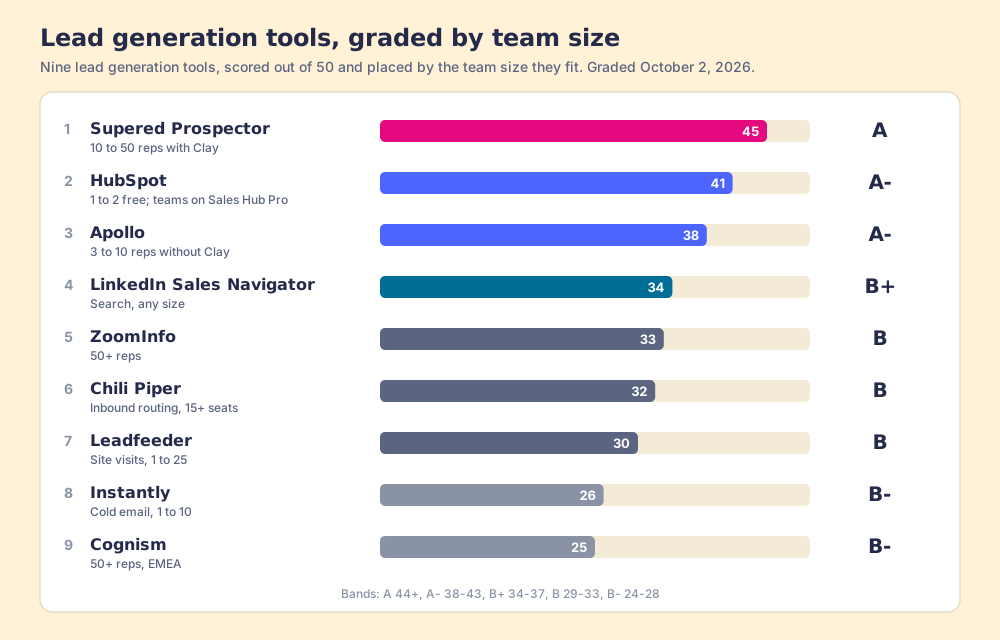
The scores, criterion by criterion, so the math is checkable. Letter bands: A 44+, A- 38-43, B+ 34-37, B 29-33, B- 24-28.
| Tool | Gets leads (x3) | Price at its size (x2) | Where the seller is (x2) | Collision control (x2) | Leader sees (x1) | Total |
|---|---|---|---|---|---|---|
| Supered Prospector | 4 | 4 | 5 | 5 | 5 | 45 |
| HubSpot | 4 | 4 | 5 | 4 | 3 | 41 |
| Apollo | 4 | 5 | 4 | 3 | 2 | 38 |
| Sales Navigator Core | 5 | 3 | 4 | 2 | 1 | 34 |
| ZoomInfo | 5 | 1 | 4 | 3 | 2 | 33 |
| Chili Piper | 3 | 2 | 3 | 5 | 3 | 32 |
| Leadfeeder | 4 | 4 | 2 | 2 | 2 | 30 |
| Instantly | 3 | 5 | 2 | 1 | 1 | 26 |
| Cognism | 4 | 1 | 3 | 2 | 1 | 25 |
Prospector scores 4 on getting leads, not 5, because it is all spear and no bait: it does not capture a form fill. The coverage it does have is Clay’s waterfall, credited to Clay. HubSpot loses a point on collision control only because the owner field shows who has a record, not whether a rep three desks over is about to prospect the same company from LinkedIn. Apollo takes the only 5 on price, since a free plan and a $49 seat are the easiest start on this card.
Corporate status, checked October 2, 2026: ZoomInfo is public (Nasdaq: GTM); Cognism has owned Kaspr since April 2022; Dealfront became Leadfeeder on March 24, 2026; Apollo, Instantly, Chili Piper, HubSpot and Clay are independent, and web searches found no new merger among them.
Where does Supered Prospector fit among sales lead generation tools?
Prospector does not bring its own database. It brings Clay’s waterfall, which is every database, routed: “Buy data from 200+ providers in one place,” and “If an enrichment returns no result, you’re not charged Data Credits or Actions” (clay.com/pricing, October 2, 2026). We chose Clay as our only data provider for that reason, and it is why Clay is not a row in the tables above. Clay is the row that contains the other rows. Clay plus Supered is the best way for a sales team to prospect: GTM engineers build in Clay, reps never open Clay.
It fits the team on the charter boat. By ten reps a company with Clay usually has a GTM engineer who has written better lead generation logic than any list on page one, with waterfalls, tiers and tags tuned to its market, and who has become the list desk. Reps ask for a list in Slack and wait. Meanwhile 45 pairs of reps can reach for the same account. Prospector changes three jobs:
- The GTM engineer. Builds named flows once, each pointing at a Clay table or function (person enrichment, buying committee) and a destination (the CRM on the account, or a sequence). “Your logic stays yours: waterfalls, tiers, tags, and sequence variables.” Start from the Supered Clay template, or bring your own tables. Prospector for GTM engineers shows the build side.
- The rep. Gets the table as a button in Sales Navigator, on a company website and in the HubSpot, Salesforce or Pipedrive record, and picks a flow from a Push menu. Navigator leads go onto a prospect list, and the rep pushes the list to a Clay table. Before pushing, the rep sees whether the person is already in the CRM, who owns them, and whether they were prospected before. The pairs table asks for exactly that check.
- The leader. Sees every list found, worked and closed. Found: reps use your tables, no duplicate work. Worked: who is working their list, and who isn’t. Closed: every lead ends the way your process says, as Qualified, Recycled or Disqualified. Prospector for sales leaders shows that view.
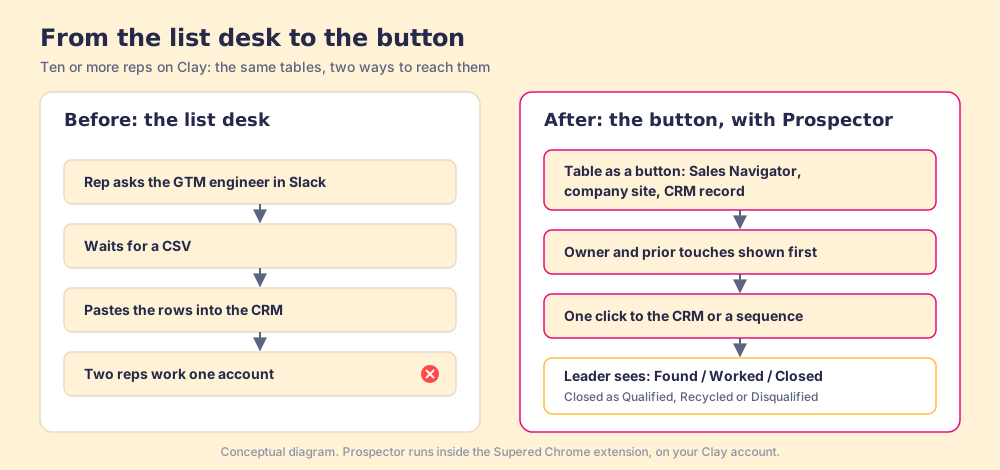
Prospector runs inside the Supered Chrome extension, on your Clay account, and reps never log into Clay. Prospector works within LinkedIn’s terms and does not copy search results in bulk; the contact data comes from Clay’s waterfall on the customer’s Clay account. Ask every vendor on this page what its extension reads on LinkedIn, ours included: LinkedIn’s help center bans extensions that “scrape, modify the appearance of, or automate activity on LinkedIn’s website” (LinkedIn Help). The Prospector page and the sourcing use case show the whole loop.
Choose something else if you do not have Clay, because Prospector runs on the customer’s Clay account and does nothing without one; RevPartners, a Clay Elite Studio Partner and the company I founded, builds and tunes tables for teams that want to start. Choose something else, too, if your leads come mostly from your own website: Prospector does not capture a form fill, and HubSpot or Chili Piper does that job.
What are the best lead generation tools for small businesses?
A small business with one or two people selling has zero or one pair of colliding reps, so collision control is worth nothing yet. The scarce thing is the founder’s hours, and the cheapest lead is the one who comes to you.
- HubSpot’s free tools. Forms, landing pages, live chat and chatbots, email marketing, meeting scheduling and a CRM, free and “never expires” (HubSpot, October 2, 2026), for up to two users on the free plan, with HubSpot branding on the chat (HubSpot pricing). The hand-raiser lands on a record you can see. Answer it the same day; Conversica’s one-in-four companies who never replied lost the lead after the tool had done its job.
- Apollo’s free plan. 900 credits per seat a year for the names you choose, with an email at 1 credit and a phone at 8 (apollo.io/pricing, October 2, 2026). Enough to test whether outbound works for you before you pay for it.
- Leadfeeder’s free plan. The companies that visited your site in the last 7 days, up to 100 companies a month (leadfeeder.com/pricing, October 2, 2026). It tells you which company looked, not which person.
- Sales Navigator Core, once outbound pays. $119.99 a month or $1,079.88 a year (LinkedIn compare plans, October 2, 2026), for the best search on the list. It sells no emails or phones, so it pairs with Apollo or a waterfall.
Skip the enterprise databases at this size. A $33,500 median contract buys depth a founder has no hours to use.
Which lead generation platform fits a sales team of three to ten?
At five reps there are ten pairs, and the bottleneck moves from hours to contact data: reps need emails and phones for people who have not raised a hand. In this band an all-in-one lead generation platform pays for itself, because each extra tool adds a place to work and a handoff.
- Apollo. Basic $49 a seat per month billed annually ($65 monthly) with 30,000 credits a seat a year; Professional $79 ($99) with 48,000; Organization $119 with a three-seat minimum (apollo.io/pricing, October 2, 2026). Data, sequences and a dialer in one bill. G2: 4.7 from 9,442 reviews. Its gap is the pairs: Apollo pricing works the credits out per phone, and a team past ten starts to need more than a record’s owner field to stop two reps working one account.
- Instantly, for cold email at volume. Growth $47 a month for 5,000 emails ($37.60 billed annually), Hypergrowth $97 for 125,000 (instantly.ai/pricing, October 2, 2026); G2 4.8 from 4,157 reviews. It is a sending tool in a separate app from the CRM, so pair it with a data source. Outbound lead generation covers the sender rules Gmail, Yahoo and Outlook now enforce.
- Leadfeeder Discover. From €79 a month on annual billing (€113 monthly), with CRM push; Activate, from €369, adds verified emails and phones. Useful when inbound traffic is real and reps want to know which accounts to call first.
Which lead generation software fits ten to fifty reps?
At ten reps there are 45 pairs; at twenty-five, 300. The tools that matter now are the ones that see the other anglers’ lines.
- Supered Prospector on Clay. The pick for teams that already have Clay, for the reasons above: the GTM engineer’s tables in every rep’s hand, the owner and prior touches shown before a push, and the leader’s found, worked and closed view.
- HubSpot Sales Hub Professional. $90 a seat per month billed annually ($100 monthly) with a one-time $1,500 onboarding fee, and sequences that send from the record the rep is already on (hubspot.com/pricing/sales, October 2, 2026). The owner field and the activity timeline are the first line of collision control. Lead routing covers the assignment rules at this size.
- Chili Piper, for inbound volume. Routing & Scheduling “Starts at $1,250 /Month,” up to 15 seats included, $45 a seat after that (chilipiper.com/pricing, October 2, 2026). A form fill goes to one owner and a booked meeting, which stops two reps answering the same hand-raiser and stops none of them answering it.
Which sales lead generation tools fit fifty reps and up?
At fifty reps there are 1,225 pairs, a RevOps team, territories, and a procurement process. Enterprise databases make sense here, because the contract finally matches the headcount.
- ZoomInfo. “More than 100 million companies, 500 million contacts,” intent data, G2 4.5 from 8,923 reviews, and a Vendr median of $33,500 a year with escalators “typically 5-10%.” ZoomInfo competitors grades it in its own lane.
- Cognism. Phone-verified mobiles for EMEA, quote only, Vendr median $32,750 a year across 94 purchases (Vendr), G2 4.5 from 1,370.
A Clay team at this size can make a database the first stop on the waterfall rather than the only one: ZoomInfo’s and Apollo’s contact steps sit in Clay’s integration directory as “Bring Your Own Account Required.” Waterfall enrichment explains the order of the route.
What do lead generation tools cost as the team grows?
The arithmetic on list prices checked October 2, 2026, per year:
| Reps | Apollo Basic ($588 a seat) | Apollo Professional ($948 a seat) | Clay Growth annual ($5,352) + Prospector ($540 a rep) | Prospector alone, if you already pay for Clay |
|---|---|---|---|---|
| 1 | $588 | $948 | $5,892 | $540 |
| 5 | $2,940 | $4,740 | $8,052 | $2,700 |
| 10 | $5,880 | $9,480 | $10,752 | $5,400 |
| 14 | $8,232 | $13,272 | $12,912 | $7,560 |
| 25 | $14,700 | $23,700 | $18,852 | $13,500 |
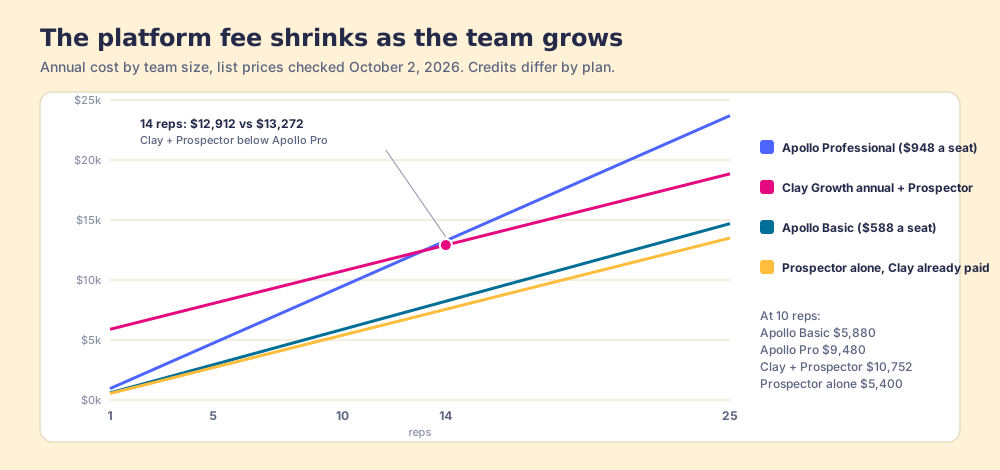
Read the table with two cautions. First, the credits are not like for like: Apollo Basic includes 30,000 credits per seat a year from one database, and Clay Growth includes 6,000 Data Credits a month (72,000 a year) shared across the team and spent across 200+ providers, with no charge for a miss. A team that enriches heavily will buy more of either. Second, Apollo Basic stays cheaper than Clay plus Prospector for any team under 112 reps on these numbers, so for a small team without Clay, Apollo is the cheaper and simpler choice, and I would buy it.
The column that changes the decision is the last one. Prospector fits teams already on Clay, where the platform fee is spent whether reps use the tables or not. The added cost is $540 per rep a year, against $588 for an Apollo Basic seat a rep might otherwise ask for. Skip the extra seats and get more out of the Clay you already pay for.
Which lead generation tools should you choose?
The fishing picture stops being true at one point: a tangled line on a boat is visible, and a collision in a CRM makes no sound. Two reps who emailed the same buyer find out when the buyer replies to both, and an unanswered hand-raiser leaves no trace at all. So the last two criteria on the card are about what the team and the leader can see. The ways forward, by headcount:
- One or two sellers. HubSpot’s free tools to capture the hand-raisers, Apollo’s free plan for a few chosen names, and a same-day reply habit.
- Three to ten reps without Clay. Apollo, from $49 a seat on annual billing, with Sales Navigator for search and Instantly if cold email volume is the plan.
- Ten to fifty reps with Clay. Supered Prospector, so the GTM engineer’s tables reach every rep where they sell and the owner shows before the push.
- Ten to fifty reps without Clay. HubSpot Sales Hub Pro or Apollo Professional, plus Chili Piper if inbound volume is high.
- Fifty reps and up. ZoomInfo in North America or Cognism in EMEA, run through Clay’s waterfall if you have it.
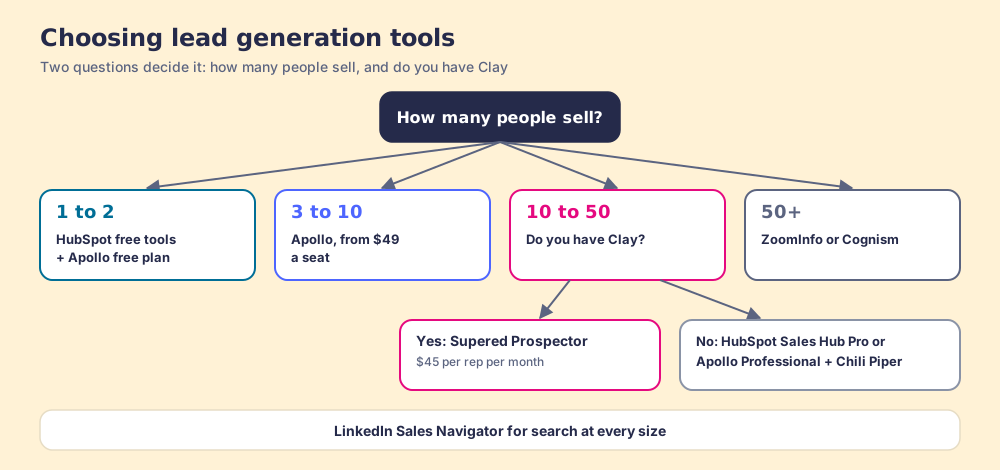
What I recommend is to buy for the team you will have in a year, not the one you have today, and to count pairs before you count features. A founder should spend nothing on lead generation software until the free tools are full. A small team should buy one platform, not four tools. And a team that has crossed ten reps with Clay already owns the best lead generation engine on this page; what it lacks is the button in the rep’s hand and a view of which lines came back with a fish. Sales prospecting tools grades the outbound stack job by job, the Clay Chrome extension page explains the rep-side category, and a Prospector demo on your own Clay account shows the lines untangled.
Frequently asked questions
What are the best lead generation tools in 2026?+
What are the best lead generation tools for small businesses?+
What is the difference between lead generation software and a lead generation platform?+
How much do lead generation tools cost for a sales team?+
Do I need Clay to use Supered Prospector?+
Why do lists of lead generation tools disagree so much?+
Your Clay waterfall, where reps already work.