Intent Data Providers, Graded: Nine Doorbells and the Rep Who Answers
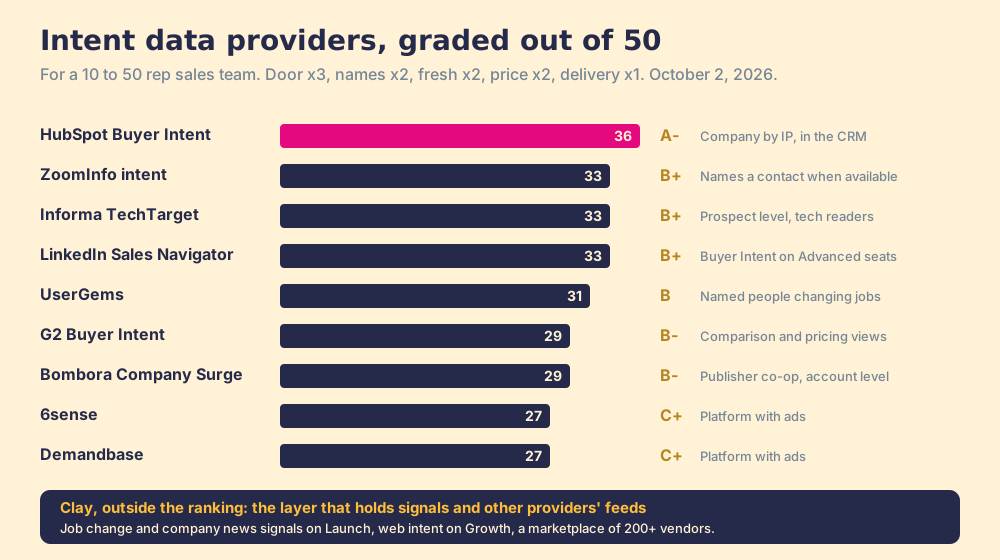
Nine intent data providers graded for a mid-market sales team on what each one sees, who it names, how fresh the signal is and what it costs, from $360 to $68,591 a year, plus the part no provider sells: a rep who works the signal.
Intent data providers are the companies that sell evidence that a business is researching a purchase, from review-site visits and publisher reading to job changes, scored so a sales team can see which accounts are in market.
A doorbell is a fine invention with one weakness. It tells you someone is at the door, and it does nothing at all about opening it. A house can have a bell on every door, wired to a chime in every room, and still leave the visitor on the step unless someone walks down the hall.
Intent data providers are the companies that sell evidence that a business is researching a purchase, from review-site visits and publisher reading to job changes, scored so a sales team can see which accounts are in market. Each one wires a bell to a different door. The quick answer, for a mid-market sales team, checked October 2, 2026:
- HubSpot Buyer Intent. The cheapest start for a HubSpot team: about $360 a year to watch 300 companies on pay-as-you-go credits.
- Bombora Company Surge. The raw third-party feed, used inside other platforms, at a Vendr median of $25,000 a year.
- ZoomInfo intent or Informa TechTarget. The two that try to name a person, sold inside larger contracts.
A team that runs Clay gets signals with its Clay plan. What no provider sells is the rep who answers the bell, and that is where the rest of this list ends up.
Which intent data providers rank highest for a mid-market team?
| Rank | Provider | Grade | Score | What it sees | Who it names | Price evidence | Best fit |
|---|---|---|---|---|---|---|---|
| 1 | HubSpot Buyer Intent | A- | 36 | Your site visitors, HubSpot’s research network, company events | Company, by IP | 10 credits per company per month | HubSpot teams starting from zero |
| 2 | ZoomInfo intent | B+ | 33 | Content reading, bidstream, IP, review-site partners | Company, plus a named contact when available | Add-on inside a quote; ZoomInfo Vendr median $33,500/yr | Teams already on ZoomInfo |
| 2 | Informa TechTarget Priority Engine | B+ | 33 | Readers on its technology publisher sites | Prospect level, known professionals | Quote only | Sellers of technology to IT buyers |
| 2 | LinkedIn Sales Navigator Buyer Intent | B+ | 33 | Activity on LinkedIn | Account | Advanced seat US$1,799.88/yr | Reps who already prospect on LinkedIn |
| 5 | UserGems | B | 31 | Your past buyers and users changing jobs | Named person | Core $40,000/yr | Teams with a large base of past champions |
| 6 | G2 Buyer Intent | B- | 29 | Category, comparison and pricing views on G2 | Company | Quote only | Software sellers whose buyers shop on G2 |
| 6 | Bombora Company Surge | B- | 29 | Reading across a publisher co-op, 25,300+ topics | Company | Vendr median $25,000/yr | Teams that want the feed inside their own tools |
| 8 | 6sense | C+ | 27 | Third-party plus your own data, with ads | Company and buying stage | Vendr median $62,440/yr | Marketing-led ABM programs |
| 8 | Demandbase | C+ | 27 | Third-party plus your own data, with ads | Company | Vendr median $68,591/yr | Marketing-led ABM programs |
Prices and plans checked October 2, 2026, from each vendor’s page, HubSpot’s credit catalog and Vendr’s marketplace (sources inline below). Clay sits outside the ranking on purpose, as the layer that holds these feeds; its section is further down.
How we graded the intent data providers
The lists that rank for this term today are written by vendors that sell intent data. Cognism’s list of 15 providers puts Cognism first (Cognism, updated September 29, 2026), and sorts the rest by kind of data without saying what a rep does when a signal fires. We sell no intent data, so we graded for the buyer we know: a sales team of ten to fifty reps that wants signals its reps will act on.
| Criterion | Weight | What it rewards |
|---|---|---|
| The door it watches | 3 | Behavior you cannot see any other way |
| Who it names | 2 | A person or a buying group beats a company name |
| Freshness | 2 | A short scoring window and fast delivery |
| Price for mid-market | 2 | A published price, or a low entry point |
| Delivery to where reps work | 1 | Lands in the CRM or the tool the rep already has open |
Each criterion is scored 1 to 5 and multiplied by its weight, for a maximum of 50. The weights serve a sales team. Move the weight to advertising and orchestration and 6sense and Demandbase climb to the top, because ads are the job they were built for. Move it to EMEA coverage and you would add vendors this list leaves out.
| Provider | Door (x3) | Names (x2) | Fresh (x2) | Price (x2) | Delivery (x1) | Total |
|---|---|---|---|---|---|---|
| HubSpot Buyer Intent | 3 | 2 | 4 | 5 | 5 | 36 |
| ZoomInfo intent | 3 | 4 | 4 | 2 | 4 | 33 |
| Informa TechTarget | 4 | 5 | 3 | 1 | 3 | 33 |
| LinkedIn Sales Navigator | 3 | 3 | 3 | 4 | 4 | 33 |
| UserGems | 3 | 5 | 3 | 1 | 4 | 31 |
| G2 Buyer Intent | 4 | 2 | 3 | 2 | 3 | 29 |
| Bombora | 4 | 2 | 2 | 3 | 3 | 29 |
| 6sense | 4 | 2 | 3 | 1 | 3 | 27 |
| Demandbase | 4 | 2 | 3 | 1 | 3 | 27 |
What does each intent data provider see?
Go back to the doorbells. A provider is worth what its door shows you that no other door does. Your own front door (your website) shows the buyers who already found you. A neighbor’s porch camera (a review site) shows people comparing vendors. A traffic counter at the end of the street (a publisher co-op) shows who is reading about the problem before they visit anyone. And an address book that updates itself shows when a person you know moves house. Here are the nine, by door, with corporate status checked October 2, 2026.
- HubSpot Buyer Intent. Three doors in one: Visitors on your own site, Research from HubSpot’s network of sites that opted in to intent sharing, and Signals such as funding rounds, executive hires, layoffs and IPOs. HubSpot says it identifies the company behind a visit by IP lookup and not the individual (HubSpot, updated September 24, 2026). It lands in the CRM the team already uses, which is most of its score.
- ZoomInfo intent. ZoomInfo describes four sources: content reading scored by its own language model, bidstream data from ad networks, IP matching across 210 million IP-to-organization pairings, and review-site partners G2 and TrustRadius. It says it refreshes intent daily and surfaces a named contact with the research “when available” (ZoomInfo, July 9, 2026). Intent is an add-on to the base contract. ZoomInfo is independent and listed (Nasdaq: GTM).
- Informa TechTarget Priority Engine. The narrowest door and the clearest view through it: readers of TechTarget’s technology publisher sites, sold as “Account and Prospect-Level Intent” from “1.9M+ buying signals a day from known professionals” (Informa TechTarget). TechTarget combined with Informa’s tech digital businesses on December 2, 2024, with Informa holding about 57%, and still trades on Nasdaq as TTGT (Business Wire). G2 rates the product 4.3 from 453 reviews; the recurring complaint is CRM export.
- LinkedIn Sales Navigator Buyer Intent. Activity on LinkedIn itself, shown on accounts in the tool where many reps already prospect. Buyer Intent comes with the Advanced and Advanced Plus plans; Core leaves it out (LinkedIn Help).
- UserGems. The address book: it tracks your past buyers and users and tells you when one starts a new job. UserGems claims “Previous customers are 3X more likely to buy again” without a published method. G2 rates it 4.7 from 167 reviews, and reviewers note job-change alerts that sometimes arrive “a few weeks” late. Job change tracking covers this door in depth.
- G2 Buyer Intent. The porch camera on the busiest street in software: “category research, competitor comparisons, pricing page visits, and direct engagement with your profile,” across what G2 says are more than 200 million buyers a year on G2, Capterra, Software Advice and GetApp (G2). It sees almost nothing for a company that does not sell software.
- Bombora Company Surge. The traffic counter. Bombora “continuously monitors company research activity against 25,300+ topics” across a co-op of publishers (Bombora), and its feed shows up inside other products, including Cognism’s Pro package. G2 rates it 4.4 from 157 reviews; one reviewer wrote that the data “is on the account level, which causes challenges to market to specific individuals.”
- 6sense. A platform with intent inside it: third-party intent, your own web traffic de-anonymized, custom keywords that it says show results “within a day,” and advertising on top (6sense). Chris Ball became CEO in September 2025, with Jason Zintak staying as chairman; no acquisition. G2 rates 6sense Revenue Marketing 4.2 from 1,561 reviews.
- Demandbase. The same shape as 6sense, named a Leader in The Forrester Wave: Revenue Marketing Platforms for B2B, Q1 2026 (Demandbase, January 27, 2026). G2 rates Demandbase One 4.4 from 2,006 reviews, with the learning curve as the common complaint.
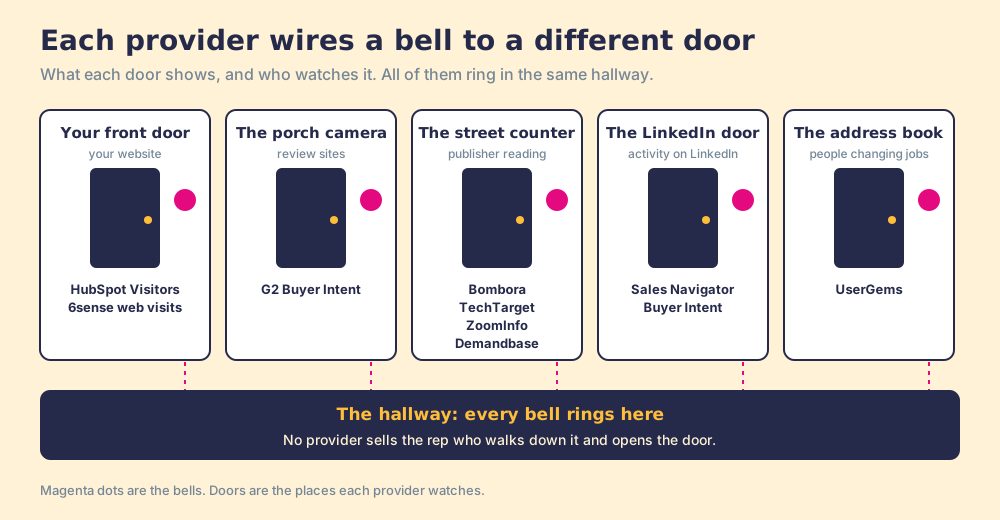
What decides a provider’s value is the door your buyers walk past. A company selling security software to IT teams gets a lot from TechTarget and G2. A company selling payroll services to restaurants gets almost nothing from either, and should start with its own site and with trigger events such as new locations or new owners.
Which b2b intent data providers name a person, and which name a company?
A birdwatcher with binoculars on a far hillside can tell you there is a flock in that tree, and roughly how big. To call one bird by name she has to walk over. Most intent data is binoculars: it tells you a company is reading, and leaves the walk to you.
Most of the b2b intent data providers on this list stop at the tree. Bombora, 6sense, Demandbase, G2 and HubSpot score companies. Bombora sells a persona-level view on top (“Account-level Intent shows you where to look. Buying-group, persona-level insight shows you who is driving the research”), but its core surge is account-level. Three providers try to name the bird: Informa TechTarget from readers who registered on its sites, ZoomInfo when its research matches a known contact, and UserGems because it starts from people you already know.
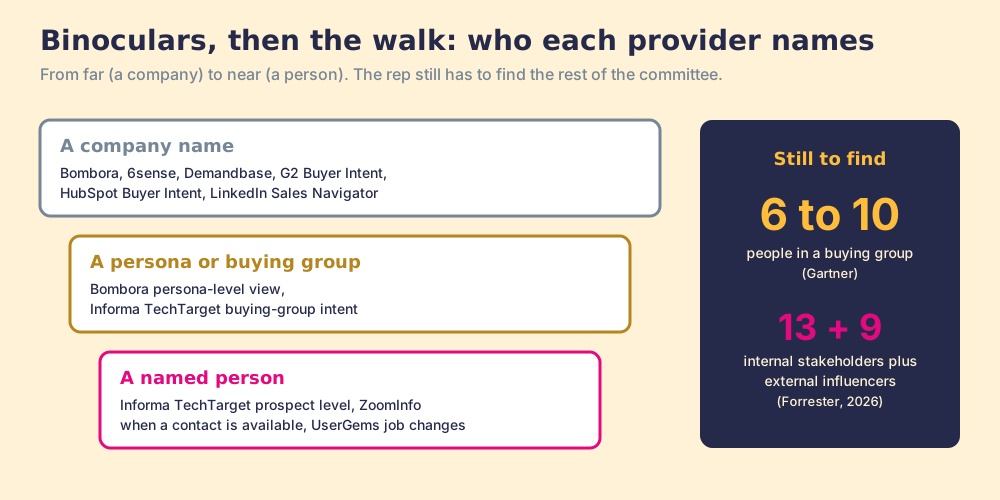
A named person helps less than it sounds. Gartner puts the buying group at 6 to 10 people (Gartner), and Forrester’s 2026 survey found “13 internal stakeholders and nine external influencers” in a typical decision (Forrester, January 21, 2026). The person who read the article is one of them. Whichever provider you buy, the rep still has to find the rest of the committee, and the B2B buying committee guide covers who those people are.
What do intent data providers cost per year?
The published and median prices, checked October 2, 2026:
| Provider | Price evidence | Per year | Per week |
|---|---|---|---|
| HubSpot Buyer Intent, 300 companies | 10 credits per company per month at $0.010 per credit | $360 | about $7 |
| LinkedIn Sales Navigator Advanced | List price per seat | $1,799.88 | about $35 |
| Clay Launch (signals included) | $167/mo billed yearly | $2,004 | about $39 |
| Bombora | Vendr median, 35 purchases | $25,000 | about $481 |
| UserGems Core | List price | $40,000 | about $769 |
| 6sense | Vendr median, 385 purchases | $62,440 | about $1,201 |
| Demandbase | Vendr median, 187 purchases | $68,591 | about $1,319 |
Sources: HubSpot’s credit catalog; LinkedIn’s compare plans; Clay pricing; Vendr pages for Bombora, 6sense and Demandbase; UserGems pricing. The per-week column is our arithmetic. ZoomInfo, G2 and Informa TechTarget publish no intent price; ZoomInfo’s whole-contract median on Vendr is $33,500 a year across 1,573 purchases, intent add-on not separated.
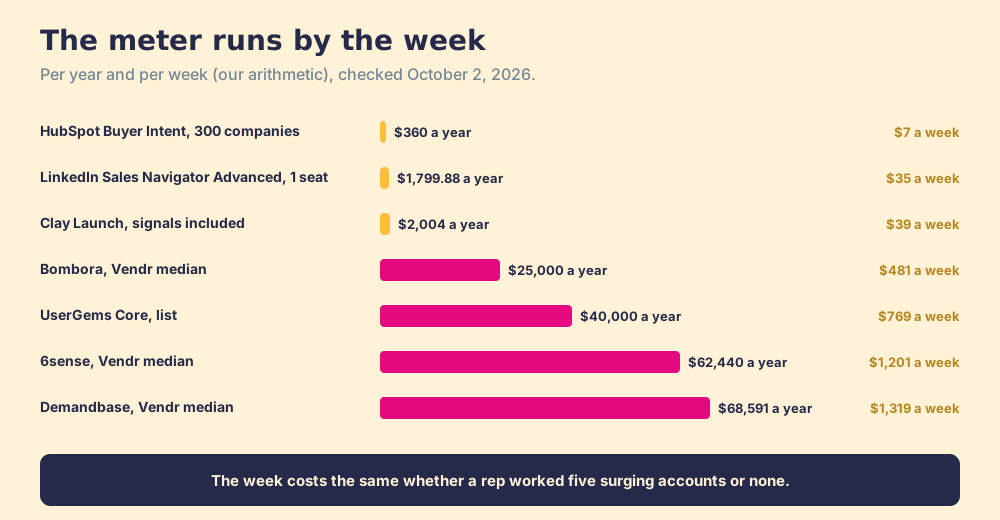
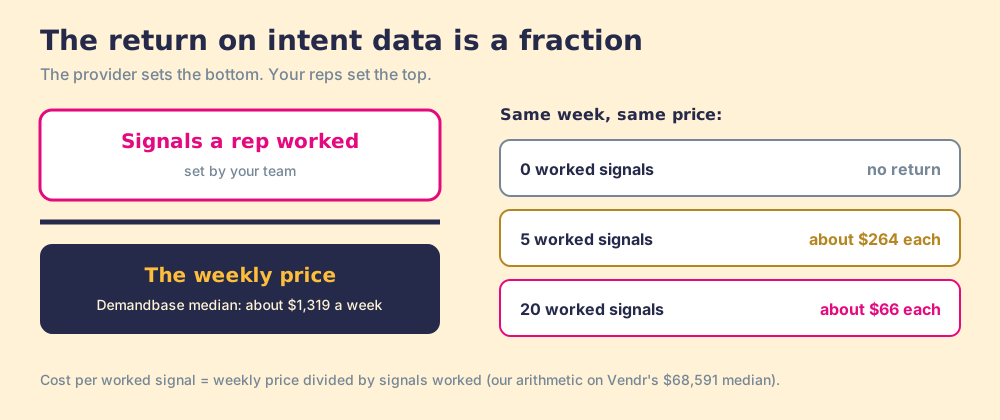
The per-week view changes the conversation with finance. A Demandbase contract at the median costs about $1,319 a week, and a week in which five surging accounts get a call costs the same as a week in which none do. The return on intent data is a fraction: price on the bottom, worked signals on top. The vendor controls only the bottom.
Where does Clay fit among intent data providers?
Clay is the row that holds the other rows. Its pricing page lists job change, company news and social listening signals on the Launch plan ($167 a month billed yearly) and web intent signals on Growth ($446 a month billed yearly), and its marketplace sells data from “200+ data and AI vendors” on one contract (Clay, checked October 2, 2026). Clay’s own glossary describes the job the same way: track “job changes promotions or other signals” and “Combine multiple data providers for the best coverage.”
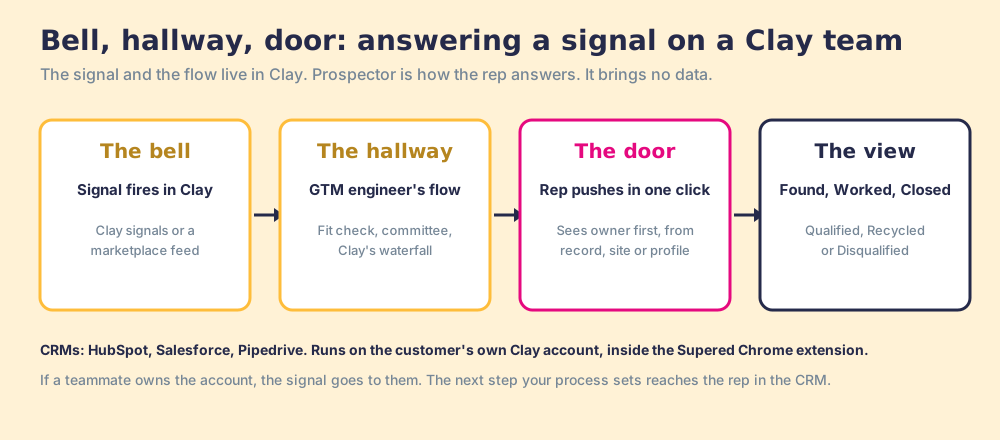
The difference is where the signal goes next. A GTM engineer builds the table once: when a signal fires, check fit, find the buying committee, run Clay’s waterfall for emails and phones, and send the people to the CRM or a sequence. Where a provider stops at the bell, a Clay table can carry the signal down the hall as far as the rep. The guide to Clay use cases shows the tables teams build.
Why is a signal worth nothing until a rep works it?
Because the providers sell detection, and detection was never the bottleneck. Harvard Business Review’s audit of 2,241 US companies found firms that tried to reach a web lead within an hour were nearly seven times as likely to qualify it as firms that waited an hour longer, and the average response was 42 hours (HBR, 2011). Those were people who filled in a form. An intent surge is weaker evidence with less urgency attached, so it waits longer.
When reps ignore signals, it is tempting to say they do not trust the data. More often the signal arrived on a dashboard they do not open, with no owner, no names and no play, so acting on it meant an hour of research before the first email. The failure sits in the system around the rep. Four things turn a ring into an answered door:
- An owner. One rep per signal, and the existing account owner first.
- A fit check. A surge outside your ideal customer profile is a bell on someone else’s house.
- The people. The committee behind the company name, by the titles your team set.
- An ending. Qualified, recycled or disqualified, so the leader sees which signals became pipeline.
Our guide to buying signals sets a response window for each kind of signal, and B2B intent data covers how old a surge is when it lands.
Where does Supered Prospector fit with intent data providers?
Prospector provides no signals and no contact data, so it sits outside the ranking. It is how a rep answers the bell on a team that runs Clay. Clay plus Supered is the best way for a sales team to prospect: GTM engineers build in Clay, reps never open Clay.
- The GTM engineer’s flow. The signal runs in Clay on your team’s own account, and Prospector turns the engineer’s flow into a named button reps pick from a Push menu. “Your logic stays yours: waterfalls, tiers, tags, and sequence variables.”
- The rep’s button. On the account’s HubSpot, Salesforce or Pipedrive record, the company’s website or a contact’s LinkedIn profile, the rep sees the matching CRM record, who owns it, and a flag when a teammate already prospected the person. If another rep owns it, it goes to them. If not, the rep runs the flow and pushes the people to the CRM or a sequence in one click, and the next step your process sets reaches the rep in the CRM.
- The leader’s view. Each list is Found, Worked or Closed, and a closed lead ends the way your process says: Qualified, Recycled or Disqualified. A sales leader watches signal-driven lists become pipeline and coaches from what converts, which is how the intent and Clay budget earns its renewal.
Prospector works within LinkedIn’s terms and does not copy search results in bulk; the contact data comes from Clay’s waterfall on the customer’s Clay account. Supered does not bring its own database or intent data. It brings Clay’s waterfall across 200+ providers, which is every database, routed, and that is why we chose Clay as our only data provider. Prospector runs inside the Supered Chrome extension and costs $45 per rep per month, billed annually, from one rep, on your Clay plan and credits. There is no free trial; the Prospector page shows the product and Prospector for sales leaders shows the Found, Worked, Closed view.
Choose something else if:
- No Clay account. Prospector needs one. HubSpot Buyer Intent is the low-cost start on a HubSpot portal.
- An advertising-led ABM program. 6sense or Demandbase run ads and orchestration that Prospector does not.
- No one to build the Clay side. RevPartners, the company I founded, is a Clay Elite Studio Partner that builds Clay tables with teams that want help.
Which intent data provider should you choose?
The best intent data providers for your team are the ones watching the door your buyers walk past, at a price you can defend per worked signal. By team:
- A HubSpot team with no intent data today. HubSpot Buyer Intent. About $360 a year for 300 companies, and it tells you within a few weeks whether anyone acts on a signal before you spend five figures.
- A team already paying ZoomInfo. ZoomInfo intent, negotiated into the renewal, because it names a contact when it can and lands in the tool reps already use.
- A technology seller whose buyers are IT professionals. Informa TechTarget Priority Engine for named readers, with G2 Buyer Intent beside it for the comparison stage.
- Reps who already live in LinkedIn. Sales Navigator Advanced, where Buyer Intent comes with the seat.
- A company with years of past customers. UserGems, or the job-change signals in Clay’s Launch plan for a fraction of UserGems’ $40,000 entry.
- A marketing team running account-based advertising. 6sense or Demandbase. The ads are the point, and the intent feeds them.
- A team that runs Clay. Clay’s signals on the plan you have, a third-party feed from the marketplace only if your buyers read on publisher sites, and Prospector so reps act on each signal from the record they already have open.
Why trust this list?
Before Supered I started RevPartners, a HubSpot partner that did only sales implementations, sold roughly twice as much Sales Hub as any other partner, and reached HubSpot’s Elite tier in 13 months. More than one client bought an intent feed, piped it into the CRM, and found months later that the surging accounts had no owner and no next step. Supered is the #1 sales enablement app on the HubSpot marketplace, rated 5.0 from 122 reviews there and 4.9 from 81 reviews on G2 (checked October 1, 2026). The disclosure: we make Prospector, we sell no intent data, and Prospector is left out of the ranking for that reason.
A doorbell is cheap; the visitor on the step is the expensive part. Before you sign with any provider, ask one question: when this signal fires, whose name is on it, and by when? If the vendor’s reply is “whoever checks the dashboard,” buy the cheapest bell on the list and spend the rest on the hallway. The buying signals guide is the next read, with a response window for each kind of signal.
Frequently asked questions
What are the best intent data providers for a mid-market sales team?+
How much do b2b intent data providers cost?+
Which intent data providers name a person rather than a company?+
How fresh is intent data?+
Is Clay an intent data provider?+
Does Supered Prospector provide intent data?+
Your Clay waterfall, where reps already work.