Buying Signals: Which Ones Matter, the Play for Each, and How Long Each Keeps
The buying signals worth a rep's time, sorted by how strong each one is and how fast it spoils, with the first move for each, the response window the research supports, and the reason most signals go unworked.
Buying signals are actions or events that show a person or company moving toward a purchase, from a pricing question on a call to a funding round or a new executive, and each one tells a rep who to contact, with what, and how soon.
A grocer stamps a date on the milk and none on the tinned beans. Both are food. One will be sour by Friday, and the other will outlast the shop. A grocer who stacked them by price or by protein would lose the milk every week and never understand why.
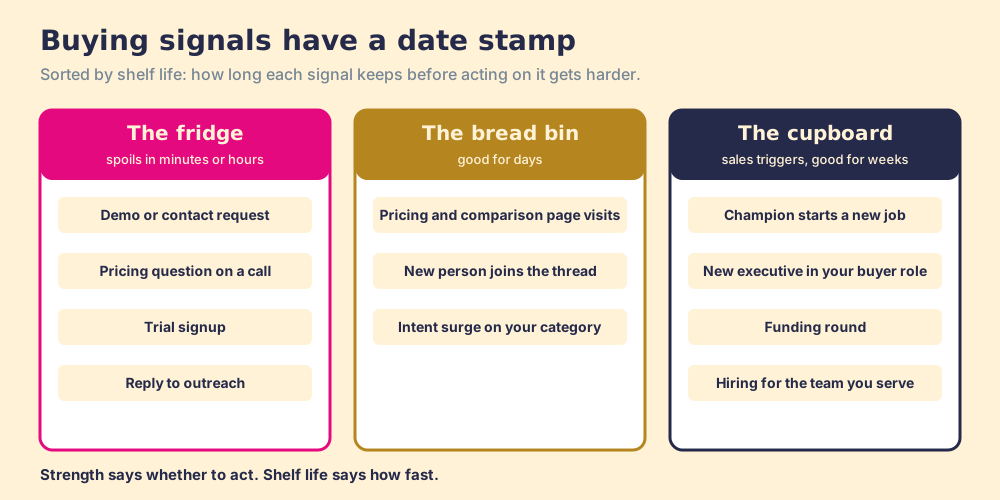
Buying signals are actions or events that show a person or company moving toward a purchase, from a pricing question on a call to a funding round or a new executive, and each one tells a rep who to contact, with what, and how soon. The lists that rank for the term sort signals by strength, high to low. Strength matters, but it is half the label. The other half is the date stamp, and it decides most of what a rep should do:
- Milk. A demo request, a pricing question, a reply to outreach. Strong, and sour within hours.
- Bread. Repeated pricing-page visits from one account, a new person joining the thread, an intent surge. Good for days.
- Tins. A champion’s job change, a new executive, a funding round. Weaker alone, and good for weeks if a rep does the research.
What are buying signals in sales?
Buying signals in sales come in two families, and the difference is who started the conversation.
- Direct signals. Things a buyer does in front of you: fills in the demo form, asks what it costs, starts a trial, replies to an email, brings a colleague to the second call. The buyer has raised a hand.
- Sales triggers. Events around an account that make a purchase more likely: a new executive in the role you sell to, a funding round, an acquisition, a past champion starting at a new company, a burst of research on your category. Sales trigger events happen to the buyer, who has asked you for nothing yet.
The two families need different handling. A direct signal is a question waiting for an answer, and the answer gets worse by the minute. A trigger is an opening no rep has walked through yet, and the first rep through it should arrive with a reason, which takes some research. Treating a trigger like a direct signal produces a fast, empty email (“Congrats on the funding!”). Treating a direct signal like a trigger produces a thoughtful reply to a buyer who already booked a competitor.
Clearbit’s guide to buying signals, one of the pages that ranks for this term, grades 15 signals from low to high and tells readers that reps are “seven times more likely to have meaningful conversations with decision-makers when they reach out within an hour of detecting a buying signal” (Clearbit, June 6, 2023). The study behind that number measured responses to web leads, people who filled in a form. It says nothing about a funding announcement. Cognism’s list rates 13 signals by strength (Cognism, updated April 16, 2026) and gives no response window at all. Both lists are useful catalogs. Neither carries a date stamp.
Which buying signals matter most?
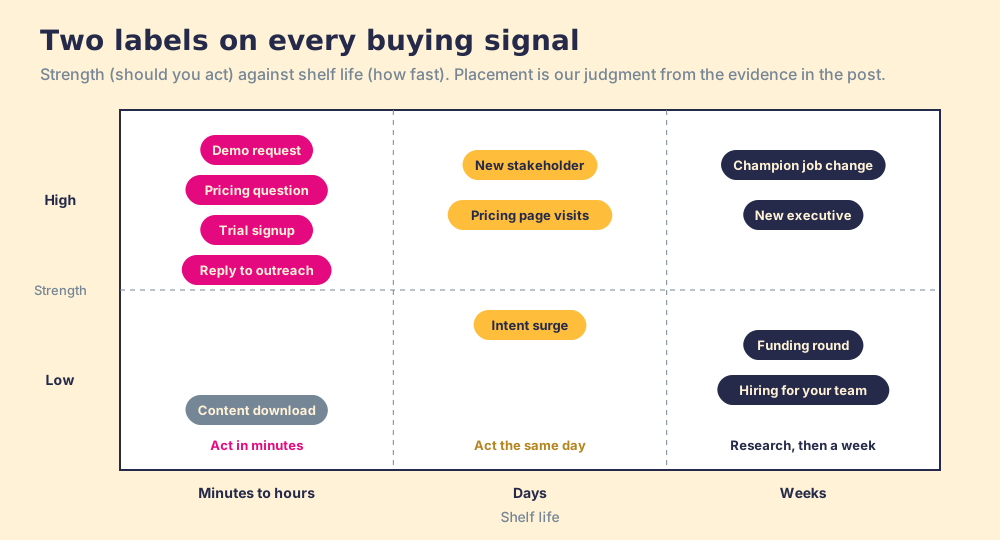
Here are the signals worth a rep’s time, with the strength, the shelf life and the first move for each. Strength is our judgment from the evidence cited below; the windows are our recommendation, built on the response-time research in the next section.
| Signal | Family | Strength | Shelf life | First move | Window |
|---|---|---|---|---|---|
| Demo or contact request | Direct | High | Minutes | Call, then email with a time | Within 5 minutes |
| Pricing question on a call | Direct | High | That call | Answer with a range and how it is built | On the call |
| Trial signup | Direct | High | Hours | Offer setup help tied to their use case | Same day |
| Reply to outreach | Direct | High | Hours | Answer the question they asked | Same day |
| New stakeholder joins the thread | Direct | Medium | Days | Map the rest of the buying group | Within 2 days |
| Repeated pricing or comparison page visits | Direct (company level) | Medium | Days | Owner sends a direct offer to the right people | Same day it reaches an owner |
| Intent surge on your category | Trigger | Medium | Days to weeks | Research play to the buying committee | Same day it reaches an owner |
| Past champion starts a new job | Trigger | Medium | Weeks | Personal note, then their new team | Within a week |
| New executive in the role you sell to | Trigger | Medium | Weeks | Researched point of view on the new role | Within a week |
| Funding round | Trigger | Low to medium | Weeks | Tie your product to what the money is for | Within a week |
| Hiring for the team your product serves | Trigger | Low to medium | Weeks | Offer how others ramp that team | Within two weeks |
| Content download or event attendance | Direct, weak | Low | Days | Nurture, unless paired with another signal | Through marketing |
How fast should you act on a buying signal?
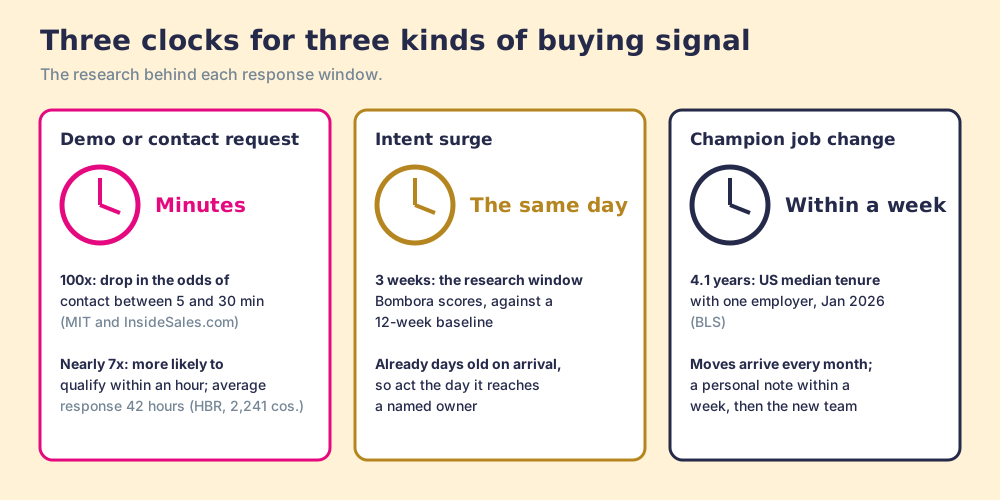
The fastest signals have the best research behind them. In the Lead Response Management study run by James Oldroyd of MIT with InsideSales.com, three years of data across six companies and more than fifteen thousand leads showed that “the odds of contacting a lead if called in 5 minutes versus 30 minutes drop 100 times,” and the odds of qualifying it dropped 21 times (MIT and InsideSales.com, 2007). A vendor co-ran that study, so lean on its direction more than its decimals. Harvard Business Review’s audit of 2,241 US companies found that firms that tried to reach a web lead within an hour were nearly seven times as likely to qualify it as firms that waited an hour longer, and the average response among those that replied within 30 days was 42 hours (HBR, 2011).
Those numbers belong to the milk. They measure a person who asked for contact and is waiting. Carry them to a funding round and the logic breaks: the buyer is not waiting for anyone, and a rep who emails within five minutes of a press release has nothing to say yet. Our speed to lead guide covers the inbound clock in full.
For the bread and the tins, the clock runs differently:
- Intent surges. Bombora scores a surge by comparing an account’s most recent three weeks of research with its own 12-week baseline (Bombora), so the signal is days old on arrival. Act the day it reaches a named owner; every extra hop spends what is left. B2B intent data covers how a surge ages.
- Job changes. A new hire spends the first weeks deciding what to change. The US median tenure with one employer was 4.1 years in January 2026 (BLS, September 24, 2026), so a champion list of any size produces moves every month. A week is fast enough if the note is personal; a month is late.
- New executives and funding. These open a window that stays open for weeks, and the risk is the empty first touch. Spend a day on research and arrive with a point of view on what the money or the new leader will have to fix.
How do you act on each buying signal?
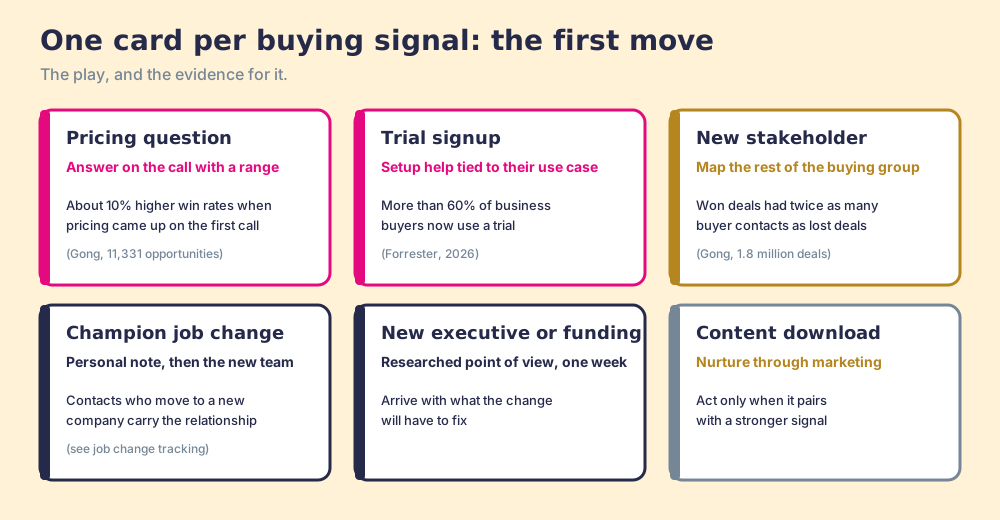
Each signal in the table needs a first move, and the evidence for each move sits beside it below.
- A pricing question. Answer it on the call with a range and how the price is built. In Gong’s analysis of 11,331 opportunities, win rates were highest when pricing came up on the first call, about 10% higher, and stayed the same whether the buyer or the seller raised it (Gong). A rep who dodges the question to “build value first” spends the strongest signal in the conversation.
- A trial signup. Treat it as a direct request for help. Forrester’s 2026 buying survey found more than 60% of business buyers now use a trial (Forrester, January 21, 2026), so the trial is where many shortlists get decided. The first move is setup help tied to the use case the buyer gave you.
- A new stakeholder. When a second or third person from the account joins the thread, map the rest of the group. Gong’s study of 1.8 million closed deals found won deals had twice as many buyer contacts as lost ones (Gong, April 28, 2025). Multithreading in sales covers how to widen the deal on purpose.
- Pricing and comparison page visits. These usually name only a company; HubSpot says its Buyer Intent identifies the company behind a visit by IP and not the individual (HubSpot). The account owner sends a direct offer to the people most likely to be comparing, found by title.
- A champion’s job change. Two signals in one: a warm contact at a new company and a gap at the old one. Somaya, Williamson and Lorinkova argue from social capital theory that “movement of employees both to and from clients may enhance firm performance” (Academy of Management Journal, 2008). Send a personal note, then find who they will buy with. Job change tracking has the full play.
- A new executive or a funding round. A researched point of view, sent to the person the change affects, within the week. The congratulations email is the empty version of this play.
Why do buying signals go unworked?
The usual explanation is that reps are lazy or do not trust the data. The research points at the system. The HBR authors traced slow responses to companies “retrieving leads from CRM systems’ databases daily rather than continuously,” sales forces “focused on generating their own leads rather than reacting quickly to customer-driven signs of interest,” and “rules for distributing sales leads among agents and partners based on geography and ‘fairness.’” In a 2023 Conversica test of 100 mid-market and enterprise companies, one in four never responded to an inbound inquiry at all (Conversica, May 4, 2023). Those were the strongest signals there are.
A trigger has it worse. It arrives on a dashboard or in a Slack channel, names a company, has no owner, and comes with no play. To act on it, a rep has to open another tab, find the people, check whether a teammate owns the account, look up emails and decide what to say. That is an hour of homework handed to the busiest person on the team, and it loses to the call already on the calendar. No rep chose to ignore it. The system made ignoring it the easy path.
So the fix belongs to whoever designs the system, and it fits on one page. For each signal your team cares about, write down five things once:
- The owner. Who gets it, with the existing account owner first.
- The fit check. Whether the account matches your ideal customer profile.
- The people. The titles and seniority to pull, since a trigger names a company and a deal needs a committee.
- The play and the window. The first move and the shelf life from the table above.
- The ending. Qualified, recycled or disqualified, so a signal that went nowhere shows up as one.
Where does Supered Prospector fit with buying signals?
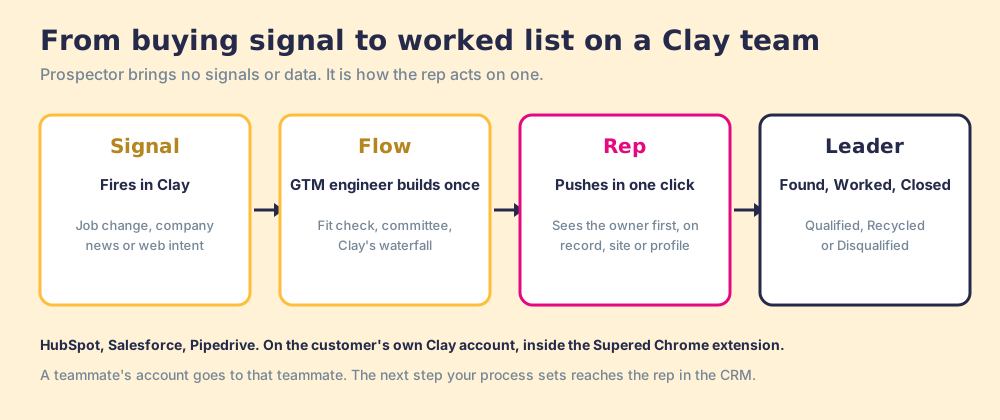
Prospector does not detect signals. It is how a rep acts on one, on a team that runs Clay. Clay plus Supered is the best way for a sales team to prospect: GTM engineers build in Clay, reps never open Clay.
- The signal and the flow, in Clay. Clay’s pricing page lists job change, company news and social listening signals on its Launch plan and web intent signals on Growth (Clay, checked October 2, 2026). Your GTM engineer builds the flow once (fit check, buying committee by the titles your team set, Clay’s waterfall across 200+ providers for emails and phones, destination) and Prospector turns it into a named button in a Push menu.
- The rep’s move, where the rep already is. On the account’s HubSpot, Salesforce or Pipedrive record, the company’s website or a LinkedIn profile, the rep sees the matching CRM record, who owns it, and a flag when a teammate already prospected the person. The plays map to the signals above: a past champion changed jobs, push them and their new team into a sequence; a stalled deal, add the economic buyer and two peers; an account showing interest, check fit and pull the people who sign off.
- The leader’s view. Each list is Found, Worked or Closed, and a closed lead ends the way your process says: Qualified, Recycled or Disqualified. A sales leader can see which signal-driven lists got worked and which became pipeline, and coach from what converts.
Prospector works within LinkedIn’s terms and does not copy search results in bulk; the contact data comes from Clay’s waterfall on the customer’s Clay account. It runs inside the Supered Chrome extension and costs $45 per rep per month, billed annually, from one rep. The Prospector page shows the product, and the sourcing use case walks the rep loop.
Choose something else if:
- No Clay account. Prospector needs one. For inbound direct signals, routing and response rules in your CRM come first.
- Your signals are mostly inbound demo requests. That is a routing and speed problem; a scheduling tool and a lead routing rule do more than a prospecting tool.
What we recommend
Write a signal ledger before you buy another signal. One row per signal your team receives: family, shelf life, owner, fit check, people, play, window, ending. A sales leader and a RevOps lead can fill it in an afternoon, and it does three things the next data contract cannot:
- The milk gets drunk. Demo requests and pricing questions get minutes and an answer, because the research on those is the strongest in sales.
- The tins get opened properly. Triggers get a day of research and a real point of view, instead of a fast note that says nothing.
- The leader can see the shelf. Every signal ends qualified, recycled or disqualified, so you learn which signals turn into pipeline and stop paying for the ones that do not.
For a team that runs Clay, we recommend Clay’s signals on the plan you already have, written into flows that check fit and pull the committee, and Prospector so reps run those flows from the record they have open. If you are deciding which signals to buy at all, our grading of intent data providers is the next read: nine providers, what each one sees, and what each costs per week.
Frequently asked questions
What are buying signals?+
What are examples of buying signals in sales?+
What are sales triggers?+
How fast should you respond to a buying signal?+
Why do buying signals get ignored?+
Does Supered Prospector detect buying signals?+
Your Clay waterfall, where reps already work.